Seventy-five percent of Canadian journalists are white. Here’s what that means for social impact coverage.
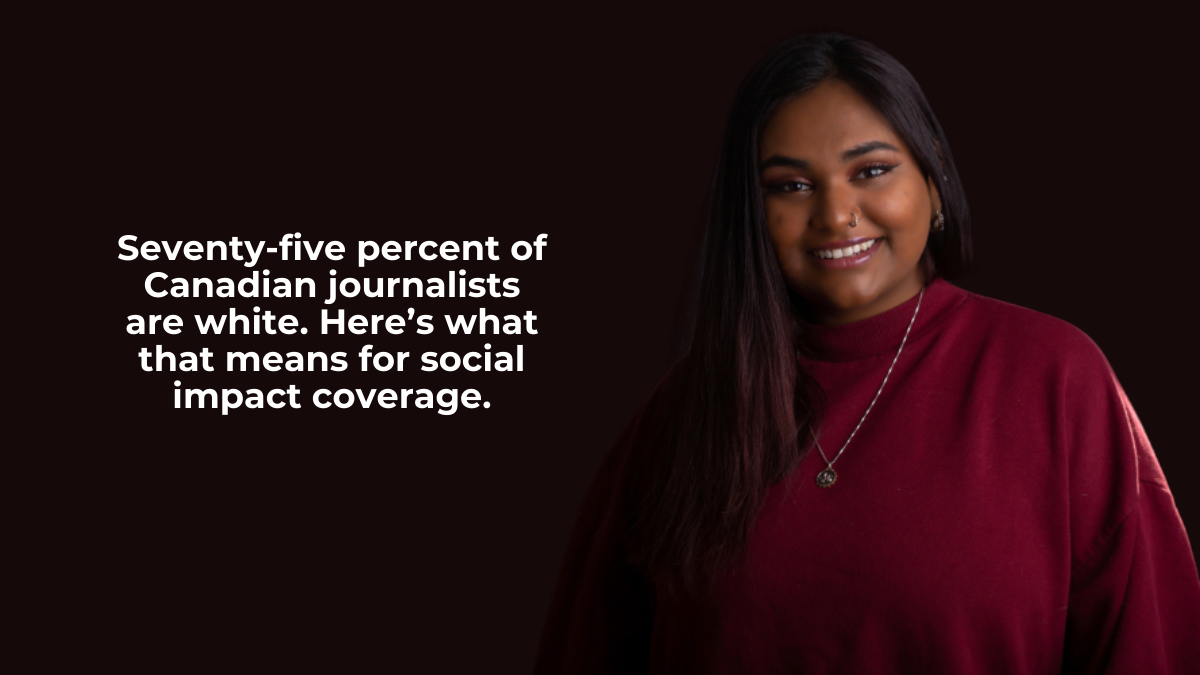
Let me begin by introducing myself: my name is Avanthika Anand and I live on the lands of unsurrendered Algonquin Territory that we call Ottawa today. I am a Gen Z-er, woman of colour, sister, daughter, friend — and I am a journalist.
After a grueling few years as an ‘international’ student from India, I graduated from Carleton University’s school of journalism in the summer of 2021. Shortly thereafter, I came to work at Future of Good as a news and features writer in the fall of this year.
This is where, dear reader, I discovered something interesting that I want to share with you.
As we know, the COVID-19 pandemic has disproportionately negatively impacted vulnerable, racialized and marginalized populations in Canada. The issues facing these communities range from housing, unemployment and food insecurity, to access to healthcare and mental health support— amidst a global pandemic.
It has also become apparent that while the sense of urgency to address issues is increasing now, the problems facing vulnerable populations in Canada have long existed before the pandemic. The pandemic simply stirred the proverbial pot, while adding to it.
And as Canada’s social impact sectors have risen to this occasion in tackling these issues through their lines of work, so did journalists in their news coverage. Where the federal budget admitted earlier this year that, “At present, Canada lacks the detailed statistical data that governments, public institutions, academics and advocates need in order to take fully informed policy actions and effectively address racial and social inequities”, the news media uncovered these stories, creating awareness necessary to take action.
In fact, the news — like charitable funding, social finance, and social impact work itself — has become a necessity to help Canadians navigate the pandemic, as it informs decision-making at all levels.
So, in my time as a news and features writer at Future of Good, a media organization focussed on covering the world of social impact, here’s the interesting thing I discovered: it turns out, Canada’s journalism industry is not very different in diversity from its philanthropic and non-profit sector counterparts.
Both are top-heavy with primarily white authority figures — leaving the racialized and marginalized populations out of the conversation. These populations that are facing dire situations because of the pandemic, remain unrepresented and their causes are not served: because the power to make decisions lies in the hands of their white, more-privileged counterparts who may not have the lived experiences or empathy for the same issues.
And this is where the vicious cycle that journalism and the social impact sector in Canada are stuck in, begins: In an age where the country lacks disaggregated data-sets to shed light on issues especially faced by these populations, and end up relying on the media for information necessary to navigate the pandemic — but 75 percent of journalists in newsrooms in Canada are white (according to a recent CAJ survey).
These journalists, like their social impact-counterparts, are not impacted by the same issues that Black, Indigenous and people of colour face on a day-to-day basis. And because they don’t have the lived experience of navigating these issues, they do not necessarily have the ability to view the world from the shoes of a racialized or marginalized minority individual. As a result, it can be argued that the 75 percent white Canadian media today is not necessarily or accurately reporting on the critical issues faced by racialized and marginalized groups.
But if the social impact sector depends on the media to inform its decisions surrounding services, support, spending and more; and the media isn’t representative of Canada’s diverse populations and issues — then what do we do?
It is clear that the cost of a lack of diversity amongst journalists to the world of social impact is very high. It takes a diverse media to inform the world of social impact, and its decisions that directly affect vulnerable, racialized and marginalized populations today.
What is even clearer is that the time is now for journalism and social impact in Canada to work hand-in-hand on matters of diversity and inclusion to change this status quo, if they want to affect real change. And at Future of Good, for the first time in my albeit-short career as a journalist, I have seen that this can be a reality.
I am writing this letter to you today as a woman of colour hired by an organization more diverse than any journalism school instructor ever allowed me to imagine. In my time here, I have seen my multi-faceted colleagues investigate a wide range of issues and craft stories surrounding them. Hopefully, these stories have made you think about your work — how do you give? Who do you give to and why? Who decides what programs and services get delivered? What communities do you work with, and why?
Next time you read a story, however — whether it’s from Future of Good or another publication — ask yourself: Who wrote this? Whose voice may have been left out of the story, and how are they affected? You might find that the answers to these questions will help you make better decisions that could affect change in the lives of those who need it.
Avanthika Anand
News and Features Writer
Your job. Your mission. Your news.
With your support, the sector you're building gets the journalism it deserves, and you get a tax receipt.

Related Articles
‘The need is endless’: Food insecurity highest in Canada’s Black, Arab and Indigenous communities
Food insecurity gaps aren’t closing, so community organizations across Canada are trying new ways to help beyond just providing food.
Controversial Palestine exhibit opens at Canadian Museum for Human Rights
The exhibit, called Palestine Uprooted: Nakba Past and Present, drew criticism even before it opened at the national museum in Winnipeg.
Vancouver tests new app to map accessibility in parks and trails
The pilot program allows app users to identify barriers in city parks to help make outdoor spaces more accessible and inclusive for everyone.
