21 social impact-obsessed people share the best book they read in 2021
Why It Matters
Learning is essential to good social impact work, and books — whatever genre — are one big way to expand your perspective.
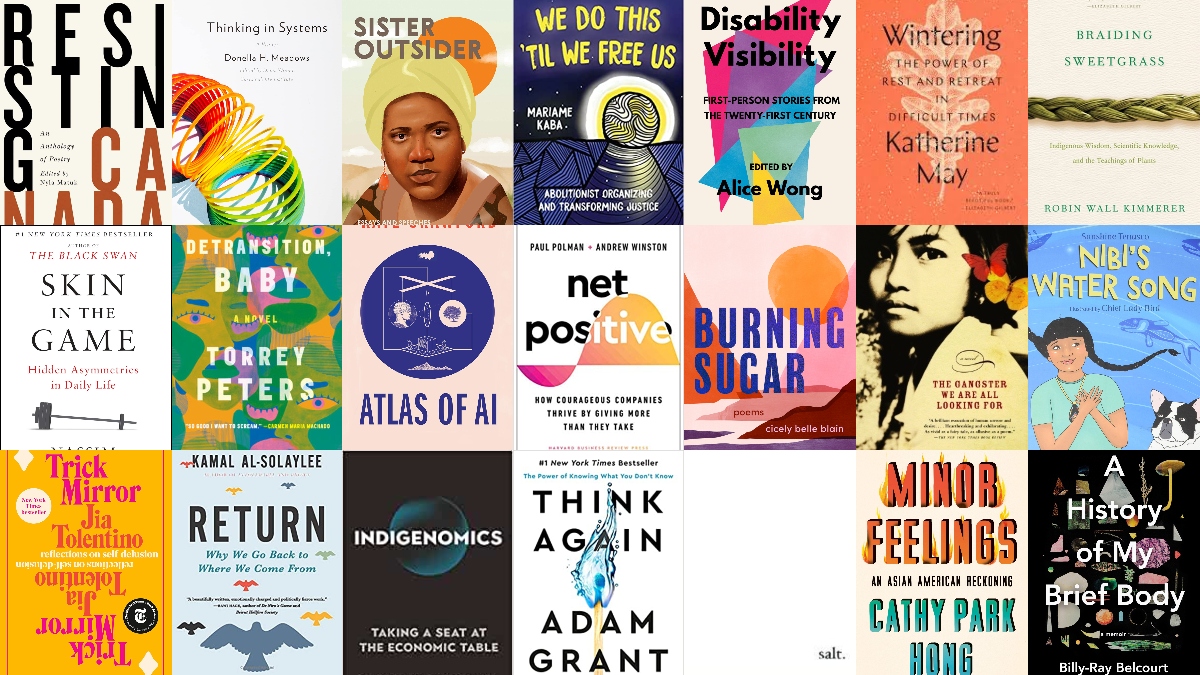
It’s that time of year again. The time of year when we ask social impact-focused people — changemakers and members of the Future of Good team — for the best book they read in 2021, and why.
As Future of Good Editorial Fellow Gabe Oatley says of their recommendation, “Not all ‘social impact’ books are how-to guides.” This list proves that — spanning poetry, essays, fiction, children’s literature, and, yes, some traditional non-fiction. Good luck picking just a few to read over the holidays.
Resisting Canada: An Anthology of Poetry edited by Nyla Matuk
“I read more poetry in 2021 than I did in any previous year, and one book I loved in particular was Resisting Canada — a beautiful anthology that celebrates poetry as political agency. El Jones writes about Omar Khadr, Billy-Ray Belcourt describes the 2009 devastation of H1N1 in God’s River First Nation, Janet Rogers examines the Truth and Reconciliation Commission’s calls to action, and so very much more. If this quote from the anthology’s introduction by Nyla Matuk doesn’t convince changemakers to pick it up, I’m not sure what will: ‘In their own mordant, elegiac, allegorical, symbolic, pragmatic, narrative, conceptual, historicizing, singing ways, every poem in this book stands against the patriotic staple of ‘belonging’ to Canada.’” – Kylie Adair, editor of Future of Good
Burning Sugar by Cicely Belle Blain
“This year, I read and kept re-reading Cicely Belle Blain’s collection of poems, Burning Sugar. Their work is part exploration, part wandering. Anti-black racism, fatphobia, and biphobia forces them to exist in an unforgiving world, so readers join them on the decision to mobilize the self and exist loudly anyway. Blain writes of racism sewn into places they have lived and visited, how it inspires and interrupts the art they observe and create. They also share the process of listening to and healing their inner child. The love, hate, grief, pain, curiosity, and infatuation feels like Blain is writing a guide about learning to live, and sometimes, just trying to survive.
Personal, candid, and blunt, Blain’s collection is for everyone. For some, it will be cathartic. It reminds us of the emotions we forgot we hid and invites us to begin healing. For those outside the Black queer experience, it helps them understand the world that exists for them is destructive for others. After being desensitized to Black trauma on our phones and tablets, it prompts reflection and empathy. In continually growing from their own experiences, Blain affirms and humanizes many others’.” – Sherlyn Assam, Future of Good editorial fellow on women’s economic resilience
Disability Visibility edited by Alice Wong
“My favourite book this year was Disability Visibility. It’s a collection of contemporary essays by disabled people compiled by activist Alice Wong. The book cover really captures my thoughts well: the essays give a glimpse into the rich complexity of the disabled experience, highlighting the passions, talents, and everyday lives of this community, and invites readers to question their own understandings.” – Malika Asthana, manager for strategy and public affairs at D2L
A History of My Brief Body by Billy-Ray Belcourt
“A History of My Brief Body by Billy-Ray Belcourt. I love this book because it truly asks, and in some ways answers, the question of how Indigenous and racialized peoples can continue to exist and thrive under the “embargo on care that is Canada”. I feel it is especially relevant at this time because one of the critical problems of our society at present is that authenticity of self for someone like me (racialized, neurodiverse woman, for example) is considered a ‘radical’ stance. This makes sense when I exist in a world not built nor designed to celebrate and cherish and sometimes, allow for it. But when I think of the future, I imagine a world where we can just live to experience life, and do so with utmost freedom from oppressive forces.” – Manvi Bhalla, president and co-founder of Shakeup the Establishment
Minor Feelings by Cathy Park Hong
“One of my top reads this year was Minor Feelings by Cathy Park Hong. This book of essays beautifully blends memoir and history to describe the Asian-American experience. Park Hong specifically reflects on minor feelings — the feelings of shame and frustration felt by many immigrants when they encounter the gap between their lived experience and the promise of the American dream. I’ve always been interested in the intersection of storytelling and social change so this read hit home for me. Other changemakers who are interested in reframing dominant (and sometimes harmful) narratives could be too.” – Katrya Bolger, audience engagement editor at Future of Good
Trick Mirror: Reflections on Self-Delusion by Jia Tolentino
“Trick Mirror: Reflections on Self-Delusion by Jia Tolentino was hands down the best collection of essays I’ve read. Cultural criticism doesn’t get much better than this. Tolentino writes on everything from athleisure to reality television to the Internet with a razor sharpness that cuts down to the centre of these topics. I found so many rich ideas in every single essay that made me want to take notes furiously like I was in a class of some sort and Tolentino was teaching me how to look at the world with new eyes.” – Neha Chollangi, special projects writer at Future of Good
Nibi’s Water Song by Sunshine Tenasco
“As I have two small children, much of my time in the evening is spent reading them books or trying to put them to bed. A book we’ve become fond of is Nibi’s Water Song by Sunshine Tenasco. Nibi lacks clean water in her community. She demonstrates perseverance in her quest to quench her thirst and along the way, teaches others about the inequitable access to resources.” – Megan Conway, CEO of Volunteer Canada
The Gangster We Are All Looking For by lê thi diem thúy
“The Gangster We Are All Looking For is a really powerful book portraying the perspective of a young Vietnamese girl’s journey from Vietnam to Canada with her father as boat people in the 1970’s. Heartbreaking yet innocent as it starts with the lens and a narrative of her at just six years old, where the world is hers to define, only to see the impacts of her journey when she matures into adulthood — racism, poverty, the realism of the Vietnam war on her family, etc.” – Thi Dao, content partnerships specialist at Future of Good
Skin in the Game: Hidden Asymmetries in Everyday Life by Nassim Nicholas Taleb
“Nassim explains how advisors who recommend interventions to social issues impede learning. More practically, it’s impossible to uncover if the interventions are working if funders or donor advisors make decisions about community programs but have no skin in the game. This fundamental principle should be the basis for all social intervention. Great quote: ‘Avoid taking advice from someone who advises a living unless there is a penalty for their advice.’ Skin in The Game is an excellent book for anyone who wants to understand why inclusive and diverse boards and non-profit leadership are essential in the community. So often, decisions are made for racialized minorities by people who have no lived experience within the community, no connection to the community, and nothing to lose if the community succeeds or fails. Nasim hypothesizes that those connected closely or living in the communities have an immediate need to come up with simple solutions. In contrast, those disconnected tend to over-analyze and come up with complex solutions that are impossible to implement, leading to ineffective interventions.” – Mina Demian, director of business development at Technology Helps
Braiding Sweetgrass by Robin Wall Kimmerer
“Braiding Sweetgrass by Robin Wall Kimmerer. Wonderfully told anecdotes woven together to deepen our understanding and appreciation for how to right relations with the land and each other.” – Maureen Fair, executive director of West Neighbourhood House
Wintering by Katherine May
“A book that continues to replay in my conversations recently has been Wintering by Katherine May. In a year that felt like the sequel of groundhog day, May’s book is a reminder of these stretches of ‘fallows periods in life when you’re cut off from the world, feeling rejected, sidelined, blocked from progress, or cast into the role of an outsider,’ for whatever reason, gave me newfound courage to embrace the quiet and the cold. Full of anecdotes about the seasons, stories of winter’s past, the traditions of the seasons that inform holidays like Halloween in western culture, this book offers a vulnerable viewpoint into the moments when we, as individuals, need or are forced into a pause. Chronic illnesses, deaths, losses, ongoing social injustices surfaced by the pandemic, mental illness, and unemployment are difficulties that I love most experienced this year. As a high-achieving person, the book gave me permission to contemplate my wintering experience and how to embrace it, vocalize it, console it, and support others personally and professionally.” – Juanita Lee Garcia, director of partnerships and strategic marketing at Venture for Canada
salt. by Nayyirah Waheed
“The favourite book I read in 2021 is salt. by Nayyirah Waheed. I related so much with it as an immigrant woman trying to hold onto my life in Western practices! It’s beautifully written, sweet as honey but cuts deep. It’s something that I read and re-read. Some of the poetry resonates a lot with how I perceive my healing journey and I use it as a guide to my emotions.” – Merve Guvendiren, former communications and mobilization coordinator at Philanthropic Foundations of Canada
We Do This ‘Til We Free Us: Abolitionist Organizing and Transformative Justice by Mariame Kaba
“My favorite book I read this year, hands down, is We Do This ‘Til We Free Us: Abolitionist Organizing and Transformative Justice by Mariame Kaba. I’m the kind of person who writes little notes in a book as I read and my copy of this book is full of arrows and underlines — it is full of profound ideas that I want to bake into my thinking. It’s both a really accessible intro to abolitionist organizing, and full of depth and critical thought for those that have been doing this work for a while. A+ wonderful read that also helps people advance their thinking of how prison abolition is central to so many other struggles like housing and food justice.” – Katie German, director of advocacy and programs at Foodshare Toronto
Net Positive: How Courageous Companies Thrive by Giving More Than They Take by Paul Polman and Andrew Winston
“I just started reading Paul Polman and Andrew Winston’s Net Positive. I am suggesting it because creating net positive companies and a net positive economy is the future and it begins today with courageous leaders and practitioners who recognize the immeasurable role companies must play in solving the world’s problems.” – Phillip Haid, co-founder and CEO of Public Inc.
Think Again: The Power of Knowing What You Don’t Know by Adam Grant
“We often reference Einstein’s witticism about doing the same thing over and over and expecting different results. Yet, how often do we apply the same behavior in our daily routines? In his book, Think Again: The Power of Knowing What You Don’t Know, Adam Grant, organizational psychologist, awakens our minds to the cognitive skill that likely matters more than the ability to think and learn: the ability to rethink and unlearn, where one of his guiding principles is to argue like you’re right but listen like you’re wrong. If our collective goal as a community is to deliver solutions to long-standing, systemic issues that hinder the sustainability of our businesses be it financial, social or environmental, I think we may all benefit from the reminder to step outside the confines of our well-constructed viewpoints. Questioning our biases and shifting our perspectives could open our minds to new horizons. Perhaps in doing so, we just may re-imagine new models of thinking and resulting behavior that could unlock the potential to not only sustain, but to regenerate the prosperity of our communities.” – Suzi Mikaelian, founder and CEO of Social Mission Canada
Detransition, Baby by Torrey Peters
“My favourite book of the year (and one I’ve gifted to several pals!) is Detransition, Baby by Torrey Peters. The book is about three New Yorkers — trans and cis — caught up in a very queer love triangle, navigating the possibility of parenthood. It’s great fiction: fast-paced, engaging, and fun. And it’ll teach you something too. If you’re a cis person whose ever wanted to better understand trans pals in your life, this book might just do it. And if you’re trans, and looking for a book where a razor-sharp author says the quiet parts of (some aspects of) the trans experience out loud, pick up this read. Not all ‘social impact’ books are how-to guides. Some are just very well written fiction that helps us understand one tiny slice of the human experience a little better. This is one of those reads.” – Gabe Oatley, Future of Good editorial fellow on transforming funding models
Return: Why We Go Back to Where We Come From by Kamal Al-Solaylee
“Return: Why We Go Back to Where We Come From by Kamal Al-Solaylee. Changemakers should read this fantastic book because it looks deep into the human heart. Change often leads to abstract conversations about policies and legislation, but at the core, change is about human beings.” – Senator Ratna Omidvar
Sister Outsider: Essays and Speeches by Audre Lorde
“My favourite read for this year would be Sister Outsider: Essays and Speeches by Audre Lorde. I had read excerpts before, but this year was the first time I sat down and read the book cover to cover. I recommend this book to anyone who is working to create social change, especially at the intersections of gender equity and racial justice; although, the collection explores so many topics that touch on a wide variety of experiences and identities. It’s great to see so many people learning about intersectionality and using the term more often in conversations about equity and justice, but I think it’s important that we use it with intention. Intersectionality isn’t just a buzzword, it’s grounded in the living experiences of people who encounter multiple forms of oppression every day. Learning about it from Black feminist trailblazers like Lorde, who wrote this collection throughout the 1970s and 80s, or Dr. Kimberlé Crenshaw who coined the term is not only educational and inspiring, but it’s also an important acknolwedgement of all the work that’s been done before us to influence social change and give us a framework to continue to make an impact. During the last year, I’ve often felt isolated, overwhelmed and tired. Reading Sister Outsider made me feel more connected to those who came before me and those who are doing this work alongside me. I was actually gifted the book by a friend and former colleague as I transitioned to a new role at the beginning of 2021. It was the perfect gift because it was exactly what I needed at that time of change in my career and it was also a great reminder of all the incredible people I have the privilege of doing this work with.” – Sydney Piggott, director of community engagement at Elevate
Atlas of AI by Kate Crawford
“Atlas of AI is a captivating and profound anthropological account of our future with artificial intelligence. It shines a light on the new colonialism, environmental degradation, and ethics. Crawford is a rigorous interrogator of how intelligence is ‘made.’ It’s a must read for changemakers.” – Vinod Rajasekaran, publisher and CEO of Future of Good
Indigenomics by Carol Anne Hilton
“Indigenomics is a must-read, as we dig deeper into what reconciliation means for all of us as Canadians. This book highlights the incredible opportunity and potential of the emerging Indigenous economy, and how it will help bring about the drastic shifts we need to see in our economic systems to move towards a sustainable future.” – Lana Selbee, executive director of Yukonstruct Society
Thinking in Systems by Donella Meadows
“Time literally evaporated in 2021. I didn’t find the time to read like I normally would, or maybe I didn’t prioritize it amongst all else. Life was overflowing with homeschooling, grant deadlines, and COVID tests. Since I was surrounded by my old books all day long, I did skim some old favorites, and rediscovered a love for poetry. One book I did re-read from start to finish was Thinking in Systems by the great Donella Meadows. I get overwhelmed by the complexity of the world’s problems and this primer has grounded me in the basics of change-making. There is big talk of systemic change in our country, but more often than not, only incremental tweaks are put forth, especially in government. I would hope that every policymaker reads this book.” – Carol Steuri, director of operations at Future of Good
Tell us this made you smarter | Contact us | Report error