Blip or trend? Government funding to charities jumped by $30 billion in early pandemic
Why It Matters
All levels of government announced new funding for the charitable sector during the pandemic. But how much did organizations net in total? And is the boost in funding here to stay?

Longtime charity researcher Steven Ayer expected data would show Canadian governments, at all levels, significantly increased funding to the sector during the early pandemic.
But figures released last week by the Canada Revenue Agency surprised him.
Between 2019 and 2021, total transfers from Canadian governments to the charitable sector increased by $30 billion, or about 15 per cent: from $199 billion in 2019 to $228 billion in 2021, according to the CRA report.
The funding boost was intended to help charities weather the early stages of the COVID-19 pandemic, said Ayer.
The largest increase came from provincial and territorial governments, which increased charity transfers by $26 billion between 2019 and 2021.
A significant share of these funds supported hospitals, long-term care facilities and schools, which saw higher labour costs during the first waves of the virus, Ayer said.
But other charities also saw a boost.
According to the CRA report, charities received $4.5 billion from the Canada Emergency Wage Subsidy (CEWS) after the program was launched in 2020.
CEWS reimbursed charities and businesses up to 75 per cent of eligible workers’ salaries for nearly 18 months, if necessary, in an effort to prevent layoffs.
The distribution of CEWS funds to charities of all kinds was “unprecedented,” said Ayer.
“I wouldn’t be super surprised if we don’t see anything like it for a very long time to come.”
Accelerating trend
However, while the widespread distribution of CEWS is unprecedented, increased government funding more generally, is not.
The overall amount charities have received from all three levels of government has been ticking up for the last 10 years, said Jodene Baker, Imagine Canada’s vice president of research and advocacy.
The pandemic funding boost represented an acceleration of that trend, not a shift, she said.
In the context of a global pandemic, it was entirely appropriate for the government to increase the flow of funds further, Baker said. “It’s the system functioning as I think it should.”
Moreover, Ayer said the funding made a big impact.
“If we hadn’t seen those multi-billion dollar programs at the beginning of the pandemic, things would have been much, much, much worse for a lot of folks.”
Post-lockdown funding predictions
Yet since 2020, many charities have faced new, additional challenges, including increased demands for services, a decline in the number of donors, and inflation.
Government relations consultant Jesse Clarke said she expects future data will show that the early pandemic government funding boost was just “a blip.”
In 2021, the federal government ended the CEWS program.
Last year, every federal ministry was also forced to identify budget cuts, which has impacted some charities, she said.
She added it would be disappointing if funding plateaues while the sector’s needs continue to increase, further widening the gap between demand and capacity.
Ayer agreed the gulf between funding needs and realities is significant.
However, he said provincial transfers have likely continued to grow because of inflationary costs and increased healthcare demands.
CRA data obtained by Blumbergs suggests federal spending on charities declined in 2022, but provincial, territorial and municipal spending continued to increase.
Sector budgets more sensitive to federal swings
As total funding climbed during the pandemic, so did the percentage of charitable funding provided by government sources.
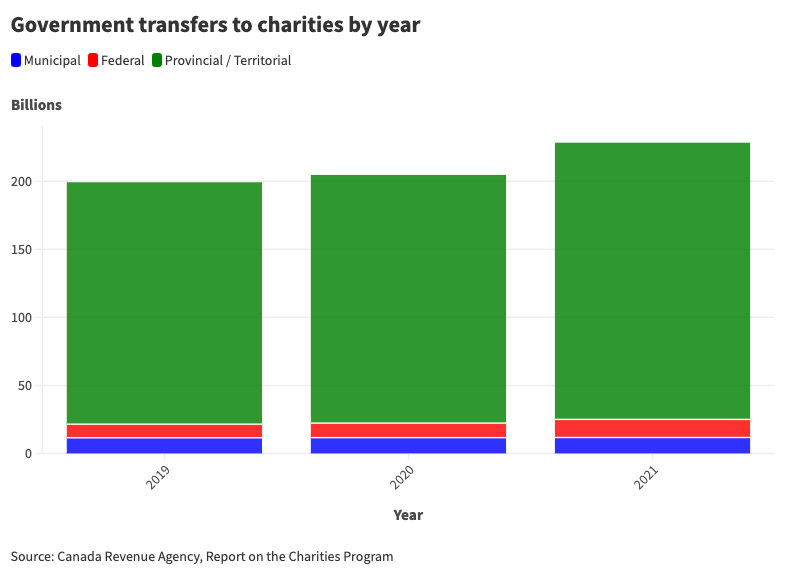
In 2021, government transfers to the sector comprised 69 per cent of overall revenue—up four per cent from 2019.
Baker said this, too, is a trend that’s been accelerating for about a decade, as the number of donors giving to Canadian charities has decreased.
While government support for the sector has been welcome, Ayer said charities’ increased reliance on the state comes with “substantial risks.”
Should governments make an effort to balance their books by cutting spending, some organizations could take a hit, he said.

How would a Conservative government impact the sector?
Conservative governments are commonly associated with tighter budgets, but Clarke said a federal Conservative government—should one be elected—won’t likely result in reduced federal transfers to charities, at least initially.
New governments sometimes find it more difficult to implement cost-cutting measures than they initially expected, because of existing contracts and bureaucratic hurdles, she said.
Recent federal history also suggests a Conservative government wouldn’t have as big of an impact on sector funding as some might assume, she added.
The biggest change between the Harper and Trudeau governments was a shift in what got funded—not the overall volume of funds, said Clarke.
The Trudeau government has offered more funding for LGBTQ and women’s organizations compared to the Harper government, she said.
Tell us this made you smarter | Contact us | Report error