Can community safety groups replace (some) policing?
Policing costs Canadians $16.5 billion each year or roughly $45 million per day
Why It Matters
Overpoliced communities are turning to grassroots organizations, often run by volunteers or underpaid workers, to keep the peace. Making space — and funding — for alternative public safety models could save lives.
Warning: This story has several mentions of police violence, suicide, mental health crises, and drug use.
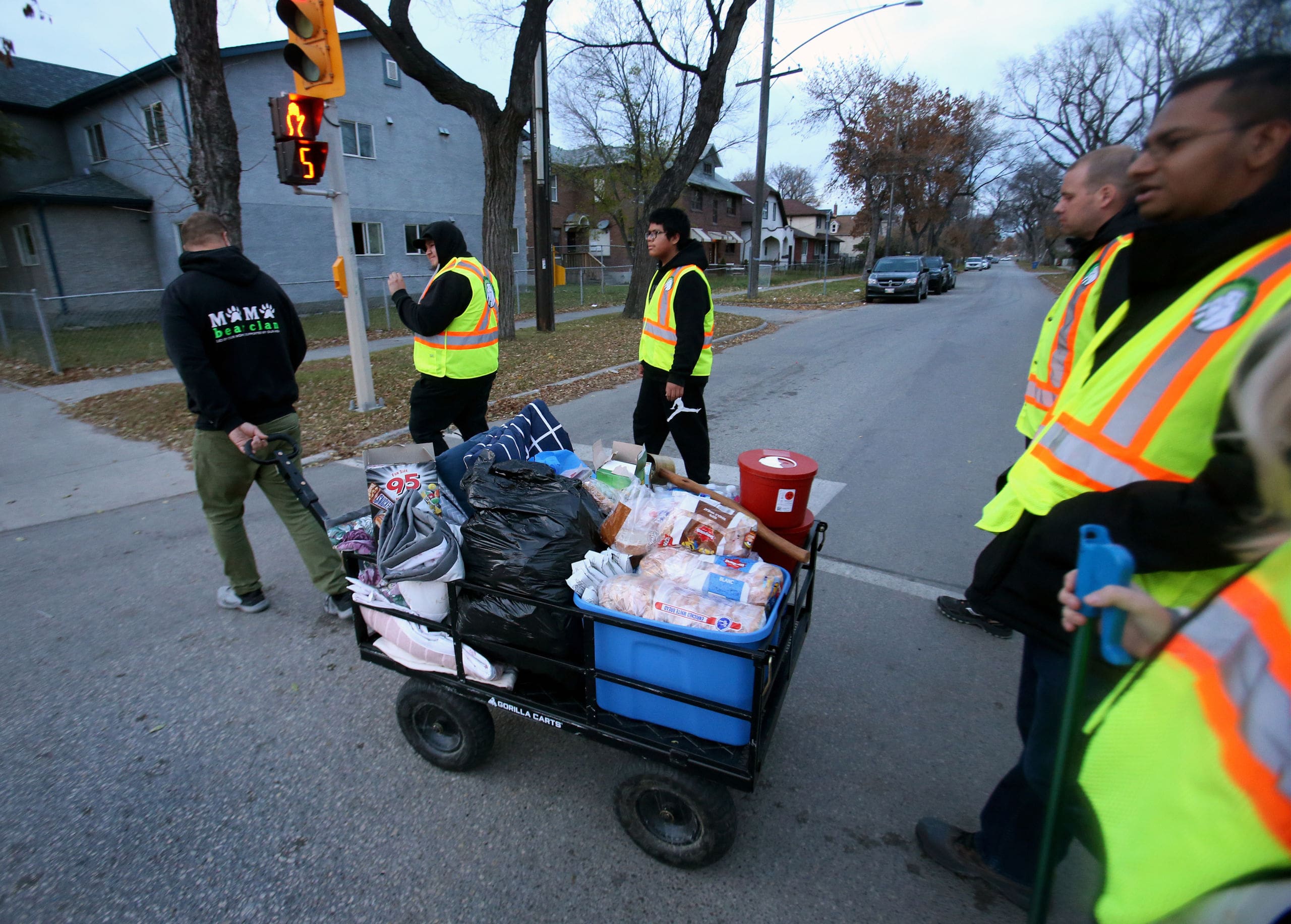
The Mama Bear Clan patrols Winnipeg’s North Point Douglas neighbourhood. Photo: Shannon VanRaes
WINNIPEG / TREATY 1 — Inside the North Point Douglas Women’s Centre, the last notes of an honour song fade into smoky air; Grace Akerstream Laing thanks the singer, then holds up a hand-drawn map of the neighbourhood. Red numbers mark the location of tents and other improvised shelters.
There are 15 in total.
“We’ve got a lot of blankets right now, so I think it makes sense to check on the camps,” she says. “Our relatives won’t go cold tonight.”
A dozen or so volunteers in fluorescent vests nod emphatically, then hustle to load a pair of landscaping wagons with snacks, bottled water, socks, sharps containers and quilts. The last-minute arrival of a man carrying boxes of miniature chocolate bars draws cheers.
The wagons roll onto the street just as the sun sets and two young men in jeans and hoodies approach; they ask about food and are handed sandwiches, water and chocolate. “A thousand miigweches,” shouts one man, using the Anishinaabemowin word for thank you as he walks off into the dusk.
Collectively, the volunteers are known as the Mama Bear Clan and they’ve patrolled North Point Douglas three times a week since 2016, offering residents a restorative, Indigenous-led approach to public safety.
“Typically, we go out there and we spread some love, we engage with people and build relationships within the community,” says Laing, who grew up in the neighbourhood and has served as the Mama Bear Clan’s coordinator since 2020. “We also pick up any weapons that we find, needles, we check playgrounds around the area and make sure that, you know, there’s nothing dangerous for kids … we provide that safety presence that people need in the North Point Douglas area.”
And they’re not alone. The Mama Bear Clan is part of a growing number of community-led patrols and outreach organizations across Canada, working to put community safety back into the hands of community members, through safety patrols, mental health outreach, food programs and much more.
Western Canada, in particular, has embraced community-led patrols. Winnipeg alone is home to eight patrol groups, including the Bear Clan, which — while not affiliated with the Mama Bear Clan — has established chapters in cities such as Brandon, Calgary, Edmonton, Regina, Thunder Bay and Montreal.
Originally founded in the 1990s, the Bear Clan was revived following the murder of Anishinaabe teen Tina Fontaine in 2014. The feeling was that, if police weren’t going to protect the community, the community would protect itself through direct action.
Municipal governments, struggling to balance ballooning police budgets with attempts to address social issues like homelessness, addiction and mental health, are also pushing services once considered the domain of law enforcement onto non-profit agencies. But while direct action at the grassroots level might keep people safer — particularly those from racialized communities — those on the front lines say offloading alone isn’t a solution to budget constraints.
“A lot of people won’t call 911, but they’ll come to us right away.”
The lynchpin driving people towards community-led safety models is mental health, says Paul McKenna, an adjunct professor at Dalhousie University who once served as deputy director of the Ontario Provincial Police Academy.
Describing it as a “lightning rod,” McKenna says police are not trained to deal with people experiencing a mental health crisis. “And we know from the unfortunate results of those interactions, whether it be death or serious injury, that the police are not good at that.”
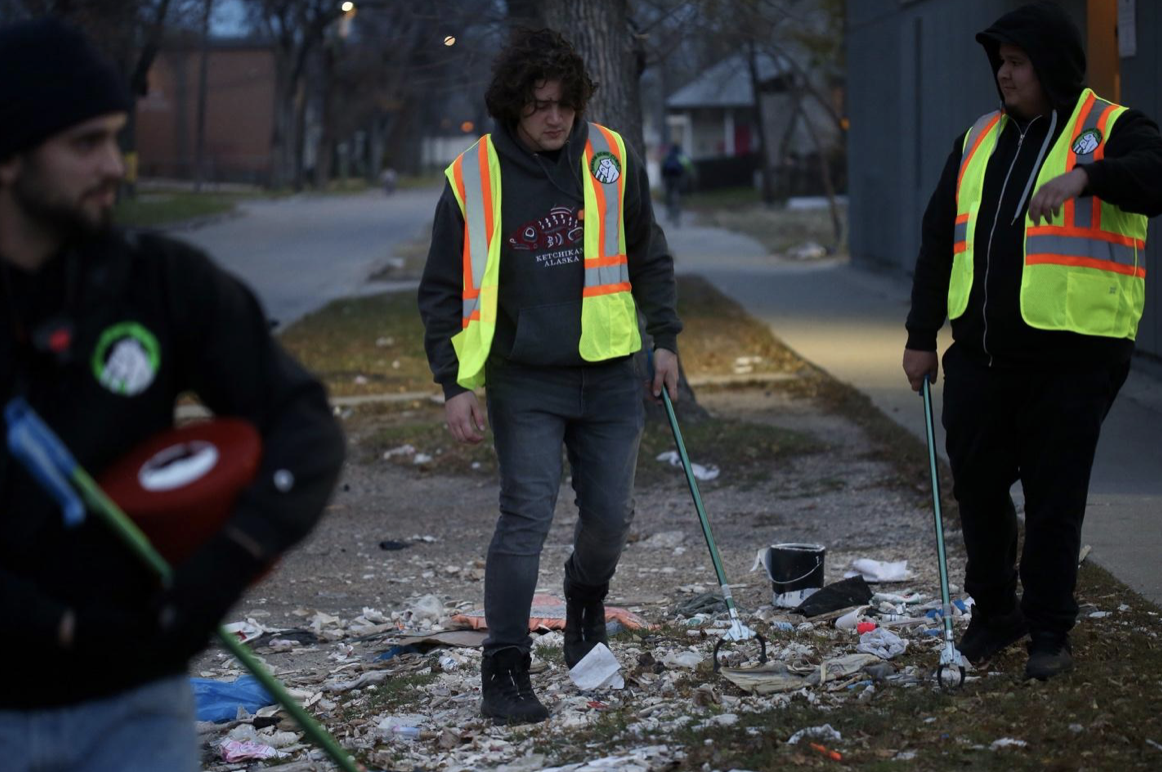
Members of the Mama Bear Clan pick up discarded needles while on patrol in Winnipeg. Photo: Shannon VanRaes
Robert Epp sees lightning strike every day on Vancouver’s Downtown Eastside; police respond to calls related to mental health, addiction or homelessness, but are unable to offer assistance.
“Vancouver’s overrun with mental health issues,” says Epp, who founded the Sweetgrass Clan four years ago, a small organization providing food, comfort and support to vulnerable individuals. “And our clients do not trust the police at all. Nobody does. In fact, they don’t even respect them … a lot of people won’t call 911, but they’ll come to us right away.”
Examples of law enforcements’ failure to effectively intercede in mental health crises are plentiful, although official statistics are hard to come by. In May 2020, 29-year-old Regis Korchinski-Paquet — who was Black, Indigenous and in crisis — fell to her death when members of the Toronto Police Service entered her high-rise apartment. A few weeks later Ejaz Choudry, 62, was shot and killed by police engaged in a so-called wellness check.
Last summer, police in Victoria responded to a mental health call for a 64-year-old Black man with an armoured truck, chemical irritants, carbine rifles and a K9 unit. Widely shared video from the incident shows police smashing windows and firing unknown weapons into the man’s home. One year earlier, the Saanich Police Department shot and killed a man threatening suicide.
The list of recent, fatal encounters between officers and people in crisis is a long one: Rodney Levi, D’Andre Campbell, Julian Jones, Chris Amyotte, Chantel Moore, Barry Shantz, Wade Vanderwal and Machuar Mawien Madut, to name only a few.
Responding to mental health dispatches with military-style tactics is not unusual in Canadian policing. A 2017 study published in the Critical Criminology journal found the Winnipeg Police Service’s Tactical Support Team, which routinely makes use of an armoured vehicle, responded to nearly 3,000 “well-being” checks in the previous year, including suicide threats.
But the problem isn’t a new one. In his book, Crisis in Canada’s Policing, former Toronto Mayor John Sewell recounts the 1979 police killing of Albert Johnston, a mentally ill man shot to death in front of his children after officers followed him into his own home. “Sadly, not much has changed in the four decades since,” Sewell writes.
What is new is a growing public appetite for community-based interventions.
Time for something different?
“This desire for a different model, for non-policing responses to community mental health crises, has existed for a really long time in our communities,” says Andrea Westbrook, manager of the Toronto Community Crisis Service Pilot at Gerstein Crisis Centre. But in recent years, thanks in part to the ability of social media to disseminate people’s lived experiences, public opinion has also begun to embrace non-coercive, community-led responses, she says.
That shift, along with the international racial justice movement ignited by the death of George Floyd — a Black man murdered by Minneapolis police officers in 2020 — has led to a ground swell of community-led safety initiatives.
Even municipal governments are turning more pointedly towards interventions lead, not by police, but by non-profits like the Gerstein Crisis Centre.
In 2022, the City of Toronto launched the Toronto Community Crisis Service; a three-year pilot project that sends mental health workers, nurses, social workers to mental health calls instead of police officers. Four non-profit organizations — the Gerstein Crisis Centre, TAIBU Community Health Centre, the Canadian Mental Health Association and the 2-Spirited People of the 1st Nations — deliver the service, which is funded by the city.
“We want to ensure that people in crisis get a public health response,” says Mohamed Shuriye, Toronto’s manager of policing reform. “These are not calls that require police resources and police don’t have the training or the time to spend on these calls.”
The main message received during the civic consultation process was that mental health responses need to be community-led and community based, Shuriye says. “We knew that we’d likely get better outcomes if people knew that their local agency or their local not-for-profit was the one who was running this organization.”
Westbrook says the pilot program was a natural extension of work the centre was already doing, adding that improved access to social resources and reduced stigma are key organizational pillars. “When we can provide a service that’s designed intentionally to meet the needs of the community that we serve, we build and contribute to safer communities for everyone,” she says.
Similar programs have sprung up in many Canadian municipalities, including Vancouver, Montreal, Saskatoon and Calgary. But some programs, like that in Winnipeg, have raised concerns about policing partnerships with community health organizations.
The Alternative Response to Citizens in Crisis, which pairs armed Winnipeg police officers with mental health professionals, has been criticized not only for being police-led, but for potentially giving law enforcement access to people’s personal health information in the process.
“Police have an overwhelming amount of power, especially with the amount of money they’re allocated. And giving them more power is never the answer,” says Daniel Friesen, a member of Winnipeg Police Cause Harm. Information collected by law enforcement during a mental health call could be entered into non-conviction data bases, he says, potentially creating further barriers for already marginalized individuals looking to access services or employment.
Are community organizations any better?
Empowering grassroots organizations to take active roles in community safety is important, but unless there’s a corresponding reduction in police power and influence, Friesen says it won’t translate into systemic change or relieve pressure on civic budgets. He also cautions that police, at times, use partnerships with community organizations to bolster their public image and deflect criticism.
Some community-led organizations also function as extensions of law enforcement, Friesen notes, and may end up replicating the same problematic structures leading to the criminalization of mental health and poverty found in agencies of the state.
Citizens on Patrol, for example, is a nation-wide volunteer organization designed to be the “eyes and ears” of local law enforcement. Members often receive training directly from the RCMP and don’t participate in outreach activities. According to the Manitoba branch’s website, the organization’s goal is “be on the look-out for any suspicious or criminal activity.”
“And so it ends up really just recreating the same cycles that police create and perpetuating the prison industrial complex,” Friesen says.
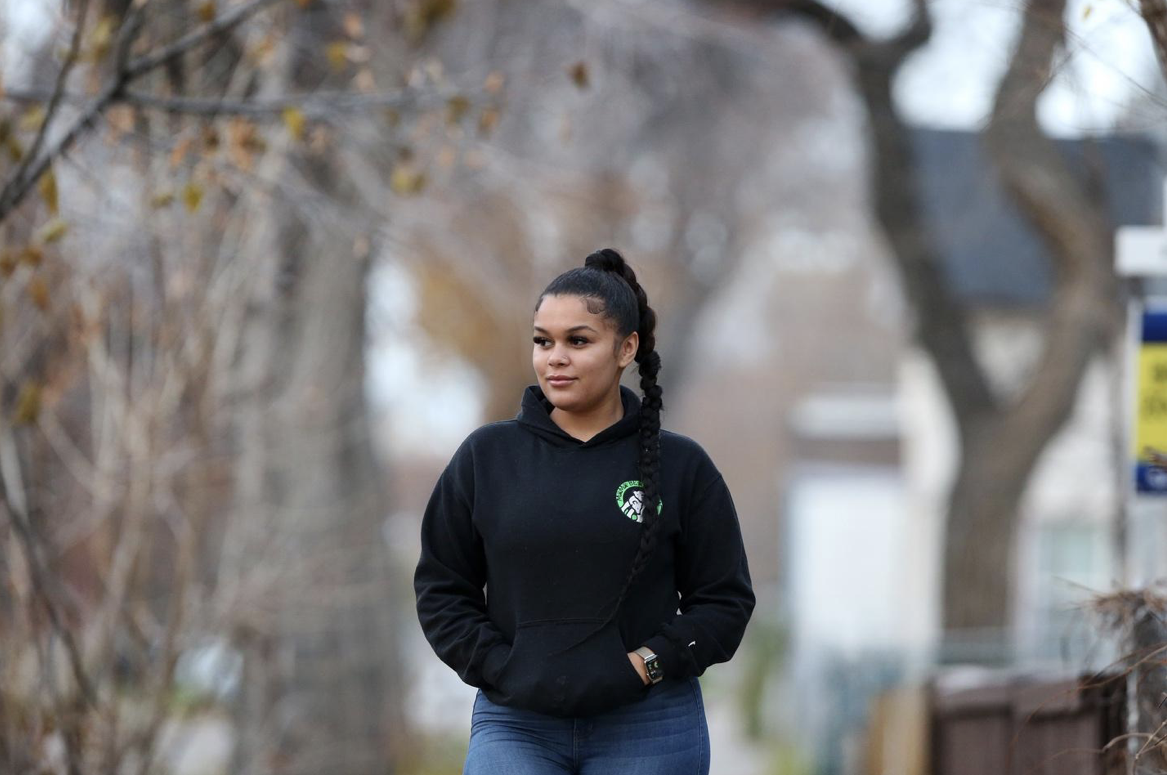
Grace Akerstream Laing is the Mama Bear Clan’s co-ordinator. Photo: Shannon VanRaes
Back in North Point Douglas, the Mama Bear Clan turns down a cluttered alley behind a strip of single room occupancy hotels, discount furniture stores and pawn shops better known as North Main. The patrol’s first stop is the parking lot of a pale brick building once home to Neechi Commons, an Indigenous food co-op, restaurant and gallery, which closed its doors in 2018.
Here, a group of men warm themselves around a rusty burn barrel. Behind them, a chain-link fence serves as an anchor point for a collection of tarps and textiles providing some, but not much, shelter from the elements.
The patrol captains greet the men by name, there are a couple fist bumps, lots of smiles and a flurry of activity around the wagons: Do you have water? Can I have a blanket? My friend needs socks. Thanks for the granola bars. How are you doing? Are you warm enough?
But some of the men are looking for something else, something more.
Laing approaches them with a metal can attached to a long, well-worn branch, sacred herbs already burning inside. Each of them holds their hands over the vessel for a moment, before drawing the sweet smoke towards themselves as they smudge.
Founded by the Women’s Warrior Circle and guided by a group of elders, the patrol is deeply rooted in Indigenous values. And while not all who volunteer are themselves Indigenous, commitment to the Seven Sacred Teachings — love, respect, courage, honesty, wisdom, humility and truth — is central to the Mama Bear Clan’s mission.

Volunteers with the Mama Bear Clan wear fluorescent vest with a mother bear and cub patch. Photo: Shannon VanRaes
Prior to the arrival of European settlers, and for some time afterwards, the eastern tip of what’s now North Point Douglas was a place where Indigenous peoples gathered for ceremony. But in 1812, the land was folded into what became the first colonial farm settlement west of Lake Superior.
Point Douglas had become a fashionable residential enclave by the 1870s, but all that changed in 1881 when the Canadian Pacific Railway cut the neighbourhood in two. By 1910, the area was crudely known as the “foreign quarter” and home to Winnipeg’s only quasi-legal red light district.
In the early 2000s, the district made headlines for crime and poverty, but also for remarkable feats of grassroots organization and citizen activism. Today, a large Indigenous community once again calls the area home.
“I think we fit in because we are an Indigenous organization and we patrol in an area that’s mostly Indigenous people. And, oftentimes, Indigenous people don’t necessarily feel safe calling the police,” Laing says, adding law enforcement frequently profile Indigenous people, leaving many community members feeling targeted and ultimately, unsafe.
That so many outreach programs or safety patrols are Indigenous-led isn’t a surprise to Judith Gale, founder of Edmonton’s Bear Clan Beaver Hill House.
“In my opinion, it’s part of the bigger picture, which is the notion of taking back our land,” she says. “Community has been taking care of community, especially in the Indigenous community, since time immemorial, you know? It’s something we always do, so we’re just continuing that tradition.”
Deeply entrenched, systemic racism and a general lack of confidence in law enforcement is a key factor pushing racialized communities towards grassroot safety programs.
According to Statistics Canada’s 2020 General Social Survey on Social Identity, 21 per cent of Black people and 22 per cent of Indigenous people have little or no confidence in police.
Only 11 per cent, or half as many, non-racialized respondents had the same lack of confidence in law enforcement.
“Relative to the overall population, Black people and Indigenous people had particularly negative perceptions of the ability of police to treat people fairly and be approachable and easy to talk to,” reads the report.
A study commissioned by the City of Montreal in 2019 found Black and Indigenous people were stopped by police four to five times more often than white people in that city. And, after first denying it, RCMP commissioner Brenda Lucki acknowledged systemic racism existed within the force in 2020.
People in crisis benefit from seeing people who look like them and understand they community they come from, says Epp, a sixties scoop survivor who moved to Vancouver’s Downtown Eastside after his partner died of a fentanyl overdose while living in North Point Douglas, leaving him to raise two young children. Police don’t often represent the people they are supposed to serve, he says.
“It instills a sense of peace and wellbeing … giving somebody a cup of coffee or giving somebody a sage; saying ‘hello, do you guys need anything?’ goes a lot farther than somebody walking around with a uniform and a baton in their hand, intimidating the heck out of everybody,” says Epp.
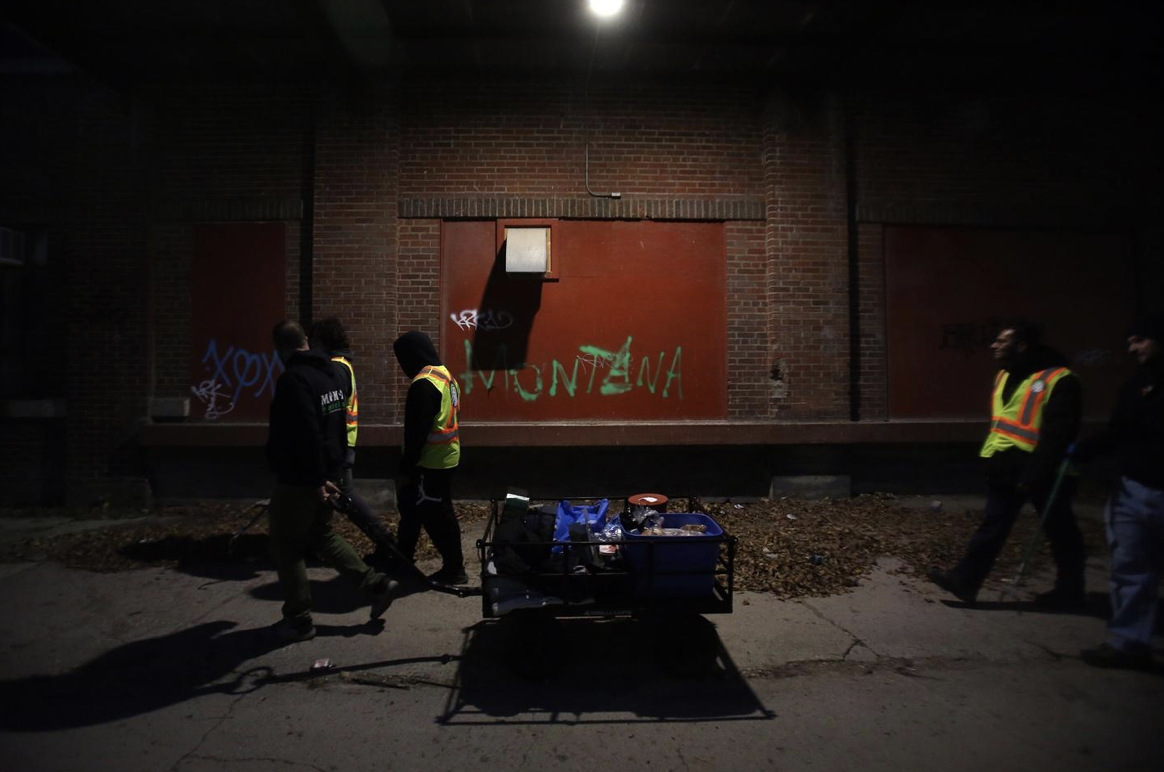
Patrols regularly walk alleys near Winnipeg’s Main Street. Photo: Shannon VanRaes
Alain Babineau is acutely aware of how deeply racism runs in police culture, both as a Black man and as a former officer. He spent 27 years with the RCMP, but only joined their ranks after filing a successful human rights complaint against the Mounties for racial discrimination during his application process.
“They profiled me as a dope dealer,” he says.
Since retiring in 2016, he’s earned a law degree and thrown himself into the fight against racial profiling in Canadian police forces. Community-led organizations have an important role to play in mitigating systemic racism by offering racialized people alternative public safety models, Babineau says.
However, police don’t always make space for grassroots entities or non-profits in the safety matrix.
“It is great to get folks from the community involved, but it has to be done as an equal partnership,” says the former officer. “And I think police officers, police services are very reluctant to do that. They are reluctant to give up any control and it can become sort of a power-tripping situation.”
Future of Good contacted the Canadian Association of Chiefs of Police for their perspective on community-led safety initiatives, including citizen patrols, but didn’t receive a response.
Like Friesen, Babineau warns community-led organizations, however well intentioned, are not immune to the pitfalls of police culture, particularly when working hand-in-glove with law enforcement.
Likewise, replacing officers with citizens or social workers is only effective if those individuals don’t hold the same biases as the service members they replace, he says.
“I’m all for police officers being removed from functions that they have no business being in. We shouldn’t be criminalizing drug addiction, we shouldn’t be criminalizing homelessness, we shouldn’t be criminalizing poverty,” Babineau says. “But a lot depends on who you’re replacing them with.”
In the 1970s and 80s, community policing came to the forefront in North America. McKenna, who authored Foundations of Community Policing in Canada in 1999, says the underpinning philosophy, centred on community involvement and crime prevention, was a good one. In practice, however, law enforcement remained in the driver’s seat.
Community-led safety shifts control away from police, says McKenna, who advocates for safety and well-being strategies that “de-center” law enforcement and re-center the people and non-profits working in those communities.
“If we look at the police as part of that larger web of security, we can start to effectively wrap our heads around how the police might be, in the future, altered or adjusted or restructured to allow for a better flow between other non-profit organizations,” he says. “And that will make cities and villages and towns safer.”
A $16.5 billion question
Movements aimed at defunding or de-tasking police, which have gained momentum in recent years, are also bringing alternative public safety models to the forefront. And while racial injustice and police brutality are at their crux, the financial burden of policing is no small consideration.
Excluding specialty law enforcement — military and railway police, immigration and fisheries officers, customs agents and the Canadian Security Intelligence Service — policing costs Canadians $16.5 billion each year, according to Black Lives Matter.
Toronto will spend an estimated $1.15 billion on policing in 2023, although Winnipeg spends more on policing per capita than any other Canadian municipality; $320 million in 2022 or 26.8 per cent of the city’s annual budget.
Law enforcement agencies, represented by powerful police unions, lobby for funding increases year after year. However, increased police spending doesn’t translate into crime prevention — Winnipeg saw a record 51 homicides in 2022, despite a $7 million budget increase that same year.
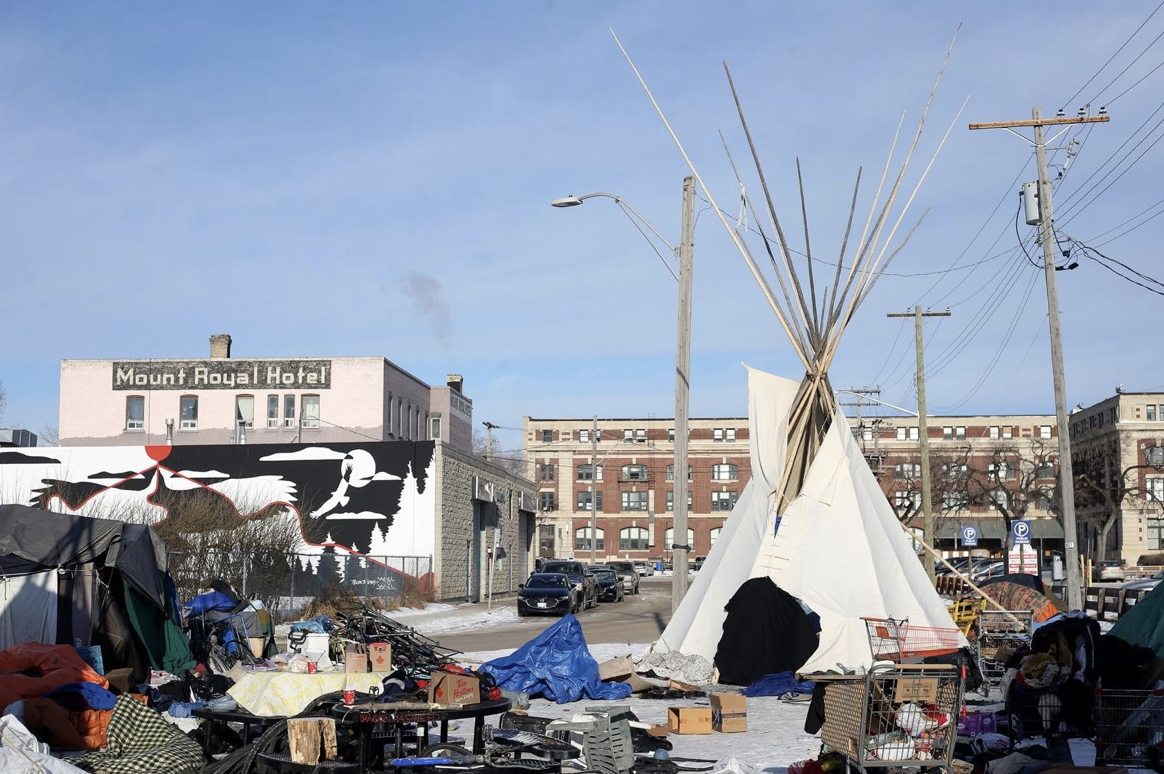
A camp used by unhoused individuals in Winnipeg in the winter of 2020, which was later demolished by city workers. A new, tiny home complex is now under construction across the street. Photo: Shannon VanRaes
“The police have presented themselves as being capable and with the capacity to do these things with proper funding,” Mckenna says. “But in many instances they’ve, if not so much utterly failed, not been truly effective.”
McKenna isn’t a defunding advocate, but he’d like money to “flow more freely and fully” to community groups tackling root causes of crime. When adequately resourced, community patrols and outreach organizations can not only address social issues stemming from drug use, trauma, mental health and homelessness, but ultimately reduce policing costs, he says.
But the “security web” only works if funding models recognize community-led non-profits aren’t optional, McKenna says. “They are vital players and need to be brought on board in a more fulsome and effective way.”
For some, shifting roles currently held by police onto community organizations presents an opportunity to reduce costs associated with public order and shrink police expenditures. But for others, it creates a problematic issue around wage disparity.
The average Canadian police officer makes $95,127 per year, according to glassdoor.com. In Winnipeg, some constables were paid more than $200,000 in 2021. The average salary at a community non-profit — which might provide services like childcare, advocacy, access to the arts, safety patrols, social services and so on — is $38,716.
Most of those who walk the streets of their communities to bring comfort and aid to their fellow citizens, such as the Mama Bear Clan, are volunteers.

Mama Bear Clan volunteers patrol along Winnipeg’s Main Street. Photo: Shannon VanRaes
“If governments are going to claim to take community safety seriously and develop these alternatives to police, they should be paid well, they should be unionized jobs, stable jobs, that people can actually make a good living at,” says Friesen.
During Winnipeg’s 2022 civic election, mayoral candidate and self-styled social entrepreneur Shaun Loney proposed a new public safety model; non-profits would take on work currently done by police, like responding to complaints about tent camps, and be paid for the value of the workload reduction delivered to law enforcement.
“If police are going out to respond to a person who has been in contact with police, say, once a month or once a week for the last two years, at some point we have to say, what is the intervention that this person really needs?” Loney asks. “And how do we rearrange how money moves so that they get that?”
Reducing the number of 911 calls law enforcement responds to goes hand-in-hand with providing compassionate responses recognizing mental health, homelessness and addiction aren’t criminal matters, he says. It’s a strategy that will, over time, shrink the number of officers on municipal payrolls, decrease police expenditures and allow funds to be redirected to community-led organizations, says Loney.
“Governments use procurement all the time and they value what they buy, but they don’t procure what non-profits have to offer,” says Loney. “And they should.”
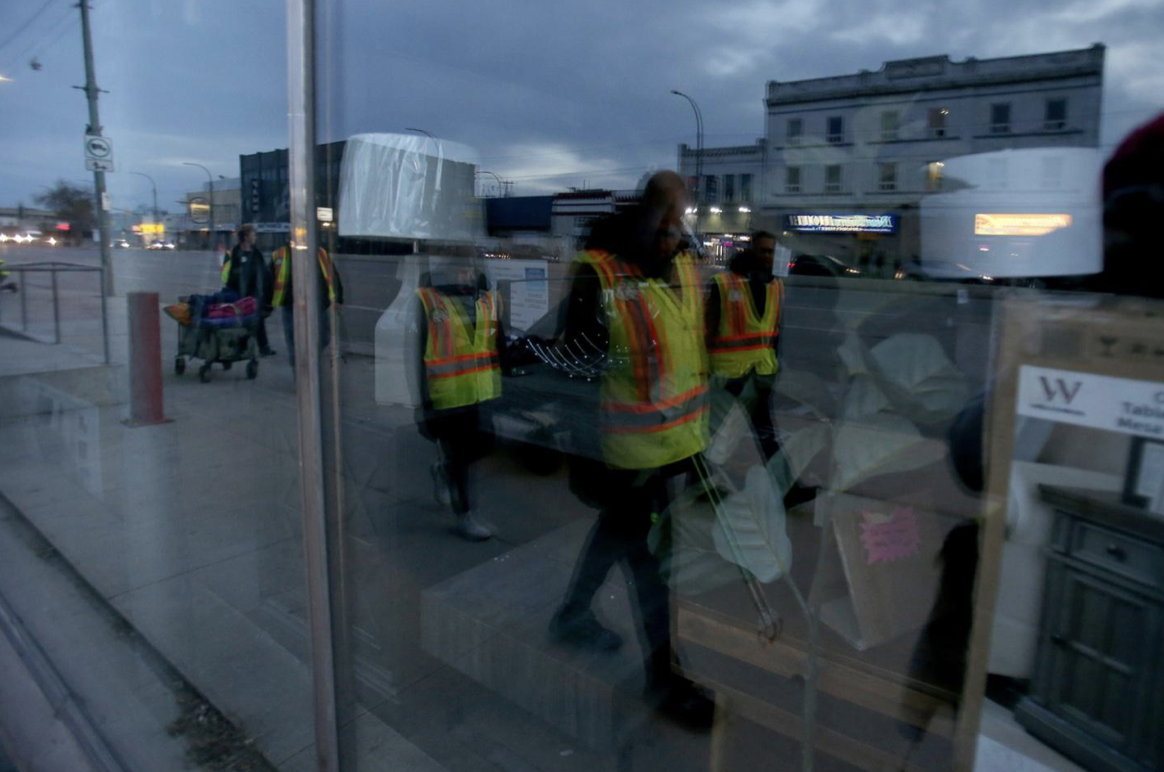
Volunteers are reflected in the window of a discount furniture shop on Main Street. Photo: Shannon VanRaes
The City of Regina does believe non-profits play a role in community safety, so much so that it’s creating an external non-profit entity to implement its new Community Safety and Well-being Plan, which focuses on six areas of concern: domestic and interpersonal violence, food insecurity, problematic substance use, racism and discrimination, safety and the service system.
“Here in Saskatchewan we have a model called a municipal corporation,” says Kelly Husack, a policy analyst with the city. “It has a unique relationship to the city, in that the city is the sole owner of it, and there’s a direct funding and reporting relationship … but it is a non-profit organization.”
It’s hoped the new organization, which is still in the early stages of development, will shift focus away from police and onto community-led safety strategies. Observers say the concept is a good one, but that its impact will be limited by a budget of $875,000 — about one per cent of what Regina will spend on policing this year.
Friesen says the amount of money going to police, in and of itself, underpins the root causes law enforcement claim to address. Issues he believes creativity and community can solve more effectively than force and incarceration.
“The solution to people not having homes is to give them homes, the solution to a toxic drug supply is to provide people with a safe supply of drugs. The solution to people not having food is to give them food,” he says. “And the reason a lot of that doesn’t happen is because resources are allocated to police that could be going towards creating those solutions.”
Often, it’s non-profits and charities that are called upon to provide housing, food, healthcare to the same individuals who get caught up in a carceral cycle.
Friesen says it’s time to start questioning not just how organizations are compensated for providing services that contribute to community safety, but whether they should be providing them at all.
As much as possible, core services should be provided by government, he says. “What is the role of government, if not to provide these basic needs for people?”
That doesn’t mean community organizations shouldn’t play a role in community safety, Friesen adds. Empowering grass-roots organizations can go a long way towards reducing police power and influence — as long as they remain independent of police agencies.
But those who hope to reduce costs through community-led initiatives will likely be disappointed. Police budgets across Canada have increased in recent years, despite growing calls by civil society and social justice movements to decrease funding.
“Politicians at all levels of government love to claim they have no control over the police, but they do control their budget,” Friesen says. Roughly 85 per cent of police budgets go towards officer salaries and pensions, meaning substantial savings would be difficult to achieve without cutting jobs — a topic few politicians dare broach.
It’s completely dark as the Mama Bear Clan begins the last leg of its Friday night patrol. Members walk along the primary dike protecting the low-lying neighbourhood from the Red River, better known as Rover Avenue. They stop to check on a memorial for Nathaniel Thorassie, a six-year-old boy who died after falling through thin ice in 2010, then break off into two groups.
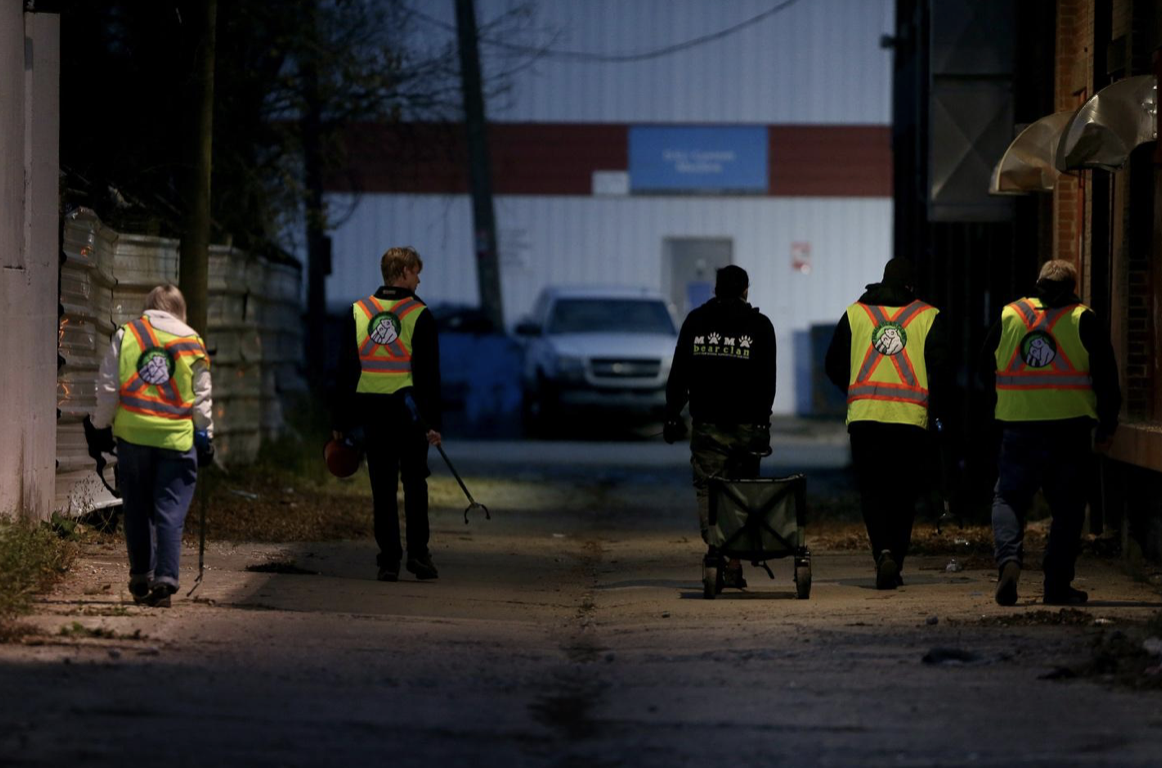
Volunteers walk an alley in Winnipeg’s North Point Douglas Neighbourhood. Photo: Shannon VanRaes
The first climbs down the riverbank to check on a small tent, nearly invisible in the dense brush, while the second assists a young girl wearing rabbit ears whose bike chain has fallen off. As she pedals away, members of the Winnipeg Police Service drive by.
“I think there will always be a need for police, but what we do is something different. It’s about the community,” Laing says. “If there’s an emergency, we will call them, but we operate totally independently.”
As much as the Mama Bear Clan gives back to the community, the community also gives back to the Mama Bear Clan. Volunteers come from all walks of life for all reasons, there are students, lawyers, retail workers, musicians and policy wonks. They walk to make friends, to help those in need, to dismantle colonialism, to stay sober and to make the city they live in a better place.
The patrol’s organizational mantra is “led by our women, supported by our men.” Or as Laing puts it, “supported by our awesome men.”
Laing’s life pivoted towards the Mama Bear Clan after her 29-year-old brother died of an overdose. Giving back to the community and connecting with those who are struggling is a way of honouring him, she says.
“When we walk, we bring our medicines out, we do our smudge, we go out there spreading kindness,” Laing says. “We are not there to intimidate people, we go out there with a gentle, kind energy and it’s well received.”
Your job. Your mission. Your news.
With your support, the sector you're building gets the journalism it deserves, and you get a tax receipt.

Related Articles

Texting with a stranger beats a chatbot at easing loneliness: Canadian study
UBC-led study challenges the idea that an always-available AI companion can substitute for a human connection.
City of Vancouver calls for festival federal funding return
Vancouver’s city council plans to push the federal government to restore and expand federal funding for major festivals and cultural events.

Victoria, Kelowna and Quebec City have the most vibrant arts and culture scenes, new index finds
The inaugural Arts Vibrancy Index showed that mid-sized cities often outperformed major Canadian cities on several indicators, including the overall share of arts and culture businesses, arts and culture revenue per capita, and arts and culture jobs per capita.
