From B.C.’s Connect Money Impact: 5 key ways to channel your money to transform communities
A recent conference in the Okanagan showcased ways to connect changemakers with those who want to invest in their communities
Why It Matters
There is no shortage of social enterprises tackling Canada’s most pressing issues, but the funding to make it happen needs to have an inclusive lens to truly help communities make change.
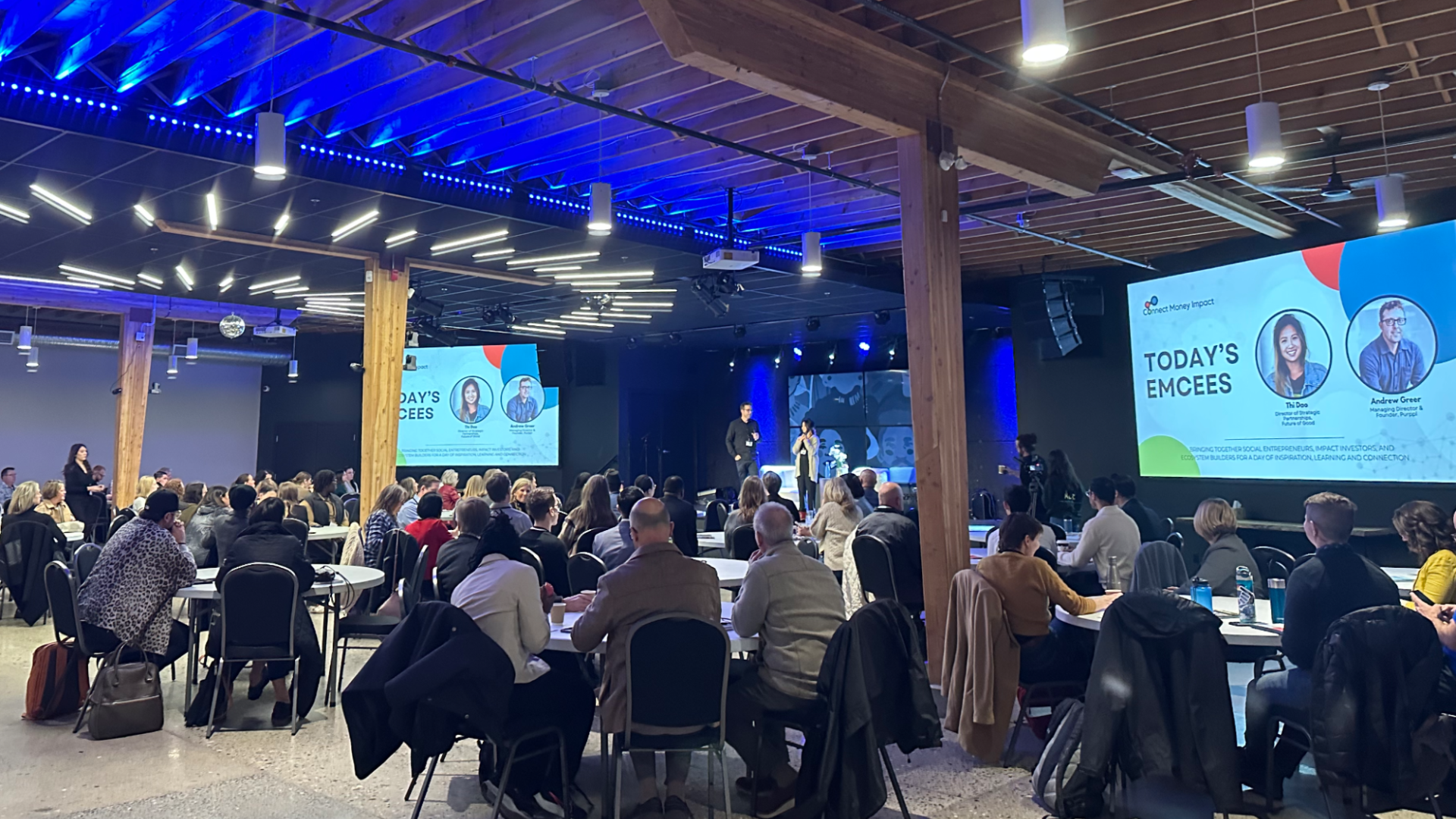
Thi Dao, Director of Strategic Partnerships at Future of Good, has lived on the unceded and unsurrendered territory of the Syilx Okanagan peoples, colonially known as Kelowna, BC. She and fellow Okanagan resident Andrew Greer, CEO and Co-Founder of Purppl, decided it was time to host honest, bold conversations for authentic and meaningful impact. Combining their passions for trusted journalism, deep partnerships, and social innovation, they partnered with Kristi Fairholm Mader, Director of Innovation and Initiatives at Scale Collaborative and made it happen.
There comes a time when it’s not enough to just talk about change but to make it happen.
Connect Money Impact was held for the first time in Kelowna, B.C., on Oct. 25 to find ways to impact the Okanagan.
Previously held in Victoria by Scale Collaborative, the Okanagan was the centre of a much-anticipated conversation, bringing together more than 150 changemakers across the B.C. interior to discuss capital, social innovation, and systems change for impact.
The event sold out and was the largest-known dialogue for social entrepreneurs, impact investors, and ecosystem builders in the Okanagan. It was a full day of honest conversation that sparked interest for more.
“The primary factor in making these events successful is people in a room with other people who share a desire to innovate, instigate, and inspire change,” said Fairholm Mader.
“Scale Collaborative has been convening the social finance ecosystem in support of social enterprises over a number of years. We were so excited to support our Okanagan partners in building on this success and making it theirs and their community’s own.”
As one of Canada’s fastest-growing regions, the opportunity to bring together leaders hungry for change was critical.
“With rapid growth, we can build a more just, regenerative economy or stand by and let widening inequity persist. I choose the former,” says Greer.
Canada is a vast country, which means there is an immense landscape in which to invest. Learnings from the Connect Money Impact can be applied to regions across the country, coast-to-coast-to-coast.
Here are five takeaways from the convening partners of Connect Money Impact.
1. Generations of people have centred deep relationships for their communities to thrive. Impact investors and social enterprises must prioritize and invest in meaningful and respectable partnerships to move forward.
Capital and growth tend to move at a fast pace. However, allowing space to move at the speed of trust is essential. Many small, deliberate steps of system change are anchored in trust cultivated over years, decades and even generations. They cannot be achieved without thoughtful consideration of the people we work with and who have been before us.
Pauline Terbasket, Executive Director of the Okanagan Nation Alliance, shared stories about Okanagan River Salmon Select, an example of the “slow lane movement.” It took more than 80 years and innovative partnerships to support the regeneration and restoration of Okanagan sockeye salmon from the brink of extinction to now providing fish to the people of the Nation and selling sought-after salmon products.
Indigenous social enterprises like this serve as examples of putting relationships with people and the planet at the centre of economic systems for true impact.
“There is so much more to share about our Okanagan salmon reintroduction story, of all the relationships built up, including cross-border with U.S. partners and relations,” said Terbasket.
“Syilx Okanagan members are also more and more interested in pursuing post-secondary education and technical skills training, so they see themselves in our own work and their own future, which is to protect, advance, and remain connected with our lands and our original foods, including ntityix, our salmon.”
2. Investments need to be distributed and governed by equity-deserving communities.
There is some serious reimagining and innovation happening in the social finance ecosystem. As increasing impact investment capital flows into the sector, there needs to be a shift in power, language, measurement and access to place significantly more capital in the direction of the women, BIPOC, and other leaders in communities leading social change in Canada.
Changemakers are noticing and responding. BIPOC-led organizations such as the Right Relations Collaborative and the Foundation for Black Communities are shifting money and power by reducing barriers and challenging investors to give authentic support rooted in community trust.
Funds like Thrive Impact allow investors to place capital deployment in the stewardship of a women-led fund. Currently, less than one per cent of all venture capital is deployed by funds led by women, which indicates deep system bias. These funds bring diverse perspectives to the entrepreneurial experience and are known to increase the capital invested in female-owned enterprises.
There is no shortage of BIPOC and women leaders inspiring this movement. But the reality is that there remains a substantial gap in the amount, the availability, and the structure of capital that can support them.
3. Changemakers are having and leading Bold conversations and solutions, and it’s time to be on board.
While a just, regenerative, and sustainable future might sound audacious, it’s happening. There is an unstoppable movement of people working day-in-day-out to make this future a reality, said Greer, even if it means questioning what has been traditionally and colonially done in the past.
Two questions surfaced between social entrepreneurs, impact leaders and investors throughout the day: What is working in the current system, and what is changing the current system? Even when things look bleak, innovation and regeneration are constantly taking place. Finding and nurturing these are imperative, and re-creating systems may not necessarily be the answer to everything.
Vinod Rajasekaran, CEO and Editor-in-Chief at Future of Good and keynote speaker, prompted us to shift our perspective on social change by asking, “What’s right with this picture?”
It’s an essential call to action for our times, to resist the dominant culture to buy or build anew and instead amplify what’s already working.
4. We need to ask ourselves what is “truly unownable?”
During the keynote conversation, Rajasekaran dropped an eye-opening question: “What is unownable?”
The question lingers today, challenging our notions of (private) ownership. At that moment, naming water, beaches, and forests was easy. But as the discussion evolved, we started to think more deeply about energy, housing, and more. What should not be owned by someone but held for community or public benefit?
This question calls in Indigenous teachings on ownership – a responsibility to future generations rather than something you own for yourself. How can we vastly expand what is collectively, community, and publicly owned?
Wealth generation is often connected to ownership. However, increasingly, the questions of ‘who gets to own’ and ‘what is actually ownable’ invite a re-think for changemakers.
5. People built these systems, which means people can change them, too.
The power of community is often underestimated, which was successfully demonstrated by Connecting the Dots, the highest-rated session for the third year in a row. This session allowed changemakers to engage in three 20-minute one-on-one conversations with peers that the organizers carefully and thoughtfully matched the evening before.
This space was deliberately curated for attendees as it showed how taking the time for deep and meaningful connections can advance critical work.
“It was like icing on the cake,” shared Kelly Terbasket, Program Director at IndigenEYEZ.
“I loved the three people you picked for me. Thank you so much. Wow. I feel very supported. I loved the process. I can’t believe how much we did in one day.”
Changemakers in all spheres need to make space and take space for community engagement, as it is these relationships that will allow us to amplify and strengthen solutions that work rather than stay stuck in pervasive scarcity.
The social sector is brimming and flourishing with hope, and the collective impact of small, deliberate steps taken by many in the movement builds a feeling that if people made these systems, people could change them, too.
The social economy embraces diverse leaders and organizations dedicated to building a just, regenerative economy. It demonstrates that as long as you’re willing, you have the power to be a part of an ever-growing ecosystem in the sector.
Looking for some hope? Here are a few folks taking steps to build a different future:
Clubhouse Childcare bought a farm to ground the leaders of tomorrow in today’s soil. Okanagan Nation Alliance built a salmon company to restore the habitat and feed the people. Home sharing through a non-profit platform like Happipad. Middle school students are building a social enterprise that plants mini-forests of indigenous plants. IndigenEYEZ helps settlers build relationships with Indigenous people and places. Propolis Housing Co-operative is running the first community bonds campaign in Western Canada to finance an affordable, net-zero housing co-op. Islamic Family & Social Services is building trauma-informed software that centres the needs of social workers and the folks they work with, rather than software built for a business relationship. Elevation Outdoors rents bikes to fund their youth programs. And Genus built outperforming investment funds without fossil fuels.
Hope is an act of resistance in the face of crisis. You’re welcome in this movement and have a role to play.
Connect Money Impact will happen again in the B.C. interior. Look for smaller gatherings that create space for relationships, action, and hope.
Your job. Your mission. Your news.
With your support, the sector you're building gets the journalism it deserves, and you get a tax receipt.

Related Articles
Case Study: Kingston’s food bank pilot combines three innovative solutions for food insecurity
Carney’s National Food Strategy includes boosting local food production. Pilots are already deployed. The federal strategy is arriving to meet it, not lead it.
How foundations responded to the 2004-2005 disbursement quota reduction – and why it matters now
Research from Carleton University, based on foundations’ T3010 data between 2000 and 2017, tells a story of how foundations adjusted their disbursements when the disbursement quota was reduced from 4.5 per cent to 3.5 per cent.

Explainer: What Realize Fund I’s final close says about the state of Canada’s social finance
Ottawa bet $400 million that public capital could build a private market for Canada’s social economy. Realize Fund I’s $276.7M close is the first real test.
