This new impact investing initiative aims to tackle Canada’s most pressing challenges. What’s their plan?
Impact United plans to “mobilize billions in capital” to address everything from climate change to inequity.
Why It Matters
The aftermath of COVID-19, along with ongoing systemic racism, will require hefty investments in everything from public health to community economic development. Impact investment is one way to do that, but some leaders say there isn’t a lot of coordination among investors themselves.

Impact United, a new initiative backed by ten major Canadian organizations, is promising to guide billions of dollars worth of impact investments towards causes as diverse as climate action, housing affordability, and racial equity.
The initiative brings together foundations like the Inspirit Foundation and WES Mariam Assefa Fund, investors like finance cooperative Vancity, and even the Canada Mortgage and Housing Corporation to bridge a gap between prospective impact investors and investment opportunities. A statement announcing Impact United’s debut says current and prospective impact investors capable of tackling Canada’s most pressing challenges are disconnected from one another and uncoordinated in their approaches.
Despite its lofty vision of mobilizing billions in capital, the initiative is still very much a work in progress. It does not yet have a set target on how much money it intends to mobilize or a formal accountability mechanism to ensure its members actually get involved in impact investing — apart from a public pledge that won’t be launched until fall 2021.
“There aren’t a lot of substantive goals around it at this point,” says Richard Muller, senior advisor and peer leader at Impact United, in an interview with Future of Good. “But I think we have to start with basically finding a common community that’s interested and explore ways to get traction with that community.”
Impact investing is a rapidly growing method used by investors in Canada to balance social and environmental improvements alongside financial returns. According to data from the Responsible Investment Association, reported impact investments in Canada have grown from $3.8 billion in 2012 to a whopping $20.3 billion in 2019. At the federal level, the $755 million Social Finance Fund also offers some serious fiscal firepower to Canadian charities, non-profits, and social purpose organizations.
“Canada is one of the top countries for social entrepreneurship, and for an impact economy,” says Andrew Chunilall, CEO of Community Foundations of Canada, one of Impact United’s members. “And I also feel that it’s a part of our economy that’s overlooked, generally, but also undercapitalized.” He believes Impact United’s goal of bringing together a broad range of potential impact investors will strengthen Canada’s impact economy overall, especially when it comes to actually securing capital. “It’s marrying the capital holders to where capital is needed,” Chunilall says of Impact United’s aims.
Investors who join Impact United will be able to participate in one of the initiative’s “communities of practice”, focus areas that include climate action, affordable housing, Indigenous economic development, and diversity, equity and inclusion (DEI). Adam Spence, CEO of SVX Canada — the non-profit financial services firm hosting Impact United — explains that members with experience in a particular community of practice “bring their resources and seek to organize communities around those areas of focus as a movement, as opposed to a membership or governed body.”
Monica Munn, managing director of philanthropy at WES — whose Mariam Assefa Fund is a member of Impact United — says her organization is excited to meet more funders who care about immigrant and refugee communities in Canada. “The more we get to meet them, the more opportunity there is to collaborate,” she says, “but we’re also really excited to bring others into that fold and create opportunities for folks who might be really excited about economic inclusion — and do that really broadly in Canada.” As an organization focused on immigrants and refugees in both the U.S. and Canada, WES Mariam Assefa Fund is one of the co-leads on Impact United’s DEI “community of practice.”
The other is the Inspirit Foundation. Jory Cohen, the foundation’s director of finance and impact investment, says Inspirit is really interested in a project around advancing racial equity within the investment management sector. While Cohen says the project’s scope isn’t fully done yet, he described it as an attempt to get investment managers big and small to create diversity frameworks within their organizations. “We think Impact United could be a really good medium to engage as many impact investors as possible,” Cohen says.
Impact United says 75 participants are already sharing ideas on how to collaborate through their online platform. On June 22, “United for Climate Action”, the initiative’s first public event, will offer potential investors the chance to explore the possibilities around climate action investing. Attendees will hear case studies on climate justice investing and a presentation from Low Carbon Cities Canada, a partnership focused on reducing greenhouse gas emissions in cities, on urban climate solutions. Impact United will also be hosting other events on the initiative’s three other “communities of practice”, too.
Muller says Impact United will also offer an event series to give investors the chance to speak with founders and entrepreneurs in Canada about their ventures. Each event includes a panel of experts to offer constructive feedback to the ventures themselves. Meanwhile, Spence says participants will also have access to SVX’s suite of programs and events as a way to connect with impact funds, organizations, and enterprises.
What Impact United currently lacks is a concrete strategy on how it intends to move the needle on impact investing in Canada, aside from running events and its online community platform. The initiative launched publicly with no stated financial targets, no hierarchy or governance structure (apart from the various “communities of practice”) and no public pledge. “They seem to have a bottom-up approach as opposed to top-down,” says Éric St-Pierre, executive director of the Trottier Family Foundation, another Impact United member. “It seems that the foundations that are already involved will help co-create what this becomes.”
However, Munn believes launching Impact United with a uniform target for all four “communities of practice” would have been far too cumbersome an approach. “Rather than having a preset and overly simplified set of how we measure success, I think our goal is to be a lot more intentional and bottom-up in how this gets created,” she says.
Muller, the senior advisor and peer leader at Impact United, says potential impact investors in Canada could benefit from expanding their networks and learning more from others. As someone with a decade of experience as an impact investor, he says his connections and confidence could keep him afloat without help. That isn’t always the case for first-timers. “A lot of people understand why it’s important to think of their capital that way, but they struggle with how they can actually move forward,” Muller says. “We’re appealing to those people to say — join with us.”
Your job. Your mission. Your news.
With your support, the sector you're building gets the journalism it deserves, and you get a tax receipt.

Related Articles
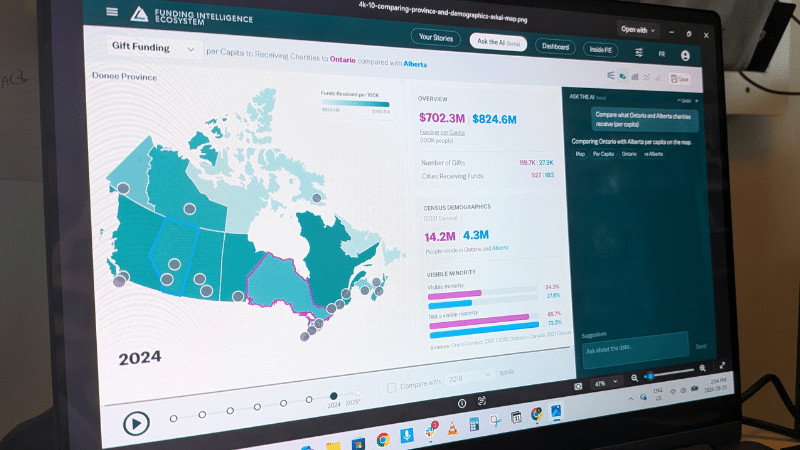
Imagine Canada launches visual tool to ‘see’ non-profit funding landscape
A new data visualization tool designed to let funders, non-profits and researchers understand the entire non-profit funding ecosystem
Ottawa chooses Canadian Housing Acquisition Fund to manage $1.5 billion affordable housing money
The massive new fund will help grant Indigenous, cooperative and non-profit housing providers easier access to capital to help buy and develop homes for lower-income Canadians.

New donation platform to help communities directly pay down mosque debt
Own Your Masjid is a project of boutique marketing agency Process Plus Marketing
