Inflation has pushed some non-profits to their “lowest point” ever; can they survive?
Core inflation hit a 40-year high this summer and nearly 60 per cent of Canada’s charities say demand for their services have outstripped their capacity to deliver
Why It Matters
As the cost of living climbs, more and more Canadians are turning to non-profits and charities for shelter, support, food and transportation. Without stable funding, these community services organizations may not be able to deliver.
 This story is part of a special report on the effects of inflation on social purpose organizations and the communities they serve. Stay tuned for more reporting on this.
When Cherise Giesbrecht answers the phone, she’s pretty confident about what she’ll hear on the other end of the line.
“Moms contact us because they can’t pay their rent, they can’t afford groceries,” says the executive director of Moms Canada. “They’re saying things like, ‘I was on a tight budget before and now I can’t keep that same budget, because prices have gone up so much.’”
The 13-year-old non-profit was founded with the aim of providing emotional support, mentorship, financial literacy and fellowship to single mothers. But over the last year, it’s seen a surge in the number of women it refers to social services and charities aimed at helping people make ends meet.
And it’s not only clients feeling the pinch, Giesbrecht says Moms Canada is also struggling under the weight of inflation. “We are, as an organization, probably at the lowest point that we’ve ever been financially.”
They’re not alone.
Across Canada, post-pandemic inflation has left non-profits struggling to meet a growing demand for services — all while seeing operational costs rise and donations fall.
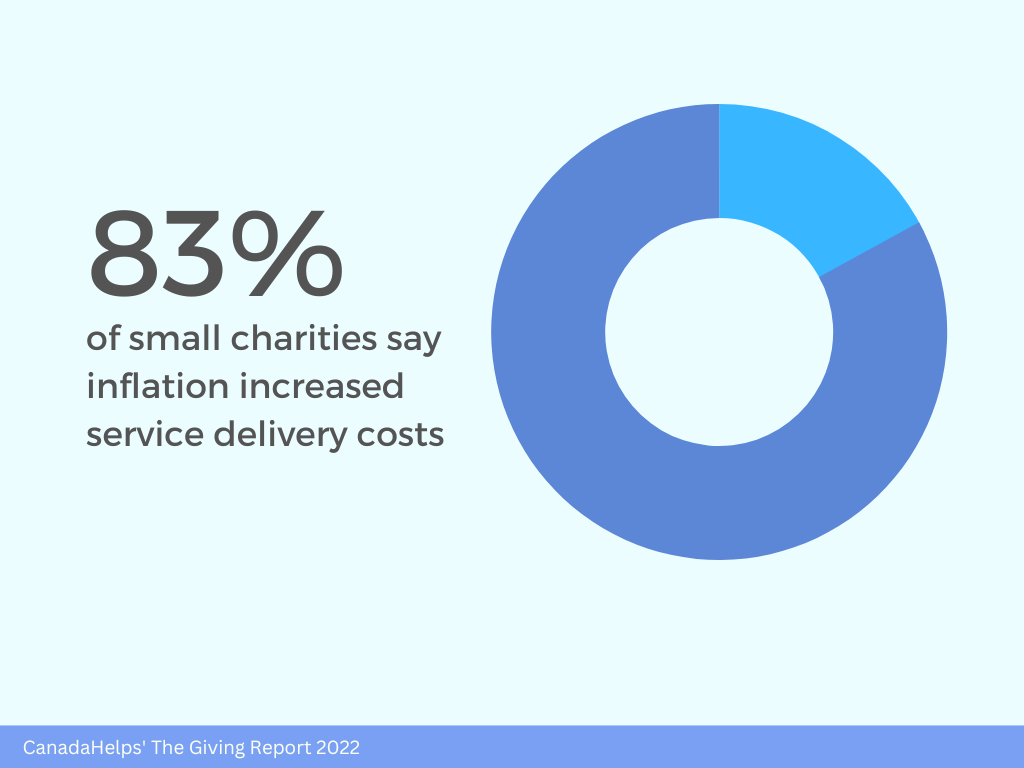
A recent CanadaHelps survey found inflation has increased service delivery costs for 83 per cent of small charities, while a further 59 per cent say demand for their services now exceeds their capacity to deliver.
“You can only move, reallocate, squeeze, change and ration to a point,” says Andrea Hesse, executive director of the Alberta Council on Disability Services, an umbrella organization for community disability service providers in that province. “It’s getting to a really critical point.”
Core inflation peaked at a 40-year-high of 8.1 per cent in August of this year, pushing the cost of fuel, food, housing and other essentials sky-high. And while inflation dipped to 6.9 per cent the following month, relief is not on the horizon.
“We’re hearing from our members that their own sustainability and ability to deliver services is really at risk due to inflationary costs,” Hesse says. “Thirty-seven per cent said they felt that was a high risk and another 30 per cent felt that was a moderate risk in the very short term due to inflationary impacts”.
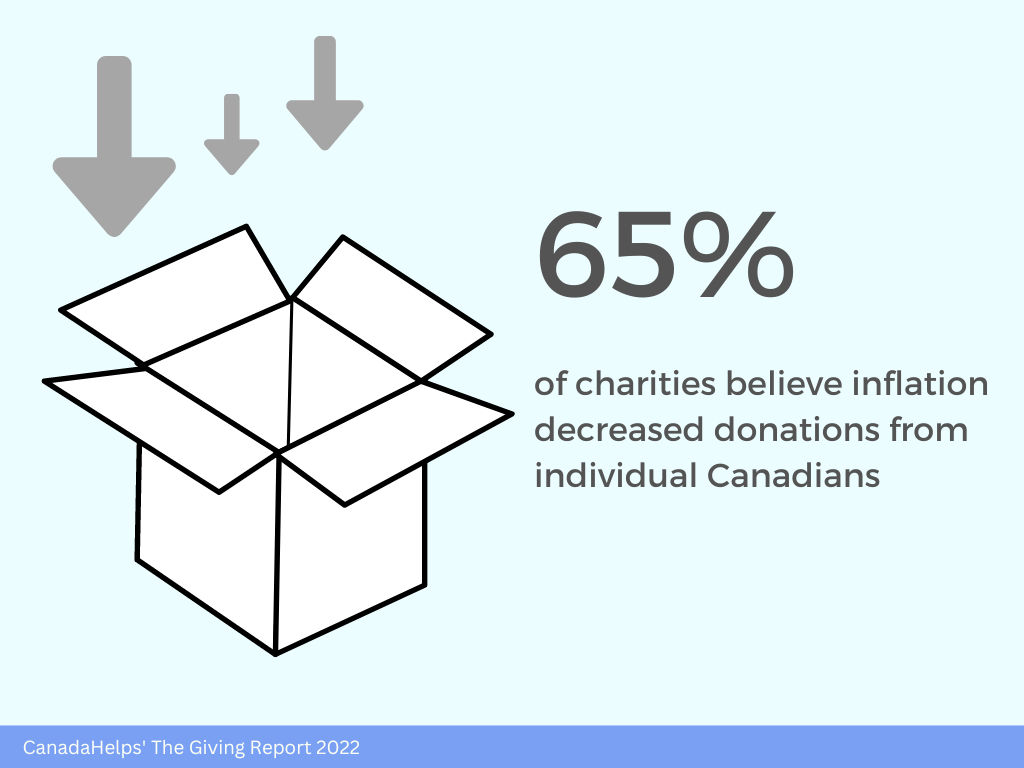
This greater demand for services has coincided with a drop in giving. A survey released by the Angus Reid Institute found 27 per cent of respondents planned to cut back on charitable donations as a direct result of inflation. According to CanadaHelps, 65 per cent of charities believe inflation has decreased donations from individual Canadians.
Shannon Craig, chief marketing officer at CanadaHelps, says while inflationary pressures have softened giving at times, it seems to be sporadic, followed by donation surges tied to particular disaster related appeals. “For us, this is a really crazy year.”
Overall donations on the charity platform were down by 11 per cent in July and August, but rebounded in September as Canadians responded to hurricane Fiona. Russia’s war of aggression in Ukraine, and the corresponding humanitarian crisis, has also been a driver of donations through the platform.
“But the actual average amount being given to charities is down,” says Craig. “It’s really the response to some of these humanitarian crises that is kind of getting us to where we would expect to be year over year … it’s shielding some of what’s going on with the average charity, which is ultimately bringing in less.”
That rings true with what Giesbrecht has seen over the last 10 months.
“A lot of donors have stopped donating due to inflation, or they’re pulling back or decreasing their donations,” she says. “And yet the need is only going up.”
At one time, Moms Canada had an office and three paid staff members. Today, Giesbrecht — a single mom herself — runs the charity out of her home and relies entirely on volunteers. Searching out low-cost spaces where the organization’s support groups can meet in-person is an important part of her job.
“Generally, we find churches are willing to let us, maybe, use their space to meet for free, which is huge because we can’t afford to keep renting,” she says.
But finding time to stay on top of a myriad of government programs and evolving resources in the non-profit sector, something Moms Canada needs to do to appropriately direct its clients, is more of a challenge. “With the reduced funding that we have for our budget it is difficult, because we don’t necessarily have as much time to research,” Giesbrecht says.
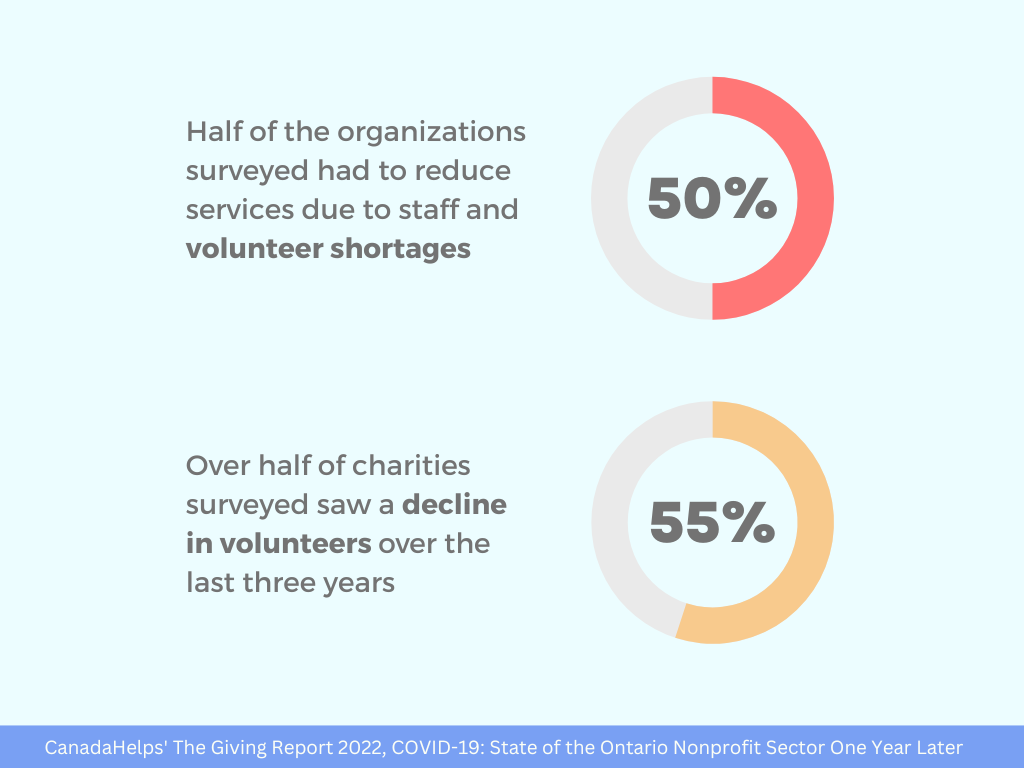
According to CanadaHelps, staff burnout is a major concern among charities as resources dwindle; 55 per cent of those asked saw a decline in volunteers over the last three years, while the inability to offer employees inflationary wage adjustments has led to retention challenges. And salaries in the non-profit sector were already lower than those in for-profit industries, even before inflation spiked this year, Craig notes.
A survey conducted by the Ontario Nonprofit Network this summer found 65 per cent of respondents had challenges with recruitment and retention in the last year. Half of the organizations surveyed have also had to reduce services due to staff and volunteer shortages — even as 74 per cent of those asked said demand for their services had increased over the same period.
Hesse says financial pressures, especially when core services are at risk, can create tension within a non-profit’s governance structure, between staff and directors, or with volunteers. “It certainly doesn’t make for positive workplaces and it certainly significantly impacts the retention and attraction rate,” she says.
Craig says the first response of many charitable organizations facing financial difficultly is to double down on major donors, but focusing too heavily on a few revenue sources can also create problems. “We know when times are tough, charities that can navigate best are those (circumstances) are those that have a diversified revenue strategy.”
Charities that have major donors, as well as smaller, mid-level donors — while still being able to engage first-time contributors — are most likely to weather the inflationary storm. However, smaller charities may not have the fundraising capacity to launch new or expanded donation drives, Craig notes.
Giesbrecht holds out hope that Moms Canada will pick up momentum, but it’s been a tough slough, especially when it comes to competing for attention on social media, which is flooded by content and appeals for assistance.
“I’m very passionate about single moms’ emotional support, I think that’s so important. And to be honest, there’s not a lot of programs that are specific to that,” says Giesbrecht. “I truly believe there’s a lot of potential … we just have to figure out the best way to harness it.”
Your job. Your mission. Your news.
With your support, the sector you're building gets the journalism it deserves, and you get a tax receipt.

Related Articles

Partnered Partnered content How construction contracts became the blueprint for social change in Manitoba
Manitoba is a leader in social procurement, with decades of partnerships among government, businesses and social enterprises that have shaped a model other communities can learn from.

Fires and floods: How Canada’s non-profits are responding to summer disasters
Several organizations have set up ways Canadians can help as more than 900 wildfires burn across the country

New “endings” hotline to help the social sector with closures, insolvency and succession
Ever / Was is run by a collective of navigators seeking to destigmatize closures and endings in the Canadian social purpose sector.
