Laughing matter: How humour offers new hope in the midst of the climate crisis
People who get information with a dose of comedy understand it better and may also remember it longer.
Why It Matters
The climate crisis threatens humanity’s very existence, yet people often resist adapting to the realities of a changing world. Humour has the power to start tough conversations and drive social change.

Esteban Gast. Photo: Andrew Max Levy
Lexa Graham jokes it was the chemical burns she got at university that gave her the thick skin she needed to go into stand-up comedy.
But a Master’s degree in chemical engineering also gave the Toronto-based comedian, writer and tutor something else — the ability to weave meaningful information on climate change into her humour.
“When it comes to climate change, you have to meet people where they are,” she says. “And comedy can be a really great way to do that.”
Graham, who has written for CBC Comedy and Reductress, is the creator of the DNAtured Journal, a satirical publication that parodies mainstream science reporting with headlines like: “World Leaders Pledge to Replace Earth Hour With Earth Moment of Silence by 2050.”
She’s not alone; Graham is part of a growing number of artists and performers who see humour as an effective way to tackle the climate crisis.
Saturday Night Live’s Aidy Bryant plays the recurring character of Mother Earth, who describes herself as “hot and pissed,” while Funny or Die has tackled the issue with a spoof pharmaceutical commercial for “Climate Change Denial Disorder.”
This Hour Has 22 Minutes, which airs on CBC, regularly addresses climate change with sketches like “Sunburnt at a Funeral,” and stand-up comedians went all in for the Ain’t Your Momma’s Heatwave special released in 2021.
None of this surprises Aaron Sachs, author of Stay Cool: Why Dark Comedy Matters in the Fight Against Climate Change.
“Comedy can be really, really good as a communication strategy,” he says.
“Maybe, if we talked to people about climate change with more of a sense of humour, then we could get people to accept the reality of climate change and help do something about it.”
It’s also a long-established coping mechanism, he adds.
Yes, the climate crisis is at a critical juncture —the European Union Climate Change Service says 2023 is on track to be the hottest year on record, and a United Nations report released this spring warned of “catastrophic warming” — but Sachs says when despair sets in, so does paralysis and inaction.
Even during some of the darkest points in human history, such as the trans-Atlantic slave trade and the Holocaust, humour was used as a survival mechanism, he says.
“Dark comedy acknowledges how awful the situation is that you’re in, and then sort of goes on to be kind of activating,” Sachs says. “It kind of spurs us to be resilient, to persevere, survive, band together, feel solidarity, you know, maybe gain some purchase on a really difficult situation and, hopefully, figure out ways to improve it.”
Most North Americans now believe climate change is both real and human-caused, although a poll conducted by Leger this summer found Canadians are far more worried about climate change than their southern neighbours. Seventy-two per cent of Canadian respondents said they were either worried or very worried about climate change, compared to about 58 per cent of Americans.
However, concern doesn’t always translate into action — something some environmental organizations are trying to change with targeted, comedy-centred campaigns promoting climate action. A few non-profits are going as far as to train comedians on how to incorporate climate content into their routines, including Generation180.
“There’s a wide body of evidence that points to comedy as being uniquely persuasive and compelling when it comes to communicating about serious issues,” says Kay Campbell, director of communications for the U.S.-based charity.
“It’s not only effective at getting people’s attention and getting them to think differently, open their minds, but it’s also linked to greater engagement.”
Learning from the experts
Generation180 partnered with the Center for Media & Social Impact’s GoodLaugh initiative to create the Climate Comedy Cohort two years ago. It brings nine comedians together for a nine-month fellowship yearly to learn about climate change and climate solutions while workshopping material that “flips the script” on the climate change narrative.
Participants meet with climate experts from the United Nations and journalists like David Roberts, who reports on clean energy, climate advocates, policymakers, researchers and many others. They already know how to be funny, Campbell says, but the fellowship gets them up to speed on crucial facts and information they can share with their audiences while also entertaining them.
“It’s quite a diverse group (of comedians), including binary, non-binary, hetero, non-conforming identities, as well as, racially diverse, because part of our goal is to reach different audiences and new audiences who just aren’t hearing about this,” says Campbell.
Each comedian must also produce a certain amount of video content, which Generation180 promotes through various partner organizations.
“The idea is that they’re creating content that helps normalize this stuff and really get people thinking,” she says.
Esteban Gast is the program’s comedian-in-residence and says his title implies a certain level of boldness around the program’s objectives. “My goal is to make people laugh, I really view comedy as a service, and I’m a comedian first,” he says. “But comedy is also an incredible vehicle for sharing information.”
Because comedians tend to travel, and comedy is so disarming, Gast says it can reach demographics that might be resistant to climate information in other settings.
“I used to live in Lincoln, Nebraska, and if I went back and said, ‘Hey, do you want to come see a show on climate science?’ Not many people are going to show up. But, if I said, ‘Hey, do you want to come see comedy?’ Then a bunch of people come out, and you’re reaching an audience that might be tougher to reach with this stuff,” he says.
Some of the information he incorporates into his stand-up comedy is broad, like the history of the term “carbon footprint,” a phrase coined by a marketing firm working for British Petroleum in 2004 to shift responsibility onto individual energy consumers and away from big oil.
Other information is very specific, like that the United States Inflation Reduction Act contains a heat pump rebate.
Gast, whose work was called “irreverent but aspirational” by Variety Magazine, also hosts a podcast called Comedians Conquering Climate Change and hopes to continue to broaden the impact humour has.
“I try to make my work really relatable,” he says.
But sometimes, the audience is closer to home.
Back in Toronto, Graham says she also uses humour when she talks to friends and family about climate change. It’s a way to take the edge off of issues some people see as controversial and translate complex scientific concepts into plain language, she says.

Lexa Graham performs in Toronto. Photo: Courtesy of Lexa Graham
“I have people in my family who are on the opposite side of several spectrums from me,” says Graham. “But we use humour, that’s our primary way of dealing with that.”
She also works to include context that makes climate change more relevant to her audiences, whether she’s performing a stand-up routine, writing satire or tutoring a math student. Graham says if science was better taught in Canadian schools, people would have a stronger basis for understanding what’s driving the climate crisis.
“I find that schools kind of strip a lot of the interest and relevance out of science, and it’s all just math, math, math,” she says. “Half the time when students come to me, they don’t have a functional understanding of what’s going on, of why something matters.”
While the DNAtured Journal is purely satirical, Graham and the writers she works with include links to actual news stories on climate change and other scientific matters throughout the website, giving readers the opportunity to learn more along the way.
The science behind the laughter
Studies show humour increases a person’s ability to retain new information, including a 2007 poll conducted by the Pew Research Center that found respondents who watched satirical news programs remembered more than respondents who read newspapers or consumed cable news.
“I’ve studied a lot about neuroscience and memory as well,” Graham says. “And a lot of how we make things memorable is tied to the idea of surprise, and humour is, in a lot of ways, the art of surprise.”
Bingbing Zhang, an assistant professor at the University of Iowa, has researched the effects of climate change memes — usually images or videos overlaid with text — on civic engagement. She found both high and low-humour memes seem to increase a person’s interest in participating in climate campaigns.
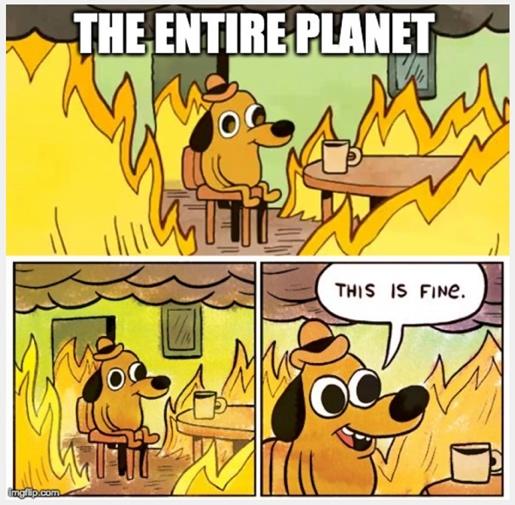 “So we know there are short-term effects, but next, it would be interesting to know how long that effect lasts,” Zhang says.
Climate change humour is not without risk, though, says Sachs. It can be unpredictable and lands differently with different people, depending on a host of factors running the gambit from age to mood and context, he says.
“In the scholarship on dark humour, there have been plenty of people who have labelled it as mostly fatalistic or even nihilistic, so that is a risk,” Sachs says.
“Different people are going to produce dark comedy that could sound fatalistic to some ears and could sound fun and real and helpful to other ears.”
But overall, the eight years the Cornell University professor spent researching humour and climate change left him more optimistic about the future.
“In many ways, we are living in very, very dark times, and I don’t mean to diminish that at all but I feel extremely hopeful right now compared to where I was a few years ago,” Sachs says.
Your job. Your mission. Your news.
With your support, the sector you're building gets the journalism it deserves, and you get a tax receipt.

Related Articles

Canada’s Sustainable Finance Taxonomy: What it is, what is happening and what’s coming next
Canada’s sustainable finance taxonomy faces big challenges, from oil and gas, Indigenous rights and the real meaning of the word ‘transition.’

Q&A: Climate action, community resilience begins with who owns our economy, Jon Shell says
Canada can’t tackle climate resilience until it confronts who owns its economy, and how inequality is rising.
Indigenous people bear brunt of climate change disasters: StatCan
New data from Statistics Canada shows that, despite only representing five per cent of the population, just under half of wildfire evacuations in 2023 were from communities where more than half the population was Indigenous.
