More than half of Ontario non-profits scaled back services in 2024, amid inflation, revenue stagnation: Report
The big risk is that people in power become numb to reports with findings like these says a charity researcher.
Why It Matters
A new report offers insight into the share of Ontario non-profits struggling and the cause of their troubles. It also offers policy solutions.

Workers unload food from a truck. (Ian/Pexels)
Heather Kirby worries that her organization may soon have some difficult decisions.
She’s the executive director of Kawartha Lakes Food Source, a charity distributing necessities to nine food banks across Central Ontario. However, the organization’s revenue is no longer keeping up with increased service demands.
She said the charity did just fine during the early pandemic. The government provided emergency funding, and the organization received a boost from individual donors, other charities, and service clubs.
But that temporary increase is gone. Kirby said service use is up compared to pre-pandemic, but revenue has flatlined.

Heather Kirby, executive director of Kawartha Lakes Food Source, said demand for the charity’s services is outpacing the organization’s revenue growth. (Heather Kirby/Supplied)
“We’re in a position where we are going to have to be making decisions of: Do we give out less food?”
If the charity is forced to do so, it won’t be alone, according to a new report from the Ontario Nonprofit Network.
In 2024, 56 per cent of non-profits reported scaling back programs or services—a 17 per cent increase from the year prior.
In addition to reducing program capacity, 33 per cent of non-profits said they increased program or service waiting lists over the past year, and 12 per cent reported discontinuing programs or services.
The report’s findings are based on a survey conducted by Environics Research for ONN, which was completed by more than 1,000 non-profits.
What’s driving program cuts?
Nonprofits don’t appear to be choosing to scale back programs by choice; instead, they’re being squeezed, according to the report.
In 2024, 55 per cent of the non-profits that participated in ONN’s survey reported stagnant or declining revenue.
Meanwhile, 84 per cent reported increased expenses, and 83 per cent reported a rise in demand for programs and services.
“The math isn’t mathing,” said Pamela Uppal-Sandhu, ONN’s interim co-executive director.
Charity researcher Steven Ayer said he expects the tough times to continue for at least several more years.
While inflation has come down in Canada, salary expectations among workers have not, he said.
Many charities may have decided not to increase wages during the pandemic but now face workers’ expectations to do so, he added.
In the ONN survey, 76 per cent of non-profits said their salary and benefit expenses increased in 2024.
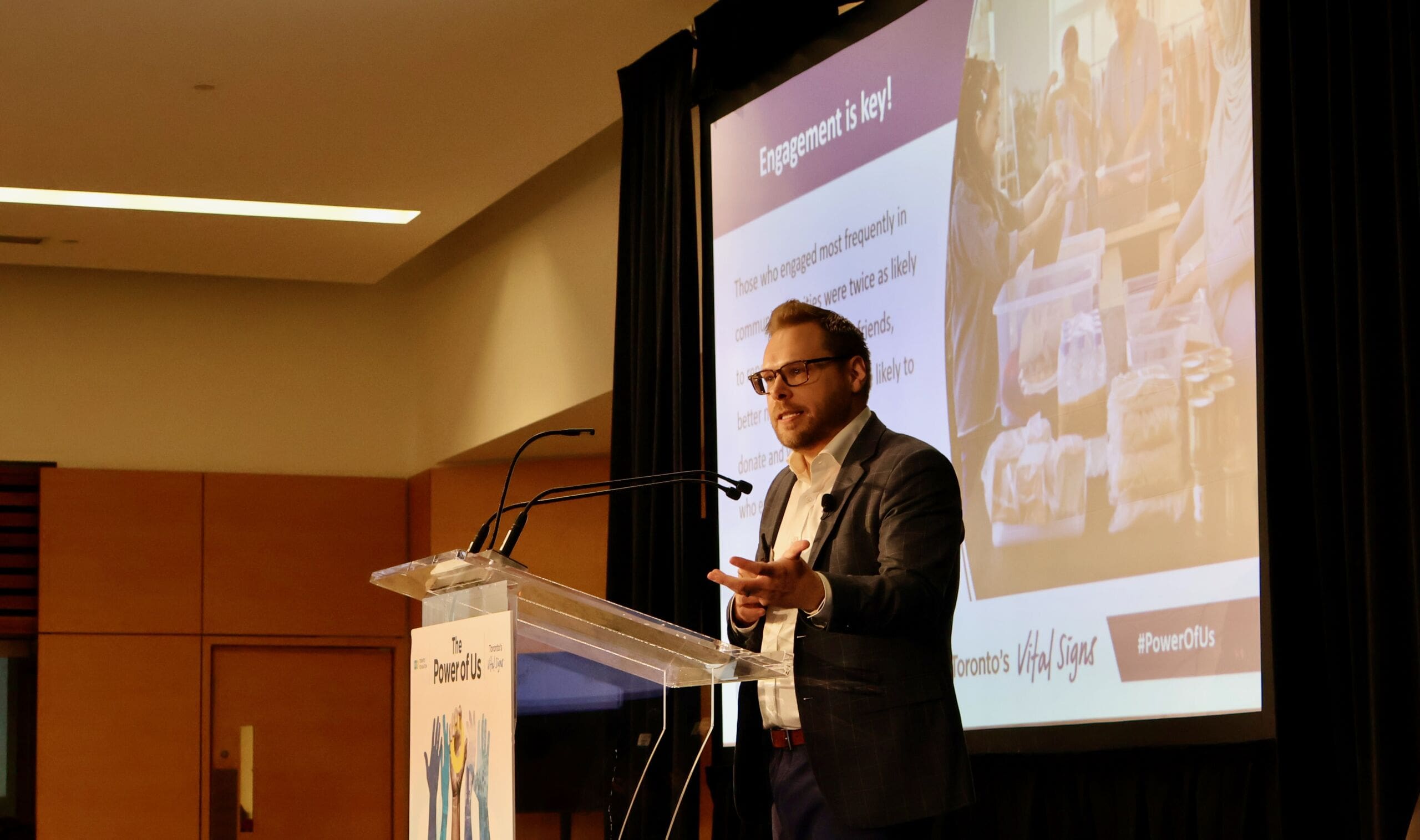
Charity researcher Steven Ayer speaks at the Toronto Public Library on Nov. 15, 2023. Ayer said the challenges non-profits are facing may persist for several more years. (Gabe Oatley/Future of Good)
Immigration-driven population increases are also stressing non-profits’ capacity, said Ayer.
Canada’s population increased by about nine per cent (3.2 million) between 2020 and 2024, according to Statistics Canada population estimates—from 38 million to about 41 million.
If absolutely nothing else had changed over the past three years, population growth alone would have significantly increased demand for charitable services, Ayer added.
While service demand and expense increases aren’t inherently bad, they cause problems when revenue doesn’t increase in step.
Government transfers form the largest portion of revenue to the non-profit sector, comprising more than two-thirds of all revenue (69 per cent) in 2021.
State funding for the sector has continued to grow over the past several years, but Ayer said it has not kept pace with increases in expenses and service demands.
Policy demands from the ONN
To help organizations cope, the Ontario Nonprofit Network is calling on the Province of Ontario to institute base funding increases for non-profits that reflect the actual cost of delivering services and inflation.
Wenjue Knutsen, an associate professor at Queen’s University who studies non-profits, said raising funding in tandem with inflation makes sense.
When inflation is up, governments collect more tax revenue into their coffers, she said. “I think that’s a reasonable request.”
ONN also wants the province to create a home in government for the sector—an associate minister within the Ministry of Economic Development, Job Creation and Trade who would champion charitable organizations, said Uppal-Sandhu.
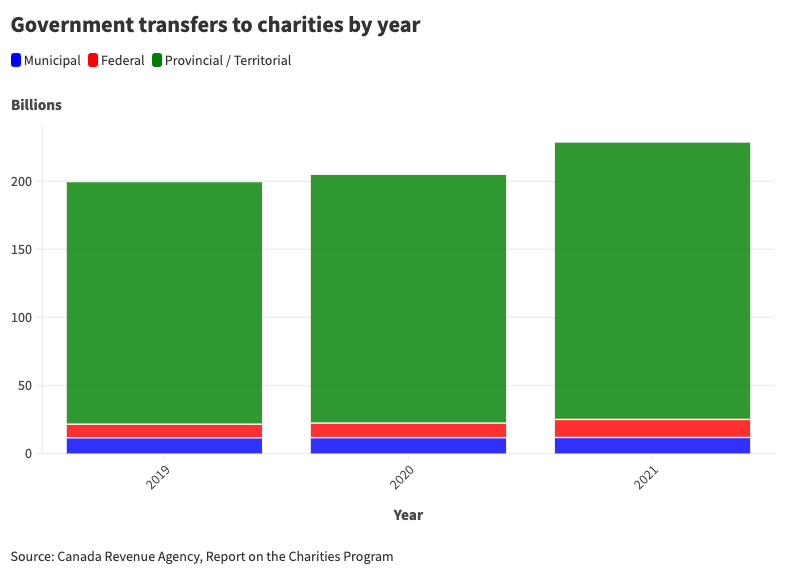
Provincial and territorial transfers comprise the bulk of government funding to the charitable sector. Between 2019 and 2021, charities received increased provincial and territorial funds to support COVID-19 spending needs. (Graphic: Gabe Oatley)
This would fill a “gap in provincial leadership” around the health of the sector and would also help reduce inefficiencies and administrative burdens for both non-profits and the government, she added.
The idea is not without precedent.
In 2021, the government of British Columbia appointed a parliamentary secretary for the non-profit sector within the Ministry of Social Development and Poverty Reduction. Newfoundland and Labrador appointed a minister for the community sector within the Ministry of Children, Seniors and Social Development the same year.
Knutsen said the idea makes sense in principle but may deliver less than hoped.
Unless the non-profit-focused ministry has specific funding to allocate, it may not be able to solve many problems, she said.
Sector red alert
For charity sector hawks, the challenges highlighted in ONN’s latest report won’t come as a big surprise.
For several years, the organization’s state of the sector reports have raised concerns about rising service demands, the impact of inflation, and flat-lining revenue.
This ongoing bad news may, too, be a challenge for the sector, said Ayer.
“The risk when you see results like this is that the folks who might be able to influence it start to get numb.”
In addition to calling on the government for help, the ONN report also encouraged non-profits to be louder about the benefits of their work with funders, community members, and service users.
“Make it clear to communities and government the breadth, depth, and value of the sector and the sector’s ability to provide high-quality and affordable publicly-funded services,” said the report.
‘Canary in the coal mine’
Pre-pandemic, Kawartha Lakes Food Source provided food for about 800 or 900 clients per month during the summer and about 1,300 per month during the winter.
Over the past year and a half, the charity has seen an average of about 1,400 clients per month, with no summer dip and no sign of a plateau in demand, said Kirby.
The charity’s member food banks typically give clients about four to seven days worth of food per month.
If the food distribution charity isn’t able to raise more money in the coming year, the amount of food offered to clients will have to decline, she said.
The charity’s team is doing everything possible to avoid this, beefing up communications and donor asks and ensuring funders and supporters know about the need. “But it is all weighing on us,” Kirby said.
“I’m very proud of the ideas and the energy and the effort and the compassion that staff are doing every day…[But] we can’t do anymore than what we’re doing.”
Your job. Your mission. Your news.
With your support, the sector you're building gets the journalism it deserves, and you get a tax receipt.

Related Articles

Case Study: Kingston’s food bank pilot combines three innovative solutions for food insecurity
Carney’s National Food Strategy includes boosting local food production. Pilots are already deployed. The federal strategy is arriving to meet it, not lead it.

How foundations responded to the 2004-2005 disbursement quota reduction – and why it matters now
Research from Carleton University, based on foundations’ T3010 data between 2000 and 2017, tells a story of how foundations adjusted their disbursements when the disbursement quota was reduced from 4.5 per cent to 3.5 per cent.

Explainer: What Realize Fund I’s final close says about the state of Canada’s social finance
Ottawa bet $400 million that public capital could build a private market for Canada’s social economy. Realize Fund I’s $276.7M close is the first real test.
