New CanadaHelps report shows charitable sector at a ‘tipping point,’ facing inflation, staff burnout, lower volunteerism
55 per cent of charities surveyed for a new CanadaHelps report said they have fewer volunteers now than before the pandemic.
Why It Matters
As a result of inflation and ongoing pandemic-related struggles, more Canadians are turning to Canada’s network of 86,000 charities for support. But for some organizations, a quadruple whammy of high staff burnout, fewer volunteers, higher cost of goods and services, and lower donations, is making it tough to keep up with the pace of the need.

Staff of MealShare, a Calgary-based food charity pose for a team portrait. Later this month, the charity will see its headcount reduced by half, and by June, all staff will be let go.
This journalism is made possible by the Future of Good editorial fellowship covering the social impact world’s rapidly changing funding models, supported by Future of Good, Community Foundations of Canada, and United Way Centraide Canada. See our editorial ethics and standards here.
At the end of this month, Mona Pinder’s charity will close up shop for good.
Pinder is the executive director of MealShare, a Calgary-based charity that partners with restaurants to provide meals to food insecure youth. As a result of its work over the last decade, nearly 6 million meals have been given to young people in Alberta and beyond.
Yet, despite the impact they’ve had, Pinder says her charity has not been able to withstand the challenging economic climate of the past year or so. “Unfortunately, due to the rising costs of food, fewer dollars donated, and the impact of the pandemic and now, inflation on the restaurant industry, we’ve had to make the difficult decision to close our doors at the end of April,” she said.
While Pinder’s charity is facing a particularly bleak outlook, they’re not alone in the struggles they’ve experienced in 2022, according to a new report from CanadaHelps, a charity that operates Canada’s largest online giving platform.
The 2023 Giving Report summarized the responses of nearly 3,000 charities to a commissioned survey. It found that many organizations are buckling under the weight of multiple parallel struggles: reduced volunteerism, high staff burnout, high inflation, lower donations, and an increase in the demand for charitable services.
More than half of charities (55 per cent) told CanadaHelps they have fewer volunteers than pre-pandemic — less helpers to pack food boxes, visit isolated seniors, or take minutes at board meetings.
Eighty per cent of charities also said inflation has increased their service delivery costs — with higher prices on gas, food, and many other essential items to fulfill their programs. (Only two per cent said they’ve seen costs decline.)
Further, to add insult to injury, though overall giving increased on the CanadaHelps platform by 4 per cent in 2022 compared to 2021, a third of charities said their overall revenue has declined from pre-pandemic levels, despite ongoing needs.
Thirty-one per cent of charities said their revenue today is below pre-pandemic levels (compared to 13 who report a boost in revenue and 46 per cent who report no change since before the pandemic) and 40 per cent of charities reported higher levels of demand for their services today when compared with pre-pandemic.
“I think it’s a real tipping point for the sector,” said Duke Chang, CEO of CanadaHelps. “Charities are being stretched.”
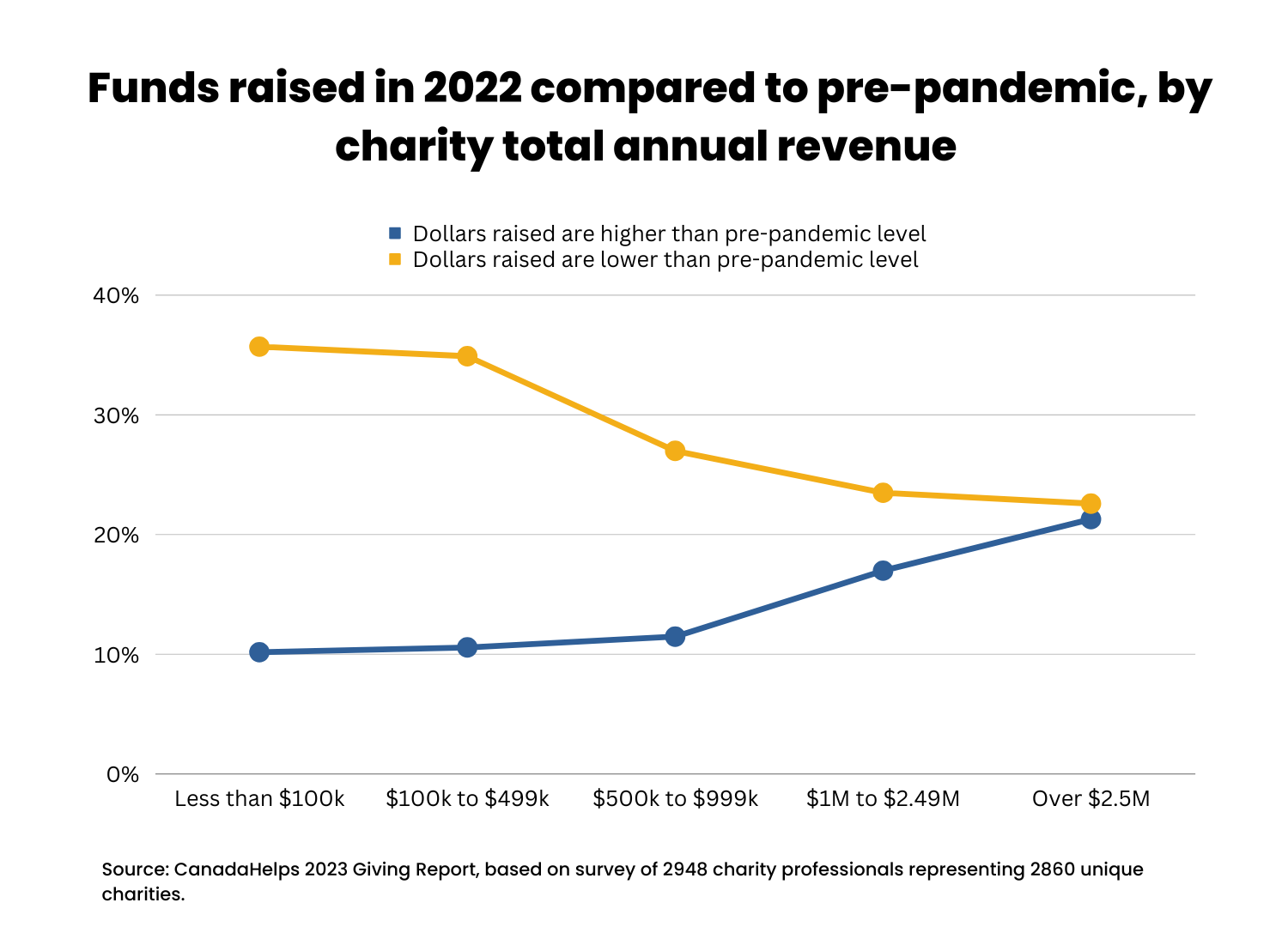
CanadaHelps’ 2023 Giving Report found smaller charities were more likely to say that they’ve raised less in 2022 compared to pre-pandemic. (Graphic: Gabe Oatley)
Donation woes continue for smaller charities
As with previous reports, CanadaHelps’s survey found that smaller charities continue to say they are struggling the most with a drop in donations. Thirty-six per cent of charities with revenues of less than $100,000 said they’ve experienced a drop in funding from pre-pandemic levels. By contrast, just 23 per cent of charities with revenues of over $2.5 million reported facing a similar funding decline.
“Smaller charities are at bigger risk because they have less wiggle room to work with,” says Chang.
“Many of them want to make sure they’re pushing everything they can towards their programs and sometimes fundraising and a focus on fundraising is coming at a cost to that.”
The report noted that many small charities, categorized as those with less than $500,000 in revenue, do not deploy many of the fundraising strategies of their larger peers. Fifty-five per cent, for instance, reported they do not have a major donor program, which focuses on raising funds from affluent Canadians, 49 per cent do not have a monthly donor program, and 46 per cent do not run events.
Fortunately, however, CanadaHelps’s survey also found that smaller charities were also somewhat less likely to say that demand for their services is outpacing their capacity to support their communities.
Forty-five per cent of charities with less than $100,000 in revenue said they are struggling to meet current demands, relative to 70 per cent of charities with annual revenue of $1 million – $2 million.
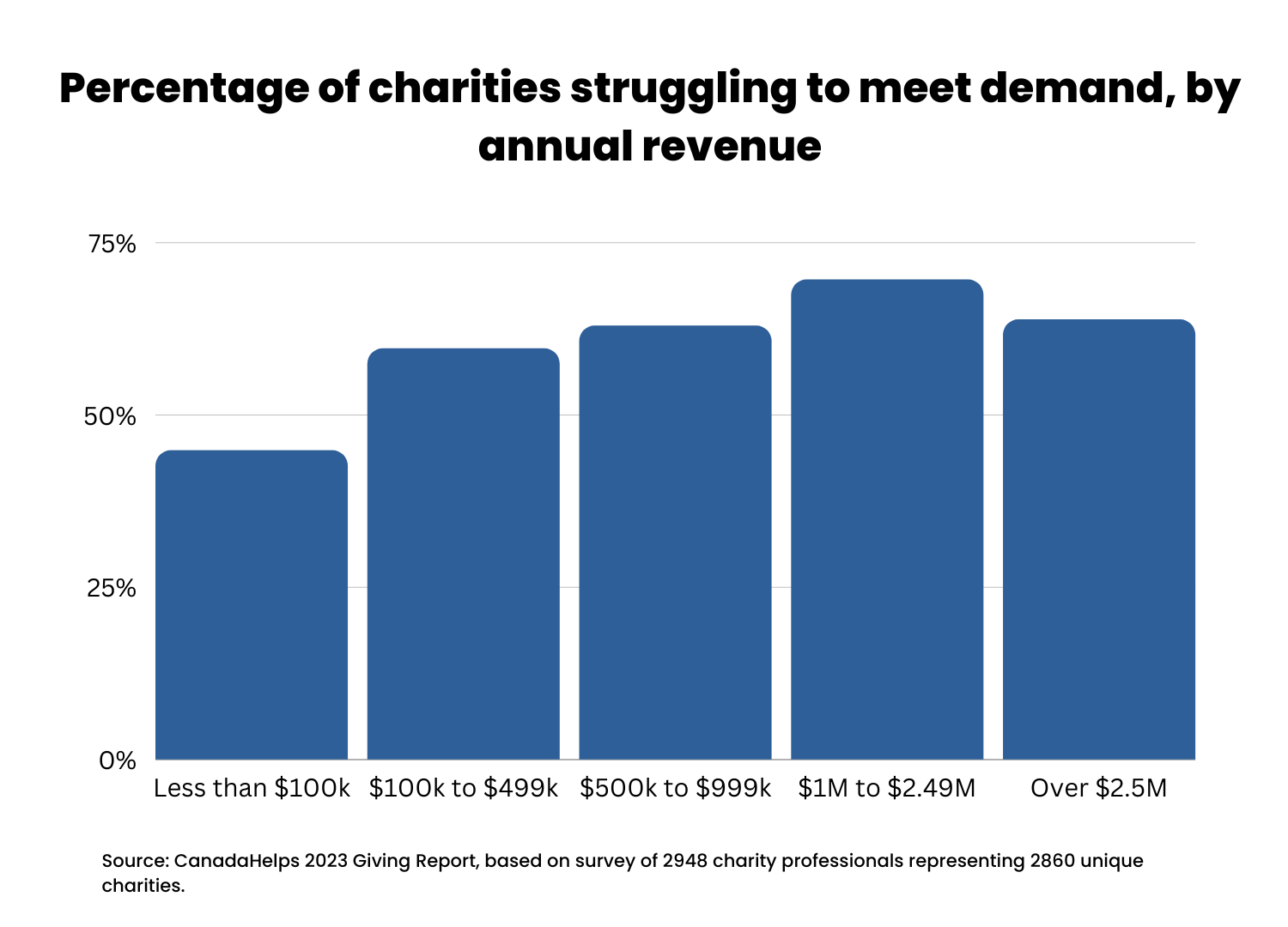
Medium and large charities are facing the toughest time in responding to the demand for services from their communities, according to a new CanadaHelps survey. (Graphic: Gabe Oatley)
Ukraine drives donations in 2022
Unlike in previous years, CanadaHelps’s Giving Report 2023 did not provide a sector-by-sector breakdown of giving on the charity’s platform, but it did show that one charitable sub-sector saw a giving boost in 2022: global charities.
Last year, donations to charities focused on international issues doubled compared to 2021, rising to 9 per cent of all giving on the platform. While many global issues could have captured the interest of Canadians, from a near-famine in Somalia, to vast flooding in Pakistan, it was the war in Ukraine that got the most support.
Dollars donated to Ukraine made up over 90 per cent of donations in this category, according to CanadaHelps.
“I think what you saw is Canadians, and charities, rising once again to the challenge,” says Chang, noting that as with COVID-19 support, once Russia invaded Ukraine, Canadians opened their wallets.
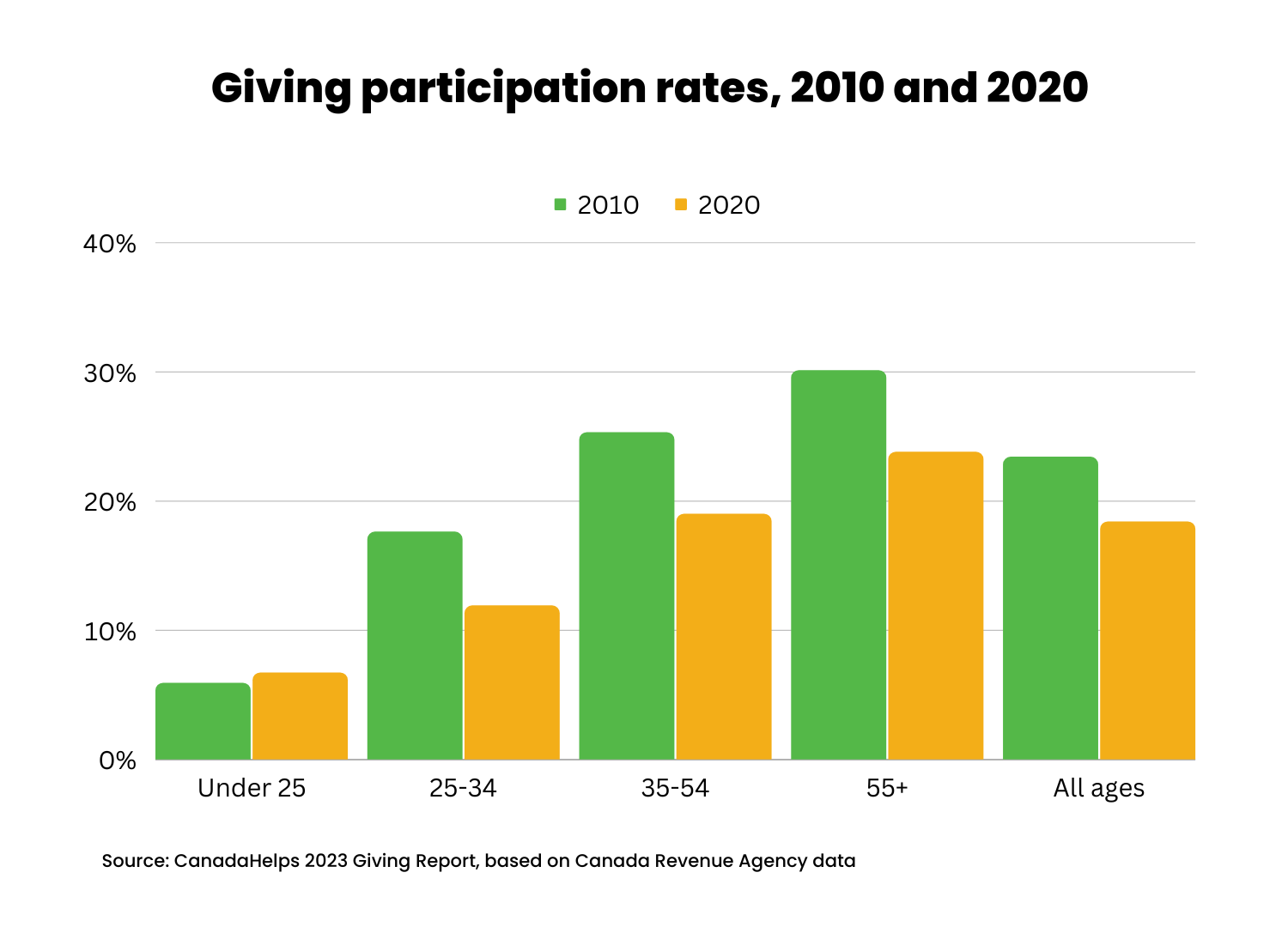
Donations from young Canadians continue to lag well behind those of their parents and grandparents, according to data from Canada Revenue Agency. (Graphic: Gabe Oatley)
Charity urges engagement with young Canadians
In addition to profiling charities’ perspectives on the current economic climate, the report also issued a handful of recommendations for how charities can make the best of a tricky time.
For one, CanadaHelps urged charities to boost their engagement with young Canadians. The report summarizes Canada Revenue Agency data, which found that in 2020, just 12 per cent of Canadians aged 25-34 reported a tax-receipted donation — a drop of 6 per cent from a decade prior.
Certainly, many young donors are facing challenges themselves — high inflation and the high cost of housing to name just two — but in CanadaHelps’s survey, charities also reported under-engaging with this segment.
Just 22 per cent of the 3,000-odd survey respondents said they have implemented a strategy focused on engaging younger Canadians, and 50 per cent say they’re dissatisfied or somewhat dissatisfied with their efforts to loop young people into their work.
In addition to getting hip with Gen Z, CanadaHelps also encouraged charities to try and better understand why volunteers are spurning them by doing something simple: asking them.
“In order for us to understand what gets them motivated, what keeps them engaged, what prevents them from investing more hours, what leads them to feeling burnt out, or what causes them to step away, we need to open a conversation,” the report says.
Further, CanadaHelps also urged charities to double-down on investments in digital transformation, invest in staff capacity as a means to prevent burnout, and explore ways to make the donation experience as meaningful as possible for Canadians.
Aside from what charities can do to weather the tough climate, MealShare’s Mona Pinder, too, is hopeful more donors will dig deep and boost their support for the country’s charitable sector.
“While it’s too late for our organization, we hope that Canadians are able to step up and support other charities that are leading critical programs and services to support Canadians across the country,” she said.
Your job. Your mission. Your news.
With your support, the sector you're building gets the journalism it deserves, and you get a tax receipt.

Related Articles

‘Astounding’: New report highlights exponential increase in care community job vacancy rates
Combining more than a dozen datasets is the first step in creating a labour force strategy, says United Way Centraide Canada

Redesigned Canada Housing Benefit could reduce homelessness by more than half: Report
End Homeless Canada’s new report shows if Canada’s Housing Benefit is redesigned, it could dramatically reduce homelessness in the country.

Partnered Partnered content Mental health support must better reflect how young men seek care: GreenShield report
New data reveals how stigma and traditional expectations of masculinity are shaping young men’s mental health, and why care models need to evolve.
