New Ontario Nonprofit Network report highlights Peel region’s dramatic spike in demand for non-profit services, amidst inflation and staffing woes
86 percent of Peel region respondents to an Ontario Nonprofit Network survey say they’ve seen an year-over-year increase in demand for their services.
Why It Matters
Non-profits provide services many families rely on: food banks, shelters, and therapy. Without a boost in funding to account for rising programming demands and increased costs due to inflation, non-profits are having to cut back on services and programs that residents rely on.
 (Credit: Unsplash / Aaron Burden)
This journalism is made possible by the Future of Good editorial fellowship covering the social impact world’s rapidly changing funding and business models, supported by Future of Good, Community Foundations of Canada, and United Way Centraide Canada. See our editorial ethics and standards here.
The pandemic has been hard on many non-profits, but it hit Brampton-based Family Education Centre like a tidal wave.
Newly stuck at home with their kids during lockdown, parents reached out to the family support non-profit for help. “Our phones were ringing off the hooks. Our parent text line was blowing up,” says Lynn Hand, Family Education Centre’s (FEC) executive director, of the early days of the pandemic. “Parents went from being just parents to being everything for their child…[and] they didn’t know how to cope.”
All of those requests for help have led to a staggering 493 percent increase in demand for FEC’s services, Hand says. In 2020, the organization served 900 parents per year. Today, it’s more than 10,000.
At the same time, however, the organization’s capacity plummeted. In normal times, FEC hosts bingo fundraisers to raise money. Lockdowns however, put an end to those, costing the organization $130,000 in lost revenue, Hand says.
With less money coming in, the organization shrunk — from 11 staff to four — which, in turn, meant that some of their programs went by the wayside. Prior to the pandemic, they provided support to parents in 26 schools in Peel. That ended. So too did parenting classes in EarlyON centres across the region.
The pandemic has been tough on FEC, an organization that operates on the traditional of the Haudenosaunee, Ojibway/Chippewa, Anishinabek, and Mississaugas of the Credit First Nation — but a new report from the Ontario Nonprofit Network shows they’re not alone in their struggle.
This spring, the non-profit advocacy organization surveyed about 1,500 non-profits across the province, asking about their experiences with client service demands, inflation and staffing from April 1, 2021 to March 31, 2022.
The response was stark: 74 percent of respondents reported an increase in the demand on their services compared to a year prior, 83 percent reported an increase in costs, and 65 percent reported staffing challenges with recruitment or retention.
Of all the regions however, the results were perhaps most alarming in Peel region. There, 86 percent of respondents reported an increase in demand for services (the highest of any area), 84 percent reported an increase in costs (some, of over 100 percent), and 66 percent reported challenges with staff recruitment and retention.
Three charity executives from the area say this, in practical terms, means fewer programs and services, longer waiting lists and greater strain on their organizations. And it won’t stop, they say, until public and private funding is boosted to account for the new economic reality.

Gurpreet Malhotra, executive director of Peel-based Indus Community Services says he found government funders unreceptive to his request for increased funds to cover rising rent costs in Brampton. (Courtesy: Gurpreet Malhotra)
Soaring rental costs put newcomer language learning in jeopardy
For Gurpreet Malhotra’s organization, it hasn’t been so much an increase in program demands that’s caused him grief as an increase in prices.
Malhotra is the executive director of Indus Community Services, a charity that provides newcomer, seniors, housing and education programs in Brampton and Mississauga with a focus on the region’s South Asian community.
During the pandemic, Malhotra learned that the landlord of one of their newcomer program sites in Brampton was keen to demolish the building to make way for redevelopment.
He and his team looked for a similar space at a similar price but just couldn’t find it. “Brampton is booming,” he says. “We can’t afford rents in Brampton.”
Between 2015 and 2021, the average cost of office space in Brampton jumped 265 percent — from about $11 per square foot to nearly $19 per square foot, according to Toronto Regional Real Estate Board Data. In the same period, by comparison, Toronto’s red hot real estate market hasn’t increased as much — growing a mere 225 percent.
Malhotra says he appealed to funders for help to make up for the rising rental cost, but was told they didn’t have the money.
As a result, he says, Indus decided to keep the programs but to offer them out of an existing agency site in Mississauga, where rents are much less expensive.
“At the end of the day, we shrunk by one location, but we maintained our square footage. But at the same time, we withdrew service from a high-needs area and moved it into a medium-need area,” he says.
The charity now provides bus tickets to newcomers who used to walk to the now-shuttered office, allowing them to get to one of the charity’s other Brampton sites where their classes are held. It’s close, so Malhotra isn’t too concerned about the impact on transit times, but he is worried about the loss of capacity — about 60 less people will now be able to access those classes in Brampton.
This comes at a time when the region needs more services, not less. Between 2016 and 2021, Brampton was the fastest-growing municipality in Canada — adding over 60,000 residents in just five years.
“It’s not like a convenience store, where one closes down, and another pops up,” Malhotra says, of the closure of the Brampton site. “Once it’s gone, it’s gone.”
Non-profits can’t keep pace with public sector pay
For Angela Carter, rising costs are a concern, but even more pressing for her organization is the increase in client demand for support — about 25 to 30 percent since the start of the pandemic — and the complexity of the challenges clients are facing.
Carter is the executive director of Roots Community Services, a charity that provides counseling support to Black, African and Caribbean residents in Peel region.
Mid-way through last year, she says, her managers started to raise the alarm. When they spoke about the challenges their counsellors were seeing with clients, they told her about an increase in the number of clients talking about suicidal ideation and drug use.
Clients are facing a litany of challenges, she says, including concerns about “learning loss” suffered by their kids during the pandemic, divorce and relationship challenges, job loss, housing precarity, rising costs and more.
“All of those things are affecting people’s mental capacity to cope,” she says.
Additionally, Carter says her organization is struggling to hang onto their staff and to fill vacancies when they do leave — an impediment to providing consistent care for their clients.
To keep staff in the agency’s therapist, psychotherapist and counselor roles, she says, Roots and other non-profit mental health providers have to compete with hospitals and school boards who are able to offer higher pay.
She says she’s lost two staff who were almost tearful to leave the organization, but says she understood their decision: “They had to look out for their families.”
This summer, ONN published a separate report that provided a snapshot of the pay disparity facing sector workers. They found that early childhood educators (ECEs) working for school boards or municipality-run centres make $25 per hour — about $7 more than their non-profit childcare counterparts. They also found that personal support workers working in hospitals make an average of 21 percent more than their counterparts working in the community sector.
Cathy Taylor, ONN’s executive director, says the discrepancy stems, in part, from a “complete systemic misunderstanding” of the work of non-profits — an incorrect belief they “can do it cheaper and more efficiently” than government agencies, she says.
The gap also partially stems, she says, from the gulf in the rates of unionization between the two sectors. In Ontario’s non-profits sector, only about 15 percent of workers are unionized, compared to 77 percent in the public sector nationally.
“Whether you’re an ECE in a school or in a childcare centre, or whether you’re a PSW in a non-profit long-term care home or a public long-term care home, it’s the same job and we should have wage grids that are reflective of that,” Taylor says.
In Peel region, 65 percent of ONN survey respondents cited the wage disparity across the sector as a factor affecting their ability to recruit and retain staff. A staggering 12 percent of respondents from the region also reported a job vacancy rate of more than 50 percent — the highest of any region in the province.
Carter says she welcomes the increased attention governments have paid to staffing issues in hospitals and long-term care homes during the pandemic, but also wants policymakers to pay attention to the challenges facing organizations like hers.
“We are trying to do prevention and early intervention so that [clients] do not end up in the hospital. We need for [the government] to look after our sector too,” she says.
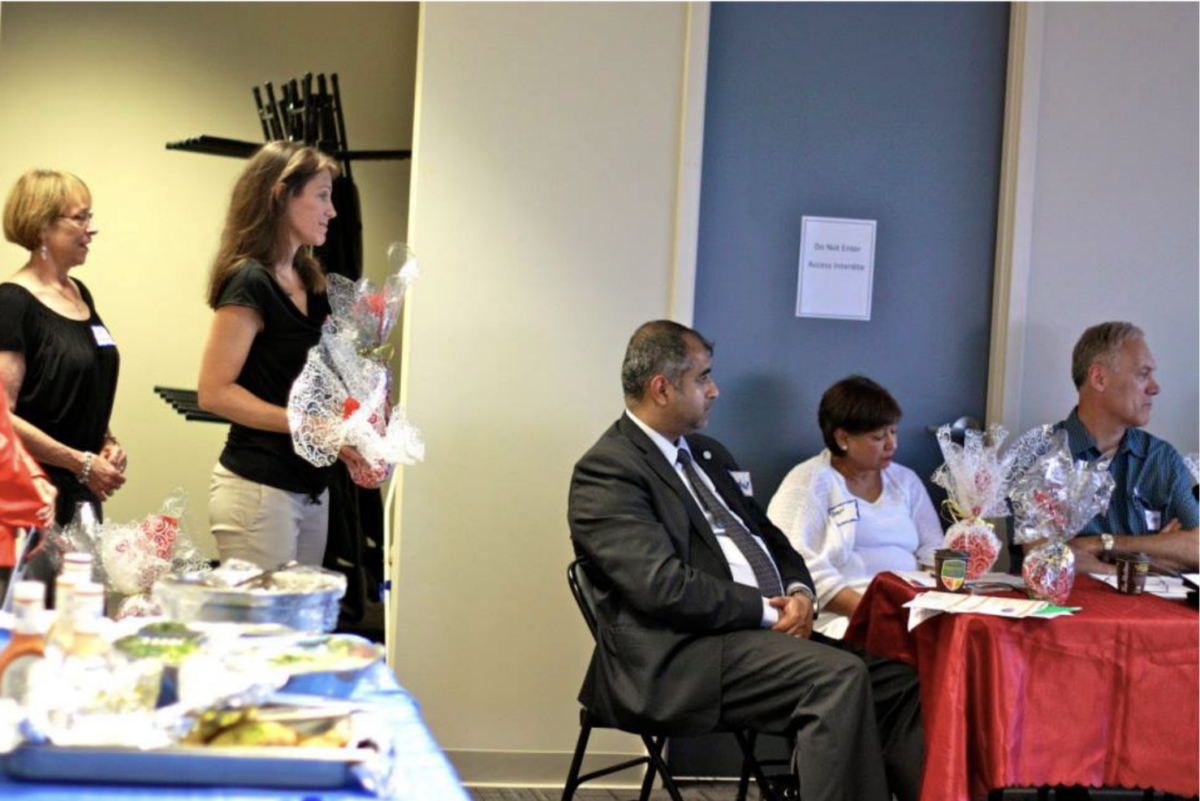 Lynn Hand (centre-left), executive director of Family Education Centre, says a sector coalition of Peel agencies formed during the pandemic has decided to continue to meet to collaborate. (Courtesy: Lynn Hand)
Non-profit ingenuity and its limits
Despite the challenges they’re each facing, Hand, Malhotra and Carter each say their organizations are doing the best they can to minimize any negative impacts on clients — and that in some cases, the pressure has actually sparked new partnerships and services.
To accommodate staffing gaps, Roots Community Services linked up with other mental health agencies who were able to provide the organization with short-term secondments after they lost staff.
Family Education Centre too found support by working closely with other regional agencies.
When all of those texts and phone calls started coming in, Hand and her team realized they needed to gather resources to support families online. They asked for assistance from the 30-odd agency members of the newly formed Peel Family Support Network, and the group delivered.
Organizations donated their time and their expertise, helping the FEC to assemble the Parenting Through Pandemic portal, a library of resources — available in seven languages — to support overwhelmed parents with tip sheets, podcasts and videos.
The spirit of collaboration across the sector isn’t limited to agencies in Peel, either. “I’ve never seen such incredible collaboration as I have in the last three years,” says ONN’s Cathy Taylor. “It’s been extraordinarily positive.”
In the same breath, however, the longtime sector advocate cautions about the folly of continually relying on workers to do more with less.
“They’ve done as much as they can do on their own,” she says. “The bulk of the solutions at this point are now at the systemic level.”
In particular, Taylor is hopeful that funders will boost funding to account for the increased costs, spurred by inflation and rising rents that many organizations are now facing.
Your job. Your mission. Your news.
With your support, the sector you're building gets the journalism it deserves, and you get a tax receipt.

Related Articles

Elbows up: Spring Impact Capital calls for a giant spreadsheet of available early-stage Canadian capital
The Vancouver impact investor wants to crowd-source a free, national directory
Blended Finance Canada launches on West Coast
The new initiative is supported by the University of Victoria, Scale Institute and Spring.

Canada’s Sustainable Finance Taxonomy: What it is, what is happening and what’s coming next
Canada’s sustainable finance taxonomy faces big challenges, from oil and gas, Indigenous rights and the real meaning of the word ‘transition.’
