Is the internet a public resource worth protecting for the next generation?
A Q&A with Mark Surman, executive director of Mozilla
Why It Matters
There’s a lot of talk, about protecting resources like water, forests, and languages for future generations. Is the internet worth protecting in the same way? Future of Good publisher Vinod Rajasekaran sits down with Mark Surman, executive director of Mozilla to talk about what a web worth protecting looks like, and how it needs to change to get there. Part of Future of Good’s Tech and Philanthropy series.
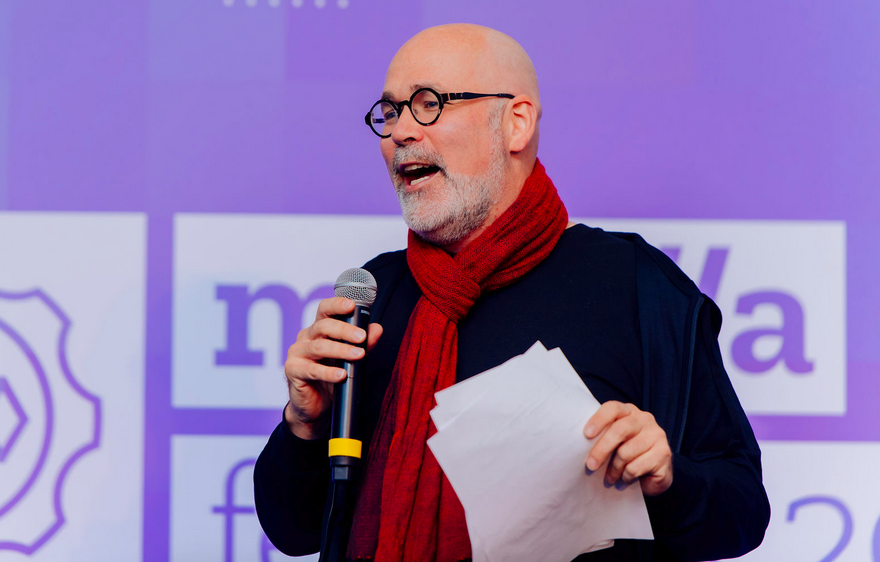
What does the internet have in common with the natural environment? According to Mozilla Executive Director Mark Surman, quite a bit. It can be exploited, power over its offerings is concentrated, and, ultimately, it’s a public resource that we all have a responsibility to protect and strengthen for future generations.
In this installment of our series looking at tech and philanthropy, Future of Good publisher Vinod Rajasekaran dives into the future of an ethical, democratized digital world with a world-renowned leader in this space.
Vinod Rajasekaran: How would you characterize the information age we’re living in?
Mark Surman: There are two things I would think about in this information age. One is the obvious — a tremendous amount of global connectivity and personal connectivity. We’re closer to each other through the internet than we ever have been. And there are lots of things that most of us love, or love to hate, in terms of being able to be constantly in touch, or know where our friends and family are, or get around a city with a map that guides us, or get products and services [via targeted ads] that guess what we want. And certainly, many of our businesses are more efficient than in the past. That’s what the digital era has brought us: a lot of delight and a lot of productivity and a lot of wealth creation.
With all of that empowerment and connection has also come an era of concentration of power that we’ve never seen in the history of human economics
Then there’s another side of it: that with all of that empowerment and connection has also come an era of concentration of power that we’ve never seen in the history of human economics, I would argue, in the hands of a few companies, whether they’re American or Chinese, but the big tech companies have an outsized influence on how our lives work and how the economy works. There’s increasing surveillance that is really at the centre of the tech economy. And it ties into a whole history of state surveillance at a level that’s completely unprecedented. So, there’s a wonderful side, and a dark side to the digital times we’re in. We’re at a spot where we have to reconcile the two.
VR: I think we’re seeing both sides play out in very real ways. It also makes me think about the narrative that’s picked up in philanthropic circles around protecting resources, like water or languages. In thinking about how much the web has offered us, do you see the web as an essential resource? Is it worth protecting?
MS: Well, I have to because it’s in my job description. But I also do believe that the web is that kind of a public resource. In the Mozilla manifesto, which was written in 2007, it talks about the internet as being a public group. The internet should be a public resource that is open and accessible to all. And that doesn’t mean that there’s not commercial activity, or we don’t think there should be commercial activity on the web. Certainly, we’re a part of that as a social enterprise, but the web or the digital sphere belongs to all of us, like the planet does. The means that we need to make sure it’s good for humanity, and that it’s healthy and sustainable.
So, very much like the physical environment, the digital environment faces many of the same risks. If you have a small set of actors over-exploiting it in unsustainable ways as I would say, Facebook, Google, Tencent or Alibaba in China are, eventually that public resource starts to degrade. It degrades in ways that are harmful for individuals and groups. In the way that misinformation is harmful, or the lack of trust in society, or surveillance — or it’s harmful in the sense of shutting other people out from using that public resource, other innovators, other startups. It’s very difficult now to get going as a company compared to how it was for Tencent in ‘98 or Google in 2000, or something like that. So, we see it at Mozilla as a public resource. But we see it as one that’s not being well stewarded.
VR: Since the Mozilla manifesto was put together, the web has changed quite a bit, right? Many would say that it’s really lost its way and we should reimagine the whole thing. Do you agree with that? What would that even look like?
MS: Well, I think we already have reimagined it five times over. So I think the question is what do we want to imagine it to be next, or evolve it into? Certainly, since we wrote the manifesto, it’s not just the web, but also the first smartphones that came onto the mass market. The iPhone emerged since we wrote that for the first time.
The computing environment was, when I was growing up, just the personal computer, and maybe a modem and a connection to the network, but now it’s so many things. So, imagining how we want that to work is the job of today, to imagine a world, a digital world, that is inclusive, that’s open, that’s transparent. But most of all, one that is good for humans, and that we all have the agency to make something good of it.
VR: What will all of this look like 10 years from now, say in 2030?
If we can get into our imaginations and then put our elbow grease behind a more decentralized, human centric digital future, I think we can build it.
MS: I can imagine one scenario as likely on our current trajectory, and I hope for another scenario. I can imagine a scenario where we continue to see consolidation of power and an erosion of trust as a result of a small number of centres of economic power, with China and the US taking their digital dominance and further centralizing economic power, and just a lot of extractive business — whether that’s extractive of us as individuals who are producing data and in some ways providing the labour behind that value, or extractive of other economies in a sort of colonial sense where you don’t see the wealth accrual going to the Global South, by and large or, or even to Europe. It really is Silicon Valley and the Chinese tech companies that control much of the game. So, I think we could continue to go down that path, and that would not be good. I think it ultimately would lead to political instability, as we’re starting to see now.
The other path is really pretty simple, which is to do what we hoped the internet would do in the first place — distribute power, moving to a decentralized web, decentralized control of data, healthy digital economies emerging in Africa, and another centre of gravity emerging in South Asia. It would be something much more distributed economically, as well as individually, where we control our own personal digital destinies. Things like data trusts, which are kind of crazy ideas right now, would reverse the direction of consent, where we would control our own data and the terms on which companies use it. This is where philanthropy can play an exciting role. Things such as data trusts would become mainstream, and we would have a much more democratized and empowered internet user base than we have today.
If you think about how crazy open source was in 1998 when Netscape open sourced the browser and that eventually became Firefox — nobody thought that by open sourcing this piece of code, that it would change the world. And it did. So maybe some of the crazy ideas that we have today, like decentralized webs and data trusts might change the world again. If we can get into our imaginations and then put our elbow grease behind a more decentralized, human-oriented digital future, I think we can build it. We’ve done bigger things as humanity, so I think it’s possible.
Your job. Your mission. Your news.
With your support, the sector you're building gets the journalism it deserves, and you get a tax receipt.

Related Articles
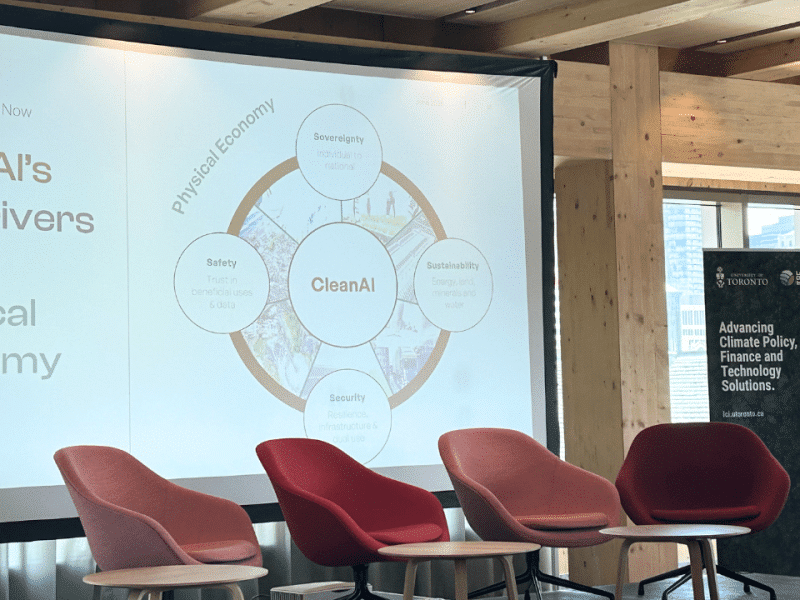
Quarter of all Canadian AI ventures could be categorized as ‘clean AI’: new research
At Toronto Climate Week, the global CleanAI Initiative shared research on the Canadian ecosystem, finding growing investment hubs in Vancouver, the GTA, and Kitchener-Waterloo.

Partnered Partnered content Non-profits are increasingly being targeted for cybercrime. Here’s how your organization can help protect itself
Being cybersecure doesn’t have to be daunting or expensive. A panel of experts discuss ways the non-profit and charitable sector can help protect itself in a constantly changing AI landscape.
Canadian astronaut, entrepreneur donates $15M to Concordia to launch new space school
Montreal’s Concordia University will be the home of the Mark Pathy Space Institute.
