Quarter of Canadian non-profit workers dissatisfied with job: report
New workforce strategies and structural change are needed to recruit and retain non-profit staff, according to experts.
Why It Matters
Non-profit employees are likelier to be unhappy and dissatisfied at work than those in the private sector. Precarious employment, inadequate income, and burnout all play a role and can lead to higher turnover rates at non-profit organizations.

Non-profit workers with a disability reported a job dissatisfaction rate of 40 per cent. (Canva)
This independent journalism is supported by Canadian Tire Jumpstart Charities. See our editorial ethics and standards here.
People working in Canada’s non-profit sector are less satisfied in their jobs than their private sector counterparts, according to a recently released report.
“When I looked at the results, they were quite striking in terms of just how much lower job satisfaction was in the non-profit sector,” said the report’s author, Steven Ayer.
“And then, as we dove into the details, some really concerning findings started to emerge.”
Using survey data collected by The Environics Institute for Survey Research, in partnership with the Future Skills Centre and the Diversity Institute at Toronto Metropolitan University, the Burden of Care report explores several issues relating to education, skills and employment, job security, technological change, and training.
But its key finding is that 26 per cent of non-profit workers report being either somewhat or very dissatisfied with their job.
By comparison, only 19 per cent of private sector workers and 17 per cent of public sector workers felt the same way.
“The high level of dissatisfaction wasn’t necessarily a huge surprise,” Ayer said. “There’s a lot of challenges — ranging from low pay to lack of benefits to contract work, to all sorts of other challenges — that emerge when working in this space.”
What was surprising, said Ayer, was the particularly low levels of job satisfaction among first-generation Canadians working at non-profits. Nearly 35 per cent reported being unsatisfied at work.
Women, young workers and people with disabilities also reported higher levels of dissatisfaction. Thirty-one per cent of women in the non-profit sector who responded to the survey were unsatisfied with their jobs, compared to just 18 per cent of men.
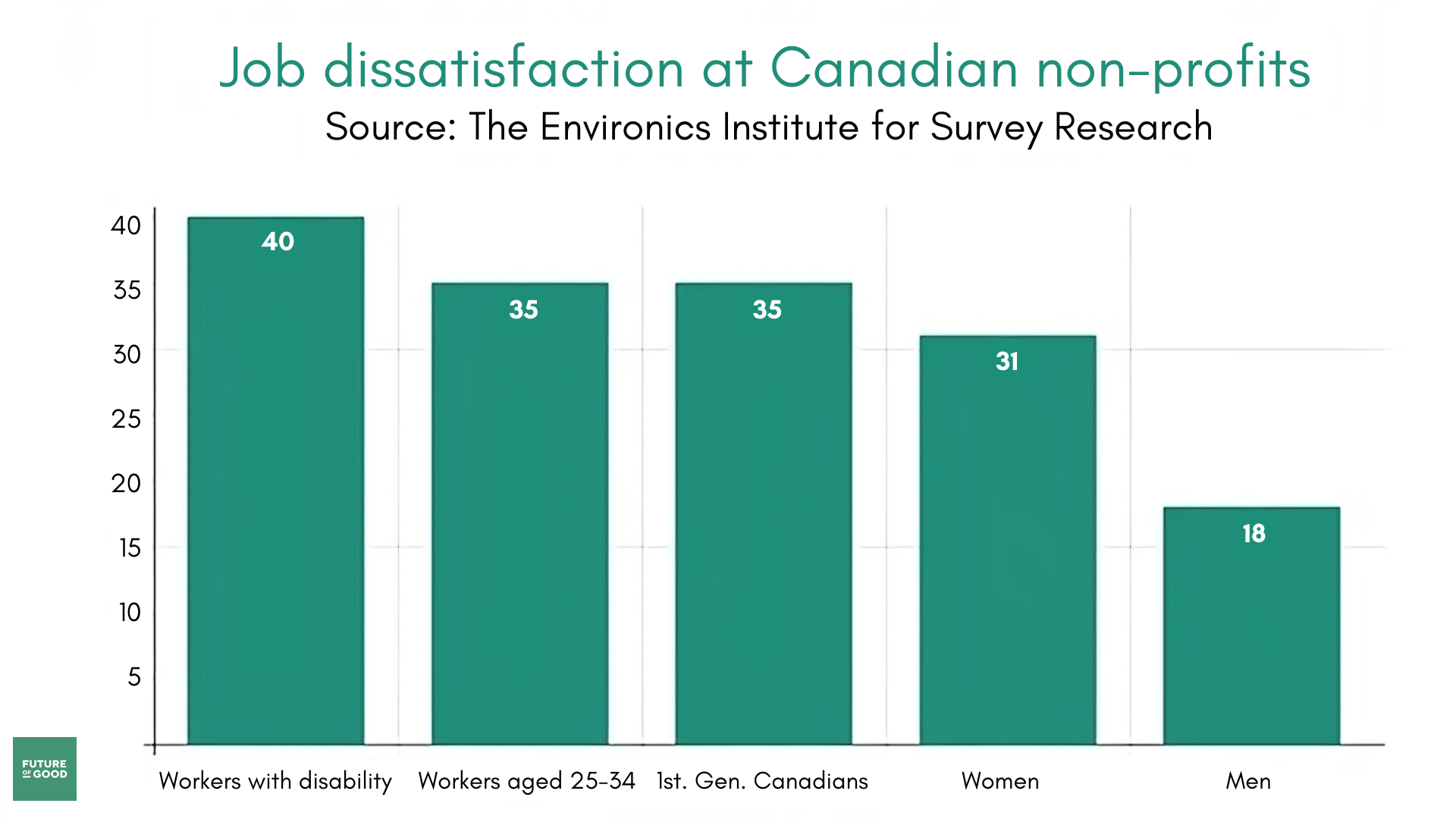
Job dissatisfaction at Canadian non-profit groups by percentage. (Future of Good)
Non-profit workers with a disability reported a job dissatisfaction rate of 40 per cent, as did 35 per cent of workers aged 25 to 34.
Those numbers reflect what Pamela Uppal-Sandhu, director of policy for the Ontario Nonprofit Network, has seen in that organization’s annual state of the sector surveys.
“Dissatisfaction is not the new news; that’s been the case forever — our salaries are not the same as public and private sectors,” she said. “But what I think is different about this moment, why perhaps the numbers are so startling or higher than we expected … is because of the pandemic.”
Non-profits have long had difficulty finding and keeping staff, Uppal-Sandhu said. Still, the pandemic increased workloads, stress and burnout, resulting in what many have called a human resource crisis in the charitable sector.
“And on top of that, the salaries can’t keep up with the cost of living,” she said. “There’s just so much more going on, which is what makes this moment different.”
Sixty-five per cent of Ontario non-profits reported staffing challenges in 2023, while 77 per cent experienced some level of staff turnover, Uppal-Sandhu said.
Precarious work, part-time positions, and low pay have all contributed to job dissatisfaction in the non-profit sector, said Ayer, noting 27 per cent of non-profit employees surveyed said their job was temporary compared to just 13 per cent of private sector workers.
Non-profit employees are also twice as likely to work part-time as private sector workers, at 34 and 18 per cent, respectively. An equal number of non-profit and private sector employees who responded to The Environics survey, 29 per cent, said their household income failed to meet their financial needs.
Affordability crisis
“We know that we’re at a moment in time where the affordability crisis is really layering more challenges on an already strained sector, and it’s employees that are feeling that crunch,” said Karen Ball, president and CEO of the Calgary Chamber of Voluntary Organizations.
More and more, non-profit employees are turning to the organizations they work for to access support, she said.
“We hear anecdotally that employees are doing things like eating lunch at the lunch programs that they’re working in and staying for the dinner program,” Ball said. “So, we can sort of assume from that, that there’s a higher than normal level of stress on employees right now.”
The report found frontline service providers had the highest levels of job dissatisfaction at 41 per cent.
That figure doesn’t surprise Ball or other leaders in the non-profit space. Community-facing staff have seen greater demand for service and have dealt with more complex issues since the advent of COVID-19 and the economic fallout that followed.
Annika Voltan, executive director of Impact Organizations of Nova Scotia, said increased demands and greater volatility have also decreased traditional volunteerism.
“And the burden of that extra work falls onto staff,” she said. “It’s creating a tipping point for a lot of people … they’re looking at other sectors, especially government, but also the private sector, for more stable, predictable income, maybe with fewer demands, less compassion fatigue and less emotional drain.”
Ball believes a provincial non-profit workforce strategy could help alleviate staffing issues and improve job satisfaction.
Policy interventions, like tax incentives for non-profit service workers, could help draw people to the charitable sector, she said.
“In Alberta, the non-profit sector employs 285,000 people … and we’re one of the only sectors without a workforce strategy,” said Ball.
“So we think that it’s a really important time to be working strategically with our partners in government to build a dynamic workforce.”
Employers and workplaces also need to be empowered to provide decent work, Uppal-Sandhu said, adding the non-profit sector faces unique structural challenges when it comes to funding.
“I’ve talked to so many executive directors and leaders over the last five years who want to do everything they can to pay their people better, and they just can’t figure out how to do it … they are just up against the wall,” she said.
“Many of them haven’t even had a cost-of-living increase to their baseline funding agreement for two decades. So how do you function in that space?”
On the same team
However, the solution isn’t to pit workers against employers, Uppal-Sandhu said, adding both want the same thing at the end of the day — better compensation, more support and greater stability.
“But the structure and the systems in which the sector operates are fundamentally flawed. And that needs to change,” she said.
Voltan said non-profits must push back when funders try to dictate salaries, adding organizations should also think about “total compensation” rather than just wages.
“There may be other, non-financial benefits that organizations can provide,” she said. That might include a four-day workweek, remote work options or opportunities for professional development and leaves of absence.
Non-profit organizations could also work together to provide better benefits and collaborate on staffing issues.
Collective pension plans or more responsive shared human resources could improve working conditions in the sector, said Uppal-Sandhu.
“Let’s start digging into the solutions and prototyping something that we can achieve at a structural, systemic level,” she said.
Looking beyond wages, Ayer and others said the sector could also improve working conditions by focusing on preventing burnout, especially for staff working in service roles. That might mean addressing underlying issues that lead to fatigue or providing access to mental health services and paid sick leave.
While the report draws on data from four cross-Canada surveys conducted between 2020 and 2022, Ayer said the overall sample size representing the non-profit sector was relatively small. Of the nearly 31,000 people who responded, only about 640 indicated they worked in the non-profit sector.
He’d like to see more research in the future.
“With the sample size we have, it’s really hard to sort of try and disentangle what’s going on,” he said.
“We would need more data.”
Your job. Your mission. Your news.
With your support, the sector you're building gets the journalism it deserves, and you get a tax receipt.

Related Articles

Redesigned Canada Housing Benefit could reduce homelessness by more than half: Report
End Homeless Canada’s new report shows if Canada’s Housing Benefit is redesigned, it could dramatically reduce homelessness in the country.

Partnered Partnered content Mental health support must better reflect how young men seek care: GreenShield report
New data reveals how stigma and traditional expectations of masculinity are shaping young men’s mental health, and why care models need to evolve.

School forest initiative set to expand outdoor learning in Ontario
Many students in Ontario will head outdoors under a new classroom and forest initiative.
