Report Card: Non-profit leaders give their score for Federal Budget 2024
The budget for 2024 has dropped. How will this impact non-profits, charities and other social purpose organizations?
Why It Matters
The broad positive impact that social purpose organizations have on Canadian society is often underappreciated or misunderstood. Social purpose leaders share their thoughts on the federal budget and how it will impact their organizations and the communities they support - including yours.

Leaders from across the social purpose world gave their report card scores for the 2024 federal budget. (Illustration by Elisha Dacey/Future of Good/Supplied photos)
Now that the 2024 federal budget has dropped, we asked Canadian social purpose leaders for their opinions.
Leaders and directors were asked to tell us what they liked, didn’t like, and what was missing and give us a report card rating of A+ (for excellent) to F (for, well, failure.)
Here’s what they had to say.
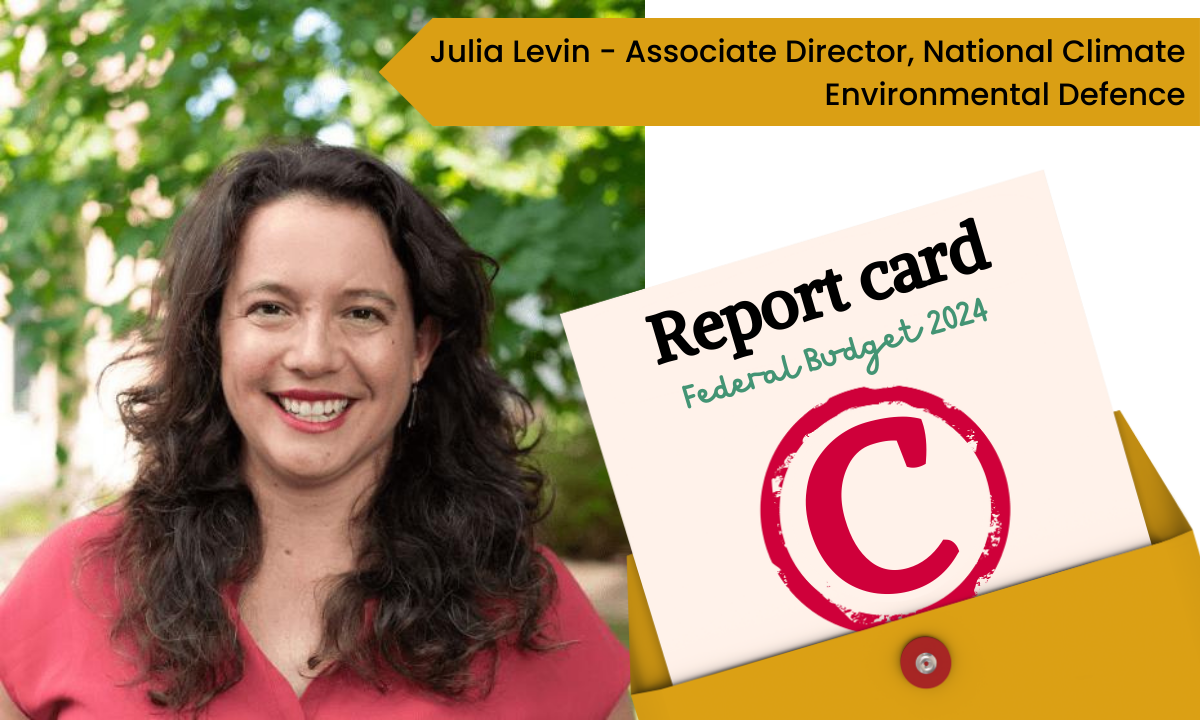
Julia Levin – Associate Director, National Climate, Environmental Defence
Report Card Score: C
This budget is intended to be geared toward younger generations, but it fails to deal with a significant source of anxiety for young people by offering little to address climate change.
This budget fails to give the climate crisis the attention it urgently deserves. Climate solutions—renewable energy, storage, transmission—are not getting the funding they need to actually support a transition off fossil fuels. There was no funding for public transit. And though we’re glad to see a new program dedicated to achieving energy efficiency for low—and middle-income households, the amount of money budgeted falls short of what is needed.
This government provided more than $18 billion in support to fossil fuel companies last year—surely they could have found more money for climate solutions.
Also missing was Minister Freeland’s update on the government’s plans to fulfil the promise to end public financing of fossil fuels.
Across Canada, people are suffering from the cost of living crisis, which is largely driven by the massive profits of oil and gas companies. A windfall tax on their profits could have been used to support Canadians and fund climate solutions across the country. “Fairness for every generation” does not include ever-worsening climate disasters.
On housing, we are pleased with the budget’s use of public lands and the financing measures, which will make it easier to shift housing construction away from sprawl and towards improving density in existing neighbourhoods. Improving how and where we build homes is key to addressing the housing shortage, meeting climate obligations, preserving farmland, and saving species at risk.
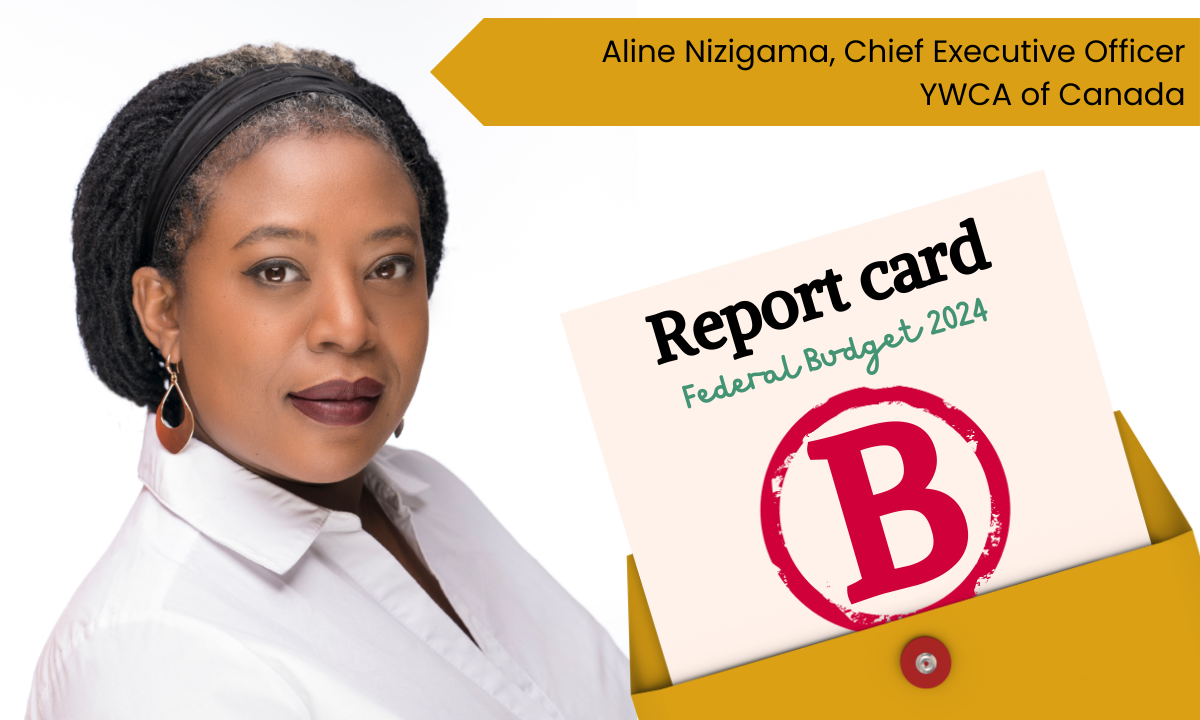
Aline Nizigama, CEO, YWCA Canada
Report Card Score: B
It is positive to see that the government is willing to invest to end the housing crisis, but more targeted investments are needed to end the impacts on women, girls, and gender-diverse people. YWCA Canada is happy to see a stated commitment to supporting women’s shelter and transitional housing through the Affordable Housing Fund. However, this commitment needs to be quantified.
The National Housing Strategy has a commitment that 25 per cent of all funds would be dedicated to projects for women, and this commitment must be included in all housing funding announced in Budget 2024.
Budget 2024 includes promising Investments in Canada’s care economy and national early learning and childcare system. As Canada’s second largest childcare provider, YWCA is happy to see $1 billion in low-cost loans and $60 million in grants to support the construction of non-profit childcare spaces.
This investment — in conjunction with further federal investment to increase training for early childhood educators — will be crucial to ensuring that every child and family has access to high-quality, affordable childcare.
The proposal of a sectoral table on the care economy and the development of a National Caregiving Strategy are promising steps to strengthen Canada’s care economy. Investing in care work supports workers, the communities they serve, and Canada.
A key area missing from the budget is dedicated funds for gender-based violence prevention work and to bolster the feminist sector. This is critical funding at a time when Canada’s rates of femicide and gender-based violence remain high.
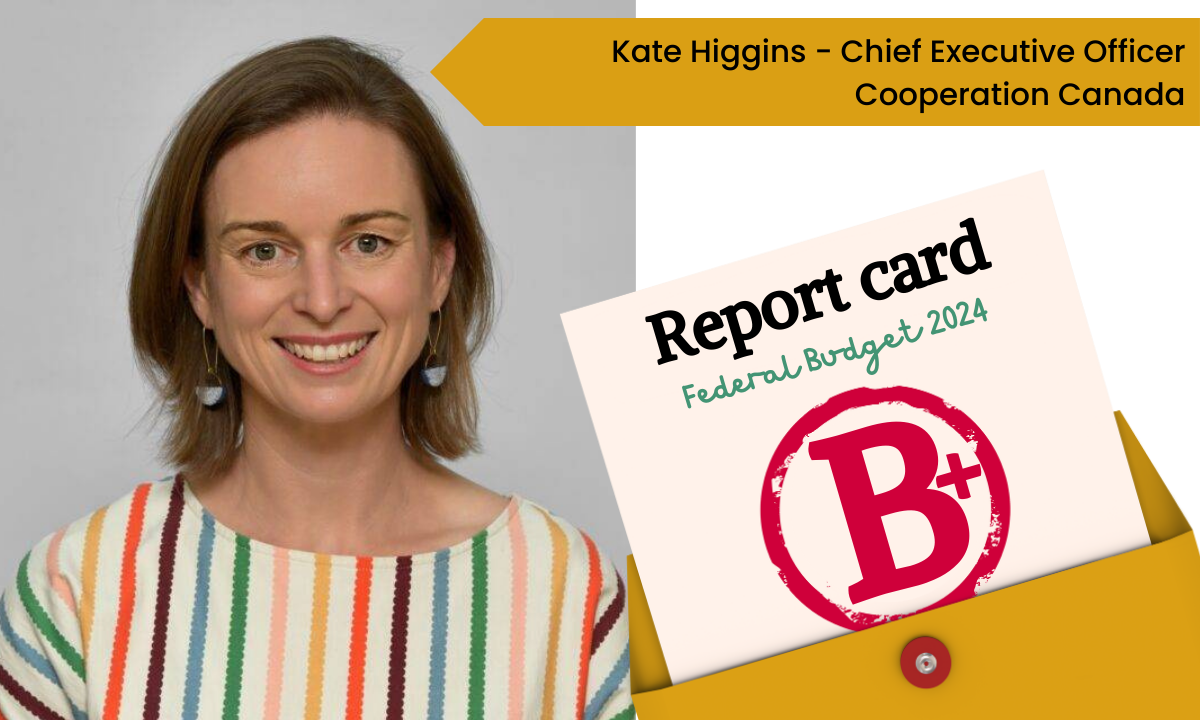
Kate Higgins, CEO, Cooperation Canada
Report Card Score: B+
At a time when humanitarian needs are surging, decades of progress on development are perilously under threat in some parts of the world, and other countries are cutting aid in Budget 2024, Canada stepped up in Budget 2024 with $350 million of new funding for humanitarian assistance over two years.
This new funding should help Canadian humanitarian organizations work with partners to deliver much-needed humanitarian assistance in some of the most devastating crises worldwide, including those in the Middle East, Haiti, Sudan, Yemen, and the Sahel. We appreciate that the government is doing this in a complex economic context here in Canada.
Canadian international development and humanitarian organizations are united in their response to the budget: more than 100 organizations signed a joint statement welcoming the boost for humanitarian aid in Budget 2024.
We welcomed the budget’s references to the importance of modernizing and investing in international financial institutions. This included the introduction of legislative amendments in Canada to better enable hybrid capital and other forms of innovative finance to be leveraged to support developing countries’ financing needs.
A new phase of the International Assistance Innovation Program is referenced in the Budget, and we look forward to working with the government on the design and implementation of this program, which seeks to leverage private and philanthropic capital in support of development.
We were pleased to see a recommitment to necessary global LGBTIQ rights international assistance programming of $10M annually by 2025.
We noted $81 million in 2024/25 to prepare for Canada’s G7 Presidency in 2025 and hope that some of this can support engagement with civil society and social impact actors on the priorities of Canada’s Presidency. We noted the investment in transforming Global Affairs Canada ($159.1 million over five years), some of which should support the work of Canadian international development and humanitarian organizations by improving efficiencies in the design and delivery of international assistance programming funded by Global Affairs Canada.
What was missing? Budget transparency. Key information is missing from the budget: there is no number, table, or graph showing the total international assistance budget for fiscal year 2024/25.
We have estimated that this year’s budget is a 5 per cent increase from last year – but this is a “guestimation” due to lack of information! We have also been advocating for international assistance spending in Ukraine to be tracked through a Ukraine or Eastern European Assistance Tracker – I would have liked to see a commitment to this in this year’s budget.
It is also important to note that Budget 2024 provided no increased or longer-term development assistance.
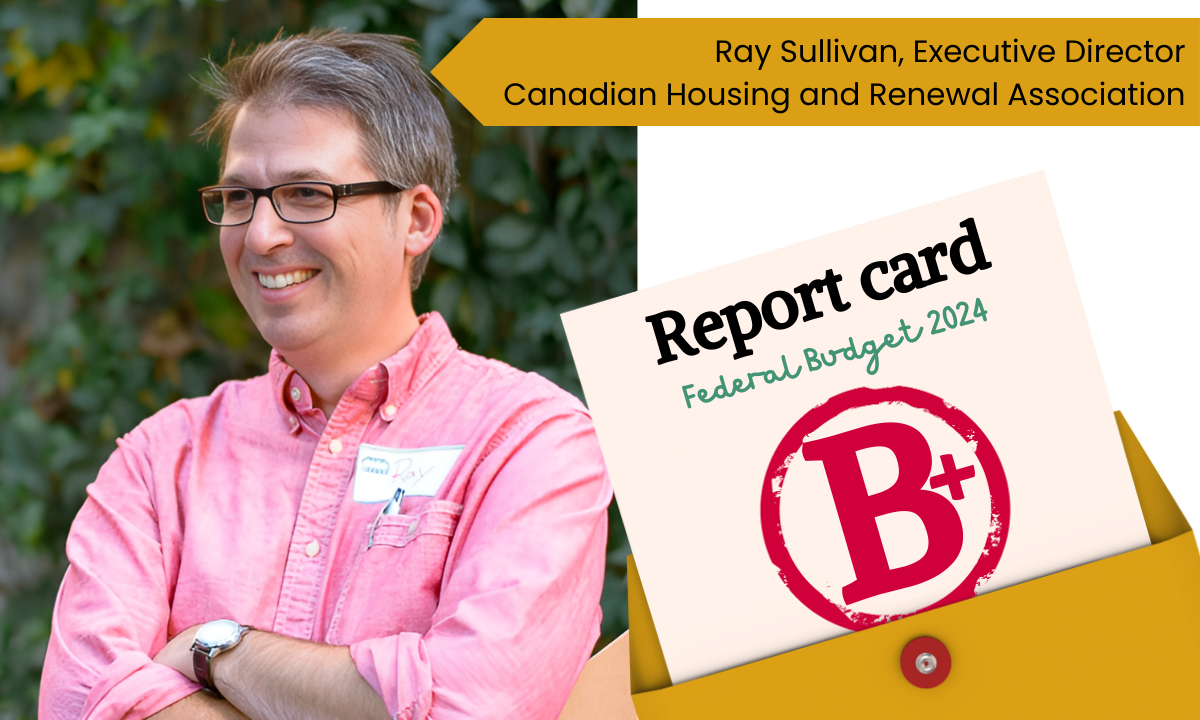
Ray Sullivan, Executive Director, Canadian Housing and Renewal Association
Report Card Score: B+
It could have been an A if it had these three components.
First, we need longer-term commitments and predictability. Some new and older measures are time-limited (like GST rebates and capital cost depreciation for new rentals). They don’t recognize that we are experiencing a structural failure in the housing market, not a temporary dip that needs a boost. All of the initiatives under the National Housing Strategy end by March 31, 2028, which is not very far away in the timeline for creating new housing. Market and non-market housing developers need stability and predictability to develop new supply.
Second, we would have liked to see an overarching goal to increase the relative share of non-market community housing within the housing supply. It is below 4 per cent, making Canada one of the OECD laggards, at less than half the average.
Third, Canada must commit further to urban, rural, and northern Indigenous housing.
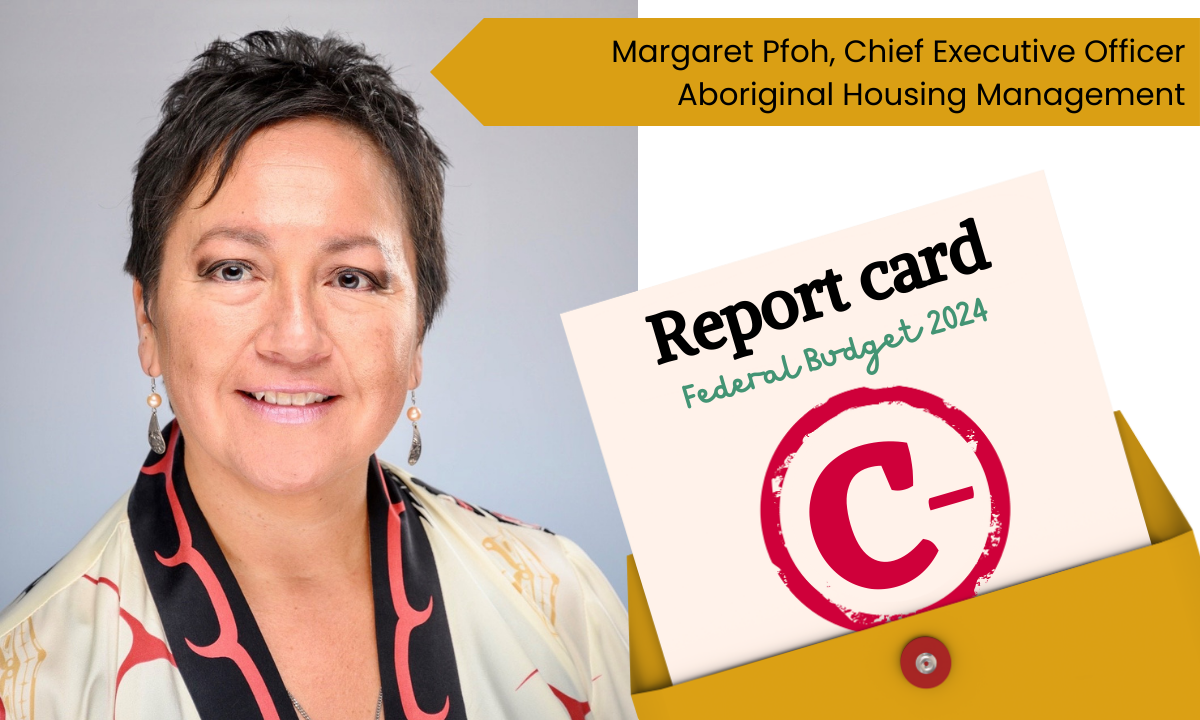
Margaret Pfoh, CEO, Aboriginal Housing Management
Report Card Score: C-
After decades of neglect, the Canadian government is addressing the housing issue. I see a real commitment. But to attribute a C+, I need to see the funding transferred now.
The Federal Housing Plan reiterates the 2023 commitment of $4.3 billion towards urban, rural, and northern Indigenous housing, stating that money will be released in 2024. This timeline is critical; it will save lives.
And we need to talk about affordability. The government is allocating an additional $1 billion to the Affordable Housing Fund (AHF). However, it is affordability for the middle class. We need deep affordability for the most vulnerable. Raising the proportion of community housing within the overall housing stock generates gains in economic productivity. For example, an increase of 1.5 per cent would boost productivity by 5.7 per cent to 9.3 per cent and add $67 billion to $136 billion to the GDP.
Lastly, I salute the new $1.5 billion National Rental Protection Fund, inspired by B.C. Rental Protection Fund. However, the B.C. government offers non-repayable loans, and the National Fund provides loans. It makes a huge difference for small non-profit developers; they cannot take on more debt. So, more prominent housing non-profits primarily benefit from the National Rental Protection Fund.

Bernard Ndour, CEO, Cap Finance
Report Score Card: B-
The government has respected the fiscal anchors it had set for itself, including maintaining the deficit at $40 billion. A challenge that remains is achieving sufficient economic growth in the long term.
He announced measures that the CAP Finance Social Finance Fund believes are aligned with the objective of a more just and equitable Canada.
For example, establishing a national school feeding program with an investment of one billion dollars over five years. And the creation of a new $500-million fund to help community health organizations that support youth mental health and support for student accommodation,
We also appreciate the modification of the Canadian mortgage charter so that it considers the payment of rent on time in the calculation of the tenants’ credit score.
On the other hand, the government’s efforts remain insufficient regarding investments in infrastructure and housing in indigenous communities and rural regions outside major centers.
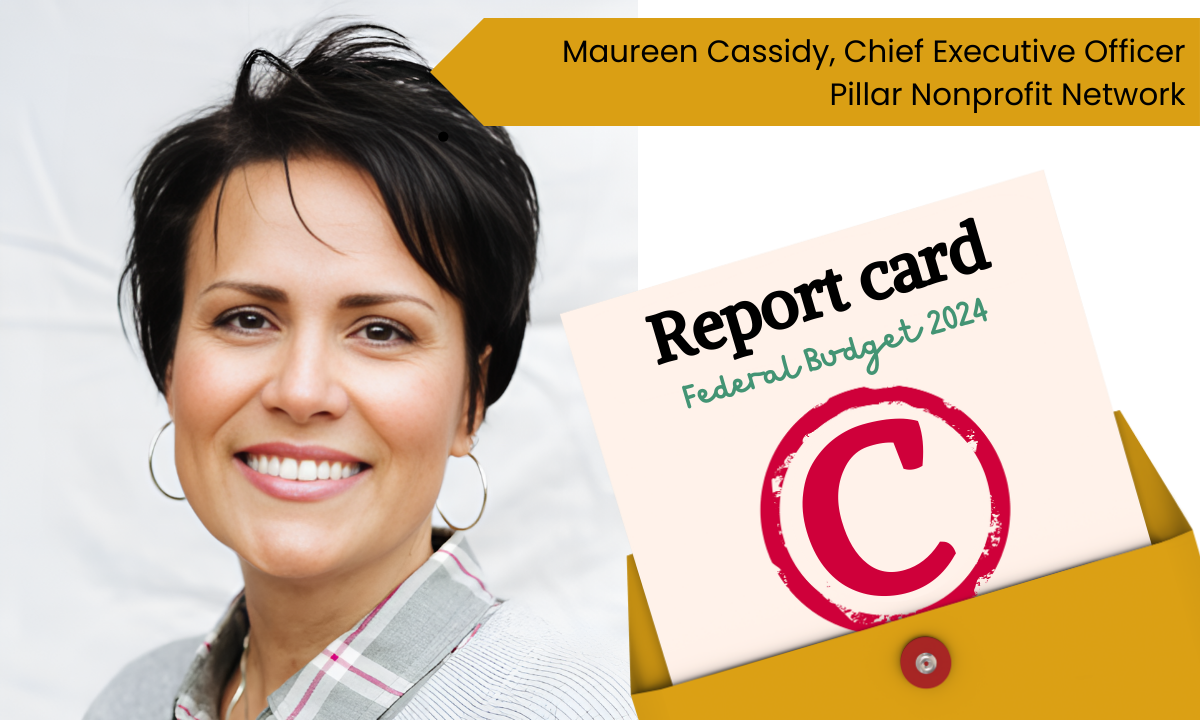
Maureen Cassidy, CEO, Pillar Nonprofit Network
Report Card Score: C
Things may not get worse for non-profits due to this budget. Still, there’s not much to lessen systemic pressures on rising costs and a languishing workforce except where targeted affordability measures help reduce social service demand and make it easier for Canadians to participate in sports and the arts.
We love the resourcing of the Canadian Race Relations Foundation and Canada’s Action Plan on Combating Hate, including its many investments. Anti-racism and anti-oppression require whole-of-community responses, and we hope these investments bring the non-profit sector along and also slowly reduce the demand for services resulting from racism and hate. Here, we also like the combination of project funding with core capacity-building funding, a key item in our advocacy for funding reform.
We love the funding to Volunteer Canada to develop a National Volunteer Action Strategy. Done well, this intervention could transform volunteerism in Canada, maintaining the community impact of the before times while remaining sensitive to Decent Work issues and the ways that folks want to engage in the community.
We think the budget is transformational on affordable housing and the role of non-profit and co-op housing providers. Much has been written about this elsewhere from the perspective of policy levers, but if the outcomes include a lessening of demand for nonprofit services related to poverty, this is good.
At a granular level, new investments in the Canada Disability Benefit are woefully inadequate, and there’s a whole lot that’s just not good enough.
We were also genuinely surprised and disappointed that the government stuck to its plan to defund Canada Summer Jobs to pre-pandemic levels, even though the program is de facto the only federal non-profit workforce development strategy outside of regulated professions and despite vigorous advocacy by non-profits and MPs across parties.
At a less granular level, it seems like a grab-bag. Except for the thinly threaded theme around affordability for young Canadians, this is another piecemeal budget with scattered investments and little sense of how they might combine to produce more equitable and resilient communities.
Even the commitment to gendered budgeting practices seems to have given way to this focus on generations, further gutting the budget of overarching consistency with this government’s ongoing priorities.
I think this is another good argument for the non-profit sector’s home in government or at least a doorway to government. Every time the federal government fails to consider how it can partner with nonprofits to achieve its equity and inclusion goals, it demonstrates a lack of seriousness or real commitment to its stated priorities.

Romain Williams, Executive Director, Inclusivity Institute for Better Data
Report Card Grade: C
While the budget has introduced several beneficial initiatives, there is room for improvement in directly supporting inclusive data practices and extending specific aid to structurally excluded groups.
The investment of more than $260 million in DEI since 2018 is commendable. It enhances sector-wide efforts to combat racism and promote diversity, aligning with IIBD’s goals. However, the absence of specific allocations for inclusive data practices limits the potential for targeted improvements in this critical area.
The allocation of more than $760 million to Black-led programs is highly beneficial, directly supporting the communities we serve. Yet, additional focus on data-driven initiatives could further enhance these efforts.
The extensive funding provided for sector support is crucial for maintaining non-profit operations, particularly under economic pressures. However, more earmarked funds for technological and data advancements would better equip the sector to leverage modern opportunities.
The significant investment in linguistic diversity supports the creation of inclusive communication tools, essential for IIBD’s multilingual initiatives.
The budget’s commitment to AI and technological funding, including $2.4 billion in AI initiatives and $200 million for the Venture Capital Catalyst Initiative, represents a significant opportunity for IIBD. These investments can support the development of AI-driven tools and solutions that enhance data inclusivity and address systemic biases. However, ensuring these technologies are developed with a focus on ethical standards and inclusivity is crucial for their effective implementation within the frameworks of organizations like IIBD.
The lack of initiatives for disability access and migrant integration is notable. Including these supports would enhance our ability to address comprehensive societal inclusivity.
Targeted initiatives for Indigenous communities and dedicated funding for inclusive data practices are essential to develop methodologies that reflect diverse populations accurately and mitigate biases.
Guidelines for inclusive data practices in federal projects would ensure that inclusivity principles are uniformly applied, enhancing the effectiveness of diversity policies and data relevance.
Tim Ross, Executive Director, Co-Operative Housing Federation of Canada
The focus on housing is welcome. Co-ops are ready to help address the housing crisis. However, we need the Co-op Housing Development Program to launch immediately.
The program was first committed to the 2022 budget. CHF Canada continues to call on the government to launch it without delay. We have shovel-ready projects at risk of missing the 2025 construction season.
Jacob Homel, Director, public affairs, Chantier de l’économie sociale
Le Chantier de l’économie sociale welcomes an ambitious federal budget that addresses some of the country’s most pressing problems.
However, among the key measures of this budget, several either require more details on their implementation or will need to be negotiated with the government of Quebec.
The Chantier would like to highlight aspects that must be integrated into the federal assessment frameworks and negotiations with Quebec to ensure that these measures support the only way to build and protect housing that can, in a long-term manner, withstand an overheating real estate market: non-profit housing.
For example, additional points should be integrated into the analysis grids for “sustainable” affordable housing. Affordability criteria over 10, 20 or 30 years only delay rent hikes. Moreover, the Canadian Rental Protection Fund must be managed by developers and social economy networks in Quebec, like the Rental Protection Fund in British Columbia.
Jason Shim, Chief Digital Officer, Canadian Centre for Nonprofit Digital Resilience
I was pleased to see commitments to supporting AI infrastructure and leadership in Canada; however, I was disappointed that there was no specific mention of this infrastructure applying to the non-profit sector. Charities and non-profits also need support to use technology effectively!
I was also pleased to see that the new advisory Council on Science and Innovation will include representation from the non-profit sector. I hope this will help ensure solid support, funding, and strategy around ongoing research on digital adoption specific to non-profit organizations, especially in the areas of AI and cybersecurity. There’s a lot of promising emerging technology, and the prospect of weaving a national research strategy around its development is positive.
Finally, I’m hopeful that the announcement of a right-to-repair framework will make technology more affordable over the long term for individuals and organizations in the sector by providing more options for fixing and upgrading equipment.
CCNDR’s goal to to ensure a non-profit sector lens is applied to tech, data, and digital adoption policy and programming. There is a lot of activity in government within this policy realm — cybersecurity, skills development programming, and technological adoption supports.
The non-profit sector needs to be engaged when these programs are being designed so that they meet our unique needs. It’s not enough to simply expand eligibility for programming designed for business to nonprofit organizations. There is an opportunity for the government to work with the non-profit sector as a partner in leading and shaping what this age of digital advancement could look like for Canadians.
Your job. Your mission. Your news.
With your support, the sector you're building gets the journalism it deserves, and you get a tax receipt.

Authors


Related Articles

Nova Scotia approves Indigenous-owned, largest-ever wind farm to power hydrogen production
The massive 1.2‑GW wind farm locks in Indigenous-led ownership and will power Canada’s biggest proposed green hydrogen export hub.

Indigenous Clean Energy now delivers 10 per cent of Canada’s generated electricity
Indigenous Nations now co-own or hold commercial stakes in enough clean energy projects to power more than 1 in 10 watts generated in Canada.

Video: Youth-led lawsuit accuses Carney government of abandoning its 2030 climate target
The groups say Ottawa’s carbon price and methane rollbacks have made its legally mandated 2030 emissions target unreachable
