Scorecard: Does budget 2021 give us the social safety net we need? Social impact leaders weigh in
Why It Matters
COVID-19 has tested Canada’s social safety nets, and many would say they’ve failed that test. Historically oppressed and marginalized communities have fallen deeper into poverty and marginalization. The budget provides a roadmap for how the federal government plans to change this reality.
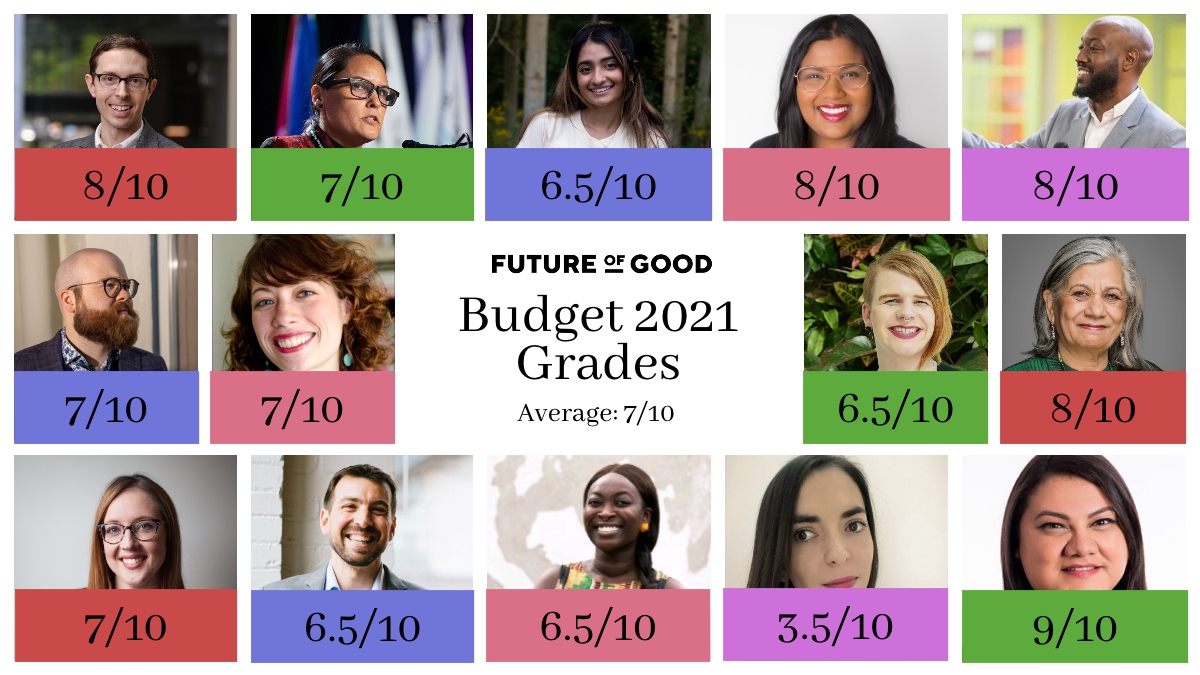
The federal budget received a lot of buzz this week.
Many called it historic, and having been tabled by the country’s first woman finance minister was only part of the reason for that. The government framed the budget as a map to pandemic recovery, and made big investments in child care and other social services.
But beyond the headline numbers, what do the people working in the social sector really think of the budget? More specifically, do they think it sets the country up with a strong enough social safety net for a post-pandemic reality? We asked 14 social impact leaders that very question — and to give the budget a rating out of 10. Here’s what they told us:
Adam Spence | CEO, SVX
Score: 8/10
I’m happy to see…
Social innovation made headlines in this budget. Alongside core investments in critical areas like child care and business support, the clear advancement of enabling policies and investments across government that advance inclusive economic growth, while also tackling economic and social challenges was a very encouraging feature. Alongside the acceleration of the Social Finance Fund and the renewal of the Investment Readiness Program (IRP), investments in affordable housing, regional economic development, women and BIPOC entrepreneurs provide a significant platform and opportunity to leverage additional capital and to grow a larger, transformative movement of investors, organizations, enterprises and funds seeking to advance social, economic, and environmental justice.
I’m discouraged by…
One gap in the budget could be described as a missed opportunity. Significant investments were made to support Canada’s international development agenda, and great work is being done on the front line by Global Affairs Canada (GAC). But there is a greater window of opportunity for Canada to clearly identify inclusive growth and impact investing as a stated public policy priority of Canada’s global agenda, particularly in the Global South. In concert with core investments in basic services and infrastructure alongside support of strong civil society institutions, Canada could provide global leadership as a model partner that is public in its support for impact investing as a political priority and a means of mobilizing capital to tackle issues from climate change to rural economic development.
Anjum Sultana |National director of public policy and strategic communications, YWCA
Score: 8/10
I’m happy to see…
This budget was historic and was truly a Feminist Recovery budget that YWCA Canada has been advocating for since the start of the pandemic. Many announcements mirrored our recommendations in our Feminist Economic Recovery Plan. It committed an unprecedented $30 billion dollar investment to build a nation-wide early learning and child care system. This is the level of funding needed to fulfill a 50-year aspiration for Canada. It won’t happen with only the federal government taking action. We need the provinces and territories at the table. We also need charities and non-profits to survive the pandemic to deliver essential services like child care and ensure a recovery that works for everyone possible. That’s why the $400 million for the Community Services Recovery Fund is an important step in the right direction.
I’m discouraged by….
During the COVID-19 pandemic, Millennials and Gen Z are experiencing a once-in-a-generation economic crisis at a formative time period in their lives. Given the unprecedented threat to young people’s prospects and potential, we need a unique approach that meets the moment with urgency and ambition. Short-term fixes like waiving interest on student loans for an additional year and increasing investments in the Youth Employment and Skills Strategy while welcome, do not go far enough. Life has completely changed and this is not how young people envisioned starting out their adult lives. Any disruption to the labour market is dire but this is worse the earlier on in your career. Young people may be dealing with the economic and social fallout from this pandemic for the next 10 years and we need to do everything in our power to avoid a lockdown generation.
Boris Martin | CEO, Engineers Without Borders Canada
Score: 6.5/10
I’m happy to see…
It is still hard to fully grasp the full scale of positive change that comes from a budget that, domestically, was designed to create transformative improvements in areas like child care, housing, employee ownership, racial equity and social innovation.
I’m discouraged by…
At the same time as a citizen concerned about vaccine equity around the world, I was left confused about the lack of long term commitment to fighting against COVID19 globally in budget 2021. From that vantage point the budget was inadequate, as if we could wish this global pandemic away as soon as we Canadians get vaccines. As if we can start the job of recovering while we leave the majority of the world in the dust, waiting for a vaccine for another two years or more.
Carol Anne Hilton | Founder, Indigenomics Institute
Score: 7/10
I’m happy to see…
This budget saw significant supports for women, girls, parents, and investments in child care. There was a lot of good in this latest budget, while of course this perception is largely dependent upon context and experience.
I’m discouraged by…
While $18 billion to ‘close the Indigenous socio-economic gap’ is flashy and compelling, I bring to attention the shortcomings of this language and approach. The socio-economic gap is the effect of hundreds of years of Indigenous economic exclusion. It’s time for modern constructive generative Indigenous economic design. It is time to start measuring Indigenous economic strength.
Debbie Owusu-Akyeeah | Executive director, the Canadian Centre for Gender & Sexual Diversity
Score: 6.5
I’m happy to see…
We are encouraged to see significant funding for youth, particularly around supporting quality job opportunities to build the first crucial years of young people’s careers and making them competitive in the labour force, and supporting entrepreneurship and mental health. More than any other group, young people have seen more job loss than any other age demographic (14 per cent, compared to 7.5 per cent among Canadians as a whole) and often have little to make ends meet. Low-wage precarious work, or lack of work entirely can take a significant toll on anyone’s mental health and quality of life, and these stresses disproportionately impact young people who are also 2SLGBTQ+, Indigenous, racialized and Black Canadians, and recent migrants, as they disproportionately represent low-wage work.
We see from the federal government an investment in young people being competitive in the labour force and considering access to entrepreneurship, supporting Indigenous students in postsecondary education, considering the role that student loans play in young people’s lives, and funding crucial mental health supports like Kids Help Phone.
While the proposal of a new $15 federal minimum wage is a step in the right direction, it will not necessarily bring workers out of poverty or improve the lives of workers. This outdated figure does not contextualize the current cost of living and the rising costs of essentials like food, housing, transportation, etc., particularly in major Canadian cities.
We’re also encouraged to see significant funding going towards supporting Indigenous and 2SLGBTQQIA+ organizations to provide gender-based violence prevention programming aimed at addressing the root causes of violence against Indigenous women, girls, and 2SLGBTQQIA.
I’m discouraged by…
2SLGBTQIA+-specific funding has been significantly negatively impacted, with the federal budget proposing $15 million over three years to Women and Gender Equality Canada (WAGE) for a new LGBTQ2 Projects Fund. This proposed amount is a reduced amount compared to the commitment from the 2019 Liberal policy platform (which was $10 million a year over three years).
This funding scarcity exacerbates pre-existing funding challenges for 2SLGBTQ+-specific organizations and we are concerned that 2SLGBTQ+-specific and 2SLGBTQ+-led organizations will have to unnecessarily compete to secure crucial funding needed to serve 2SLGBTQ+ organizations across Canada.
The consultation period of the LGBTQ2 Action Plan and the limited funding for 2SLGBTQ+ communities leaves more to be desired and has us contemplating the federal government’s commitment to investing in improving the social, health, and economic outcomes of diverse LGBTQ2 communities throughout Canada.
Fae Johnstone | Principle consultant, Wisdom2Action
Score: 6.5
I’m happy to see…
I was encouraged by the funding commitments made to advance affordable child care in Canada, and the new investments into the feminist movement. These investments will go a long way in advancing gender equity in Canada, and strengthening our feminist organizations.
I’m discouraged by…
I was disappointed by the tiny amount of funds earmarked for 2SLGBTQ+ community organizations. Front-line 2SLGBTQ+ organizations have been responding to numerous crises facing our communities for decades, including homelessness, poverty, mental health issues and more, which have been made all the more complex amidst a global pandemic. It is disappointing to see such a paltry commitment of $15 million, spread over 3 years and 13 provinces and territories. We cannot substantially tackle homophobia and transphobia without direct, operational, funding for 2SLGBTQ+ community organizations. The lack of investment in our communities was a huge missed opportunity in budget 2021.
Gloria Novovic | Policy lead, Cooperation Canada
Score: 3.5/10
I’m happy to see…
The most encouraging are allocations towards initiatives tackling systemic racism: funding better and more disaggregated official statistics, investing in a Black-Led Philanthropic Endowment Fund, expanding locally-led green projects of Indigenous communities etc.
On my radar are the announced commitments towards climate finance: so far Canada has been failing to meet its fair share and is one of the worst offenders for providing loan-based climate finance. We are hoping the government’s commitment to solving the climate crisis matches its rhetoric: we need to see sustainable, substantially increased, grant-based climate finance that focuses on both climate mitigation and adaptation, to support community resilience and historically marginalized communities.
I’m discouraged by…
The liberal government passed up a unique policy window to invest in an effective global COVID response and a strategic agenda for building back safer, healthier, more sustainable communities in the aftermath of the pandemic. The pandemic highlighted how interconnected our economies and our global health are, as well as just how much we rely on social nets in every area of our lives. The government had the perfect opportunity to propose a bold and a strategic vision – instead they chose to win a few political points and apply band-aid solutions
What is alarming about this budget is how fragmented and inward-oriented it is. We know that Canada will not recover from this pandemic until the world recovers, but Budget 2021 positions Canada as an underperforming partner across humanitarian and development arenas, yet again. Global experts are warning of famine, a debt catastrophe, the reversal of 25 years of human development progress, yet Canada is contributing less than half of its fair share globally. These funding levels are not only modest: they are unsustainable, as they are increasingly in the form of loans and also unpredictable, with ‘governance by announcement’ approach hindering the ability of the entire sector (including Global Affairs Canada) to plan strategically.
Jane Hilderman | Executive director, Climate West
Score: 7/10
I’m happy to see…
As a working mom, the investment in daycare was both bold and overdue. The roll-out with provinces will take time to sort out, but so goes with transformative social programming.
I’m discouraged by…
Assuming a low-carbon future is part of the new “social safety net,” the government’s (increasingly) laser-like focus on emission reductions matters. But they’re missing some wins to advance adaptation to climate change. Budget 2021 offers billions in new support for energy retrofits of buildings, but does not align this program to boost the resilience of buildings in the face of flood, fire and other extremes. Let’s do both! In short, for climate action, this budget gets some foundations in place, but significant scale up is yet to come.
Jocelyn Formsma | Executive director, National Association of Friendship Centres
Score: 9/10 overall; 6/10 for urban Indigenous communities
I’m happy to see…
Overall, I am extremely encouraged by the record contributions and investments for Indigenous people. I am very happy to see the expansion of Aboriginal Head Start program, Indigenous Community Support Fund (ICSF), Indigenous Early Learning and the support provided to charities and non-profits through the temporary Community Services Recovery Fund. We have worked extremely hard with our partner organizations to ensure that Friendship Centres and other charitable organizations will be eligible so that they can continue providing those life-saving services at the community level.
I’m discouraged by…
I am disappointed that the 2021 federal budget does not directly mention Friendship Centres and that the supports for urban Indigenous people that are mentioned in the budget, are spread out amongst multiple departments. It will take us some time to digest whether these supports are actually applicable to urban Indigenous communities. At the national level, our head office will do our best to do some of the heavy lifting for our Member Friendship Centres. However, at the community level, our Friendship Centres will require more capacity to chase down these opportunities when compared to the capacity held by other urban organizations. It is also important to highlight that urban Indigenous organizations are more likely to be led by women and 2SLGBTQQIA+ people, therefore the uncertainty that we are feeling as urban Indigenous people, will also spill over into this gender consideration as well.
Manvi Bhalla | Founder, Shake Up The Establishment
Score: 6.5/10
I’m happy to see…
I’m encouraged by the investments in child care, as this has major implications on what a post-pandemic reality looks like for women. Given that women are often forced to take on a disproportionate amount of unpaid domestic labour, increasing investments into affordable child care is one way to begin to address gender-based income inequity. Along these lines, the investments in Black and Indigenous communities was encouraging. However I also recognize the tireless role that BIPOC-led advocacy groups played in ensuring that these supports were included in this budget, and I hope that this is only the beginning of many financial supports that are provided to the communities that have and continue to be the most underserved by our governing structures.
I’m discouraged by…
In an Ontario context, the South Asian community was one of the populations hit hardest by COVID-19, particularly within the hot spots of Toronto, York Region and Peel Region which were among the regions with the highest caseloads across Canada for the duration of this pandemic. As far as I know, there weren’t any sort of additional supports for South Asians, particularly essential workers who have had to work throughout this whole pandemic, and who have had to manage the devastating impact on their (and their loved ones’) physical and mental health throughout this time.
Further, I can’t fail to mention that this budget doesn’t adequately address the climate crisis. I saw Seth Klein’s commentary on Twitter and his comment on how this budget is targeting a 36 percent reduction in GHG emissions, when a 60 percent reduction is the minimum we need to be aiming for, says it all. The amount being invested in this budget doesn’t even compare to the US, nor does it reflect the urgency of investing in a just transition — because whether we like it or not, the energy transition is upon us.
Senator Ratna Omidvar
Score: 8/10
I’m happy to see…
I am encouraged by the historic contributions to child care in the budget. This is a significant and important initiative that will help many families.
For the charitable sector I am encouraged about the $400 million recovery Fund. It will help charities recover from the pandemic. However, the fund needs to provide core funding to charities and prioritize small and medium charities and non-profits that are hard hit by the pandemic.
I’m discouraged by…
Despite some good initiatives for the charitable sector, I am discouraged that a vision wasn’t laid out for the sector. We are left with trying to piece together the budget and the government response to the Senate Charities report to find some vision.For major social policy. I was hoping there would be an exploration of a basic income to provide modern income supports.
Sarah Schulman | Founder, InWithForward
Score: 7/10
I’m happy to see…
Big (and long overdue) investments in early childhood, long-term care, and low-wage worker benefits. Of course, there are bright spots in the budget — glimmers of what might be possible when we put resources directly into the hands of communities, and create new kinds of roles for citizens: for example, the investment of $200 million to establish the Foundation for Black Communities, led by black communities — not by government, or the creation of the Canada Digital Adoption Program, to match young people with tech know-how to small businesses.
I’m discouraged by…
In 2021, the goal should not be to simply repair the holes in our existing social safety net, but to transition our safety nets intro trampolines. Doing that requires re-imagining the purpose of our welfare state, or in the terms of this budget, the function of social infrastructure.
Beyond the litany of numbers for new benefits and services lies a status quo narrative: one of economic productivity and growth. The welfare state is positioned as a tool to drive greater prosperity and wealth — not as a tool to foster connection, cohesion, or contribution. The title of the budget is telling — focused on recovery, which is a return to normal, not a re-envisioning of normal.
Too much of the budget relies on dominant logics: putting more money into more programs administered by old world bureaucratic systems, without investing in the social sector’s capacity to do different, not just better. Building a just society, where we all have the capabilities to flourish, requires wholly different beliefs, relationships, and practices — ones rooted in wellbeing, not just productivity.
Tristan Smyth | Chief operating officer, Canadian Roots Exchange
Score: 7/10
I’m happy to see…
Probably lost in the promises of hundreds of millions of dollars is that Budget 2021 commits to reducing credit card transaction fees for SMEs. Canada has some of the highest interchange fees in the world. This will be a boon for social enterprises and not-for-profits that rely on sales as a revenue stream by decreasing their overhead costs.
I’m discouraged by…
Members of the not-for-profit community continue to wait for the federal government to implement many of the recommendations from the Special Senate Committee on the Charitable Sector. The launch of the disbursements from the Social Finance Fund, continuation of the Investment Readiness Program, and creation of a Community Services Recovery Fund are half-measures rather than holistic solutions to the debilitating funding uncertainty that many nonprofits and charities, not just currently, but continually face. Until there are significant changes to the Income Tax Act, Canadian Not-for-Profit Corporations Act, and how the government supports the sector, we are not talking about building back better, we are talking about building back the same.
Victor Beausoleil | Executive director, SETSI
Score: 8/10
I’m happy to see…
Rating the budget from one to ten is challenging based on the seriousness of the times we are living in. We are consistently reminded of the centuries of systemic racism in Canada, and our inability to address many challenges as a nation. Communities already marginalized by racism and inequity were hit hardest by COVID-19.
The work of the Foundation for Black Communities has been inspiring. And the subsequent bold proposal to establish greater equity in resource allocation through the development of a Black-Led Philanthropic Endowment Fund is very promising. The proposed funding through the Supporting Black Canadian Communities Initiative at ESDC is also another solid step in the right direction.
We are excited about the investment in the Women Entrepreneurship Strategy, and the National Action Plan to end Gender-Based Violence. These two important initiatives are imperative for a nation that we can all be proud of.
The announcement of the renewal of the IRP and the planned disbursements of the Social Finance Fund provides another remarkable opportunity to scale innovation and establish a thriving, inclusive and diverse social finance ecosystem in Canada.
I’m discouraged by…
I was disappointed by the fact that the word co-op was not mentioned in the budget. The cooperative movement in Canada is 4 percent of the GDP and employs approximately 200,000 Canadians.
I was also disappointed in the framing of social procurement, specifically around ownership
with a limited social value agenda. A vision for a more inclusive economy is one of shared prosperity and well-being. Social procurement is a tool that when widely adopted and prioritized will benefit all Canadians.
Despite competing interests, we aim to work within the community, partner with stakeholders and support our government to actualize the vision conveyed in the budget and ensure that no Canadian is left behind.
Tell us this made you smarter | Contact us | Report error