TakingITGlobal has been providing micro grants to youth-led projects for almost 20 years — here’s what they’ve learned
Through accessible, low-barrier grants, the #RisingYouth project funded 7,000 youth-led projects in the last five years for youth-led initiatives across Canada
Why It Matters
Youth are inheriting complex and urgent problems, yet they say they need holistic support if they are to contribute to solutions. It’s vital to give youth agency to act on their ideas and solutions from a young age, TakingITGlobal argues, to encourage them to continue being actively involved in global and local issues.
This story is in partnership with TakingITGlobal. See our editorial ethics and standards here.
As a teenager, Jennifer Corriero was quick to point out what wasn’t working in her school system. While she was an avid volunteer, she also noticed that there were not nearly enough volunteer placements for her and her peers to be actively involved in their community.
One day, running late to school, Corriero got called to the principal’s office. She was worried she was in trouble, but to her surprise, her principal instead suggested she apply to the City of Vaughan’s Youth Cabinet, as a student who had a lot of ideas and opinions.
“That was a very powerful act — to be asked my opinion,” says Corriero, who served as the editor for the school newspaper, and also went on to be selected as a member of the Vaughan Youth Cabinet.
“I felt that in my high school years there weren’t enough outlets [for youth activism],” says Corriero. “I got really lucky that I got chosen to participate, but … I really felt a sense of responsibility to create more opportunities [for others].”
Corriero founded TakingITGlobal, an organization delivering youth engagement programs, in 1999 as she and co-founder Michael Furdyk were rollerblading around Ottawa, trying to figure out how to make a space to empower youth to participate in local and global issues.
In 2004, the organization began with their first round of micro grants, one-time grants that go up to a few thousand dollars and fund small-scale projects, to support youth-led initiatives globally. In the Middle East, they created a micro grant program with the Library of Alexandria for over a decade called Youth for Change that supported youth-led projects in the region.
Then, In 2017 TakingITGlobal started their #RisingYouth project, supported by the Government of Canada’s Canada Service Corps initiative. #RisingYouth sought to fund youth leaders in Canada through micro grants in starting their own projects and creating a network of support for them. Between 2017 and 2022, the #RisingYouth project funded more than 7,000 grants amounting to around $7.8 million in funding.
Why are micro grants important for youth changemakers?
Corriero says that supporting youth with their ideas at an early stage is vital to encourage their momentum as young changemakers.
“When you’re in that stage of adolescence, in your formative years, there’s a certain sense of rebellion that you might have and there’s also a certain sense of forming your identity. So youth need those [learning] spaces to form ideas, opinions, and their voices,” says Corriero.
The #RisingYouth project funded youth projects across Canada in every province and territory working on a diverse range of issues from climate change to queer rights. Some projects are as straightforward as making hot meals for folks living in an encampment, while others deal with longer projects like creating a series of short films about 2SLGBTQI+ youth.
Youth could apply for grants of $250, $750 or $1500 to go toward their projects or initiatives, and needed very few eligibility requirements to apply. Applicants mainly needed to identify an issue, propose their solution with an action plan within the grant application, making it accessible for a wide range of youth.
Keeping the application process straightforward and simple was an important element for the #RisingYouth project, according to Corriero. The response time for when applicants heard back about the status of their application was even capped at 30 days. In the last year of the #RisingYouth project, the average response time for applications was nine days.
The opportunity to do these types of projects also gives youth the opportunity for skills development like financial literacy and project planning that is most effective through hands-on experience, she says. Youth can also learn how to design a project that will benefit and have an impact on those in need.
Learnings from the #RisingYouth project
One of the major takeaways for Corriero through doing this project, she says, was the importance of structuring the program to match how youth function, rather than adhering to the donor. Having a quick response time was part of this, but also tailoring the general grantmaking timeline to the participants.
In dealing with this challenge themselves, the #RisingYouth project developed a technology solution that made it easier to have applications come in and grants flow out on a rolling basis through an alert system.
“How do we make sure that the donors are not unnecessarily defining the experience for the participants?” says Corriero, “that’s the biggest challenge for our sector.”
TakingITGlobal’s team also found that beyond the microgrants, building a network for youth was helpful in building a supportive culture for participants where they could learn from each other. Corriero says that even for the applicants who weren’t approved for a grant, the team would meet them for a consultation to help them enhance their application.
Having flexible mechanisms for youth changemakers has a lot of benefits, according to Corriero. While being surrounded by people who support them will give youth a sense of belonging and connectedness, in the long-run, that support “fuels a mindset of social innovation and a constant source of creativity, which we need as a society.”
Projects funded through micro grants can be scaled into bigger initiatives
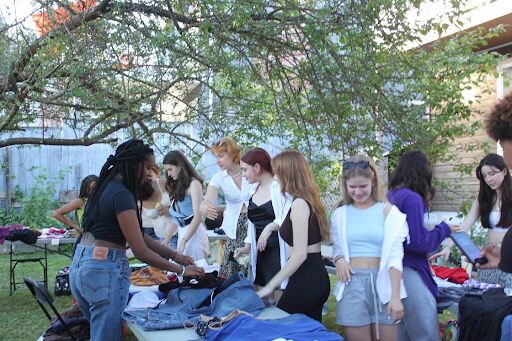
For Tasia Valencia and Nika Rovensky, #RisingYouth alumni, their micro grant allowed them to organize a clothing swap event as a response to the negative environmental impacts of fast fashion. The community event in Coquitlam, BC this past summer also had a keynote speaker who spoke about the issue of fast fashion and trend consumption.
“Micro grants are an amazing way to fulfill productive ideas from an upcoming generation, especially for those who do not have the funds to make an idea come to life. They are just enough to get a project done, and it can be the start of a very impactful initiative that continues beyond an initial micro grant,” says Valencia.
In the future, Valencia and Rovensky are planning on doing seasonal clothing swaps and community-centered fashion events through their initiative, CC Vintage.
“I’ve also grown my interest in sustainable fashion since our first community event in July 2022,” says Valencia about their clothing swap. “A peer and I have since started a fashion club in our school where we are planning various events that address fast fashion issues and encourage sustainable clothing consumption such as more clothing swaps, runway shows, clothing drives, and upcycling workshops.”
Corriero says that similar to Valencia, other #RisingYouth alumni have felt more confident in their skills and leveraged their initial idea and applied it to other projects.
“If youth don’t have an outlet for idealism, it will risk hopelessness, powerlessness or a sense that they cannot change the systems that aren’t benefiting them,” says Corriero, “but even from a few hundred dollars to up to $1,500 allows for their imagination to be given that chance to come to fruition.”
Your job. Your mission. Your news.
With your support, the sector you're building gets the journalism it deserves, and you get a tax receipt.

Related Articles

Disbursement quota change released extra $711 million into charitable sector: Imagine Canada
New research into the impact of the disbursement quota changes has found that 1,190 foundations, primarily private, were affected. According to Imagine Canada’s principal researcher David Lasby, these foundations would previously have been “disbursing below the levels required by the new quota.”
Protecting rural housing: Saltbox Fund founder on the power of lending circles
KJ Conyers-Steede is piloting a peer-to-peer community financing model that can be scaled and replicated across rural Canada.

How philanthropy can uplift affordable housing
A new affinity group hosted by Philanthropic Foundations of Canada (PFC) will bring together foundations with deep expertise in funding housing, as well as those that might be new to the space.
