Here’s how 3 Canadian tech companies are reinventing philanthropy
A whole new world of giving
Why It Matters
The tech sector is one of the biggest drivers of new wealth in Canada. In this Member Exclusive series, we continue to unpack how tech companies are creating new types of structures to give back, beyond conventional foundations and programs — and why this trend is essential to understand to take advantage of an emerging tech philanthropy landscape.
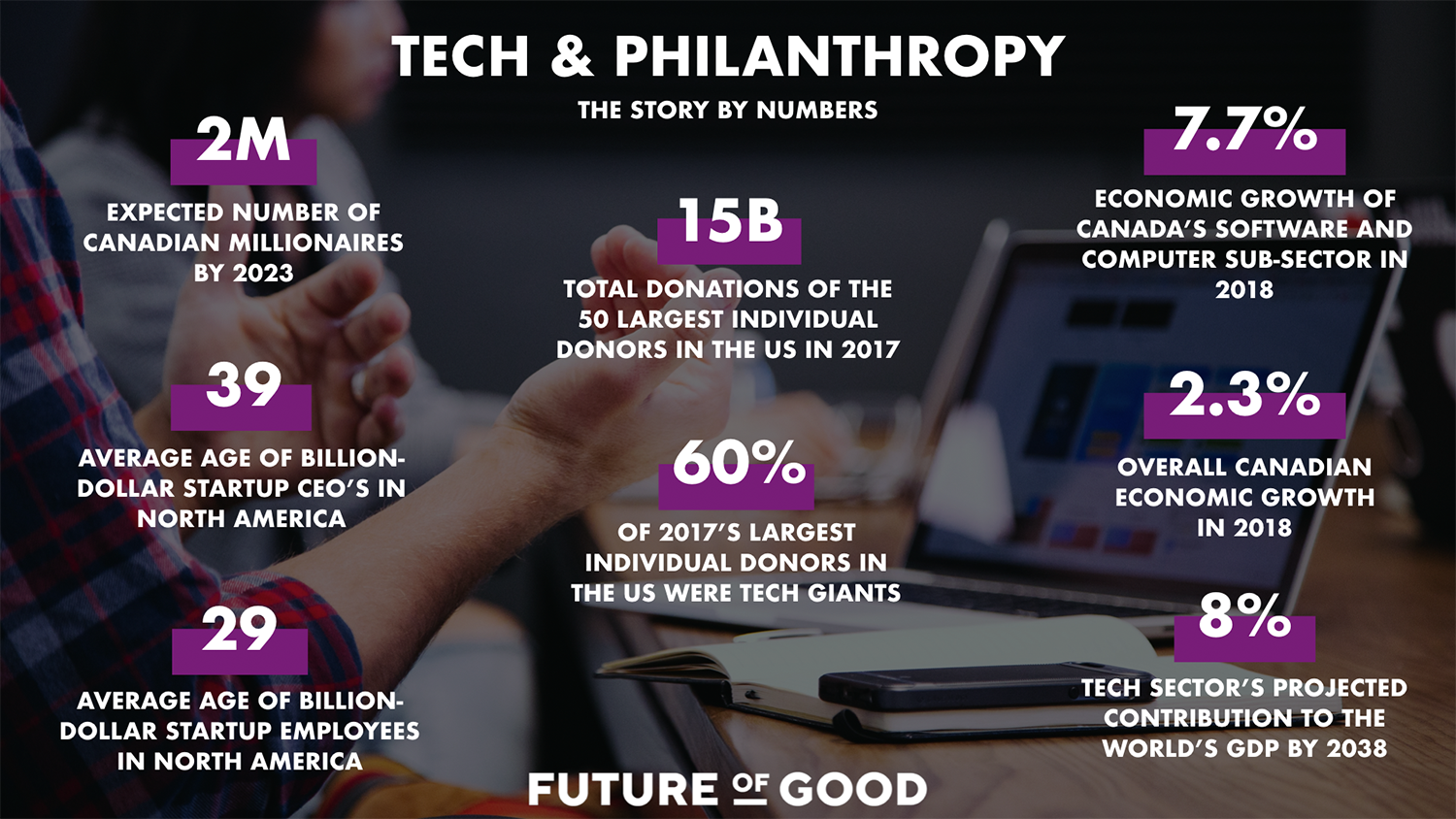
Today, more and more tech companies are giving back. Canadian companies like Hubba are partnering with women’s shelters to provide web development workshops, while LEAP helps donors like Google.org allocate money to Canadian social ventures.
There’s a growing expectation for the corporate sector to give back more meaningfully, and in 2019, it’s estimated that the Canadian corporate sector contributed $4 billion to charities. In the past decade, community investments from the corporate sector have become far more sophisticated, with companies building impact directly into their business models. It comes as no surprise that social purpose businesses are now employing over 254,000 Canadians.
Animikii is an Indigenous-owned business in British Columbia driving positive change for Indigenous Peoples through technology. “Giving back is woven into everything we do,” explains founder Jeff Ward. “It’s like the wings of a bird: on one side are our operations and for-profit work, and on the other side is the impact work that we do. We couldn’t fly without both sides.”
These blended structures, often seen in tech, are disrupting traditional ways of giving back. So — are new structures driving greater social impact?
New structures for giving back
Brett Tackaberry is Chief Technology Officer at Rebel.com, a company that creates web development tools.
“[With] a company of our size, we need every dollar to ensure that the next month is going to be more successful than the last,” says Tackaberry. “So what can we do if we can’t give cash? That’s where we have these strategies to give back, such as our space, our products and our expertise.”
Social media platform Hootsuite’s impact strategy has four pillars: People, Planet, Product and Profits. For the latter, they invest into areas that align with their brand, such as matching employee donations. “It’s through all these initiatives that we hope, in our small way, helps build a better world,” says Henk Campher, Vice President of Corporate Marketing.
Employee activism plays an important role in tech giving. In 2018, Animikii’s volunteer hours rose drastically. “The feedback [of wanting to volunteer more] came directly from our team,” Ward says. “We offer a Social Impact Circle where everybody has the opportunity to participate [and set goals for the year]. It’s super important that our team feels included, and that they’re leading the way forward.”
Is that so different from traditional giving?
Studies show that millennials opt for immediate action for social causes, and are less concerned with who is creating solutions. Instead of top-down structures with granting bodies, lengthy timelines, and specific funding criteria, younger donors want a peer-to-peer framework — driven by tech.
The Upside Foundation is a non-profit that leverages this shift, offering Canadian tech founders the opportunity to give back from day one. Instead of donating time and resources they may not have as a new start-up, the Upside Foundation makes it easy for companies to pledge equity, in case they have a liquidity event in the future.
For Executive Director, Jennifer Couldrey, tech companies are the ones deciding what social impact looks like tomorrow — businesses like Wealthsimple and Wattpad, who are members of the foundation. “The old [philanthropy] model was ‘keep your head down, focus on building your empire’ — and then when you’re nearing the end of your life, you [can] think about how you give some of it away. In the last 20 years, [we’ve] started to see this shift towards ‘giving while living’. Our model is aligned with that sort of broader shift.”
For Campher, that broader shift is critical to creating lasting social change; positive forces like money and education “can now go directly to the beneficiaries, with their constant input.”
Before becoming the first Indigenous B-Corp in Canada, Animikii was already operating as a social venture. “We thought that we could formalize our impact process, and one [approach] was creating the Animikii Foundation, which I was really excited about,” Ward says. “When we dug further into the legality around that, we found that the charity system is very restrictive in how you can make your impact and who you can give back to in-house.”
Not having an official charitable arm never stopped Animikii.
“One of our goals this year is to increase Indigenous participation in the tech and entrepreneurship sectors. There are scholarship programs, and once we identify a need for applicants, we just write a cheque,” Ward says. “A lot of the other funding avenues out there, in particular for Indigenous students, are very restrictive or nonexistent in some cases. By operating within a corporation, we can give back at the speed of business, and not be bogged down by the technicalities of running a charity.”
Couldrey acknowledges how difficult — and at times messy — it can be for a company to give back in a way that is meaningful. “It can be easy to lose your vision. When I talk to people about why they decided to share their upside with us, they say, ‘I had pure intentions going into this. I wanted to build something good for the world — and this is one of the ways that I can be tethered to that intention.’”
Of course, not all tech companies have the same motivations for creating long-lasting change when giving back. “There have been some bad actors in the impact space that have a link at the bottom of their website: ‘Corporate Social Responsibility,’” Ward says. “Beyond some surface-level work in writing a cheque or two, it’s really not woven into the fabric of the culture and the organization.”
On the topic of third-party fundraising, Tackaberry notes, “It’s great for a tech company to grow moustaches for Movember, but they need to add what they do best into the mix. Otherwise it’s kind of like a CSR program, where they haven’t woven in the true value of the company. What Rebel.com is really great at is getting people online. We can grow great moustaches, sure, but we’ll have more impact if we focus on what we do best.”
Campher points to a notorious blind spot that affects tech philanthropy: “I feel that tech industry often focuses on the problem, rather than the solution, and this approach often this just confirms bad behaviour. For example, throwing money at an issue, like STEM education, over and over again, and expecting it to immediately affect change. Often this way of tackling issues delivers an externally perceived benefit with little input from those on the ground, or from those who are directly benefiting.”
Campher’s advice to tech companies giving back? “Just listen! The digital landscape has connected people – people who were previously excluded – into the economy and the discussion.”
For Ward, disruption will come from employees themselves. “[Social impact] will be driven by teams, if not demanded. Tech companies are going to have to adopt an authenticity into their giving back.”
Reflecting on the increasing demand for corporations to act responsibly, Couldrey says, “I think there’s a real appetite [for giving back]. There’s a real excitement around this as we see the tech industry in Canada starts to mature.”
Ward, Tackaberry, Campher, and Couldrey’s leadership in tech show us that traditional giving structures are shifting. With tech being one of the biggest drivers of new wealth in Canada, it’s no surprise that companies like theirs are at the forefront, creating social impact differently.
Your job. Your mission. Your news.
With your support, the sector you're building gets the journalism it deserves, and you get a tax receipt.

Related Articles
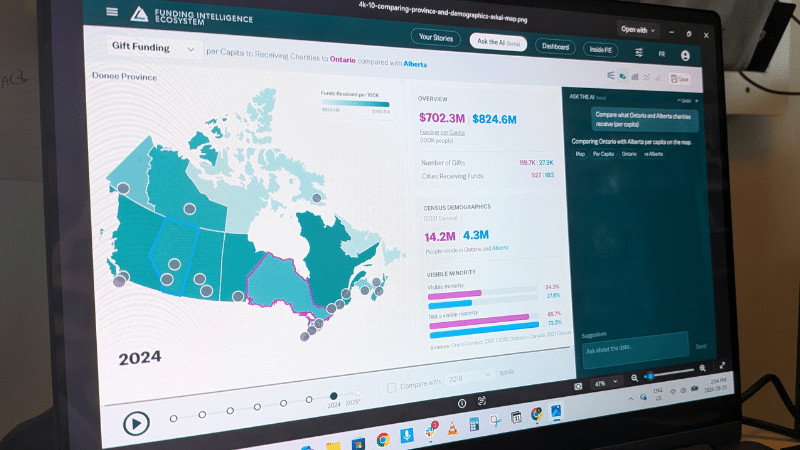
Imagine Canada launches visual tool to ‘see’ non-profit funding landscape
A new data visualization tool designed to let funders, non-profits and researchers understand the entire non-profit funding ecosystem
Ottawa chooses Canadian Housing Acquisition Fund to manage $1.5 billion affordable housing money
The massive new fund will help grant Indigenous, cooperative and non-profit housing providers easier access to capital to help buy and develop homes for lower-income Canadians.

New donation platform to help communities directly pay down mosque debt
Own Your Masjid is a project of boutique marketing agency Process Plus Marketing
