Ten observations about the state of Canada’s outcomes-based finance efforts
The Raven Indigenous Impact Foundation and the Sorenson Impact Institute at the University of Utah have published the first comprehensive report on Canadian Outcomes-Based Finance.
Why It Matters
Between 1960 and 2023, public social expenditures more than doubled from less than 10 per cent of GDP to more than 20 per cent on average across Organization for Economic Cooperation and Development (OECD) countries. However, these investments in social and environmental causes have not resulted in as much impact as hoped. The answer partly lies in how those resources are deployed in these causes.

A new study sheds light on what Canada currently looks like when it comes to using investment money for public good. (Canva/Supplied)
Over the past decade, Canada has invested nearly $20 million to support more than 10,000 beneficiaries through outcomes-based finance (OBF).
The first Canadian OBF was Saskatchewan’s Sweet Dreams in 2014, which focused on young mothers. The expected outcome was keeping 22 children out of foster care. However, it exceeded the initial objective and reached 54 children.
Long-term advantages of Sweet Dreams included education and sustained employment for mothers.
“The State of outcomes-based finance in Canada” is Canada’s first comprehensive review on the topic. The report points to the benefits and limits of this emerging financial tool. It includes lessons from other jurisdictions and recommendations to facilitate a Canadian deployment.
The report was done by the Raven Indigenous Impact Foundation and the Sorenson Impact Institute at the University of Utah.
We noted 10 observations about the report, inspired by several conversations we had over the year with OBF’s stakeholders and throughout the preparation of this article, which was published in early 2024.
Observation 1: OBF shifts mindsets
Traditional financing either focuses on input or output.
Outputs represent the byproduct of a process – like the number of students graduating from a program. Inputs go into a process, like the number of staff hired to run a program.
However, these indicators do not say much about the change in beneficiaries’ lives.
“Outcomes represent the true condition that is trying to be improved–kindergarten readiness, cardiovascular health, carbon footprints, wages, and so forth,” says the report.
“Two-thirds (65 per cent) of the participants to the report conveyed that their engagement with OBF initiatives significantly transformed their perspective on systems change and problem-solving.”
Those participants believed that embracing an outcomes-focused approach positively affected all parties involved.
“Several interviewees observed that service providers were innovating at an accelerated pace compared to prior experiences, particularly regarding their approach to data collection,” said the report.
“Rather than simply employing outcome information to bolster annual reports for funders, organizations had transitioned to using it to inform their impact and shape their organizational priorities.”
Observation 2: There is no OBF without political champions
OBF challenges conventional government program procurement and funding methods.
Therefore, cross-partisan political backing and championing is critical to the success of these initiatives, said 58 per cent of the interviewees.
Backing is even more crucial during periods of political transition, and political champions are required at different levels of government.
“These champions are often individuals recognizing that the diverse needs of communities cannot be adequately addressed through conventional spending regarding complex policy areas,” said the report.
The report highlights how the U.K. has made significant strides in fostering political support for OBF.
Big Society Capital was established in 2012 to fund such efforts. It was funded through English dormant bank accounts and contributions from the four major U.K. banks.
“One of the strengths in the U.K.’s political support for OBF is the broad cross-party consensus. Successive governments have endorsed OBF to deliver better outcomes while controlling costs. This consensus fosters a stable environment for OBF, ensuring that initiatives continue regardless of leadership changes,” said the report.
In the U.S., OBF initiatives have largely emerged at state and local levels with field-building support from the federal government.
“States such as New York, Massachusetts, and Utah, driven by individual political leaders, financial intermediaries and local agencies, have been at the forefront of championing OBF efforts,” according to the report.
Through initiatives such as the Social Innovation Fund, the Obama administration provided several grants to explore and structure OBF initiatives.
Furthermore, the Social Impact Partnership to Pay for Results Act (SIPPRA) allocated $100 million U.S. to improve the effectiveness of specific social services.
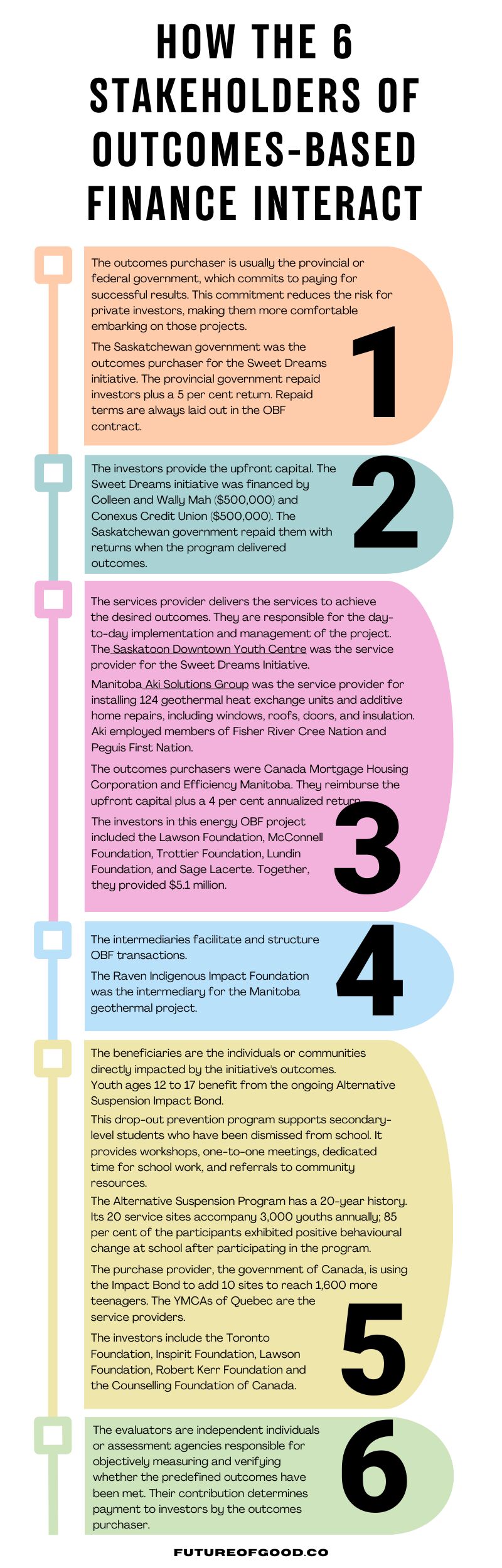
In Canada, Manitoba’s Social Innovation Office is leading the efforts. Since 2014, it has acted as an intermediary for structuring four social impact bonds.
Manitoba’s SIO is working on its first justice social impact bond, an initiative to support youth aged 12 to 18 under restorative justice, community service orders, and/or custody. The future three-year program will target 200 youth in Winnipeg and Thompson.
However, aside from Manitoba SIO’s lead, the report points to a void regarding federal and provincial champions.
Observation 3: The jury is still out on who should lead OBF
Half of the interviewees in the report favoured an outcomes-purchaser-led approach, while the other half believed community leadership was essential for OBF origination.
Outcome-payer-led initiatives ensure the clarity and specificity of the objectives aligned with the purchaser’s priorities. They can enable greater scale, facilitate more extensive policy discussions, and increase the likelihood of systematic changes. Additionally, centralized planning can lead to resource optimization.
“However, this approach may sometimes overlook unique contextual or social factors in various regions or communities, resulting in less effective programs. It can also stifle innovation and creativity at the grassroots level and often involves bureaucratic processes leading to delays and inefficiencies,” said the report.
Community-led initiatives benefit from co-designed context-specific solutions. They increase program relevance and effectiveness.
“Local involvement promotes community ownership and engagement, fostering a sense of responsibility.”
The interviewees advocating for a community-led approach pointed out historical mistrust between the government and beneficiary communities due to the intact systems of colonization.
OBF can encourage rebalancing power dynamics among all stakeholders, mitigating the imbalances often associated with traditional funding, said the report authors.
“Respondents also contended that the community-led approach could be more sustainable, as the involved organizations maintain autonomy and ownership, which may not always be the case with outcomes-payer-led initiatives.”
National and international precedents confirm that the sooner community and purchaser entities and interests align, the better the outcome’s success trajectory.
Observation 4: The ESG buzz could accelerate OBF initiatives
In the early days of OBF, interviews with more than a dozen venture capital firms and wealth managers from major Canadian banks found that traditional finance market practitioners had a limited understanding of the OBF instrument.
The recent emergence of environmental, social and governance (ESG) considerations has raised hopes for more inclusive and open discussions on OBF with practitioners in the traditional finance realm.
Observation 5: OBF does not induce government disengagement
Some suggest that OBF allows governments to reduce public programming while enabling companies to profit from social issues.
Contrary to this perspective, participants asserted that they had never encountered a situation where this was the case.
Observation 6: OBF is not universally applicable
“[OBF] is best suited for evidence-based interventions directed at high-cost, persistent issues,” reads the report.
As governments frequently outsource responsibilities, the collaborative process of OBF offers a promising avenue for building a shared understanding of what it takes to shift systems and capital toward the betterment of society, according to the report.
Observation 7: New procurement practices are critical to scaling OBF
Government departments and agencies show interest in the OBF model due to its value-for-money proposition. However, they encounter obstacles when negotiating legal agreements and procurement policies.
Some Canadian provincial governments, namely Manitoba, have made noteworthy strides, particularly in offering pathways for Indigenous leadership in OBF and streamlining the procurement process.
Social procurement is an innovative procurement practice.
The report mentions Buy Social Canada, a social enterprise and a movement which creates a marketplace where purpose-driven purchasers can find value-driven suppliers.
Nova Scotia Careforce is one of those suppliers.
The healthcare agency serves clients in Pictou County and the Annapolis Valley in Nova Scotia. It is an approved supplier of Veterans Affairs Canada, the Workers’ Compensation Board and insurance companies.
Observation 8: OBF could raise investors’ engagement
“According to insights from interviewees, entities such as impact investing institutions, foundations, and high-net-worth individuals swiftly increase their capital contributions to service providers participating in OBF arrangements.”
OBF tends to nurture more dynamic and adaptable relationships with investors than traditional grant or philanthropic models, according to the report.
“(…) one interview participant highlighted that an impact investor opted to contribute the proceeds from an OBF contract after witnessing the outcomes produced by the intervention. Another participant emphasized that when OBF is structured effectively, it mobilizes the investor to take a more active and flexible investing relationship than is often taken in a granting approach.”
Observation 9: A tax write-off could promote OBF
A participant suggested promoting OBF investment from a policy perspective, making the loss of principal resulting from a failed OBF initiative eligible for a tax write-off.
Observation 10: The creation of outcomes funds and outcomes-purchase funds would accelerate OBF transactions
The Raven Indigenous Outcomes Fund and the Maycomb Community Outcomes Fund are examples of dedicated funds.
The first fund addresses health and climate issues in Canadian indigenous communities.
The second focuses on “underserved and often under-estimated communities.” This $53 million impact debt fund is led by Maycomb Capital, a U.S. women-owned and led impact investing firm.
Phase 2 of the Community Outcomes fund will target early childhood, workforce development, and health equity.
Outcomes funds pool investors’ money to invest in OBF initiatives.
Outcomes-purchase funds differ from outcomes funds because they are government-led. They are procurement initiatives ensuring a dependable source of funding for OBF.
These outcomes-purchase funds can be included under the umbrella concept of social procurement. They can be designed with varying levels of support from government bodies, thus encouraging collaboration at both the national and local levels.
Those funds offer several advantages: “ (…) ensuring the readiness and availability of outcome purchase funding, navigating government turnovers, managing the complexity of transaction designs, and reducing the upfront resources required for implementation,” said the report.
Between January 2011 and November 2021, 17 outcomes purchase funds were launched worldwide.
“The largest outcomes purchase fund in the U.K. is the central government’s Life Chances Fund: a £70 million ($122 million) commitment over nine years starting in 2016 to provide contributions to outcome payments for payment-by-results contracts tackling complex social problems. The fund aims to support over 51,000 individuals to achieve better life outcomes in health, employment, and housing areas.”
Your job. Your mission. Your news.
With your support, the sector you're building gets the journalism it deserves, and you get a tax receipt.

Author

Related Articles

Case Study: Kingston’s food bank pilot combines three innovative solutions for food insecurity
Carney’s National Food Strategy includes boosting local food production. Pilots are already deployed. The federal strategy is arriving to meet it, not lead it.
How foundations responded to the 2004-2005 disbursement quota reduction – and why it matters now
Research from Carleton University, based on foundations’ T3010 data between 2000 and 2017, tells a story of how foundations adjusted their disbursements when the disbursement quota was reduced from 4.5 per cent to 3.5 per cent.

Explainer: What Realize Fund I’s final close says about the state of Canada’s social finance
Ottawa bet $400 million that public capital could build a private market for Canada’s social economy. Realize Fund I’s $276.7M close is the first real test.
