The climate crisis could break the disaster philanthropy model — what can donors do about it?
“Climate finance isn’t about charity, it’s really about justice.”
Why It Matters
Climate-related disasters are becoming more frequent, resulting in an ever-greater need for humanitarian relief and recovery funding. But experts say the quickened pace of climate-related calamities is leading to donor fatigue and stressing the global capacity for recovery.
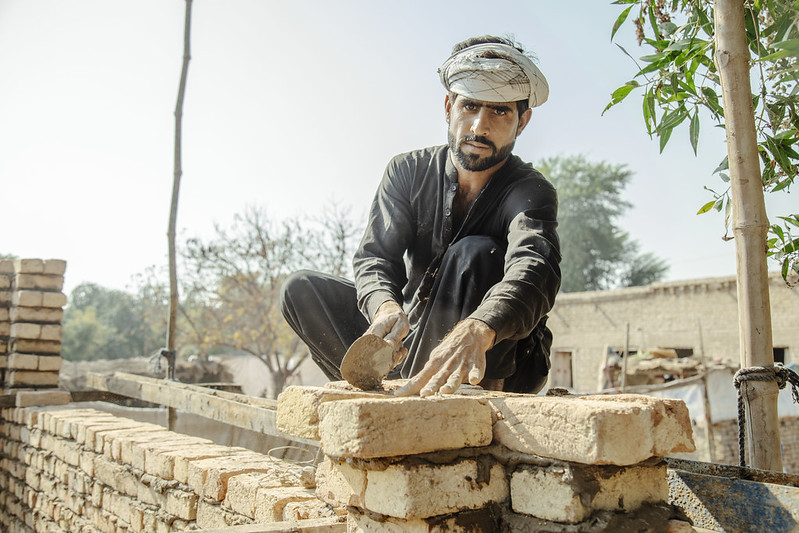
A man rebuilds his home following the August 2022 floods in Pakistan. Photo: Shuja Hakim/United Nations Development Program
It’s been one year since a storm the United Nations’ secretary general called a “monsoon on steroids” devastated Pakistan, killing more than 1,700 people and causing an estimated US$30 billion in damage — and experts say the donation pattern that followed the disaster offers humanitarian organizations a glimpse into the future of emergency fundraising campaigns.
Miranda Gallo, Islamic Relief Canada’s interim advocacy manager, describes the scale of the crisis as nearly “unfathomable” and notes more than 33 million people were affected — a population nearly the size of Canada’s.
Canadians, like many others, opened their wallets to help, delivering life-saving tents, food kits and cash to those fleeing the destruction. But the need generated by the crisis has outstripped global donations, according to data from the United Nations Office for the Coordination of Humanitarian Affairs.
In 2022, just 72 per cent of the UN’s humanitarian relief plan was funded — US$342 million of a requested US$472 million — and the gap between needs and funds grew larger this year: just 64 per cent of the 2023 plan has been funded to date, or US$218 million of US$344 million.
Those gaps have consequences. Approximately 20.6 million people are in need of support, but according to the United Nations, only 7.3 million people have received aid. Islamic Relief International says malnutrition, water shortages and school drop-outs have increased as a result of the funding shortfall.
Experts worry Pakistan’s unmet recovery needs are a sign of things to come, particularly as climate disasters become more common.
The World Meteorological Organization says natural disasters have increased fivefold over the last 50 years, largely due to climate change. Jeffrey Schlegelmilch, director of Columbia University’s National Center for Disaster Preparedness, says this has increased the number of fundraising appeals made by humanitarian organizations and contributed to “donor fatigue.”
While some causes continue to garner strong support, experts say the accelerated pace of climate disasters will exacerbate existing inequities between fundraising campaigns. Some disasters capture media attention, soliciting sympathy and an outpouring of aid, but many don’t.
Experts also say there are signs the volume of donations is not keeping pace with the increased frequency of disasters, something Schlegelmilch says will “break” the disaster philanthropy business model — just when local populations most need humanitarian support.
“There’s no doubt, on the current trajectory — it’s going to break — and I think we’re closer to that breaking point where people realize,” he says.
But international non-governmental organizations and climate justice groups say there is cause for optimism, as well as things donors and civil society organizations can do to help.
Gallo says donors and foundations must increase the share of funding they dedicate to disaster prevention and long-term recovery work. They also need to push the federal government to pay its “fair share” in order to help vulnerable nations prepare for the future.
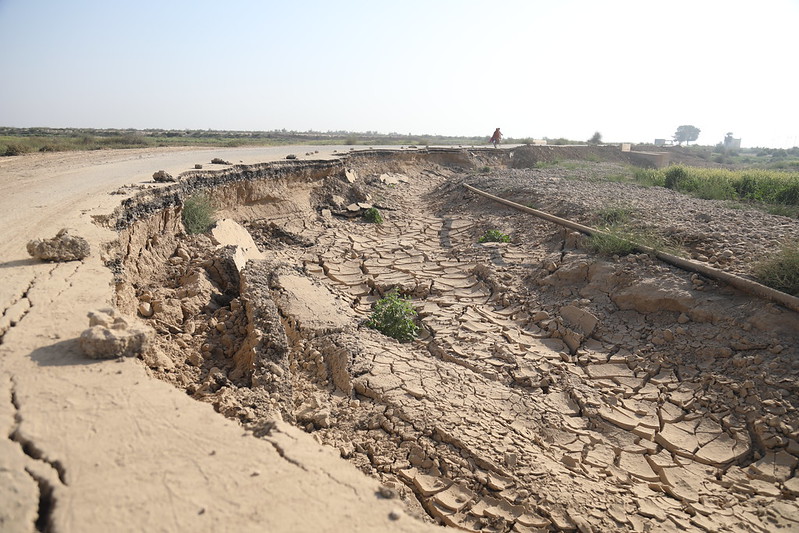
A road in northern Pakistan damaged by the 2022 floods. Photo: Shuja Hakim/United Nations Development Program
Disaster donations not keeping pace?
Carleton University professor Susan Phillips and social researcher Dr. Kristen Pue explore this issue in a chapter of a new anthology, writing that disaster-related donor fatigue may already be setting in.
Pue tracked funds raised domestically by the Canadian Red Cross in response to ten natural disasters between 2013 and 2019, and found most funds went to the three earliest disasters: the 2013 Calgary flood, the 2016 Fort McMurray wildfire and the 2017 BC wildfires.
While donors contributed $189 million for the Fort McMurray wildfire, they chipped in less than $4 million to support each of the seven disasters that occurred between 2018 and 2019.
The devastation in Fort McMurray was significant, but Pue found the disaster raised four times as much per evacuee when compared to the 2019 spring floods in New Brunswick, Ontario and Quebec combined — $2,148 per person in Fort MacMurray, relative to $527 for floods in Eastern Canada.
A similar pattern may be taking shape globally.
Between 2001 and 2021, the average shortfall in funding for United Nation’s natural disaster appeals increased nearly 12 times — from an average shortfall of $430 million between 2000-2002 to one of $8.4 billion between 2019-2021, according to Oxfam.
Phillips and Pue also expect the increased pace of climate disasters to accelerate the “unevenness” of aid provided to various crises.
Studies have shown rapid-onset disasters like floods or wildfires raise more than protracted crises like famines. Disasters that receive more media attention, or those that involve victims to whom donors can more easily relate to, also raise more funds.
Richard Morgan, executive director of Humanitarian Coalition, which raises funds on behalf of 12 disaster relief member charities, says Canadian donors offered significant support in response to the war in Ukraine, floods in Pakistan and the earthquake in Türkiye. But adds that funds were tougher to raise in response to East Africa’s hunger crisis.
Schlegelmilch says donors’ attention spans are also shrinking, pushing some humanitarian organizations to act faster than ever before to secure donations, including creating “dark sites” — web pages pre-populated with information that can be published immediately post-disaster.
Experts also worry donors will continue to give the lion’s share of donations to immediate disaster response efforts, rather than invest in resilient infrastructure and post-disaster recovery projects with the power to mitigate the effects of future climate disasters.
In 2019, about 950 foundations gave $352 million to disaster assistance, according to the Centre for Disaster Philanthropy. Of that sum, 51 per cent went to response and relief (US$180 million), whereas only 4 per cent (US$13 million) went to resilience and 6 per cent (US$21 million) went to reconstruction and recovery.
“You look at someone whose house burned down and they’re getting resources because someone gave money. I would never say that that’s not useful or important, but we have to ask ourselves, ‘Why is the house burning down?’” Schlegelmilch says.
But while Phillips, Pue and Schlegelmilch say the giving-forecast is gloomy, non-governmental organizations and climate advocates see a clear path forward.
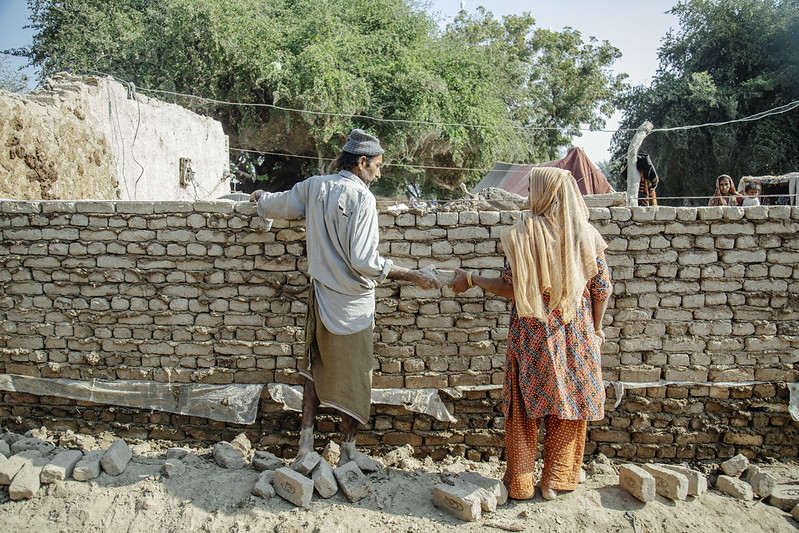
Locals rebuild their home in the south eastern city of Daddu, Pakistan after the 2022 floods. Photo: Shuja Hakim/United Nations Development Program
Canada must pay its ‘fair share’
With more floods, wildfires and famines on the horizon, Gallo says she’s hopeful individual donors, philanthropic foundations, business and other institutional donors will increase the share of funds they send to support climate disaster prevention and provide more money for long-term rebuilding.
But more importantly, she wants both every-day and institutional donors to email and call their elected officials to demand the federal government boost funding for so-called “climate finance” and accelerate work on the Loss and Damage Fund agreed to at COP27 in Egypt last year.
Gallo says philanthropy plays a crucial role in providing fast and nimble funding in response to crises, but that only government has the power to respond to the climate crisis more broadly. And many Canadian climate advocates say Canada hasn’t been doing enough.
At COP15 in Copenhagen in 2009, Canada and other wealthy nations pledged to provide a collective $100 billion in climate financing each year by 2020 to support developing countries to reduce emissions and engage in climate adaptation.
But that pledge, while celebrated, didn’t include many specifics.
Between 2015 and 2021, Canada met its self-imposed target of $2.65 billion in climate financing, but Pratishtha Singh, a senior international policy analyst with Climate Action Network Canada, says that tally doesn’t come close to Canada’s “fair share” based on historical carbon emissions and capacity to contribute.
Federal data shows Canada was the world’s 10th largest emitter of greenhouse gases in 2019, while the World Bank lists Canada as having one of the world’s largest gross domestic products. To pay its fair share, the network says the federal government would have to contribute $3.2 billion globally each year.
Increased funding, from Canada and other so-called developed countries, could help countries like Pakistan move away from polluting industries like oil and coal and invest in disaster-resilient infrastructure, Singh says.
Singh and other climate advocates also say Canada must boost its commitment to climate finance grants and reduce its reliance on loans. Between 2018 and 2020, 79 per cent of the government’s bilateral climate finance was debt — making it third most reliant on this finance tool of seven peer countries, according to a Climate Action Network report.
“Climate finance isn’t about charity, it’s really about justice,” says Greenpeace climate campaigner Salomé Sané.
“Countries that need this funding shouldn’t be required to repay wealthy, polluting nations for adapting to climate change that those nations have created in the first place.”
In a report pleading for increased climate finance, Islamic Relief International notes Pakistan is one of the world’s most vulnerable nations when it comes to climate-related disasters, despite being responsible for less than one per cent of global emissions. The same is true of many coastal states and nations at risk of climate-related calamities, including Hawaii, which was just devastated by wildfires.
Islamic Relief International argues Canada and other wealthy nations must promptly make good on the landmark commitment made at COP27 in Egypt last year to create a Loss and Damage Fund supporting climate-vulnerable nations with recovery when disaster strikes.
Binding contribution agreements would lead to a faster and more equitable distribution of capital — while also preventing hurried diplomatic negotiations post-disaster — but Sané says they’re a tough sell.
A transnational committee created at COP27 will make recommendations on the fund’s structure at COP28 this November. Islamic Relief International says there’s no reason the fund shouldn’t be up and running 12 months later.
Gallo says its essential donors and institutional funders put climate finance at the top of their elected official’s political agendas if these goals are to be met.
Politicians have told Islamic Relief Canada that Canadians don’t contact them about issues like climate finance, something Gallo says needs to change if people want to see action. “If citizens care enough to donate, how simple is it to send a quick email?” she says.
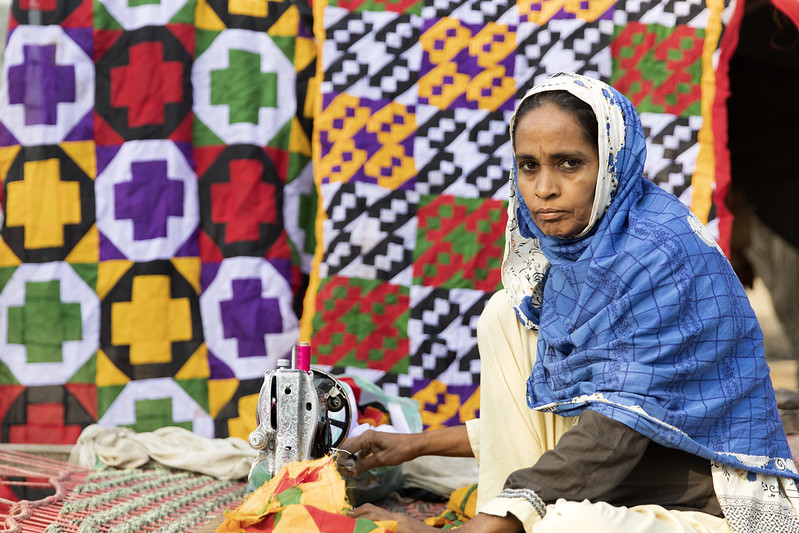
A local woman sewing in the south eastern city of Daddu, Pakistan after the 2022 floods. Photo: Jamil Akhtar/United Nations Development Program
Shovel-ready projects waiting for support
Gallo says her colleagues at Islamic Relief Pakistan are doing the best they can with the resources they have, but more help is needed. United Nations’ data shows the same is true in Türkiye, across the Horn of Africa and in Mozambique, where aid workers are still helping communities recover from recent disasters. And if countries around the world don’t reduce their carbon emissions, develop climate-resilient infrastructure and create disaster response tools, this pattern will be repeated in the future.
But despite the threat, Phillips and Singh say there are bright spots on the horizon.
Prompted by the COVID-19 pandemic and racial justice movements, an increasing number of foundations are taking action on systemic issues directly impacting Indigenous and other racialized people, including climate change, according to Phillips.
The federal government is also taking some positive steps, Singh says. In 2021, the federal government promised to double its climate finance funding from $2.65 billion (2015−2021) to $5.3 billion (2021−2026) and to reduce reliance on climate financing loans — boosting the proportion of grants from 30 per cent to 40 per cent.
Gallo says these efforts can’t come soon enough.
Governments and non-governmental organizations have the tools to respond to the climate crisis — drip irrigation to prevent droughts, flood walls to prevent the worst damage from floods — but they need the money to do it, Gallo says.
“The goal is to treat the disease — to not even need the medication or the band aids,” she says.
Your job. Your mission. Your news.
With your support, the sector you're building gets the journalism it deserves, and you get a tax receipt.

Related Articles

Canada’s Sustainable Finance Taxonomy: What it is, what is happening and what’s coming next
Canada’s sustainable finance taxonomy faces big challenges, from oil and gas, Indigenous rights and the real meaning of the word ‘transition.’
Q&A: Climate action, community resilience begins with who owns our economy, Jon Shell says
Canada can’t tackle climate resilience until it confronts who owns its economy, and how inequality is rising.
Indigenous people bear brunt of climate change disasters: StatCan
New data from Statistics Canada shows that, despite only representing five per cent of the population, just under half of wildfire evacuations in 2023 were from communities where more than half the population was Indigenous.
