“This isn’t something that’s gone away’: Workplace sexual harassment victims’ group seeks continued funding, greater awareness
About 75 per cent of those who report sexual harassment face retaliation.
Why It Matters
The limelight may have faded, but the importance of the #MeToo movement hasn't. However, without adequate funding, programs designed to support sexual harassment survivors won't last.
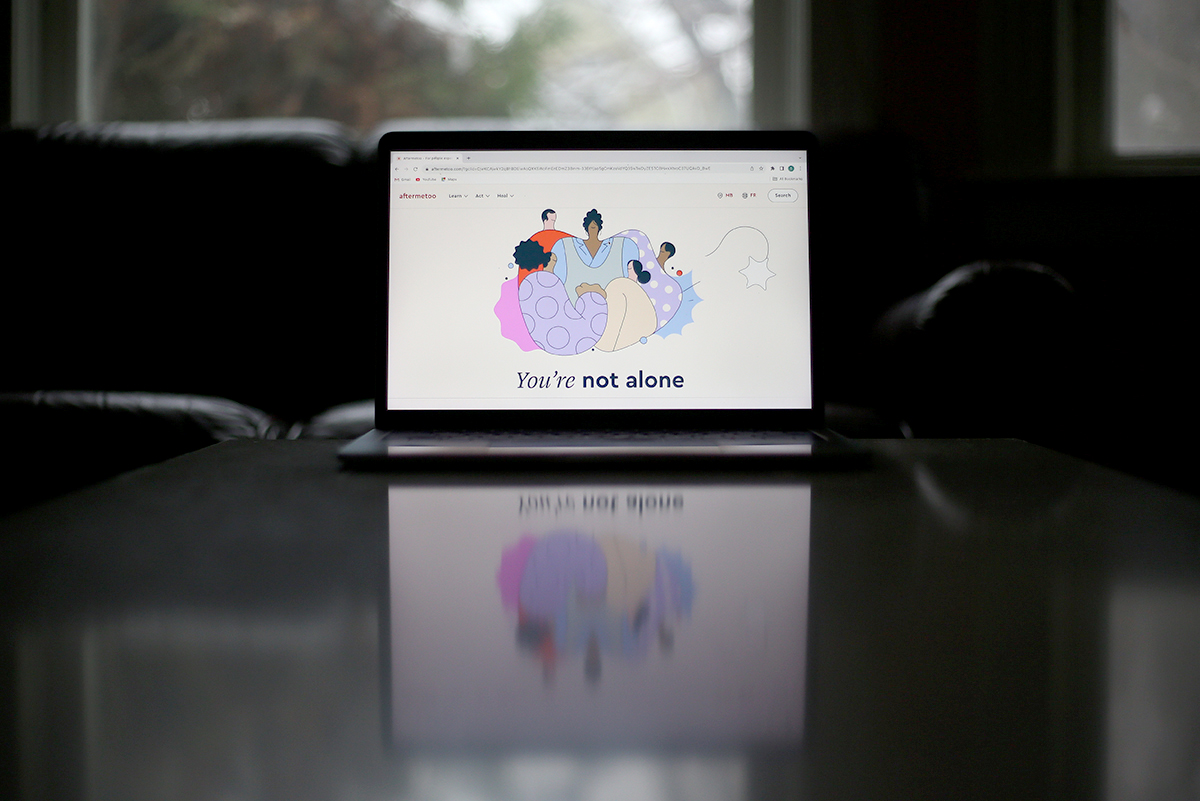
The landing page of Aftermetoo.com. Photo: Shannon VanRaes
An organization supporting victims of workplace sexual harassment says they’re in danger of losing vital funding as public attention shifts away from the #MeToo movement.
“This isn’t something that’s gone away,” said Kate Cornell, an advisor with Aftermetoo, an organization offering survivors of workplace sexual harassment legal resources via a digital platform.
“Researchers describe repeated workplace sexual harassment as a major scarring event, equivalent to being incarcerated or sustaining a major injury.”
Despite the fact that workplace sexual harassment continues to be a serious, if under-reported, problem in Canada, Cornell said funding for the program is scheduled to end in March of next year.
Created in partnership with the Canadian Women’s Foundation in 2017, Aftermetoo is primarily funded by the Government of Canada’s Workplace Harassment and Violence Prevention Fund and the Justice Partnership and Innovation Program.
The charity will hold a hill day on Nov. 7, meeting with parliamentarians and senators in Ottawa, to push for continued funding for organizations addressing sexual harassment in the workplace, including Aftermetoo.
“We just want to share with parliamentarians, their staff and their constituents that this site exists and talk about the resources it offers,” Cornell said, adding the day-long event will target the House of Commons Standing Committee on the Status of Women.
She would also like the committee to initiate a study of workplace sexual harassment and prevention.
“Now that we’re six years past that original #MeToo tweet, we think that it’s a good time to consider a study and really look at what organizations, not just Aftermetoo but all organizations, have accomplished with five years of funding, as well as how much more still needs to be done,” Cornell said.
Liz LeClair, a Halifax-based fundraising professional currently suing Clearwater Seafood co-founder Colin MacDonald for alleged sexual misconduct, said the Aftermetoo site provided her with valuable resources.
“My experience is not all that different from a lot of survivors or targets who find themselves in an incredibly overwhelming situation. It’s really hard to figure out what your rights are and how the law works,” LeClair said.
“It’s a bad analogy, but I’m in the Maritimes, so I’m going to use it anyways: it’s like being at sea and seeing the lighthouse. You finally have some sense of what direction you’re heading.”
Aftermetoo also provides resources to the loved ones of those experiencing sexual harassment at work, LeClair said, something she found particularly useful.
“People don’t realize how traumatic it is for friends and family of the person who’s been impacted,” she said.
“I think for my husband or others to be able to go and look at the site and know how they can help, it was really meaningful.”
LeClair is one of 15 people attending the hill day, along with representatives from the YWCA, Western University’s Center for Research and Education on Violence Against Women and Children and the Canadian Women’s Foundation.
Debbie Owusu-Akyeeah, executive director of The Canadian Centre for Gender & Sexual Diversity, will provide the keynote address at a reception co-hosted by senators Marilou McPhedran and Donna Dasko.
“If you are someone who has been subjected to sexual violence, or if you are someone supporting someone who’s been subjected to violence, it is very, very easy to assume that you’re alone,” she said.
“And so it’s not only having the resources available, but it’s making them easily accessible as well.”
Programs aimed at combating gender-based violence need enough funding to adapt and create evidence-informed resources, Owusu-Akyeeah said.
Existing resources also need to be regularly updated to reflect the real-time needs of people facing harassment, influenced by things like increased violence towards people of different genders or sexual orientations, she added.
“What the #MeToo movement did was force people to think about gender-based violence and shift how we talk about it. But that doesn’t mean that gender-based violence has completely been eliminated,” she said.
New research is showing exactly how enduring the impact of workplace sexual harassment is.
A study by the American Association of University Women estimates about 75 per cent of women who report sexual harassment at work face retaliation., At the same time, research from the Time’s Up Foundation found that over a woman’s lifetime, the direct and indirect costs of sexual harassment can amount to as much as US$1.3 million.
“This is having an incredible impact on survivors, and we really want parliamentarians to know how expensive it is to the economy,” Cornell said.
“It’s wonderful that we have the new childcare programs and that we have lots of other controls and checks and balances for workers’ rights. But this one is a huge one that often flies under the radar because not very many survivors report it.”
Your job. Your mission. Your news.
With your support, the sector you're building gets the journalism it deserves, and you get a tax receipt.

Related Articles
Migrant-led non-profits prioritized through RADIUS’s participatory grantmaking
RADIUS’s participatory grantmaking process shows how community voices and lived experience can shape funding decisions.
7 short documentaries about Canadians making change you should watch
Citizen Minutes looking for Canadian changemakers for fourth season docs

Homelessness organizations dealing with increasing legal attacks, anti-poverty rhetoric: Ontario Nonprofit Network
In a recent brief, the ONN said “hostility against people experiencing homelessness and/or mental health and addictions challenges” is rising.
