Ukrainians fleeing war are arriving in Canada. Here’s how community service organizations can be a lifeline for them – and everyone else needing safety
Why It Matters
Refugees are among the most vulnerable people in Canadian society – and can remain so for years after their arrival.
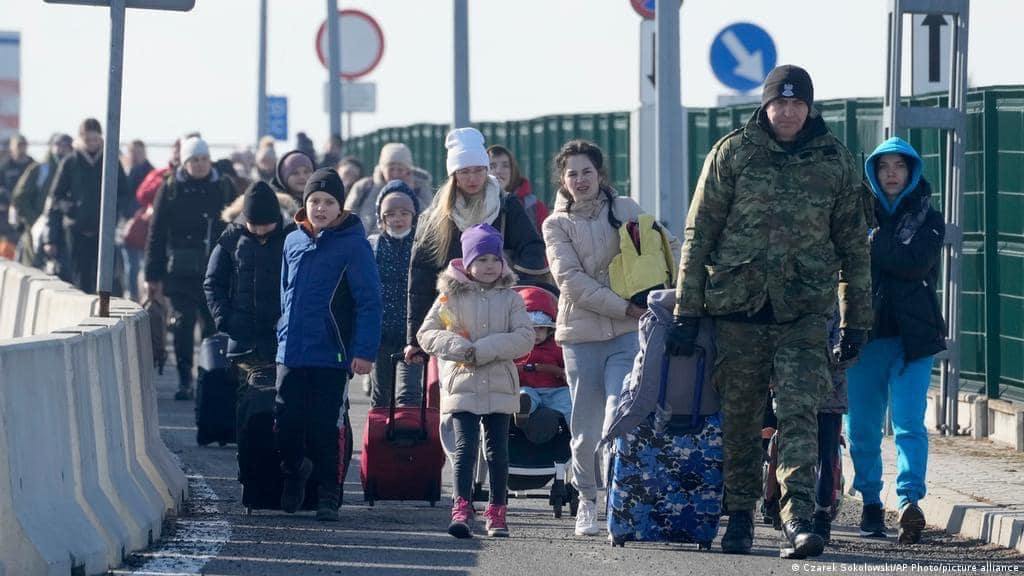
Ukraine’s current refugee crisis is massive.
Within three weeks of an all-out Russian invasion of the Eastern European nation, roughly three million Ukrainians – triple the population of Ottawa – had fled. It is the worst refugee crisis within Europe since the end of the Second World War. Yet it still pales in comparison to the scale of global displacement around the world.
There are anywhere between 55 to 60 million refugees around the world. Abdulla Daoud, executive director of The Refugee Centre in Montreal, lists off just a few. “There’s the Syrian crisis and the Yemeni crisis that’s still ongoing,” he begins. “There’s the Afghani crisis that’s still ongoing. There’s the Bosnian crisis that’s still ongoing. There are different crises going on throughout Africa – the Eritrean crisis. People claiming refugee status due to their political status, or due to sexual orientation – coming from all around the world. We’ve even had people come from China.”
Canada typically accepts tens of thousands of refugees every year, although the pandemic has stemmed applications. According to CBC News, Canada had only welcomed 7,800 government assisted refugees as of Oct. 31, 2021 – well below its target of 12,500. Out of a goal of 22,500 privately sponsored refugees, or those taken in by group sponsors or organizations, just 4,500 had entered the country. And roughly 32,000 people asked for asylum after arriving in Canada. Immigration, Refugees and Citizenship Canada (IRCC) expected to see 45,000 in 2021.
Resettlement agencies are already gearing up, but so are community service organizations like the YMCA and United Way. In fact, many organizations juggle both resettlement and long-term community support. The Ukrainians arriving in Canada will be in a somewhat different situation from Afghans and Syrians – they may not qualify for an asylum claim if they fled through a ‘safe’ region like the European union. However, the Canadian government recently launched the Canada-Ukraine Authorization for Emergency Travel, a program that allows Ukrainians fleeing the war to stay in Canada for up to three years. They’ll also receive work permits, school registration, and the chance to apply for post-secondary institutions.
Their clients may start out in language classes, move to a transitional housing system, then drop their kids off at a daycare while they start their first jobs in Canada. Community service organizations that offer all of these programs are a lifeline for refugees but struggle with their own challenges during the COVID-19 pandemic – not to mention refugees arriving in Canada from all over the world, every single day.
Last summer, around 41 percent of all social service charities told Imagine Canada’s Sector Monitor that their capacity was exceeding the demand for their services. That was before the Afghan refugee crisis, Omicron wave, and the impending arrival of Ukrainians fleeing the Russian invasion. If nearly half of community social service organizations were struggling then, what about today?
Soccer practice…and refugee resettlement
At the YMCA of Hamilton, Burlington, and Brantford, newcomers can access recreation programs, homework clubs, and youth centres – regardless of where they’ve come from. There is little difference between the types of services offered to refugees and those available to lifelong Canadians living in the community. Anyone with children needs an after-school program. Newcomers in need of job retaining may need employment services or a night school program. And, on weekends, newcomer families may simply want to take advantage of a pool, social club, or amateur sports team to relax.
Lily Lumsden, senior regional manager of YMCA Employment & Immigration Services, says one of the most important aspects of the Y’s work is connecting newcomers with local associations and churches – something she says will be crucial for Ukrainian arrivals. “Hamilton does have a very close-knit Ukrainian community,” Lumsden says. “That’s going to be really critical to connect them to, if they’re not already connected.” According to 2016 federal census data, around 17,000 people identify as Ukrainian in the Hamilton area.
Community social services organizations like S.U.C.C.E.S.S. (also known as the United Chinese Community Enrichment Services Society) provides support in spades – and is still doing so, despite the COVID-19 pandemic’s many challenges. Although it was started in the 1970s by a group of immigrant women in B.C., S.U.C.C.E.S.S. also provides programming for children, seniors, and everyone in between. About 60 percent of the organization’s 72,000 clients served last year were newcomers, according to executive director Queenie Choo. “We serve clients, no matter what needs they have,” she tells Future of Good.
As robust as the Y and S.U.C.C.E.S.S. are, community services organizations have not had an easy time over the past two years of the COVID-19 pandemic, let alone the capacity issues that always exist in the non-profit and charitable sector. Public health restrictions forced the Y to temporarily close health and wellness centres, as well as childcare, that provided clients with a place to work out and stay healthy. That included refugees. “When the Syrians came in, we worked with our health and fitness centres on a discounted, subsidized membership for the families,” Lumsden says.
Thankfully, the Y has been able to keep its immigration and refugee services department running thanks to robust provincial and federal government support throughout the pandemic. “Over the past two years, we were able to maintain our funding – and actually get more funding in some cases – to support clients in both our newcomer programs and our employment programs,” Lumsden says.
But not all refugee-focused organizations have been able to keep up with demand. Sojourn House, a Toronto-based emergency shelter and transitional housing organization for newly arrived refugees, is including the purchase of another building – if possible – to run another transitional housing program specifically for refugee youth. Money is the main issue. “We could probably take out a second mortgage,” says Debbie Hill-Corrigan, executive director of Sojourn House, “and we could probably finance something. But in order for it to be workable, we would be dependent on rent supplements, which is a program of the City of Toronto.” In other words, the city could remove those supplements in the future and leave Sojourn house in a vulnerable position.
Long wait times at Sojourn House, and community service organizations, have unfortunately been a fact of life for many years before the COVID-19 pandemic began. “People used to always say ‘don’t bother calling Sojourn House’,” Hill-Corrigan says, “because we were always full.”
Now hiring: refugees
Boosting the internal capacity of community service organizations at a time when multiple refugee crises and the COVID-19 pandemic are hitting all at once will require some creative thinking by sector leaders. Lumsden found a way to address the need many refugees have for Canadian work experience and the frontline staffing crisis – and she did it four years before the Ukraine crisis began. Lumsden, along with a colleague at the Y designed a program that gives newcomer-trained teachers job placements in childcare centres.
“That really boosts the diversity of our childcare centres,” she explains. “Say we have a family from Iraq. If we’re trying to get their child in a childcare centre, isn’t it cool if they know one of the educators is also from Iraq and speaks Arabic?” In the past four years, Lumsden says the Y placed around 200 teachers. They receive not only stable employment, but also placement hours to qualify as registered early-childhood educators – which allows them to command higher hourly wages.
According to Alexandra Dawley, senior manager of refugee settlement and integration at MOSAIC, hiring refugees can help organizations immensely, even if they don’t have Canadian work experience. “Studies show that this can result in a diversified workforce, assessing skilled and qualified candidates, increasing employee communication and empathy, and keeping roles filled by ideal candidates,” she wrote in a statement to Future of Good. “Refugees commonly show a great degree of retention and loyalty to those who hire them.”
Many resettlement agencies (including Sojourn House) make a point of hiring former clients as frontline support workers or translators. These employees understand the journey refugees make, understand their language and culture, and can make their transition to Canadian life as smooth as possible. Even at community service organizations with no resettlement experience, refugees may be invaluable employees. Canada frequently attracts newcomers whose professional credentials often go unrecognized in their new country – doctors who work as taxi drivers, scientists who become baristas. Granting professional work experience at a social impact organization may be the step up a refugee needs to solidify their Canadian work experience.
For community service organizations without the means to hire refugees, one easy way to help refugees without stressing internal capacity is simply to listen to the experts. The YWCA of Greater Saint John has a list of tasks newcomers who arrive might need help with in their first two months (setting up bank accounts, social insurance numbers, school registration) that could be important for community service organizations to know. MOSAIC suggests organizations reach out to it for advice – or simply Google local resettlement organizations in their area to learn more.
Alone at the airport
Unfortunately, not all categories of asylum-seekers receive the same degree of support when they do arrive in Canada. Government-sponsored refugees, such as the 25,000 Syrians who were resettled in Canada between 2015 and 2016 as part of the federal government’s Operation Syrian Refugees, are pre-screened in United Nations Human Rights Commissioner (UNHCR) camps before they fly to Canada.
When a government-sponsored refugee comes here, they’re already considered a landed immigrant,” says Hill-Corrigan. “They already have landing papers. They have access to all of the language training programs that the federal government pays for. They can go to settlement organizations that are set up to provide services just for them.”
Many of the service providers who assist government-sponsored refugees are non-profits or charities like the YMCA of Greater Saint John, who run a mix of newcomer and community social services. “When someone comes in to seek settlement services, they’re coming into our regional Y building, where the pool and the childcare and the fitness centre are located,” says Kathryn Melvin, general manager of newcomer and community connections at YMCA of Greater Saint John. “We all work together here to make sure people are supported and we can refer them to appropriate programs, whether they’re in our own association or anywhere else in the community.”
However, asylum-seekers – those who arrive at Canada’s borders without pre-screening – have a much more difficult time accessing programming. Hill-Corrigan explains that asylum-seekers aren’t considered to be refugees, and therefore subject to protection, until they’ve been established to be a refugee by the Immigration Refugee Board – a process that can take years. In the meantime, these asylum-seekers need to navigate community social services themselves. Many turn to non-profits or charities like Sojourn House when they arrive to get some stability while they await their hearing.
Many of these asylum-seekers aren’t fleeing major wars. In fact, despite the highly publicized humanitarian crises in Syria and Afghanistan, asylum-seekers from both nations aren’t even in the top six most common countries of origin. In 2021, the most common origin – with 3,321 claims – was Mexico. India came in at 2,642, followed by Iran at 2,466, Turkey at 1,179, and Haiti at 970. (Only 207 asylum claims were made by Syrians in 2021, and 416 by Afghanis). Many of Sojourn House’s clients come from Columbia, China, Ethiopia, Eritrea, and Yemen. Their reasons vary widely – and are sometimes as simple as wanting to raise their kids elsewhere. “Some people come just because they want a better life for their children and feel that Canada is a very safe haven,” Hill-Corrigan explains. “It’s a country that is very representative of diverse communities including, usually, their own communities.”
At Toronto’s airports, Hill-Corrigan says, immigration officials give a one-page document to anyone claiming refugee status that mentions Sojourn House. In fact, Sojourn House’s reputation for helping asylum-seekers extends well beyond Canada’s borders. Ethiopian refugees, she says, often arrived in Canada already knowing about them. “We have taxi drivers deliver people to our door because they knew about us,” she says. “Because the taxi driver himself probably stayed here.”
Well equipped to help.
Much as Canada’s community service organizations are willing to help asylum-seekers arriving from all corners of the world, the country’s immigration system has its dark side. Many asylum-seekers who arrive from the United States are imprisoned in immigration detention and then sent back to their country of origin, sometimes under dangerous circumstances. Refugees fleeing war can have a difficult time coping with past traumas, even with professional help. Canada’s asylum system can be frustrating, opaque, and even cruel.
As of late March, Ukrainians fleeing the Russian invasion of their country hadn’t yet arrived en-masse. Around 50,000 are expected to arrive in Canada – although Lumsden says millions are already fleeing Ukraine. During the Syrian crisis, Lumsden says, Hamilton took in around 1,400 refugees. “We could probably manage that many as a community,” she says, “but it really is up in the air in terms of how many will actually come.”
Ukrainians who’ve already traveled to Canada to be with friends or relatives are seeing a massive outpouring of support. Those who arrive later may find themselves struggling to establish new lives, learn French or English and – potentially – call Canada home. It isn’t clear whether the Canadian government will eventually offer a permanent path to citizenship for Ukrainians fleeing the war. What happens at the end of the three-year temporary visa process is very much up in the air.
In the meantime, organizations like The Refugee Centre say they’re up for the task of assisting refugees wherever they come from. “I think Canada, because it is such a diverse country and there’s people from all over the world here, is unique,” Daoud says. “With the ongoing Ukrainian crisis, we’ll be well equipped for that as well.”
Tell us this made you smarter | Contact us | Report error