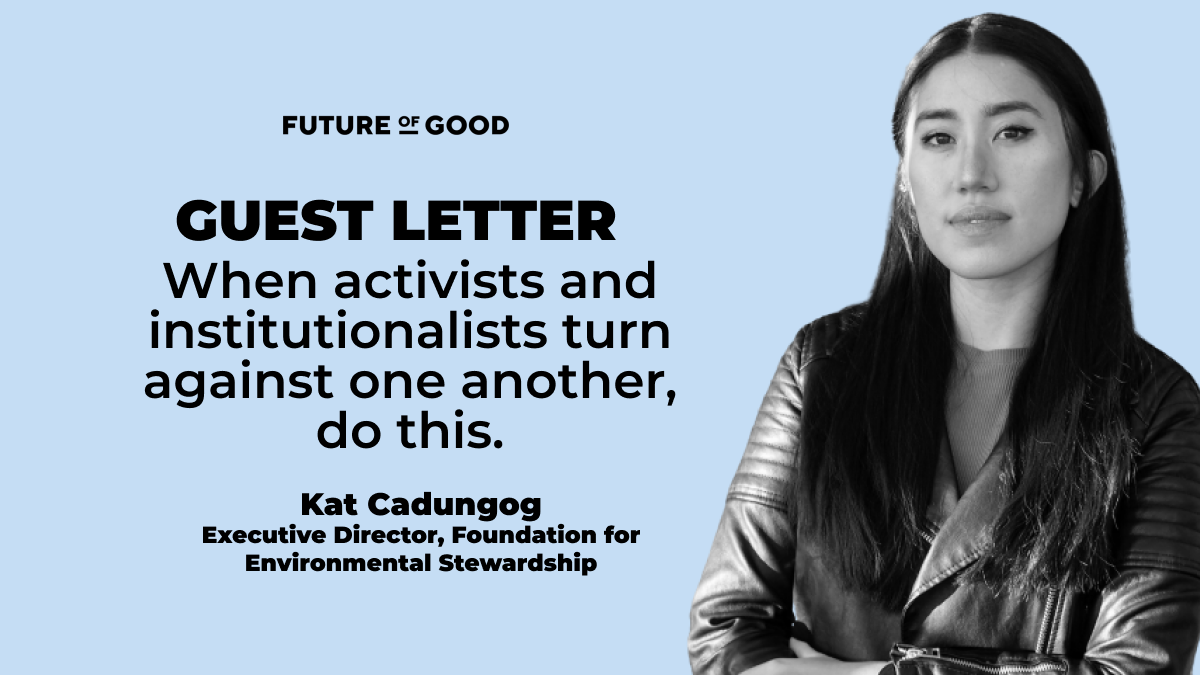
When activists and institutionalists turn against one another, do this.
Why It Matters
As Kat Cadungog writes in this story, “until we can solve our in-house disputes…it will be difficult to mobilize at the scale and speed we need to to solve the climate crisis” — or any social crisis, for that matter.
Everyone is tense.
Watching the news today, it feels as if there is an excess of tensions in what’s currently referred to as Canada, whether it’s among oil and gas companies and Indigenous land defenders, abolitionist movements and police forces, or — yes — those in support of the “freedom convoy” and those against it.
Yet, the most surprising tensions are not the ones that exist between groups with contradicting views of how society works or how it should be, but within the social sector itself. These tensions internal to the social sector emerge because while the sector commonly agrees about its goals, we cannot agree about how those ends ought to be pursued. These disagreements have resulted in in-house, or rather, in-sector arguments. Such arguments have led and can only lead into gridlock.
This issue is common in the climate sector. Discussions in the sector about resource allocation, for instance, commonly devolve into speculations about whether to focus on funding climate change adaptation or mitigation strategies, while others want to expand support for institutional or grassroots groups. These types of discussions and debates commonly overtake the actions that were the goal of these organizations in the first place. Verbal gridlock takes many forms, including distracting language games and quests to undermine competing methodologies.
I’ve even personally witnessed groups refusing to work with other groups on the grounds that they were too far apart on ideology.
Some groups have even become so timid and so afraid of being rejected by their peers or to offend the communities they serve, that they retreat from the public eye and stop from fully participating in the movement. Unknowingly, it was the sector’s own hypercritical lenses that added a layer of psychological pressure on folks to either be ‘perfect’ or cease to exist. As a result, the sector is often left with people who refuse to be in dialogue with each other and groups that are too afraid to actively participate in the sector, once again leading to gridlock.
We in the social sector are not in a position to allow unproductive gridlock to continue. The climate movement is at a critical point in the fight to reduce and capture emissions. Pressing for change is required on all fronts. All available tools must be utilized to meet climate targets. To have a concerted effort, the folks wielding these tools must engage in dialogue. The way forward is not exclusionary. All voices in the discourse must be heard.
My proposed approach to the sector’s gridlock is, then, to facilitate dialogues. It is to maintain meaningful conversations once these dialogues have begun. I am not a stickler for firm and resolute answers. Rather, I would like to see the sector facilitating autonomy, empowering people locally, and granting an open forum to many disparate groups and individuals, rather than trying to settle on the best theory to underpin climate action. I think the way forward is to hear the voices that can so easily be silenced — or left in obscurity on account of powerlessness.
This approach is not one that is founded in obscure theory. In developing it, I have drawn on my own experiences as a leader in the youth climate movement — specifically, helping to lead a program that has affectionately been named the “Youth Harbour”. The Youth Harbour is a youth-for-youth support system that seeks to provide financial and technical support to the youth-led climate movement. At the Harbour, we’ve established a Youth Steering Committee that assists in the formation of our organization’s priorities, thematic topics, and granting decisions.
The Youth Steering Committee includes representatives from the youth-led climate movement. These members advise on the priorities of that movement, drawing on first-hand knowledge and understanding. Our goal in establishing the committee has been to further our own goal of offering our own idiosyncratic support to the youth-led climate movement in a way that best respects the consent of youths themselves.
All the while, though, we are very cognizant of the challenges of appointing representatives. As mentioned, the social sector is rife with disagreements about ideologies and methodologies, and the youth-led climate movement is no different. The movement is divided particularly between grassroots activists and institutionalists. We felt that if we filled the committee with grassroots activists, institutionalists may not have resonated with the decisions of the committee, and vice versa.
Our approach has been to invite folks with varying and sometimes even contradictory perspectives to come to the committee. As fans of dialogue, we planned to host some trial conversations and hope we would not encounter gridlock. Well, it’s now been six months of working closely with our 10-person committee. Several convenings have been hosted, documents have been shared, and ideas have been formed in collaboration. I am happy to report that the lessons we have learned (so far) are positive. My personal feeling and hope for the future is that there is a way to mediate diverse perspectives, and I will now offer strategies to mediate conversations based on my learnings.
First and foremost, I would like to add a caveat that no one is obligated to remain in spaces that are harmful to them physically, mentally, emotionally, or spiritually. To participate in meaningful conversations, there is no situation where racist, sexist, homophobic, or any discriminating remarks can be condoned. If there are any concerns about language, or topics that are “off-limits”, those should be explicitly expressed before the dialogue begins and always add equity primers and code of conducts for mandatory reading. We have to not only provide spaces of respect and trust, but also actively condemn places and spaces that allow for hate.
And now the list:
- Anchor the group on one united narrative and goal and continuously remind them of what the end goal is. It is helpful to develop a guiding document and shared vision statement that everyone can sign onto.
- Brief everybody individually, then as a group on ground rules and expectations. Be clear and transparent with exactly who is going to be there so folks do not feel blindsided when someone they may not be attuned to shows up.
- Explicitly state that consensus is not mandatory but discourse is. There is a rule during our Youth Steering Committee meetings that if a member disagrees with another person’s perspective that rejecting an idea cannot stand alone but must be paired with an alternative solution — or if no alternative can be offered, an explanation of the emotions or reactions towards the initial offering. This is meant to facilitate understanding and value sharing, to reinforce that we are all working towards the same goal.
- Refrain from expressing your opinion as a facilitator, or assign a “neutrality monitor” to signal to the facilitator when they think you’re voicing an opinion rather than a fact. Sometimes as mediators, we mistake our own opinions as objective truths and if you state one of your opinions as an objective truth then a member disagreeing with your sentiment may either feel threatened and/or choose to disengage because they do not see the purpose in disagreeing with what others believe to be a fact.
- Monitor the dynamics and the formation of relationships between people during the meeting. Within the first 10 minutes of dialogue, it is evident who will sympathize with whom and who will disagree with whom. Do your best to balance opinions and allow people with differing opinions to take turns expressing their thoughts so no one feels like a minority or majority when it comes to their opinion.
- Keep track of who has spoken and for how long. This is especially the case if you have people of varying gender identities in dialogue. One study found that even if a group of five has a majority of three women, they each speak 36 percent less than each of the two men. Before the meeting begins, provide everyone with time limits to share their initial thoughts and enforce the time limit. Encourage folks that are more reserved to speak and encourage them by asking follow-up questions to clarify their points.
- Stay engaged after the discussion. If you monitor the dynamics and speaking points closely during the meeting, you will begin to identify gaps and looks that imply an “unsaid” dynamic between people. Keep track of this and follow up with everyone, asking them questions beyond the content of the discussion — questions like, “how do you feel about that meeting?” or,“do you feel that you were able to voice your opinion in that discussion?” and, “is there anything you would like to add?”
- Ensure that the discussion leads to a tangible document. Often, people partake in conversations but feel that their input was not meaningfully incorporated. When people feel this way, it acts as a greater incentive to disengage because they perceive their participation in these spaces as unfruitful and unappreciated. Instead, clearly share what recommendations you chose to incorporate and which recommendation you chose not to incorporate and why
These are just a few strategies that have worked for the team at The Youth Harbour. I am not here to diagnose societal problems or prescribe solutions, but I do believe that until we can solve our in-house disputes, that it will be difficult to mobilize at the scale and speed we need to to solve the climate or any other crisis. As the old adage goes, “a house divided against itself cannot stand.” Even if we do not agree on each other’s means to an end, as folks working in the social sector, we must remember that we do not have the authority to dictate whose opinions are worth upholding and whose voices can and cannot be included.
Tell us this made you smarter | Contact us | Report error