Documentary theatre: How to tackle a polarizing issue in a way that helps people talk to each other
Why It Matters
The energy transition divides Canadians along provincial, industrial, and occupational lines. This polarization hinders progress on the issue, as it does for many sensitive matters. Documentary theatre is an example of an initiative designed to foster dialogue on complex issues.
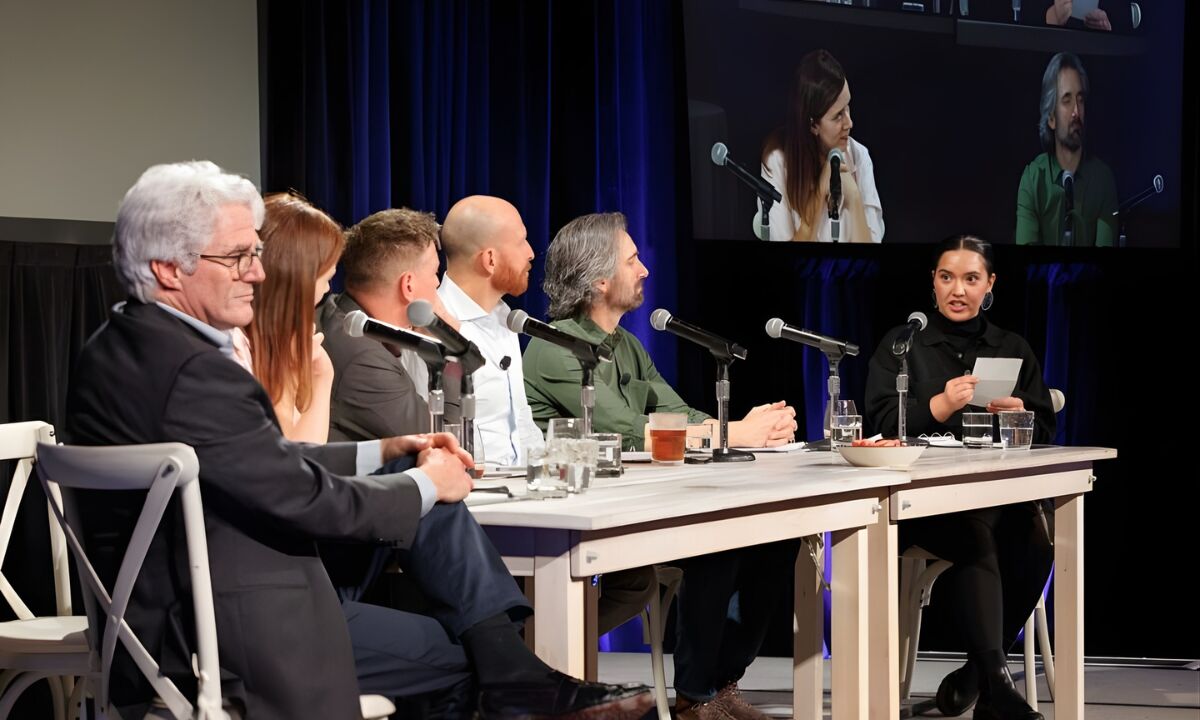
“I believe that artists should not be on the margins of society, limiting themselves to entertaining. We must utilize our communication skills to facilitate effective discussions on complex and sensitive issues. Thus helping to shape public policies.” – Annabel Soutar, co-founder and artistic director of documentary theatre company Porte-Parole.
A few weeks ago, I attended a performance of one of Porte-Parole’s creations, a play titled “The Assembly: Energy in Canada.”
Designed as part of a series centred on the same idea, Porte-Parole explores a sensitive topic by interviewing various stakeholders with opposing views. A few of them are then chosen to attend a dinner moderated by two company members.
@futureofgood Tackling polarizing topics through theatre. #documentarytheatre #democracy #performance ♬ original sound – Future of Good
Dinner date
The dinner is structured in two parts. First, the guests get acquainted and share their views. Conversation, the organizers tell me, can get heated.
Then, the moderators invite the guests to write a letter to a polarizing figure associated with the topic. The letter’s content must emerge from a consensus, not a majority vote.
For “Energy in Canada”, the guests wrote to David Suzuki, a Canadian pioneer of environmental defence, in response to his gloomy statement on failing to shift the narrative on climate.
The dinner is recorded and edited into a play, of which all the words are the guests’. Actors play various guests, and the play is then performed.
The play concludes with audience participation. The actors leave, and the spectators are invited to sit at the table on stage to share their opinions and feelings.
For the performance I attended, the characters included environmental activist and Shift director Adam Scott, oil and gas entrepreneur Michael Binnion, Anishinaabekwe engineer Kaella-Marie Earle, who works at Enbridge, and Meredith, who runs a non-profit organization bringing people together in rural, small, and suburban areas to support policies that help people and nature. ‘Meredith’ is a pseudonym for a real person who requested anonymity.
“These characters are archetypes of polarization on the energy issue. What comes out of their conversation is the difficulty in discussing and the necessity to tolerate conflict and discomfort for dialogue to progress,” said Soutar.
How different audiences reacted
It can be argued that energy policy sits at the top of Canada’s polarizing issues. As I write these lines, Prime Minister Mark Carney and Alberta Premier Danielle Smith have signed a memorandum of understanding for a new pipeline project.
While Smith embraced this opportunity for Alberta’s citizens, B.C. Premier David Eby, who was not part of the conversation, denounced the reversal of the ban on oil tankers on the northern coast of B.C.
In Quebec, where I live, pipelines are not welcome; back in 2015, two-thirds of Quebecers opposed the Energy-East project crossing their territory. It was abandoned in 2016.
“Prime Minister Carney suggests, just like [former PM Stephen]Harper did, that Canada become an energy powerhouse. He also aspires to lead the fight for climate change. How will he thread the needle?” asked Soutar.
“We need an inter-provincial conversation on this. The question is: who should be at the table?
“As long as we consume fossil fuels, the oil and gas sector should be included,” she added.
In November 2024, Porte Parole was invited to perform “Energy in Canada” at the Calgary Petroleum Club, a private club for Calgary’s business community.
“That a Quebec theatre company took the time to explore the energy universe and reflect on different points of view probably gave Albertans some hope,” said Soutar.
“It shows not all Quebecers sit at the extreme left, uninterested in Alberta’s economy and way of life.”
Energy in Canada was never performed in a theatre. It was instead presented at different business events in Alberta, Ontario and Quebec.
“As one could expect, depending on the city, the audience did not sympathize with the same characters,” said Soutar.
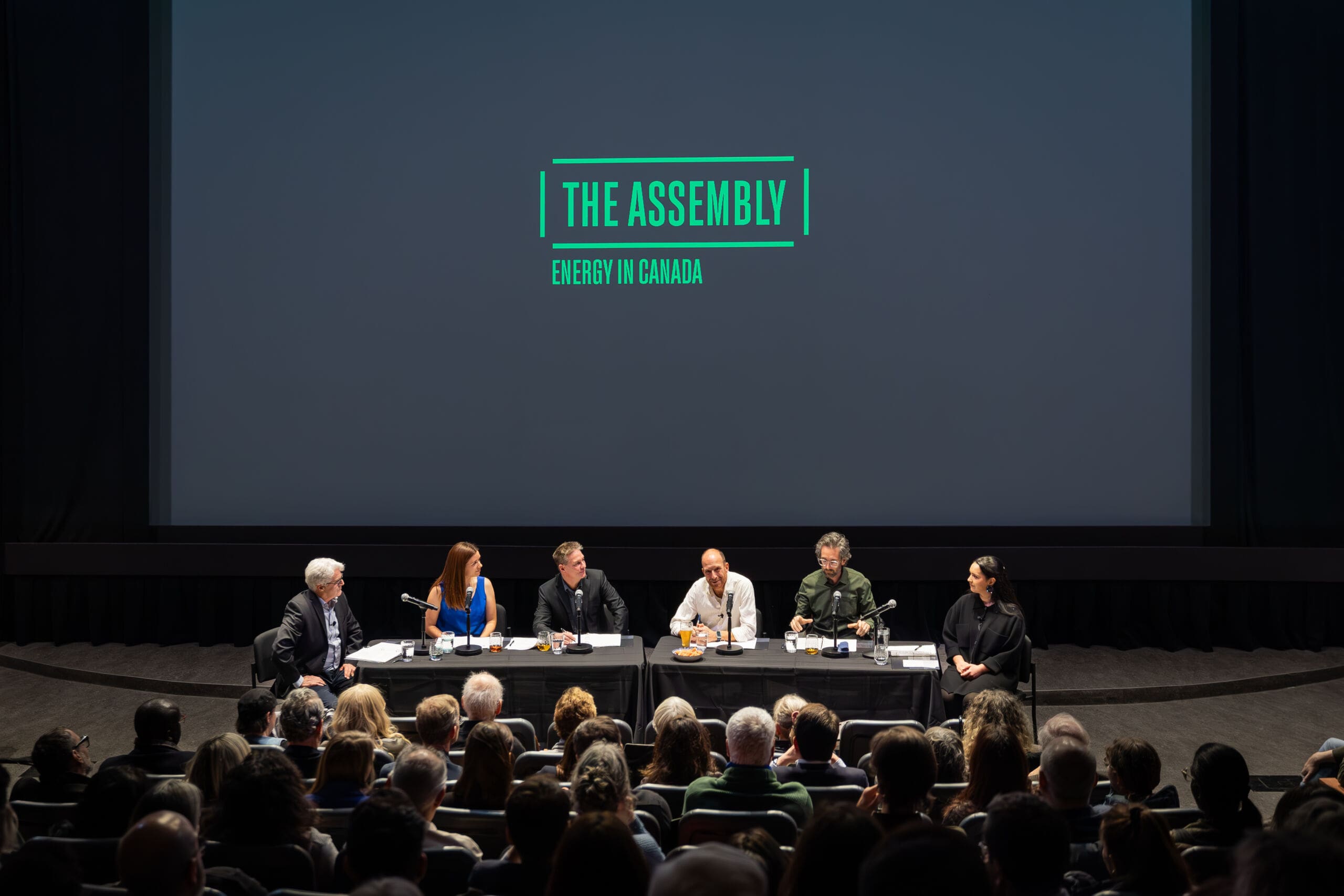
However, “at Montreal’s Sustainable Finance Summit, spectators said that although they disagreed with the oil and gas guy, the play opened their minds a bit because it was not only about opinions. The character touched on why he thinks this way,” she said.
In Toronto, Scott and Binnion’s discourse raised the audience’s awareness about the ineffectiveness of both sides’ communication strategies.
The two isolated sides surrounding fossil fuel exploitation in Canada surfaced in the first few minutes of the play. For example:
Binnion: I think there is a portfolio of energy choices that we should be working to say, how can we bring our emissions down in line with the targets we want?
Scott: We’re not trying to bring them down, we’re trying to go to zero!
And another one:
Binnion: Put your own… put your own money behind that one.
Scott: I did! I electrified my house.
Binnion: No, I mean, start…start…start putting billions of dollars into the companies that are doing that.
Scott and Binnion remained on opposite sides of the spectrum; however, this does not mean the exercise was pointless. On the contrary, the dynamic with the other characters gave the audience plenty to reflect upon.
At different moments, both Meredith and Earle felt empathy or flat-out disagreed with Scott or Binnion.
Earle: (to Scott) But I share the same issue as you, where I think that the energy transition isn’t happening fast enough. Um, I think a lot of people are scared of breaking the rules in oil and gas, which I am not afraid of whatsoever.
Meredith : (about Binnion) You know, he’s a conservative oil energy guy, but he showed up. (…) He’s not a villain, in my opinion. He’s someone who’s in the movable middle and trying to do the right thing and doing it from his value set. And so I’m like, there’s so much room to work together in this crisis.
The goal, said Soutar, is to help rehabilitate the art of conversation.
“When we enter into a conversation, do we demonstrate curiosity or do we aim to convince? There is no dialogue without curiosity.”
My five takeaways from this exercise
1. We all get stuck in “factland.”
The expression is Meredith’s, and Binnion says it very clearly to Scott. “You don’t…to the point that you don’t even think it’s a point of view! You think it’s just a fact! I got that about you. So…and I don’t want to argue with you because there’s…there’s no discussing…”
Seeing the characters argue was an awakening; facts are not neutral, they carry our points of view.
2. Some questions lead everybody to open up
My favourite question from the moderators to the characters was: Have you ever been misunderstood or judged?
Here are their answers.
Earle: Oh, yes. Um. I actually just listed like the people who’ve not agreed with me. So, there’s two types of people: shame-slinging altruists, I call them. Um… I just don’t engage with them because they think that they’re so right. They’re so rigid…and the other people that have a humongous problem with me…um…are staunch supporters of the status quo.
Meredith: The people that I have the biggest challenge with are like… Boomer white men who affiliate themselves with the Green Party! Also women. The 1990s environmentalist who kept growing and accumulating wealth, and wants everything to be individual action and “do as I say, not what I do.”
Scott: Judged. Uh. I…I go into every conversation I have, saying, ‘Don’t shoot the messenger.’ Because what I’m telling you isn’t something that I made up.’ And I think identity is a huge barrier here. People say, ‘I’m a conservative, I can’t believe in climate change’. And people project their discomfort and rage about being challenged in what they perceive as their identity. And so, I often find myself in the ‘who are you to question who I am?’ situation.
Binnion: Like every single day of my life. So but…but… but you know what I’ve kind of learned from that is that you can’t…You know, nobody’s going to listen to me.
The moderators’ question took me back to a solutions journalism workshop I attended called “Complicating the narratives”. It covered new ways to report on controversial issues and polarizing politics.
Some suggested icebreaker questions from the workshop were: What is oversimplified about this issue? What do you think the other side wants? What’s the question nobody is asking? What do you and your supporters need to learn about the other side to understand them better?
3. Uncover motivations rather than positions
The way Binnion defended the oil and gas sector, one could think it was an identity matter. But it turns out, it was not. Here is the story behind his professional choice.
“I actually swore when I was a kid I would never work in the oil and gas industry. I said, it’s a dinosaur industry. And I’ve probably been, I haven’t been in every industry, but I’ve been in a lot of them. And in the oil and gas industry, I get to deal with more interesting technologies than I did when I was in the high-tech sector. So, it’s really, really interesting, fun technology, right? And the other reason I got stuck there is that my big dream was I wanted to find a giant field (…)”
Binnion’s career was more about the technology and the thrill of the hunt than about the oil and gas industry. This leads to the following question: Could renewable energy offer him the same technology buzz?
4. Communication and advocacy are about results, not about being right
On the night of the play, the real Adam Scott was in the room. He came on stage and was interviewed by Annabel Soutar, the co-founder of Porte-Parole.
She asked him, “How do you feel about being portrayed and hearing your words on stage?”
“It was a stressful evening,” he said. “Tonight, and during the taping, I felt stressed by my own failure to communicate what is in my head.”
His feeling is shared by many people doing advocacy work. His reflection on his experience was enlightening. “For many years, I have exposed the facts, but the truth is, I am very emotional. Conversations are difficult. Kaella-Marie and Meredith exposed me to the idea of using a wider lens,” said Scott.
5. Duality enriches the debate
Earle was the most complex and, therefore, to me, the most interesting character. Her Indigenous heritage, combined with her job in an oil and gas company, widened the discussion.
“I was a climate activist for a really long time, and I now work as a pipeline engineer, but every day I’m like, ‘Okay, what am I actually doing that’s in alignment with my cultural values?’ And a lot of it isn’t. I know that it’s not.
“I don’t stand on the side of any oil and gas company that has historically done fucked up shit, and most of them have. But while I’ve seen gross injustice, I have seen some, a lot of like, success. “I would say that one thing that gave me a lot of peace in my life was having a conversation with the former Senator Murray Sinclair two years ago where we were sitting one-on-one, and um, I started crying because I was so upset. I was like, ‘How do I…how do I reconcile being deeply entrenched in my cultural values – understanding that the Seven Sacred teachings all refer to our deep connection to the land and taking care of it – and like being in oil and gas?’
“And he said – and this man is the titan of reconciliation and justice for First Nation, Inuit and Metis people – he said, ‘The only way that you can change the direction of the way things are is by existing where you’re at.’”
The impact on the audience
I attended the play with Malorie Flon, Executive Director of L’Institut du Nouveau Monde (INM), a non-profit seeking to increase citizen participation in democratic life. INM moderates public participation exercises. I was interested in her take on the play’s capacity to facilitate public conversation on a complex issue.
“Art is a magnifying mirror of society. It confronts us with archetypes. We see their clumsiness, their incomplete reasoning, and their emotional stands. I believe this allows us to reflect and to think in a more nuanced way and to seek solutions,” said Flon.
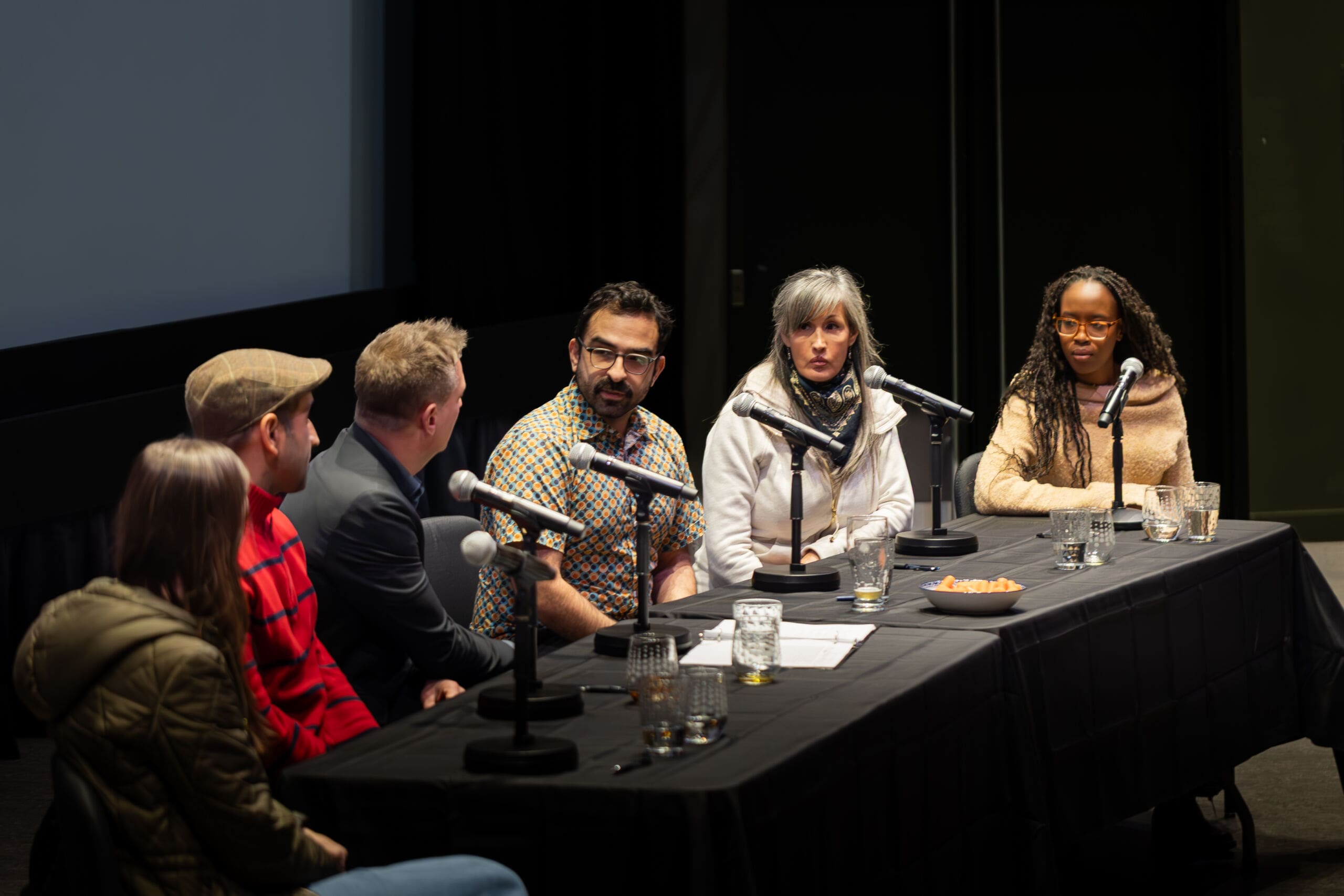
We witnessed this impact on the audience when the actors left the stage to leave their seats to the spectators.
“The play ends on a provoking note to trigger reactions from the audience,” said Soutar.
It worked; a dozen spectators came on stage one after another to share their energy stories.
“It was a powerful moment,” said Flon. “They all were constructive stories, as if these spectators needed to counteract the gridlock that the characters were stuck in.”
Their stories were about the individual energy solutions they had implemented at home or the start-ups in which they had invested their money.
“I don’t know if the play changed the four characters who participated. However, I am convinced that it changed some spectators, affirming the need to find a passageway on this polarizing issue,” she added.
I totally agree. Seeing real characters discuss a polarizing issue helped identify the flaws and limitations in our arguments, and maybe take things from another angle.
Tell us this made you smarter | Contact us | Report error