Fighting predatory lending: West Coast credit unions join philanthropic effort
The DUCA Impact Lab has so far partnered with Ontario credit unions Kindred and Your Neighbourhood to fund its Escalator Loan program, which provides loans to people stuck in the payday loan cycle. Now, Vancity and Coast Capital will also be providing funding.
Why It Matters
BIPOC women are some of the highest users of payday loan programs. In its pilot, the Escalator Loan program has lent money to 150 people, and wants to reach 3,000.

Attendees at the launch of McMaster University’s Social Impact Hub pilot on financial inclusion, where DUCA Impact Lab’s Executive Director, Keith Taylor, presented the Escalator Loan program (DUCA Impact Lab / LinkedIn)
Editor’s Notes: An earlier version of this article stated that the DUCA Financial Services Credit Union was the primary lender for the Escalator Loan program. This has now been corrected to state that the DUCA Impact Lab Social Finance Corporation is the lender. We have also clarified that the DUCA Impact Lab does not report data to credit bureaus at present.
A growing pilot is helping people escape predatory payday loans, some with interest rates above 60 per cent.
The DUCA Impact Lab says it will partner with two additional credit unions to continue growing its Escalator Loan Program.
Vancity and Coast Capital will join the Kindred Credit Union and Your Neighbourhood Credit Union in Ontario in providing philanthropic funding to the DUCA Impact Lab.
The Escalator Loan – a program spun out of the non-profit arm of the DUCA Credit Union – offers a way for people stuck in the payday loan cycle to access money without high interest rates and high monthly repayments.
If loans are paid back on time, loan recipients are also entitled to a rebate.
The payday loan industry regularly bends or even breaks the rules, said Keith Taylor, executive director of the DUCA Impact Lab.
Of the 150 people that the Escalator Loan has lent funds to so far, the “average [interest] rate that they were paying when they came into the program was 59.9 per cent,” he said.
At the time, Taylor added, that rate was just below the usury limit – the maximum legal interest rate set by a creditor – in Canada.
As of January 1, 2025, the criminal rate of interest was reduced to 35 per cent, specifically to combat predatory lending practices.

Keith Taylor, executive director of the DUCA Impact Lab, during a presentation about the Escalator Loan at McMaster University. (DUCA Impact Lab / LinkedIn)
The program works by approving people for loans based on their cash flow rather than their credit scores, and regular repayments positively impact a borrower’s credit score. At present, the DUCA Impact Lab does not report to credit bureaus.
Nearly two million Canadians use payday loans each year. A significant portion of those surveyed by the Financial Consumer Agency of Canada did not have credit cards or a line of credit, and fewer than half understood the costs incurred when borrowing with a payday loan.
Derisking philanthropic capital
The 150 Escalator Loan borrowers have already seen improvements in their financial stability, Taylor said.
DUCA Impact Lab staff have heard that the loan is making it easier for people to pay for rent and groceries. Borrowers have also seen improvements in their mental and physical wellbeing, he added.
When comparing an Escalator Loan to a standard payday loan, the former can cut the total loan repayment period in half. Without the fees payday lenders charge borrowers, the total cost of borrowing has also fallen by 92 per cent.
“The last time we did the analysis, we’d done about $750,000 in lending. That resulted in about $1 million in interest savings that was being redirected into the pockets of low-income folks,” Taylor said, referring to the lower interest payments that Escalator Loan borrowers have to pay in comparison to payday lenders.
Credit unions seemed like obvious partners to Taylor, given the number of credit union members experiencing this financial pressure and relying on the payday loan industry.
@futureofgood
Taylor also worked for a community services organization in East Toronto, where he saw, “in real time what it means to be stuck in a payday loan or to be hounded by payday lenders.”
He added that, as institutions set up to protect members’ money, credit unions are not equipped to take on the risk that this type of loan might pose, namely that a borrower might default.
Kindred, Your Neighbourhood, Vancity and Coast Capital are therefore only providing philanthropic capital to support the scaling of the loan, as well as referring their customers to the program if they feel it is a good fit.
The loan program does not financially impact the four partner credit unions, and the DUCA Impact Lab is the only lender, providing Escalator Loans to borrowers across the country.
Taylor is hoping to develop an impact investment framework to raise further capital from foundations. “I think there is a strong value proposition, especially for community foundations, because a lot of this has a direct local impact,” he said.
For the remainder of the pilot, the DUCA Impact Lab team will be looking to reach a representative sample of loans by 2030, aiming to reach around 3,000 people and $25 million in lending.
Your job. Your mission. Your news.
With your support, the sector you're building gets the journalism it deserves, and you get a tax receipt.

Author

Related Articles
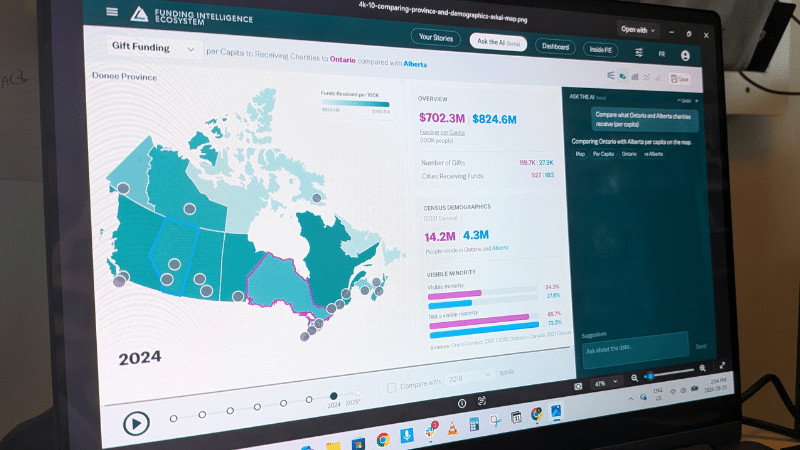
Imagine Canada launches visual tool to ‘see’ non-profit funding landscape
A new data visualization tool designed to let funders, non-profits and researchers understand the entire non-profit funding ecosystem

Ottawa chooses Canadian Housing Acquisition Fund to manage $1.5 billion affordable housing money
The massive new fund will help grant Indigenous, cooperative and non-profit housing providers easier access to capital to help buy and develop homes for lower-income Canadians.

New donation platform to help communities directly pay down mosque debt
Own Your Masjid is a project of boutique marketing agency Process Plus Marketing
