Canada’s next budget will shape the COVID-19 recovery. Here’s what the social impact sector wants.
These eleven social purpose organizations shared their priorities for the expected spring budget in a series of submissions late last year.
Why It Matters
Canada’s social impact sector could play a significant role in the COVID-19 pandemic recovery. Many of its priorities are similar to the federal government’s own plans for a pandemic recovery, but Ottawa has barely mentioned the sector.
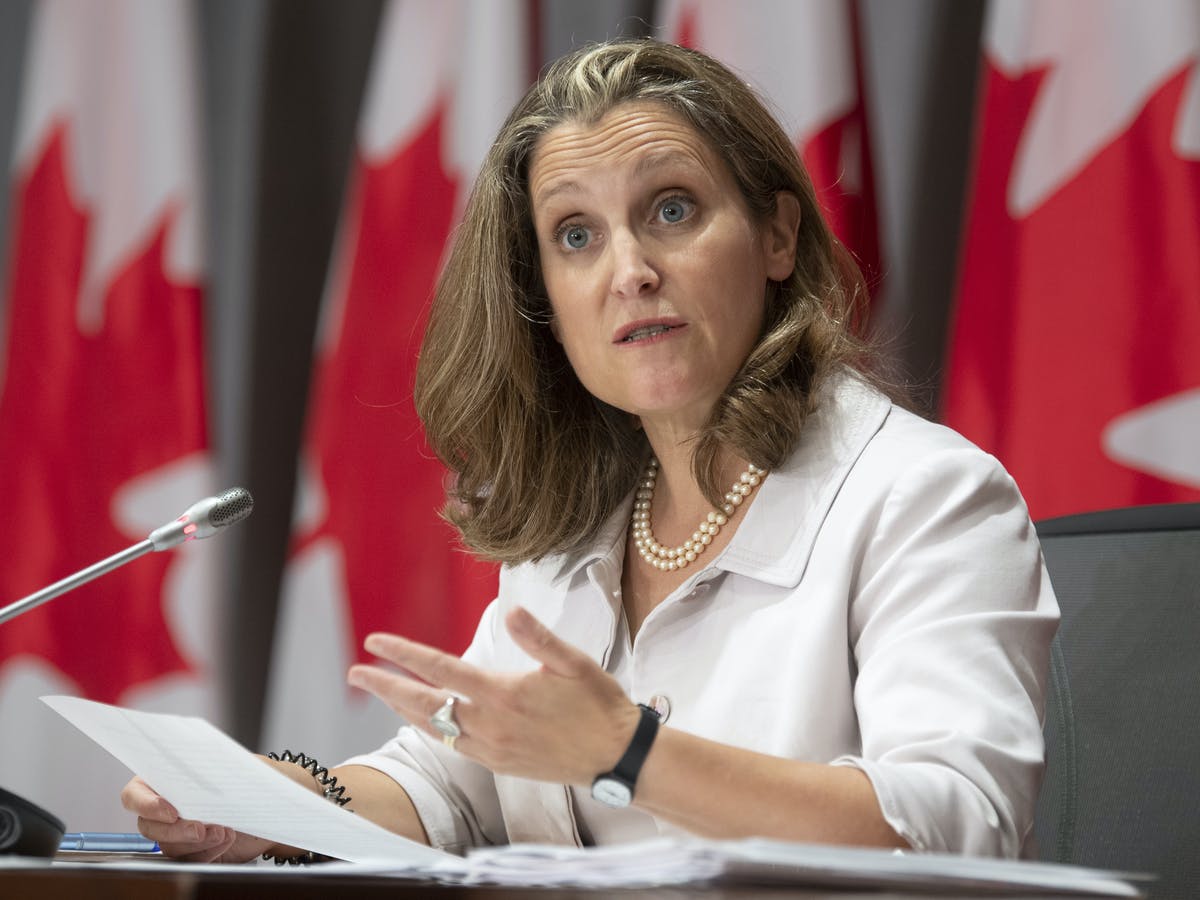
Photo: THE CANADIAN PRESS/Adrian Wyld
Canada’s next budget promises to be one of the most significant in recent memory.
Unemployment, elder abuse, climate change, gender equality, Indigenous rights, and childcare all remain huge issues as Canada and the world continues to grapple with the COVID-19 pandemic. The government and Canada’s social impact sector agree on the need for extensive investment for years to come, but it remains to be seen how that will happen. The federal government has suggested its next budget could be released as early as this March.
In last fall’s Throne Speech, a high level overview of the government’s priorities, the Liberals promised a $75 to $100 billion economic stimulus package, the seeds of a national childcare framework, significant investments into the COVAX international vaccine access program, and a green reimagining of the economy. But the social impact sector received almost no mention.
After the federal government requested proposals for their 2021 budget last year, Canadian non-profits, charities, and philanthropic organizations submitted briefs en masse. They call for everything from better funding for childcare to ensuring Global South countries have enough COVID-19 vaccines to inoculate their populations.
Future of Good reviewed 11 pre-budget submissions from organizations all across Canada focused on a wide variety of issues — domestically and internationally. Here is what the world of social impact is looking for:
Canadian Community Economic Development Network
A national member organization focused on community economic development across Canada.
Notable budget asks:
- Ensure equity-seeking groups have a major role in the implementation of a Social Innovation and Social Finance Strategy.
- Establish a national program for community investment funds across all of Canada’s provinces.
- Accelerate the timeline of the federal government’s Universal Broadband Fund and use it to help communities buy their own broadband networks.
The government’s past promises:
- The recommendations of the Social Innovation and Social Finance Strategy Co-Creation Steering Group include establishing a guiding council with “official language minority communities”.
- Currently, the Universal Broadband Fund is offering $1.75 billion to connect all Canadians to high speed broadband internet by 2030.
Imagine Canada
Along with sector research and resource sharing, this organization advocates to the government on behalf of non-profits and charities.
Notable budget asks:
- A central “home” for the charitable and non-profit sectors within the federal government, something Imagine Canada has demanded for years. This recommendation is at the top of its recommendations for the 2021 budget.
- Making federal government grants and contributions to social impact organizations last at least two years, be more flexible, and offer the possibility of renewal.
- Have Statistics Canada start collecting “comprehensive economic and employment data about our sector” with a $1 million per year budget.
The government’s past promises:
- Last year’s fall economic statement made no mention of a central “home” for the charitable and non-profit sectors.
- In January, leaders from some of Canada’s largest charitable organizations met with Social Development Minister Ahmed Hussen to push for a $500 to $700 million community service sector relief fund, but it isn’t clear whether the government will agree.
- The federal government hasn’t said anything about a social impact sector-specific hub for employment data, but analysis by the Action Plan on Women in the Economy Taskforce could be relevant — at least three quarters of all sector workers are women.
Oxfam Canada
Oxfam Canada is an anti-poverty charity focused on women’s rights around the world.
Notable budget asks:
- Allocate $2 billion a year to fund a public childcare system across Canada, a request made in a separate joint brief filed on behalf of 14 feminist organizations.
- Modernize Canada’s EI system with a system that adopts the flexibility and accessibility of CERB.
- Invest an additional $2 billion into Canada’s international feminist response to COVID-19, and double the country’s contributions to the Feminist International Assistance Policy from $6.2 billion to $12.4 billion over five years.
The government’s past promises:
- In last fall’s Throne Speech, the Liberal government promised a national childcare program, but, so far, it is only providing around $20 million over the next five years to start designing the plan.
- CERB and its successor program, the Canadian Recovery Benefit, saw several extensions, as COVID-19 related unemployment rates remained high. However, the federal government has not said whether it plans on overhauling EI in the long-term.
- Canada’s feminist foreign policy framework is still under construction, but Canada launched the Feminist International Assistance Policy in 2017 to promote inclusive governance, gender equality, and peace and security.
Co-operatives and Mutuals Canada
A member association for Canada’s 8,000 cooperative enterprises. It also advocates to the government on their behalf.
Notable budget asks:
- Provide $9.9 million over three years through Co-operatives and Mutuals Canada as “an investment in the recovery, growth and launch of co-operative enterprises across the country.”
- Encourage traditional small and medium enterprises to convert to co-operatives when their original owners retire.
The government’s past promises:
- Converting traditional businesses into cooperatives was not mentioned in either the fall economic statement or the Throne Speech, and even the pre-budget submission from Co-operatives and Mutuals Canada notes the practice is not well-known in Canada.
Canadian Council for Youth Prosperity
A national cross-sector collaboration of corporate leaders and communities focused on developing Canada’s youth workforce.
Notable budget asks:
- A $25 million stimulus package for youth-serving non-profit mentorship operations, to help youth find mentors during the COVID-19 pandemic.
- Fund a $50 million “technology endowment” for employment service providers to help them provide youth with “the hardware needed to thrive in this digital world, and the training to use it”.
- Add a separate Labour Market Agreement, a funding agreement from Ottawa to Canada’s provinces and territories to help workers return to their jobs or train for new ones, specifically aimed at youth.
The government’s past promises:
- In the fall economic statement, the Liberal government promised $447.5 million in new investments into supporting up to 120,000 positions for the Canada Summer Jobs program in 2021.
- The statement also proposed investing $573.3 million over the next two years for the Youth Employment and Skills Strategy (YESS), a plan to help young Canadian workers find jobs and build up their skills, and provide around 45,300 job placements in total.
- The government also promised to eliminate all interest on Canada Student Loans and Canada Apprentice Loans for the 2021-2022 year.
Climate Action Network Canada
A coalition of more than 100 organizations, including labour, development, faith-based, and Indigenous groups, focused on climate change.
Notable budget asks:
- Commit roughly $5.04 billion Canadian to international climate finance under the United Nations Framework Convention on Climate Change, with at least 15 percent of it going to projects that tackle gender equality.
- Forbid the government from using Export Development Canada “to expand the fossil fuel industry in Canada and around the world.”
- Fund a cross-departmental internal task force on clean and just recovery during COVID-19 to both assess government spending and “build bridges between the federal government and impacted communities that are receiving federal relief and recovery support.”
The government’s past promises:
- Canada is still heavily invested in the fossil fuel industry. While the Liberals have promised to fund a green economic recovery from COVID-19, they have not shown signs of a rapid shift away from fossil fuel development and export.
- According to research from the International Institute for Sustainable Development, Canada provides roughly $14.3 billion U.S. (or around $18 billion Canadian) in subsidies for the fossil fuel industry, mostly through public finance.
- The fall economic statement included lots of language on a green recovery from COVID-19, including $2.5 billion for clean power through the Canada Infrastructure Bank, along with $2 billion for large-scale building retrofits and $1.5 billion for zero-emission buses.
Social Capital Partners
A social finance firm that works on everything from launching social enterprises to helping workers facing employment barriers find good jobs.
Notable budget asks:
- Create Canadian employee ownership trusts, a model that allows traditional businesses to transition towards worker ownership.
- Create a policy framework that encourages owners, companies, and employees to transition to employee ownership (including a review of the Income Tax Act).
The government’s past promises:
- No mention of employee ownership trusts exists in the Liberal government’s fall economic statement nor its Throne Speech.
CanAge
An independent non-profit that advocates on behalf of Canadian seniors across the country.
Notable budget asks:
- Create a national elder abuse and neglect awareness campaign. CanAge says allegations of elder abuse have increased significantly since the COVID-19 pandemic began.
- Require federal agencies to collect disaggregated data, or data broken down from a larger category, on elder abuse and neglect across Canada.
- Study whether the federal government should implement a Canadian Adult Protective Services arms-length government agency.
The government’s past promises:
- Seniors associations have asked the federal government to create a national senior strategy for years, but this hasn’t happened yet.
- Canada’s Youth Employment and Skills Strategy, along with several other plans related to mentorship and Indigenous culture, acknowledge the significance of Elders in imparting Indigenous wisdom. However, there is no overarching campaign specifically focused on the needs of Indigenous Elders.
- The federal government does maintain public resources on recognizing and fighting elder abuse.
YWCA Canada
One of Canada’s oldest charities focused on community building for women, girls, gender diverse, and Two-Spirit people.
Notable budget asks:
- Fully implement all of the calls to action in the Truth and Reconciliation Commission (TRC) and the calls for justice in the Missing and Murdered Indigenous Women and Girls Inquiry report.
- Legislate at least 14 paid sick days for all and offer paid family leave for all workers in Canada.
- Provide permanent resident status on arrival to all migrant care workers and their families entering Canada.
- Establish a $500 million per year National Action Plan on Addressing Gender-Based Violence.
The government’s past promises:
- A significant number of the TRC’s calls to action have seen moderate or little progress, according to a 2020 report card issued by the Assembly of First Nations.
- In 2020, the federal government announced the Canada Recovery Sickness Benefit, which offers $500 per week to workers isolating during COVID-19, for up to two weeks, but this can only be used for COVID-19 related reasons.
- The federal government now allows some refugee claimants who worked in healthcare during the pandemic to apply for permanent residence status, but this isn’t as comprehensive as what the YWCA is asking for.
Indigenous Leadership Initiative
An organization focused on strengthening the nationhood of Indigenous communities so they can steward their lands, young Indigenous leaders, and the skills and capacity of communities.
Notable budget asks:
- Commit to Indigenous-led conservation, including land planning and stewardship as part of the federal plan to protect 25 percent of its lands and waters by 2025.
- Support Indigenous-led conservation efforts in setting new targets under the United Nations Convention on Biological Diversity.
- Boost funding to the Indigenous Guardians Pilot Program, trained experts on environmental sustainability, to at least $300 million per year.
The government’s past promises:
- The Guardians Pilot Program, along with the Indigenous Circle of Experts, a working group of both Indigenous experts and government officials, are among the federal government’s conservation policies.
- Total investment for the Indigenous Guardians Pilot Program runs to about $25 million. Around 70 projects have received funding. However, the Indigenous Leadership Initiative argues these programs are fairly short-term in nature.
Ontario Council of Agencies Serving Immigrants
An organization representing newcomer focused agencies across Ontario.
Notable budget asks:
- Create a National Action Plan Against Racism with concrete goals and measurable targets.
- Update the federal government’s Poverty Reduction Strategy to focus on alleviating disproportionate levels of poverty in racialized communities across Canada.
- Stop sending refugee claimants back to the United States under the Safe Third Country Agreement, a rule that allows border officials to remove refugees who first enter the U.S. from applying for asylum in Canada.
The government’s past promises:
- The federal government launched a three year, $45 million Anti-Racism Strategy to fight racism and discrimination across Canada.
- Canada’s Poverty Reduction Strategy, launched in 2018, promises to reduce poverty by 20 percent by 2020 and by 50 percent in 2030. It does mention that race is a factor in poverty and suggests improving data collection on the experiences of racialized communities, but does not say anything about poverty alleviation specifically among those communities.
- The federal government is currently appealing a court decision ordering it to stop sending refugee claimants back to the U.S. under the Safe Third Country Agreement.
Your job. Your mission. Your news.
With your support, the sector you're building gets the journalism it deserves, and you get a tax receipt.

Related Articles

Explainer: Why, despite Ottawa’s billions in spending, the country’s biggest housing provider is still facing a $3B hole
Expiring funding streams and lack of funding keeps social housing stock in poor condition

Non-profit coalition joins Supreme Court intervener list challenging Doug Ford’s Ontario Place destruction plan
The case, which will begin hearings in October, has attracted national interveners as the fight over redevelopment escalates.
Redesigned Canada Housing Benefit could reduce homelessness by more than half: Report
End Homeless Canada’s new report shows if Canada’s Housing Benefit is redesigned, it could dramatically reduce homelessness in the country.
