THE TECH PHILANTHROPY MARKET IS BOOMING. HERE’S WHAT YOU NEED TO KNOW.
It’s a whole new era
Why It Matters
The tech industry is booming in Canada, and with industry growth comes new injection of philanthropic capital. In this series, we unpack how the tech sector is shaping a new philanthropic landscape, and why this emerging donor market is essential to understand.

Today, much of the world’s wealth belongs to global technology companies and their founders, with technological breakthroughs happening at an exponential pace. The top ten wealthiest people in the world are tech founders, including Jeff Bezos (Amazon), Bill Gates (Microsoft), Mark Zuckerberg (Facebook), and Larry Page (Alphabet/Google). As for Canadians, wealthy tech founders include Garrett Camp (Uber), Tobias Lutke (Shopify), and Peter Szulczewski (Wish). (In case you didn’t notice: that’s a lot of men…!)
The need for philanthropy remains ever-present with rising global challenges. At the same time, the collective wealth of the world’s billionaires increases by $2.5 billion every day, and there are 143 tech billionaires in the world. The number of Canadian millionaires is growing fast, too, with the 1.3 million Canadian millionaires in 2018 expected to grow to two million millionaires by 2023. On top of that, the average CEO of a billion-dollar startup in North America is 39 years old, and the average employee working for them is 29.
With these sorts of numbers, it’s not surprising that the tech sector contributes significantly to Canada’s GDP. According to the Government of Canada, the software and computer services sub-sector alone grew by 7.7% in 2018, outpacing the Canadian economy growth of 2.3%.
According to history, with industry growth comes philanthropy — and the next tech era is no different. Philanthropy is experiencing a seismic shift in wealth due to the growing influence of a new generation of tech founders and CEOs.
This shift started at the turn of the millennium, during a period associated with the rise of Silicon Valley, high-tech clusters, and the infamous dot-com crash which began on April 17, 2000.
To give a little context, Silicon Valley has been globally recognized as a hub of technological innovation since the 1970s. Between the mid 1990s and 2001, Silicon Valley, alongside several high-tech industries, went through rapid growth before a sudden economic downturn. However, by 2008, Silicon Valley’s high-tech companies had generated $57.7 billion in wages — nearly 14% higher than the total wages earned in those same industries in 2001.
With this sort of boom came the injection of philanthropic capital; in 2017, the 50 largest individual donors in the U.S. gave away a combined $15 billion, and 60% of those came from tech giants.
One example is Canadian Jeff Skoll, the first president of eBay, who later founded the Skoll Foundation. The foundation aims to drive large-scale change by investing in, connecting, and celebrating social entrepreneurs solving the world’s most critical issues, from education to human rights to the environment. In total, the foundation gives out $40 million in grants every year.
Clearly, technology is driving a new era in philanthropy. At the same time, we are seeing a shift in how we think about the purpose of capital; in August 2019, 181 CEOs in the United States signed the Business Roundtable’s landmark statement redefining the purpose of a corporation to ‘meet the needs of all stakeholders’.
Business and technology expert Don Tapscott calls this whole period of change the ‘New Economy’, with the ‘Internet at its heart’. Klaus Schwab, founder of the World Economic Forum, described the borderless promise of the Fourth Industrial Revolution as: “The possibilities of billions of people connected by mobile devices, with unprecedented processing power, storage capacity, and access to knowledge, are unlimited. And these possibilities will be multiplied by emerging technology breakthroughs in fields such as artificial intelligence, robotics, the Internet of Things [etc].”
So how exactly is tech philanthropy different to traditional philanthropy? Some of key markers include the tech sector’s heavy emphasis on a global outlook and data-driven decisions — as well as providing huge donations with the ambition to transform entire fields.
There are several Canadian companies who are putting their energy into addressing global challenges, and who count data and intellectual capital as part of their philanthropic giving. The new WealthSimple Foundation aims to support children in reaching their full potential by addressing the education gap by providing access to education savings grants and investments.
Another example of this is Shopify’s new Sustainability Fund, which sees the e-commerce platform committing a minimum of $5 million annually to address climate change through carbon sequestration and carbon-neutral operations. Shopify recently went public and WealthSimple is named as one of the hottest companies to consider an initial public offering (IPO) along with companies such as Wattpad, Vidyard, and Hootsuite.
Canadian tech companies are positioning themselves to tackle climate change, education, and other challenges. Meanwhile, corporations who have been around since the 90s have also incorporated new social impact practices. Salesforce adopted a ‘1/1/1 Model’ of charitable giving: donating 1% of employee time, product resources, and profits to charitable causes. In the 16 years they have been using this model, Salesforce has donated $96 million.
Will the bubble burst again? The signs are pointing to ‘no’ — tech companies are projected to keep growing exponentially over the next 20 years, and according to one study, will be four percent of the world GDP by 2026, and 8 percent by 2038. There’s no denying it: technology-influenced social impact is part of a new wave.
Modern philanthropy is grounded in the confluence of technological advancement, the rise of the billionaire philanthropist, and the limitations of public sector funding. As well as this, technological connectivity is reshaping the way that social and environmental issues are being addressed and the ways that philanthropy is expressed.
Whether you are a giver, a go-getter, or both, the Fourth Industrial Revolution is going to change the way you give, get, live, and work.
Stay tuned for the next article in this series, where we dive into the first of four trends contributing to Canada’s tech sector driving a new philanthropic landscape.
Your job. Your mission. Your news.
With your support, the sector you're building gets the journalism it deserves, and you get a tax receipt.

Related Articles

Elbows up: Spring Impact Capital calls for a giant spreadsheet of available early-stage Canadian capital
The Vancouver impact investor wants to crowd-source a free, national directory
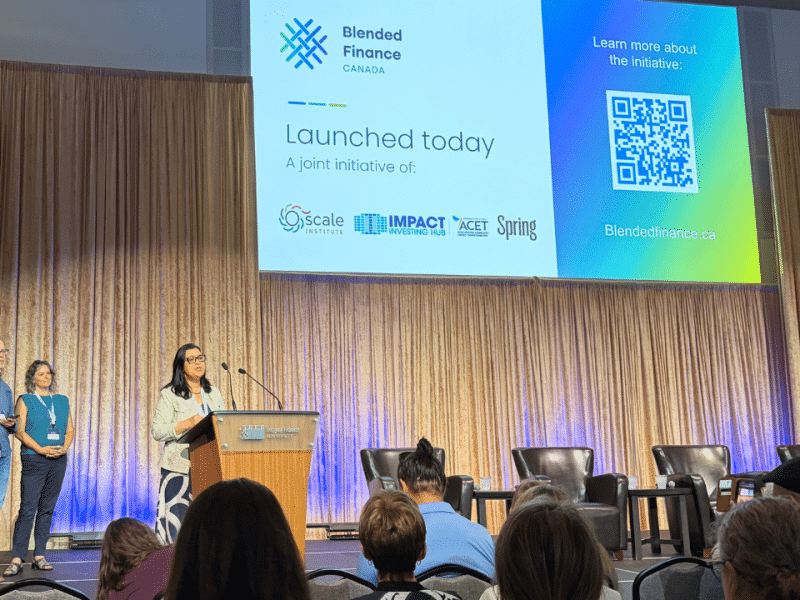
Blended Finance Canada launches on West Coast
The new initiative is supported by the University of Victoria, Scale Institute and Spring.

Canada’s Sustainable Finance Taxonomy: What it is, what is happening and what’s coming next
Canada’s sustainable finance taxonomy faces big challenges, from oil and gas, Indigenous rights and the real meaning of the word ‘transition.’
