How place-based investing could help finance cities’ climate plan: the LC3 network case
Climate-mitigation funding is drying up like the lakes and rivers it’s trying to save. So how can Canada’s cities and municipalities pay for their plans when funding gaps prevent them? Social finance reporter Diane Berard explores the LC3 network in the case study below.
Why It Matters
Municipal climate action faces a significant funding gap. For instance, Vancouver’s 2024 climate budget report estimated a $97 million funding gap for the $215 million in capital investment needed over 2024–26 to implement the city's climate plan. A fresh pool of money is critical, and it must be substantial.
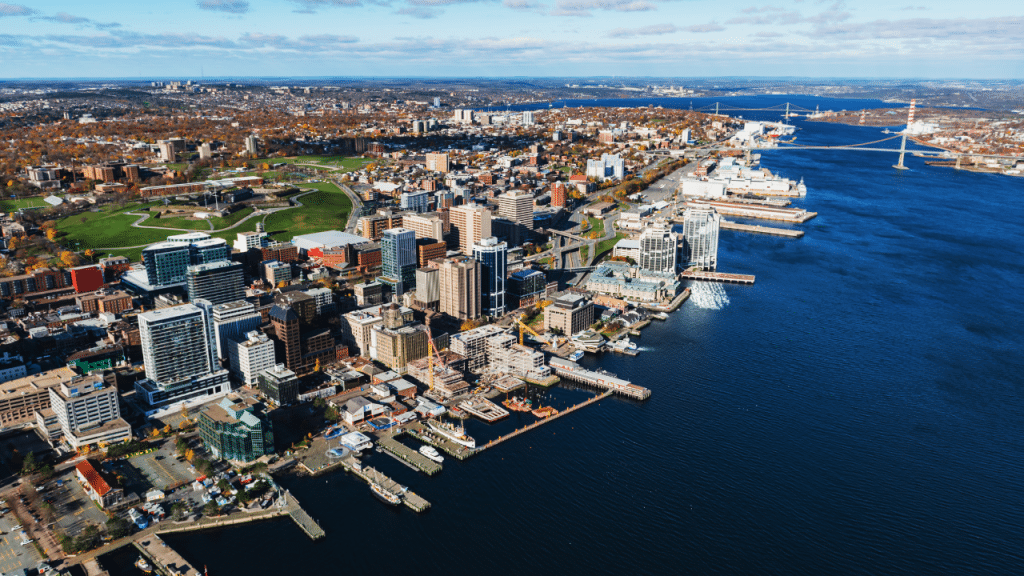
In December 2025, the City of Toronto adopted its second climate action plan. Vancouver and Edmonton will unveil their new versions during the first half of 2026.
They did this despite the fact that there is no federal or general provincial requirement for cities to have or implement a climate action plan.
Edmonton is an exception; its City Charter grants Edmonton specific powers and obligations not available to ordinary municipalities, including the obligation to maintain and periodically review its climate strategies.
In Quebec, municipalities must have a climate action plan approved by the Ministry of the Environment, the Fight Against Climate Change, Wildlife and Parks, to access provincial climate funding.
Even without legal obligations, Canadian cities develop these plans because, more than any other level of government, they are dealing with the impacts of the climate crisis on their populations’ daily lives.
The options to finance municipal climate action plans are getting dry
Cities access climate funding through four sources.
There are perpetual endowments, such as the $2.4M programs from the Federation of Canadian Municipalities Municipal Fund.
Next are large federal programs like the Zero Emission Transit Fund and the Building Retrofits Initiative from the Canada Infrastructure Bank.
Cities can target federal programs, such as the Greener Home Affordability Program.
Fourth, there are city-specific instruments like Toronto Green Debentures and Halifax Climate Action Tax (a three per cent dedicated property tax).
However, these sources are running dry.
Prime Minister Mark Carney’s 2025 budget proposed cancelling or changing climate rules and initiatives, while cutting billions of dollars in planned environmental spending.
This pattern is consistent across provinces, too: environment and climate ministries are absorbing cuts or freezes, and municipal grant programs are expiring without renewal.
For example, this spring, Alberta’s substantial municipal climate action rebate program, the Municipal Climate Change Action Centre (MCCAC), is set to expire. According to its own budget, the province doesn’t plan to keep funding it.
Since 2009, the MCCAC has offered matching funding up to $500,000 to 175 municipalities for energy conservation and electricity generation projects, and to hire a staff energy manager.
In the next three years, the B.C. The Ministry of Environment and Parks will see an $11 million reduction.
Nova Scotia cut the total budget of its Department of Environment and Climate Change by 25.3 per cent. Among the casualties is the student transit pass pilot program, which had allowed junior high and high school students to use Halifax Transit for free.

“Public money — at every level of government — will not be enough to finance [municipalities’] climate ambition, ” said Pierre-Laurent Macridis, Financial Innovation Director at Greater Montreal Climate Fund (GMCF).
An experiment in place-based climate funding: the LC3 funds
The Low Carbon Cities network’s (LC3) mission is to attract private and philanthropic capital to support municipal climate financing.
This partnership between seven Canadian cities and the Federation of Canadian Municipalities (FCM) was launched in 2023, with an $183M endowment from the federal government.
The endowment is distributed among Toronto, Vancouver, Edmonton, Calgary, Halifax, Montreal, and Ottawa, which together house half of the Canadian population.
The funds are place-based; they are designed to help the city they are attached to achieve its Climate Action plan.
Place-based finance is challenging, especially in certain regions.

“If I were in Toronto, Vancouver or Montreal, I could have five meetings daily with potential investors,” said Kevin Mullen, investment manager at Halifax Climate Investment, Innovation and Impact HCI3 Fund.
“Fortunately, money works on a formula. Nationally organized funds need reliable regional players to diversify,” he added.

“We are close to the work, we can measure, monitor and report the actual and potential impact to investors and cities,” said Mike Mellross, vice-president of the Alberta Ecotrust Foundation and lead creator of the Climate Innovation Fund.
“Big funds are sort of faceless; the impact side might get a little bit lost.”

The LC3 funds endowments range from $20M to $100M. However, the ambition goes beyond those numbers.
“We are catalytic capital,” said Vincent Moreau, managing director at the Greater Montreal Climate Fund.
Attracting millions, hopefully billions, into climate projects to counter government austerity and keep the momentum is ambitious.
However, there is a 30-year track record of proof-of-concept for LC3 funds: the Toronto Atmospheric Fund (TAF).
How it all began: Toronto Atmospheric Fund
“In the 1990s, the City of Toronto thought: climate is a global issue, but what do we do locally?” said Julia Langer, a climate action expert and TAF CEO.
“A group of city councillors saw the need for an agency that wasn’t part of the city, because it really has to do core functions, like picking up garbage. And climate action wasn’t going to be deployed in a quarter or even a four-year term of council. There was a need for staying power,” she added.

TAF’s first investment was a loan to help the City of Toronto replace all outdoor lighting from mercury vapour to sodium halide, resulting in $2.5M in annual savings and significant reductions in emissions.
Over the years, TAF financed the campaign to end coal-fired electricity generation in Ontario, which reduced carbon emissions by 69 million tonnes.
It helped establish Smart Commute, now a regional Metrolinx program that helps employers reduce staff travel time and transportation emissions. It was the first funder of Enwave, an energy company that uses cold water from the depths of Lake Ontario to cool several downtown buildings.
Then TAF turned to the federal government to grow its endowment, Lager said.
Ottawa’s answer was, “We don’t want to just do Toronto. Why aren’t there atmospheric funds in other cities?”
Same regional mandate, different structures
“All of us share a common mandate to address municipal emissions and promote co-benefits. But we each pursue our mandate in a slightly different way,” said Melina Scholefield, executive director of Zero Emissions Innovation Center in Vancouver (ZEIC).

TAF is a non-profit. The Greater Montreal Climate Fund is a charitable organization. HCI3 is a subsidiary of Nova Scotia Efficiency One, and the Climate Innovation Fund is a program of the Alberta Ecotrust Foundation. Vancouver ZEIC is an independent non-profit and registered charitable organization. OCAF was incubated by the Ottawa Community Foundation until 2024; it is now a charitable organization.
All hubs have invested their initial endowment for returns. Each year, they disburse a portion for grantmaking and impact investing.
Follow the carbon
Climate projects have come a long way since the days of replacing outdoor lighting.
“Our mantra is: follow the carbon,” said Lager.
Five universal investment themes unite all the LC3 hubs: building retrofits, EV charging and fleet electrification, sustainable mobility, and clean energy.
Then, geography shapes local priorities.

The Halifax/Kjipuktuk region has a significant opportunity to move its buildings away from oil heating.
“Our first impact investment was $500,000 in the Deep Retrofit Accelerator Initiative,” said Sarah Chiasson, executive director at HCI3.
The Alberta Climate Fund’s first impact investment was in renewable energy.
“In 2025, we invested in RE Royalties, an energy royalty-based financing company,” said Mellross. RE Royalties provides capital to wind farm and solar plant developers. In return, it secures shares of gross revenue over periods of 20 to 25 years. The remuneration is linked to revenue, not to profit.
RE Royalties recently financed $6.3M for a solar project in Sturgeon County, a municipal district in the Edmonton Metropolitan Region. It will power the equivalent of 57,000 homes.
The amalgamation of Ottawa brought in rural areas, said Cherise Burda, OCAF’s executive director and a champion of urban sustainability.
“The city is out on a sprawl, steadily adding houses. Tailpipe emissions are significant; adding secondary suites in urban and suburban areas could reduce emissions associated with new housing by 35 to 50 per cent,” she added.
OCAF is working on ways to accelerate Ottawa’s new secondary suite program, called “Fill it first.”
It has also commissioned a study to identify pathways for Canada’s largest technology park, Kanata, to meet its growing energy needs with clean energy.
It’s a classic case of chicken and egg. Which comes first: the demand for climate solutions, or the solutions themselves?
Both, said Shofield.
“A lot of our work is building the confidence, the know-how and the critical mass of the people doing the work in the field and those looking for their solutions.”
Build the market, and they’ll come: From energy efficiency to last-mile delivery
The LC3 hubs must not duplicate the private market.
“They demonstrate solutions to be scaled up to the level needed to address our climate goal,” said Oscar Espinosa, project director for LC3 at the Federation of Canadian Municipalities.
Take the MultiRés program, which provides financial support and technical expertise to multiplex owners. No cash is required upfront; owners repay with the energy savings.
“We put $1 million in grants, and that attracts $70 million impact investing from private investors and foundations for multi-residential buildings energy retrofits,” said Macridis.
MulitRés Investors receive both financial and social returns, he added.
“The contract highlights that owners cannot raise the rent after the retrofits and ‘renovict’ the renters.”
In five years, another stakeholder will take over MultiRés, and GMCF will move on to create a new financial instrument to fill another gap, said Moreau.
Electrifying last-mile delivery, financing municipal eco-fiscal measures, and converting geothermal energy are all on the GMCF’s to-do list.
The last-mile delivery is mostly done by subcontractors, many of whom are newcomers with no credit history, said Macridis.
“We are working on a product that derisks credit access for these entrepreneurs. It implies about 200 truck conversions [to electricity], contributing to lower Montreal transport emissions.”
What if external investors could finance a fund matching the revenues cities collect from their eco-fiscal measures?
“It is the perfect illustration of place-based impact investing,” said Moreau. “The investor has assurance that her money will be directed to climate action in the geography of her choice.”
Geothermal energy faces significant barriers in Quebec; the payback period is longer than in other provinces because hydroelectricity prices are very low. However, it is an energy-efficient technology that Quebec Hydro would like to see deployed.
The crown corporation offers subsidies, but building owners receive them after the conversion is completed.
“We’re exploring creating a financial vehicle of several tens of millions of dollars into which pension funds, family offices, and other financial actors could invest. The fund would grant bridging loans, repayable upon collection of the subsidy,” said Moreau.
As for MultiRés, the geothermal fund is planned as a proof-of-concept to be turned over to a third party.

“LC3 hubs can take the time to really understand the market, working at a small scale to identify the challenge and provide solutions that can be scaled,” said James Nowlan, who worked on climate action plans for the Ontario government before joining the City of Toronto as director for Environment, Climate, and Forestry.
“The time we invest in crafting financial tools is as critical as the money we allocate,” said Lager, giving the example of the Energy Saving Performance Agreement (ESPA).
In 2015, TAF invested and incubated Efficiency Capital, a for-profit, socially responsible venture. Together, they created ESPA.
Efficiency Capital pays for the purchase and installation of energy- and water-efficiency equipment. The building owner shares the energy savings until the investment, plus a modest return, is repaid, usually over an eight- to 10-year period.
“We used our asset to do a bunch of deals, to show it works,” said Lager. Today, the Canada Infrastructure Bank and the Vancity Community Bank are financial partners of ESPA.
How a financial tool convinced Toronto council to step up the construction code
The market is very powerful, but public policy is much more so, said Lager.
For example, the TAF Green Condo Loan prompted changes to Toronto building requirements.
TAF identified a split incentive: condo developers build cheaply because they don’t operate the building; condo owners pay the energy bills.
“We financed the incremental cost of building 25 per above the construction code,” said Lager. The loan was transferred from the developer to the condo corporation, which repaid it with its energy savings.
After enough loans were made, TAF went to the city with proof that developers could build better. The city raised the bar.
“We don’t just use our endowment for money. We use it for change; with the green condo loans, our financial intervention catalyzed a policy change,” said Lager.
“The LC3 strength is its long-term societal view with the public good in mind,” added Nowlan.
Addressing local needs with a national scope: Kite Mobility
An example is Kite Mobility, a Canadian electric car-sharing company. It addresses two climate goals: reducing the carbon footprint of buildings and accelerating the electrification of transportation, said Macridis.
“One model is with new construction: underground parking represents, on average, $100,000 in capital costs per parking space. So, skip the parking and offer car sharing instead. The other model is for seniors’ residences, people downsizing don’t want to own a car but want access to one,” said Langer.
TAF identified the investment opportunity, and the Edmonton/Calgary and Montreal hubs co-invested.

Kite’s team says its shared mobility projects could improve housing affordability for residents by saving developers millions of dollars in capital costs. It’s called co-benefits; many impact investors are looking for those.
There’s no such thing as a standalone climate change project, said Jonah Bernstein, director, environment and climate change at the City of Halifax.
“We look for a social equity component. Is there an Indigenous ownership component? Air quality improvement for residents? Positive impact for the marginalized community or low-income Albertans?” said Mellross.
One cannot separate climate from people, added Espinosa. “The problem is we focused too much on silos — I’m in climate, I’m in the economy, I’m in the social side. The reality is that it is all interconnected. And that is central to the LC3 model: that multi-solving approach.”
What’s next: headwinds and a nation-building project
What are the odds of LC3 funds replicating the success of TAF?
Several structural headwinds remain unaddressed. Capital markets are notoriously short-sighted — and climate investments require patience. “A lot of investors still think in very short cycles,” said Espinosa.
“Institutional investors repeatedly say they want to invest in climate solutions, but internal incentive structures don’t reward them for the extra due diligence it takes,” said Lager. “This sector is coin-operated. If they don’t get compensated, they don’t do it.”
And there is a newer competitor for impact capital: artificial intelligence.
“The rush of investment into AI is actively draining early-stage climate companies of potential funders, lengthening their fundraising timelines and narrowing the field of engaged investors,” added Lager.
Meanwhile, the political ground beneath cities keeps shifting. Provinces have walked back municipal climate, creating whiplash for cities trying to plan 10 and 20 years ahead.
On the upside, “The cost-effective solutions are now available to us,” said Bernstein. “That didn’t exist 20 years ago. Wind, solar, batteries, and EVs were all more expensive. And we’re seeing those costs come down.
“So we have a business case: we can address climate change and affordability simultaneously. It’s an easy argument now. However, we need to address the scaling problem.”
Jonah Bernstein
Private investments look for a business case and for predictability.
Policy remains the strongest incentive. “When programs are in place, we see a lot of action. When they end, we see a change,” said Nowlan.
On April 11, a resolution to make energy efficiency one of the nation’s building priorities was adopted at the Liberal Party national convention. It was presented by Deputy Eric St-Pierre, who was the Trottier Foundation’s CEO before entering politics.
Maybe that could be the clear market incentive needed to scale climate investment.
Your job. Your mission. Your news.
With your support, the sector you're building gets the journalism it deserves, and you get a tax receipt.

Author

Related Articles
Federal court rejects Ottawa’s bid to quash youth-led climate case
Federal Court says youth climate advocates deserve a full hearing on whether Ottawa weakened Canada’s 2030 plan.
New UBC-Kelowna tool helps cities plant trees where they’re needed most
CanopyFit maps physical barriers alongside heat and equity data to maximize shade and cooling.

Canada’s Sustainable Finance Taxonomy: What it is, what is happening and what’s coming next
Canada’s sustainable finance taxonomy faces big challenges, from oil and gas, Indigenous rights and the real meaning of the word ‘transition.’
