
This article was produced in partnership with SVX. You can read our full editorial standards here.
Partnered Partnered content Should Canada regulate the price of farmland? System is currently in market failure: experts
About 170 people took part in the Regenerative Food Systems Investment Canada summit in Winnipeg last week, where recurring themes included finding flexible capital for farmers, protecting Canada’s food sovereignty and farmers’ role in mitigating climate change.
Why It Matters
Canada is losing young and new farmers at a rate that threatens long‑term food security, biodiversity, and climate resilience. Without structural interventions — from land‑price regulation to catalytic capital — the market continues to reward consolidation while shutting out the next generation of producers.
As the price of Canadian farmland continues to rise, creating a barrier for newcomers and those wanting to buy or continue family farms, regulating farmland prices was floated as a potential solution at a recent summit.
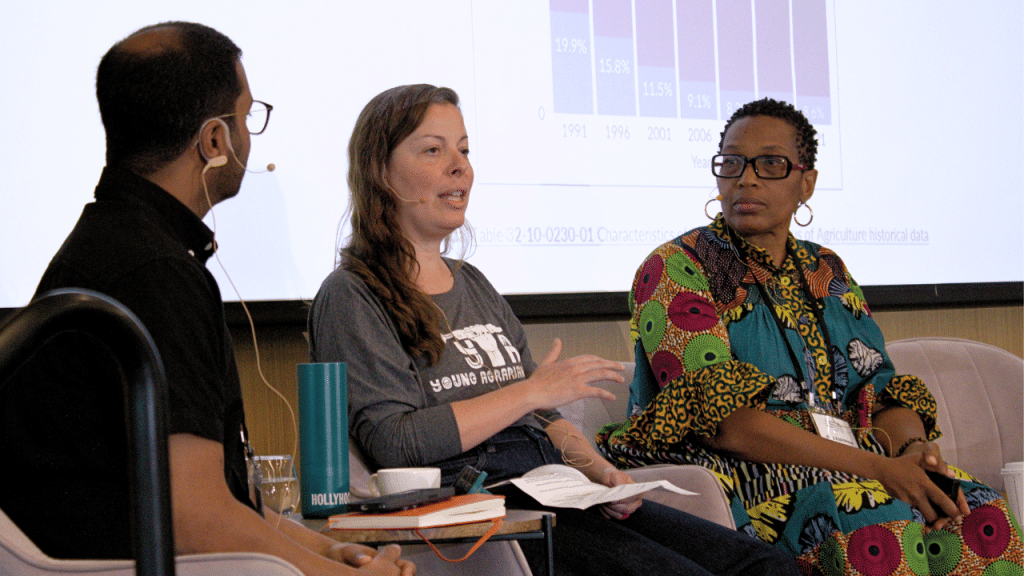
“As the cost of land and production increase, less and less people can either stay on the land or get onto the land. So market failure,” said Sara Dent, co-founder of Young Agrarians, to a group of about 170 participants at the Regenerative Food Systems Investment (RFSI) Canada summit in Winnipeg, May 27.
“It’s… one of the most important concepts right now for the sector. It’s widely recognized by the institutions that we have market failure conditions for agriculture.”
According to a Canadian Food Studies report, the number of farmers aged 35 and under has dropped from about 79,000 to 25,000 between 1991 and 2016, a 70 per cent decline in the number of young farmers. The number dropped to 22,690 by 2021.
“This means that Canada is losing young farmers at twice the rate that it is losing farmers overall,” the study authors wrote.
“The census comes out every five [years], and we’ve gone from 1.6 to 1.3 – like, predictably, we’re going to be at 1.0 per cent of the Canadian population farming,” said Dent.
Add in farm consolidation by corporations and rising land prices, without some sort of intervention, market failure worsens, said Afua Asantewaa, Inclusive Prosperity Fund’s executive director, during a session moderated by Wayne Miranda of Definity Foundation, along with Dent.
“We continue losing our young farmers, our newcomers who want to farm, the market is not conducive to supporting them,” she said.
“The likelihood is we lose food security. That is it.”
Canada also risks losing food sovereignty, and it becomes more difficult to mitigate climate change on farmland, Asantewaa added.
“It’s not just our food that we lose, we lose biodiversity, and the opportunity for the next generation to be on the land.”
“We’re in the end game, folks,” echoed Dent.
“We’ve created an ecosystem where [we’ve] created a lot of wealth as people bought farmland, [in] the 80s, 90s, 2000s, and sold. And now … we’ve hit the breaking point.
“We have to all try and figure out how to be geniuses and mitigate the capitalist system.”
Fighting market failure
Dent said several tools will need to be deployed to ensure farms aren’t swallowed entirely by corporations and to offer opportunities for people who wish to become farmers.
Buying land and creating land trusts is one way to help preserve family farms, the crowd heard.
In addition to buying land or helping new farmers acquire it through equitable lending practices, both Young Agrarians and Inclusive Prosperity work with newcomers to Canada and potential farmers to educate them in sustainable and regenerative farming practices.
It’s the investing in human capital that will make the biggest difference, said Dent.
“I would argue that if you’re not investing in human capital as your primary focus in the sector, that all the R&D, and all the AI and all the tech… you can do all of the whatever you want to do at the research level, but you still are not going to have farmers.”
That investment includes education, jobs, training and providing a robust network for new farmers to learn together, she added.
The next big factor is catalytic capital, said Asantewaa.
“It is patient capital. It is flexible capital,” she said. “It allows us to work with our clients to meet them… where they are.”
The newcomers who access Inclusive Prosperity’s programs are entrepreneurial-minded but may not have a proper business plan that will allow them to access loans.
“Compared to conventional or traditional financing, they expect clients to be bankable, ready, right?
“There are so many requirements they need from you, that from the beginning, they’ve already blocked you from accessing the very resources you need to get you going.”
This is where philanthropy comes in, said Dent.
“We need like zero to 2 per cent kind of lending.”
All stakeholders also need to coordinate and be flexible, Asantewaa added.
She cited an example where her organization received a government grant for capital for farmers to help them guarantee loans at traditional banking institutions.
Despite asking for the grant money to be received before farming season began, it was received in May.
From May to October, farmers were in their fields and too busy to work on things like business plans and to make sure their applications were up to par.
By the time plans were finalized, it was too late, as government funding restrictions required them to deploy this capital by a certain date. Ultimately, Inclusive Prosperity had to return the money, said Asantewaa.
Regulating the price of farmland
Asked what the big sky solution would be for ensuring family farms don’t continue to dwindle, Dent said it’s time to look for a big, systemic solution.
“Let’s regulate the price of farmland,” she said.
“That would be my very first thing, that I wonder if our super-capitalist inflation economics [system] would be into,” she added with a laugh.
“But just thinking about the France model, where they have regulated the cost of farmland. You have much more affordable organic food and a food environment for the people, so I would regulate that cost.”
In the 1960s, France created rural land agencies to “regulate agricultural land markets as higher agricultural incomes and growing demand for land increased the price of farmland,” according to Michel Merlet, founder and director of the International Association for Contributing to the Improvement of Governance of Land, Water and Natural Resources.
The agencies work by giving them first rights to buy agricultural land for sale.
“If they think that the asking price is higher than the market value they can suggest a lower price; in which case the vendor can either accept the lower price, withdraw the land from the market, or ask the court to set the price,” he wrote.
All parties must agree before the transaction takes place, said Merlet.
After that, the land is put up for sale to other producers, who must apply to purchase it.
The system has worked fairly well, said Merlet, noting that there has “not been a general shift towards large farms … [and the system] has helped avoid major concentrations of land.”
Still, Dent said after the talk that this would not happen in Canada without intentional government support.
“I mean, even suggesting to a room like this in the Canadian context and regulate the price of farmland … a lot of people would have to die before something like that would happen.”
Your job. Your mission. Your news.
With your support, the sector you're building gets the journalism it deserves, and you get a tax receipt.

SVX’s mission is to advance social, environmental and economic justice through impact investing. As a nonprofit, diversified financial services firm, SVX works with investors, funds, enterprises, and institutions to help them take the first step or next step on their impact journey.
Author

Related Articles

Explainer: Quebec’s pension fund stopped investing in oil and made $4B more in green energy. Now politicians and Canada’s pension sector need to get the memo
Quebec’s pension giant proves renewables can outperform oil — and exposes how far behind the rest of Canada’s funds really are.
Explainer: A new tool to hold real estate investors accountable on housing
A new disclosure framework gives Canadian investors their first standardized way to assess whether their real estate portfolios align with the human right to housing.

Explainer: Why this new Nova-Scotia platform could solve a major community investing problem
Backr could solve a big barrier to local investing: the lack of infrastructure connecting everyday Canadians to community finance tools.
