Case Study: Kingston’s food bank pilot combines three innovative solutions for food insecurity
Carney’s National Food Strategy includes boosting local food production. Pilots are already deployed. The federal strategy is arriving to meet it, not lead it.
Why It Matters
About 90 per cent of the leafy greens consumed in Canada are imported, leaving community food programs exposed to forces entirely outside their control. For food banks operating on thin margins and shifting donation streams, that exposure is a structural vulnerability, not just an inconvenience. As a result, more food programs are pivoting toward growing their own.
For years, the City of Kingston has redirected parking fine revenue to local food organizations — a program called Fines for Food — to help them buy and distribute groceries to residents.
Last fall, some of that money was instead used to help a food bank grow its own.
In October 2025, the City launched a pilot project redirecting a portion of that funding: instead of purchasing food, it would finance its production.
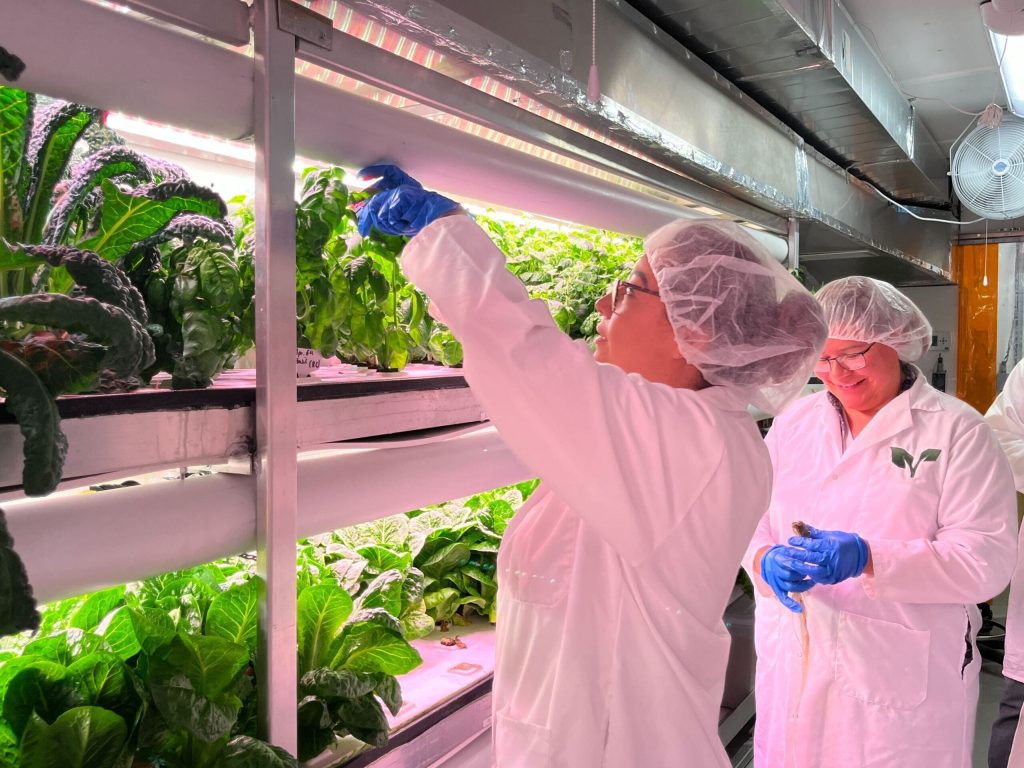
Fresh food is grown in a modular vertical hydroponic farm: a 40-foot, climate-controlled unit roughly the size of two parking spots that operates year-round.
Eight months in, the numbers are worth noting. The unit has produced 3,900 pounds of spinach, romaine lettuce, and pac choi, serving 112 households daily through the Partners in Mission Food Bank’s model grocery store.
The food grown on the farm was selected either for its nutrient-dense value or because it was familiar and easy to incorporate into daily meals.
What is farm-as-a-service, and how does it open new possibilities
The farm operates through a partnership with Growcer, an Ottawa-based agricultural technology company, using the industry’s farm-as-a-service (FaaS) model.
The distinction matters for non-profits evaluating whether this is replicable.
Purchasing a modular vertical farm outright costs about $250,000, plus shipping. Under the FaaS model, organizations access the same system for a monthly fee of $4,000 — with Growcer handling installation, maintenance, training, and ongoing technical support.
The subscription shifts financial and operational risk away from the non-profit, and the organization gets year-round produce without hiring agronomists or managing equipment failures.
Kingston’s $80,000 contribution from parking fine revenue, about two months’ worth, supports the farm’s operations, with additional support from a portion of a $1.5 million donation by RBC to the Ottawa Community Foundation’s Food Resiliency Foundation Fund, a donor-advised fund managed by Growcer.
Ottawa: adding workforce development to its food production project
Kingston’s pilot isn’t the only experiment running. Ottawa added a twist to its own pilot project.
When the Ottawa Mission, the city’s oldest emergency shelter, partnered with Growcer and RBC in June 2025, it designed the investment to do three things at once: grow food for shelter residents, supply its expanding food truck program, and train the next generation of food-sector workers.
The goal is to produce 20,000 pounds of leafy greens a year, enough to supply all the shelter’s meal programs.
Participants in the Mission’s free Food Services Training Program now receive hands-on training in sustainable farming and food production alongside their culinary training.
A single capital investment serves three purposes: feeding shelter residents, expanding the food truck’s reach, and training the next generation of food-sector workers.
This integration matters for funders and program designers. It turns a farming investment into a workforce pipeline, opening new funding streams and demonstrating broader social returns.
Emergency as a catalyst
The Kingston pilot emerged from a declared emergency.
In the KFL&A region (Kingston, Frontenac, Lennox and Addington), KFL&A Public Health (now South East Health Unit) reported in 2023 that about one in three households was experiencing food insecurity.
In January 2025, Kingston City Council formally declared food insecurity an emergency — a move that signals political will and often unlocks additional funding and action.
Since then, the Partners in Mission Food Bank has recorded a 25 per cent increase in usage in 2026. But the more revealing shift is in who is coming through the door: 19.6 per cent of food bank clients are now employed, up from seven per cent in 2019.
Kingston’s data shows that food insecurity is increasingly a cost-of-living crisis rather than an unemployment crisis.
It’s the same pattern across Canada.
In Greater Montreal, Centraide reports that about 20 per cent of households seeking food aid have employment income — consistent with Kingston’s data.
Canada’s Food Price Report 2026 projected that an average family of four could spend $995 more on food in 2026 than in the previous year.
Food production is one of the five pillars of the Kingston Food Framework, adopted in May 2025, reflecting a deliberate shift in how the municipality frames the problem — not as a gap in charity, but as a gap in infrastructure.
Other municipalities are watching — and moving
Kingston’s emergency declaration and pilot are being studied by other Ontario municipalities facing similar pressures.
The City of Vaughan has taken a regulatory step that often precedes investment: it updated its zoning bylaws to permit vertical farm operations, removing a barrier that stalls projects in many other municipalities.
Land availability, zoning, and access to water and electricity remain real constraints — the FaaS model addresses cost and expertise, but not infrastructure gaps.
In June 2025, Feed the Need in Durham (FTND) — the region’s central emergency food distribution hub — received a $72,000 grant from the Ontario Trillium Foundation to finance a production pilot with Mighty Harvest, a vertical farm operator.
The project aims to increase access to healthy food for 700 households each week.
The City of Brantford formed a committee to explore the idea of producing on vertical farms. It identified a series of challenges, including access to land, water, and electricity.
Based on other municipalities’ experiences, the committee recommended that a partnership-based approach involving diverse leaders across the local food sector would be required.
Partners would include at least a landowner with the required space and the necessary electrical, water, and internet amenities, and a non-profit food provider to lead distribution of the produced greens.
Federal momentum sets in
In June 2026, Prime Minister Mark Carney launched Canada’s first National Food Security Strategy, backed by $3.2 billion in investment over ten years.
The strategy spends $750 million to expand year-round domestic production of fruits and vegetables through greenhouses, vertical farms, and other controlled-environment agriculture.
For municipalities and non-profits that have been building these programs on a patchwork of parking fines, donor-advised funds, and foundation grants, the federal strategy represents a potential shift in scale — if the funding reaches the community level rather than pooling at the production end.
The import dependency on leafy greens is also a food sovereignty argument, and the federal strategy implicitly acknowledges it. Local production is not only a food bank solution; it is a supply chain resilience strategy.
Three bets, stacked
Kingston and Ottawa did not just grow lettuce. They ran a test to see whether three kinds of innovation, deliberately stacked, could shift how a city feeds its most vulnerable residents — and whether the model could survive beyond the pilot.
The first bet is financial: that existing revenue streams — parking fines, donor-advised funds, bank commitments — can be redirected toward productive infrastructure rather than ongoing purchasing.
The FaaS model makes this more accessible than asset ownership, reducing the capital threshold for entry and keeping technical risk off the non-profit’s balance sheet.
The second bet is technological: that modular vertical farming has reached a scale and price point where nonprofits can realistically operate it, or at least access it. The farm-as-a-service model is what makes this true in practice. Without it, the capital cost alone would exclude most food banks.
The third bet is social: that food production, workforce training, and community food programs can be designed as a single integrated investment rather than three separate line items. The Ottawa Mission’s integration of its Food Services Training Program with farm operations is the clearest example: one facility, one budget, three outcomes.
Each of these innovations carries concerns that remain unresolved. Zoning barriers, infrastructure costs, and the sustained political will needed to keep parking fine revenue flowing toward farms rather than road repair are real constraints.
The federal strategy provides momentum but not guarantees. Who decides where that $750 million flows? What’s the risk that it goes to large greenhouse operators rather than community-based FaaS models?
Your job. Your mission. Your news.
With your support, the sector you're building gets the journalism it deserves, and you get a tax receipt.

Author

Related Articles

Elbows up: Spring Impact Capital calls for a giant spreadsheet of available early-stage Canadian capital
The Vancouver impact investor wants to crowd-source a free, national directory
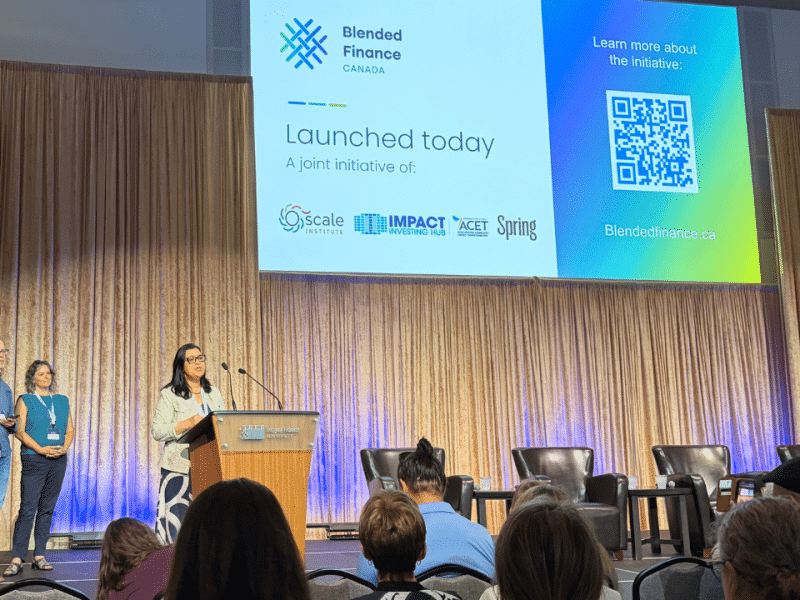
Blended Finance Canada launches on West Coast
The new initiative is supported by the University of Victoria, Scale Institute and Spring.

Canada’s Sustainable Finance Taxonomy: What it is, what is happening and what’s coming next
Canada’s sustainable finance taxonomy faces big challenges, from oil and gas, Indigenous rights and the real meaning of the word ‘transition.’
