Blended Finance Canada launches on West Coast
The new initiative is supported by the University of Victoria, Scale Institute and Spring.
Why It Matters
Blended finance is a growing social finance tool that is nonetheless underutilized in Canada. The announcement of a new venture bringing together various stakeholders signals to the sector that more creative solutions are needed to fund projects that otherwise might be overlooked.
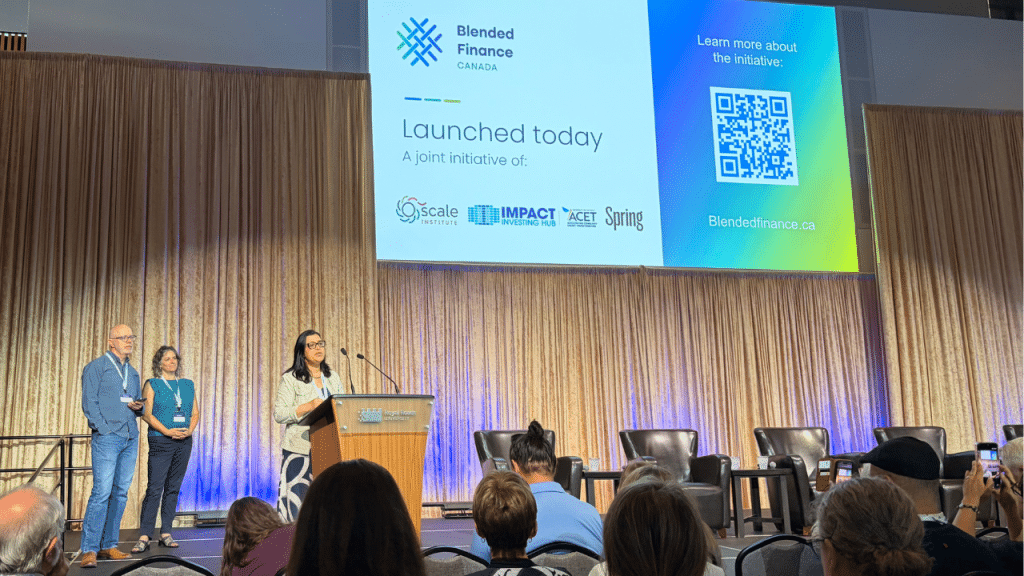
A new way to help non-profit organizations access money to make social and environmental change has launched in B.C.
Called Blended Finance Canada (BFC), the joint venture was announced in Victoria on Tuesday and is driven by the University of Victoria’s Impact Investing Hub, Scale Institute and Spring.
“We consistently hear that the ambition, local leadership and technical potential for community energy transformation are present, but access to capital remains a major barrier,” said Curran Crawford of the University of Victoria.
The idea is to help local communities and funders team up to create money solutions that fit what the community actually needs, said Crawford.
From there, it should be easier to get ideas off the ground and turn them into real, working projects, he added.
The persistent challenge, said organizers, is that many community projects that could help the transition to a low-carbon or sustainable economy or address complex social problems are overlooked by traditional funding sources like banks.
They can be flagged as too early, too small, too risky or even too innovative.
That’s where blended finance comes in.
What is blended finance?
Blended finance in the Canadian context is a way to pool money from different sources together to make things less risky for investors when trying to pay for a project.
It is a model that was first developed in Quebec and has started to become a central tool for funding social impact projects.
With blended finance, in general, philanthropy absorbs the initial losses that can come with new projects and governments or foundations can provide guarantees, making it an easier sell to traditional financial institutions to provide loans.
There are some pros and cons to the method. Blended finance offers easier access to money for said “risky” projects, is generally more flexible with financing and gives opportunities to scale local solutions.
However, it also introduces market logic into non-profit work, brings more pressure to be able to show a project’s impact (data that isn’t always easy to come by) and can risk sidelining things like smaller or justice-oriented organizations.
While it’s becoming a more prominent model in Canada, it’s still an underdeveloped tool, said the new venture on Monday.
“Blended Finance Canada will connect rigorous research with real-world experimentation, build accessible knowledge and tools, and develop the skills and talent needed to design and implement effective blended-finance solutions across Canada,” said Basma Majerbi, Director of the Impact Investing Hub.
The group plans to focus on financing money gaps for projects that affect Indigenous, rural, remote and historically underserved communities, she added.
BFC will focus on four connected areas, including studying how blended‑finance tools work, how money is structured, who carries the risk, and how impact is measured; working with communities and investors to design and test financing solutions in real projects; bringing stakeholders together through roundtables, working groups, and labs; and sharing practical tools, case studies, training, and guidance to help people use blended finance effectively.
The initial money for BFC came from the Canada First Research Excellence Fund through the ACET initiative at UVic, which will help build the systems needed to scale new financing solutions, said the group.
Researchers from Waterloo’s WISIR and Royal Roads University will help, and a wide range of partners from financial institutions and governments to social enterprises and universities will all be invited to participate.
BFC will announce how it will run and with whom in the fall.
Your job. Your mission. Your news.
With your support, the sector you're building gets the journalism it deserves, and you get a tax receipt.

Author

Related Articles
Imagine Canada launches visual tool to ‘see’ non-profit funding landscape
A new data visualization tool designed to let funders, non-profits and researchers understand the entire non-profit funding ecosystem
Ottawa chooses Canadian Housing Acquisition Fund to manage $1.5 billion affordable housing money
The massive new fund will help grant Indigenous, cooperative and non-profit housing providers easier access to capital to help buy and develop homes for lower-income Canadians.

New donation platform to help communities directly pay down mosque debt
Own Your Masjid is a project of boutique marketing agency Process Plus Marketing
