Explainer: The divergent fix-it paths of Ontario and B.C.’s condo oversupply problem
Both provinces have too many tiny, shoebox condos, but both are taking different approaches to fixing it.
Why It Matters
It’s rare to watch two governments run the same test at the same time. Ontario and B.C. are both trying to turn about 2,200 unsold units into rental homes. B.C. says they’re going to buy directly and take on debt to do so, becoming the owner. Ontario will lend a small portion to a private fund, which will then raise the rest, becoming the creditor. This difference will influence who bears the brunt of a market downturn. Who profits if prices rise? Who controls the units in five years?

Canada has a housing conundrum: empty condos are piling up in its two biggest cities while renters can’t find housing they can afford.
These empty units are not serving anyone, including the cities, the developers, or the population. So why not turn them into rentals?
Well, that’s easier said than done.
Desjardins recently released a new report examining how the Ontario and B.C. governments are using their power in two different ways. The report’s angle is: “Is the government intervention justified? Will it pay off?”
But we also want to know: For each solution, who bears the risk? And who gets the reward?
Ontario chooses private financing
The Ontario government is using the Building Ontario Fund (BOF) to invest in repurposing empty condos.
The BOF was created in 2024 to invest in large infrastructure projects that generate revenue and serve the public interest.
Its investments are catalytic; they are structured to attract institutional investors, public-sector entities, governments, and Indigenous communities.
For this deal, BOF invested $300 million in High Art Capital, a private investment firm. It combines mezzanine debt and equity.
Mezzanine debt sits below senior debt, but above equity. It carries a higher risk than a loan, because you get repaid after traditional lenders.
But to compensate for the added risk, mezzanine debt commands significantly higher interest rates than senior debt.
High Art Capital included BOF’s $300 million in its new GTA Rental and Affordable Housing Initiative, with the goal of reaching $1.3 billion.
This amount will be used to buy 2,200 unoccupied condos and convert them into rental units. A quarter of them will be affordable.
What is an affordable unit?
Defining affordability is becoming increasingly complicated. It varies across geographies and stakeholders.
Over the last year, the Quebec government added “intermediary affordability” as a new category.
The government cited rising land and construction costs to justify this new category, which targets middle-class families with two and three-bedroom units. Rents are 50 per cent higher than traditional affordable units.
Opinions are divided on the efficiency of this solution in addressing Quebec middle-class families’ ability to pay.
High Art Capital’s affordable rents are expected to be set at the lower of either 25 per cent below local market rent or 30 per cent of median gross household income across the GTA.
According to the available information, some kind of protection will be applied to keep these units affordable over time. These affordable units are meant to stay affordable indefinitely: High Art Capital says they’ll be protected in perpetuity through title-based commitments.
For the other units acquired, the Ontario government requires that they remain in the rental market for five years.
What is key here is that there is no guarantee they could not return to an ownership model after those five years are up.
B.C. relies on public debt
The Ontario government will rely mainly on private capital to bail out the private sector, with a limited contribution from BOF. In this way, the Ontario government is a lender; it will not own the units.
B.C. will rely on public debt. Its own agencies will buy the units, with a contribution from the federal government.
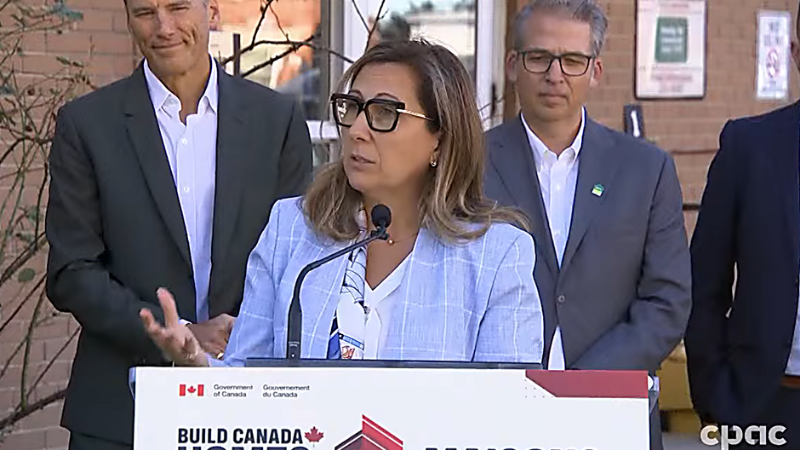
Build Canada Homes, the brand-new federal Crown corporation, and BC Housing, the province’s own housing Crown corporation, will work together on this deal.
Build Canada Homes is only a few months old. Its mandate is to build affordable housing across the country, in partnership with provinces, municipalities, and private developers.
BC Housing has run the province’s social and affordable housing system since 1967 – almost 60 years.
B.C.’s empty condo conversion numbers are similar to Ontario’s at about 2,200 empty units. The total cost is also similar: $1.45 billion compared to $1.3 billion.
However, the risk structures have nothing in common.
The federal government and B.C. government will each cover 10 per cent. These subsidies would be the equivalent of the down payment. The rest will be public debt.
That makes B.C.’s program more expensive for the government than Ontario’s.
The program has drawn real political heat. Both Prime Minister Mark Carney and BC Premier David Eby admitted they could have done a better job at explaining it.
B.C. units would be bought below construction cost, according to both Premier Eby and Prime Minister Carney.
“No developers will be profiting from this,” Eby said.
Ontario’s units will likely be acquired at below-market prices, too. Experts say that those bulk deals for empty units include at least a 10 to 15 per cent discount.
Ontario helps renters, B.C. encourages owners
One twist worth mentioning is that the B.C. target isn’t permanent rental housing. It’s rent-to-own.
A household rents a unit for a set number of years. Part of each rent payment is set aside as a future down payment.
In this model, part of the risk is shifted to the households.
At the end of the term, the household applies for a mortgage and buys the unit at an agreed-upon price. But if a payment is missed or something falls through, the household could lose some or all of the money set aside.
As well, not all condos qualify for rent-to-own units, because size matters. Most condos were built for investors and renters, so they tend to be small.
A rent-to-own program needs units sized and located for people planning to settle down, often families.
France’s experience
Buying distressed condo stocks from private promoters is routine business for CDC Habitat, France’s largest public housing provider, which manages more than 563,000 units. It has been doing it for years.
CDC Habitat’s mission is countercyclical: the worse the housing market is, the more units it buys.
It is the real estate subsidiary of Caisse des Dépôts, a public financial institution managing long-term investments.
In comparing France’s longer experience with buying distressed units, the question is: what happens to the units after they are bought and made available again?
Well, in France, the government retains the asset and the long-term rental income.
Contrast this with Ontario, which retains the units only temporarily through a private fund manager who profits from the eventual resale. B.C gives up the asset entirely to the end occupant once the rent-to-own path is completed.
What about prices?
Economic science tells us that scarcity influences prices: a smaller supply means higher prices.
Will taking empty condos off the market create more price hikes?
In France, new condo prices continue to rise no matter how many units the CDC bought in hard times. However, experts blame construction and land costs, environmental regulations, and slow permitting, not CDC Habitat’s repetitive buyouts, as the reason for rising prices
Now we come to the “B” word: is this a bailout for developers?
The answer rests on the price paid for the empty units, as stressed in this interview with UBC real estate professor Tsur Somerville.
Somerville told The Hub B.C.’s plan could either be “smart or really dumb.” The difference comes down to execution.
His preferred model would have developers compete on price, with the government buying the cheapest units first and walking away once its budget is hit.
Ontario picked its structure: a repayable loan, a five-year clock, and a private manager who profits from what happens after.
B.C.’s structure remains murky, with a much larger public balance sheet at stake.
Whichever government gets its pricing and safeguards right will determine who actually maintains some level of affordability for these units once the ribbon-cutting is over.
The question remains: Who’s left holding the risk if the market goes sour?
Your job. Your mission. Your news.
With your support, the sector you're building gets the journalism it deserves, and you get a tax receipt.

Author

Related Articles
Ottawa chooses Canadian Housing Acquisition Fund to manage $1.5 billion affordable housing money
The massive new fund will help grant Indigenous, cooperative and non-profit housing providers easier access to capital to help buy and develop homes for lower-income Canadians.

New donation platform to help communities directly pay down mosque debt
Own Your Masjid is a project of boutique marketing agency Process Plus Marketing

Elbows up: Spring Impact Capital calls for a giant spreadsheet of available early-stage Canadian capital
The Vancouver impact investor wants to crowd-source a free, national directory
