Imagine Canada launches visual tool to ‘see’ non-profit funding landscape
A new data visualization tool designed to let funders, non-profits and researchers understand the entire non-profit funding ecosystem
Why It Matters
A new way to visualize Canada’s funding system could potentially lead to fresh insights on where and to whom funding is granted across the country.
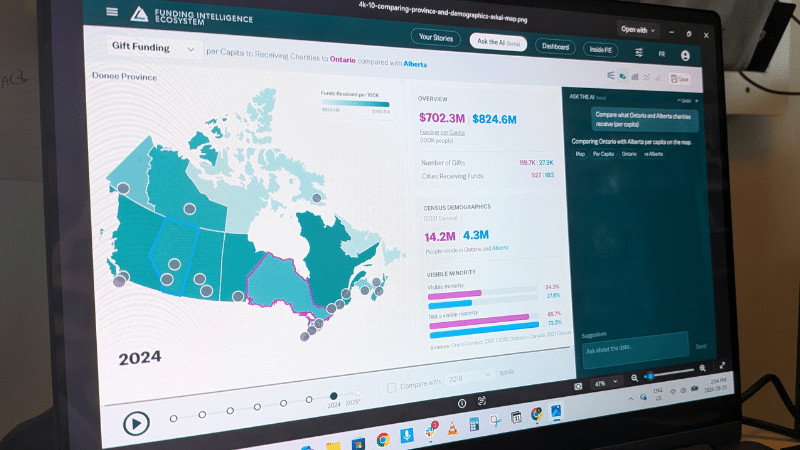
Imagine Canada has devised a whole new method for understanding the non-profit funding landscape in Canada.
The Nonprofit Funding Intelligence Ecosystem is a software-as-a-service (SaaS) add-on to the organization’s existing Grant Connect platform.
The new tool, which is being “soft-launched” on Oct. 19 (as a closed beta release), will offer data visualization capabilities, as well as the ability to search using an optional natural language “AI” interface.
It has been designed to meet the needs of non-profits, funders (including foundations, governments and corporations) and researchers (journalists and academics), who wish to form a deeper understanding of exactly where money is going and how it’s being distributed, according to Stephen Baldwin, Imagine Canada’s director of digital product.
In contrast to Imagine Canada’s typical approach of doing its own analysis and issuing reports, Baldwin said the new tool is a way to crowdsource research and understanding into the non-profit sector.
“There are billions of dollars of institutional funding from foundations, government, and corporations flowing to Canada’s charity and non-profits, but there isn’t kind of a comprehensive way to view all that data to understand the trends,” he said.
“Is that money increasing or decreasing? Is more going to certain regions than others? Is there more going to certain causes—whether it’s health or education or social services? Are we seeing any major changes there?
“We thought there was a real opportunity for us to build a platform…that brings all this data together and allows you to interrogate it through different data visualizations,” he added.
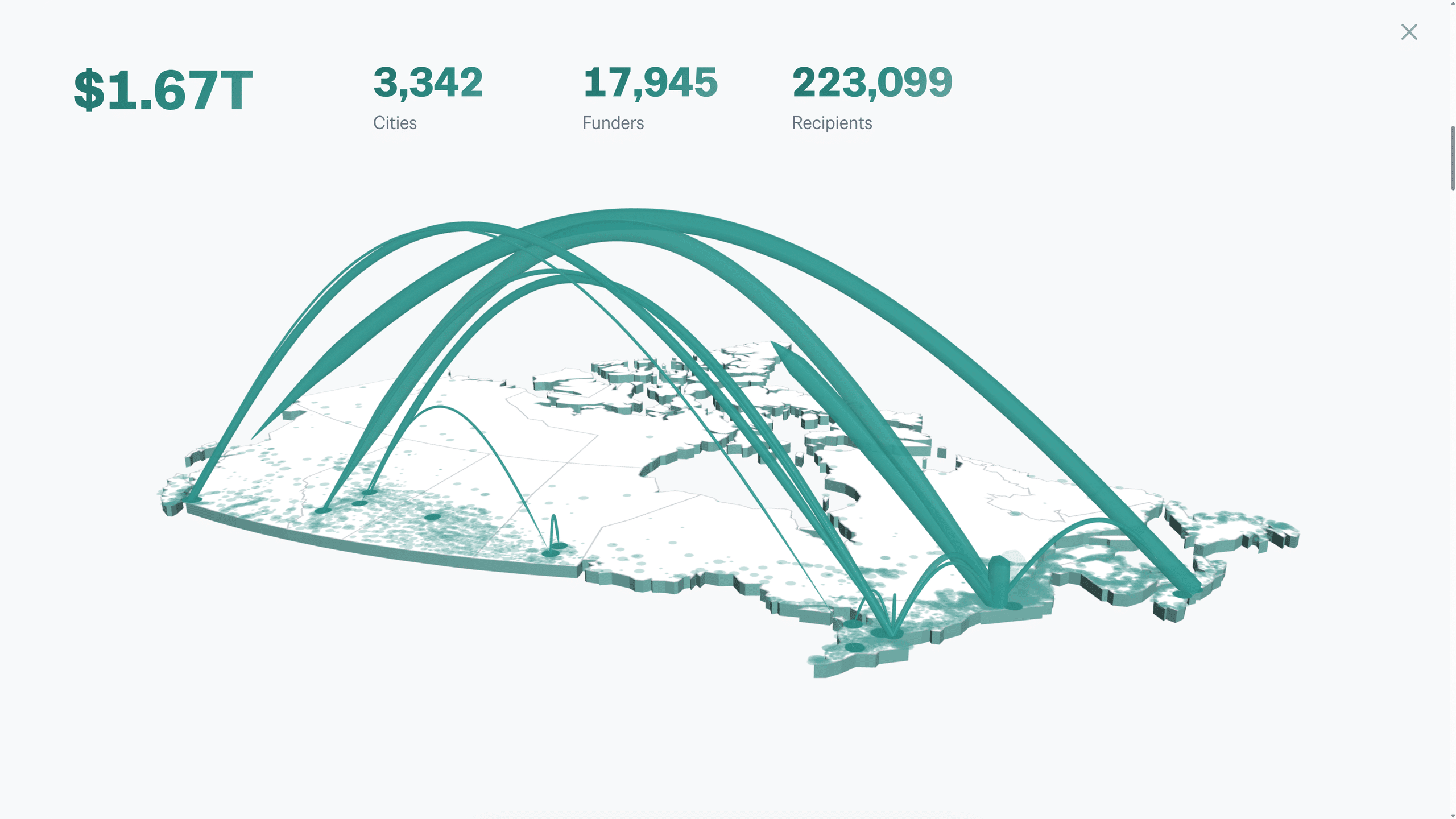
Any organization that already has a subscription to Grant Connect, which is celebrating 60 years, will have full access to the ecosystem. Additionally, people who use public or university libraries will have free access to the system for querying.
Starting in November, Imagine Canada will begin to promote the data visualization tool, and hopes to offer data-storytelling workshops in order to help people learn how to make use of the data.
“My biggest fear with this thing is we create this tool that’s very useful—we think there’s tons of great data in it—and then nobody uses it. I want to do everything I can to avoid that,” said Baldwin.
For example, he said a charity might find it useful to use the ecosystem when preparing a funding application to make the case that there has been a significant decline in funding for a certain type of activity, or that funding has declined for all charities in its geographic region.
On the other side, Baldwin said funders could find the tool useful if they’re looking for new services or regions to invest in.
While Baldwin said he hopes to eventually bring on more data partnerships and find ways to reduce siloed information in the non-profit funding world by creating a “centralized sort of data commons” and possibly by adding an application programming interface (API) which would more easily allow the ecosystem to share information with other databases and systems, he first needs to monitor how the tool is being used.
“There’s a concern that a platform like this could be misused, that the data could be misinterpreted, all kinds of those risks.
“I think, for the first few weeks, it’s just going to be looking at the product metrics to see how people are using it, and then seeing what people in the non-profit sector are saying about it.
“From there we can get a better sense of what the most valuable pieces are.”
Imagine Canada worked with Eugene Chen, chair of the Canadian Open Data Society, on the build. The organization also reached out to other AI experts and volunteers, including some from Data for Good Waterloo. The project was funded by Mastercard Changeworks.
Your job. Your mission. Your news.
With your support, the sector you're building gets the journalism it deserves, and you get a tax receipt.

Author

Related Articles

Ottawa chooses Canadian Housing Acquisition Fund to manage $1.5 billion affordable housing money
The massive new fund will help grant Indigenous, cooperative and non-profit housing providers easier access to capital to help buy and develop homes for lower-income Canadians.

New donation platform to help communities directly pay down mosque debt
Own Your Masjid is a project of boutique marketing agency Process Plus Marketing

Explainer: The divergent fix-it paths of Ontario and B.C.’s condo oversupply problem
Both provinces have too many tiny, shoebox condos, but both are taking different approaches to fixing it.
