Explainer: Why, despite Ottawa’s billions in spending, the country’s biggest housing provider is still facing a $3B hole
Expiring funding streams and lack of funding keeps social housing stock in poor condition
Why It Matters
Housing supply isn’t only about new units; existing stock matters as much. When it comes to social and affordable housing, the quality of the existing stock matters even more, as market rents are not a viable alternative.
A note on the data: figures below come from CMHC’s 2025 Social and Affordable Housing Survey, which covers subsidized and non-market rental housing — co-ops, non-profits, and public housing — not private-market rentals. Quebec’s numbers are undercounted: the survey excludes housing administered directly by the Société d’habitation du Québec, so Quebec’s real social-housing stock is likely well over 125,000 units.
Toronto Community Housing Canada’s largest social housing landlord, which oversees more than 57,000 units, is bracing for a funding cliff.
A city auditor general’s report released in late July found that TCHC needs $4.5 billion in repairs between 2026 and 2035, but has only $1.5 billion planned to cover them, a gap that could push more than half of its portfolio into critical condition. A key federal funding stream underpinning its capital budget is set to expire in 2027.
It’s a jarring contrast to the headline federal number: Ottawa says it has committed $15.83 billion through the Affordable Housing Fund to build or repair more than 236,000 units nationally since the National Housing Strategy launched.
That’s actually more repaired units cumulatively than the number of units CMHC’s latest survey rates as “Poor” today (137,572).
On paper, the money looks like enough. On the ground, in the country’s largest social housing portfolio, it isn’t landing fast enough.
That gap between what’s committed nationally and what’s reaching the oldest, most deteriorated buildings is the story underneath CMHC’s newest data on Canada’s 591,259 social and affordable rental units.
What’s at stake for tenants
The reason building condition matters so much here is that this stock exists precisely because market rents are out of reach.
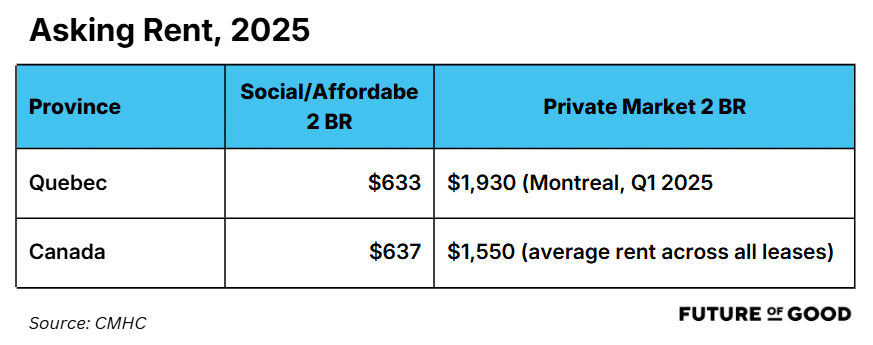
CMHC’s 2025 survey puts the average subsidized 2-bedroom rent in Quebec at $633 a month and $637 nationally, compared with a private-market average asking rent of $1,930 in Montreal and $1,550 (purpose-built average) nationally.
“Purpose-built” refers to apartment buildings that were constructed specifically to be rented out, as opposed to condos, single-family homes, or basement suites that happen to be rented.
It’s the category CMHC’s Rental Market Survey tracks separately from its Condominium Apartment Survey, because purpose-built rental buildings (private landlords, 3+ units, built as rental stock from the start) behave differently as a market than rented condos, which are owned unit-by-unit and can be pulled back into owner-occupancy at any time.
For the households in this system, there’s no “market alternative” if a unit falls into disrepair.
Note: the market comparisons use different measures. Montreal’s figure is an asking rent (what’s advertised to new tenants), typically higher than a blended average since it excludes long-sitting tenants on older, cheaper leases. The Canada figure is CMHC’s average across all occupied units. Treat the two rows as illustrative rather than directly comparable.
Age predicts condition, and two provinces are furthest behind
Cross-referencing CMHC’s data on when units were built against how they’re rated today shows a strikingly linear pattern: the newer the stock, the better its condition.
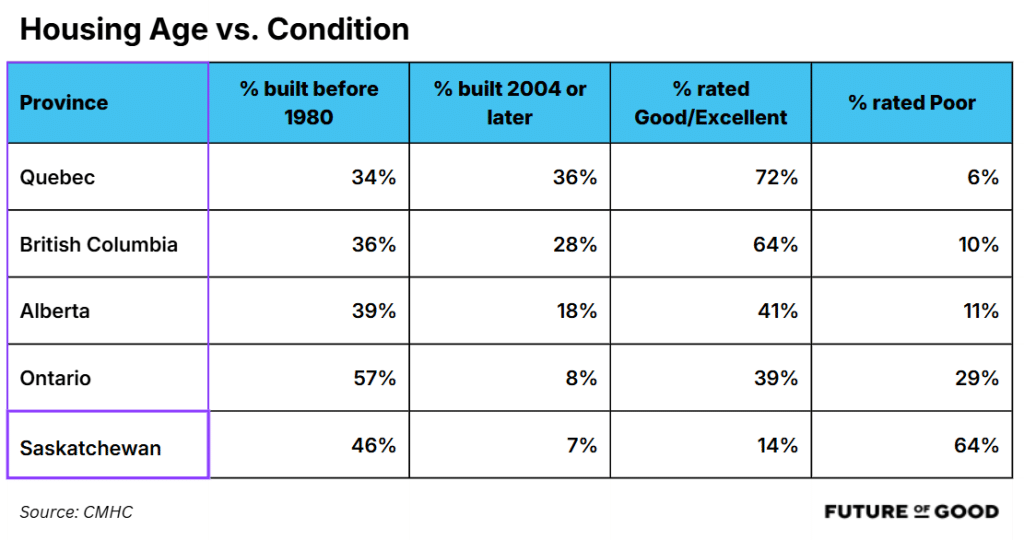
Saskatchewan, where fewer than one in ten units were built after 2004, has nearly two-thirds of its social housing stock rated “poor,” the worst in the country.
The province committed $9.2 million in its 2025-26 budget to repair 285 units, against roughly 13,700 units rated “poor”, covering about 2 per cent of the need. A $17.6 million (split between repairs and new construction) to be added for 2026-27.
Ontario’s problem is one of scale rather than proportion: 29 per cent of its 317,000 units — nearly 91,000 — are rated “poor”, more than in any other province. The province’s own repair targets for 2025-28 cover about 23,300 units, which would amount to only about a quarter of that backlog before TCHC’s $3-billion shortfall is even factored in.
Vacancy has climbed, then plateaued
CMHC’s national vacancy rate for social and affordable housing nearly doubled between 2019 (1.6 per cent) and 2023 (3.1 per cent), then levelled off at 2.9 per cent.
Quebec bucks the plateau: its social-housing vacancy rate has tightened to 2.2 per cent, down from 3.2 per cent in 2023, even as the national rate holds flat.
How rent gets set
Not all subsidized housing works the same way. There are four rent determination mechanisms:
- Income-based (RGI): rent capped as a share of tenant income (historically ~25-30 per cent). This is the classic “social housing” model, dominant everywhere;
- Operational-cost-based: rent set to cover the building’s operating costs, typical of co-ops and some non-profits (cost-recovery, not income-tested).
- Market-based: rent pegged near market rate, with the “affordable” element coming from a capital subsidy rather than an ongoing rent discount.
- External entity: a third party (housing authority, funder) sets the rent.
According to CMHC’s survey, 85 per cent of Canada’s stock (502,860 units) uses income-based rent.
Quebec is the outlier here too: 17 per cent of its stock (11,248 units) is operational-cost-based, by far the highest share of any province, reflecting its historically strong non-profit and co-op housing sector — a difference from the RGI-dominated public housing model that prevails almost everywhere else.
What to watch
Toronto Community Housing’s board has accepted all 10 of the auditor general’s recommendations on prioritizing repairs, but the underlying funding gap remains unresolved heading into 2027, when a key federal stream expires.
Ontario tabled a budget in March 2026 projecting a $13.8-billion deficit — a backdrop that will shape how much room the province has to close its own repair gap.
Whether federal reinvestment dollars — including the new $1.5-billion Canada Rental Protection Fund launched under Build Canada Homes — reach the oldest stock in Ontario and Saskatchewan, rather than being absorbed into new construction elsewhere, is the next number worth tracking.
Your job. Your mission. Your news.
With your support, the sector you're building gets the journalism it deserves, and you get a tax receipt.

Author

Related Articles

Explainer: The divergent fix-it paths of Ontario and B.C.’s condo oversupply problem
Both provinces have too many tiny, shoebox condos, but both are taking different approaches to fixing it.

‘Canada must not go down that road’: More than 250 organizations demand investigation into CBSA after student protesters issued exclusion orders
The students were protesting after being denied post-graduation work permits they say they were eligible for when they enrolled at Portage College.
Trump’s ‘renaming’ of Lake Ontario is emblematic of centuries of colonial erasure
Why a single renaming order taps into deeper fights over land and language
