Half of Filipino immigrants to Canada are overqualified for their jobs: StatCan
‘For the relationship that Canada has with the Philippines, it seems like it’s lopsided.’
Why It Matters
It’s a well-known fact that professionals who immigrate to Canada face barriers to employment, usually due to certifications or credentials that don’t translate. Filipino workers are generally referred to as a success story, but half of them are overqualified for the jobs they do in Canada, illustrating how much work is left to do to bring down those barriers.

Filipino immigrants are often called an economic success story in Canada, but new data shows the majority work in lower-wage jobs, and nearly half are overqualified for the roles they find.
A recent Statistics Canada study on Filipino populations found that as of 2021, nearly half of working-age Filipinos in Canada have post-secondary credentials. Of this, about 80 per cent obtained their education outside Canada.
The majority of Filipinos with degrees in medicine, dentistry, optometry, or veterinary medicine did their schooling elsewhere, and nearly half of working-age Filipinos with bachelor’s degrees or higher end up working jobs they’re overqualified for.
“Filipinos become like sources for cheap labour for jobs that Canadians are not incentivized to do,” said Al Quinn Alquinto of Migrante Ontario, the provincial chapter of a global alliance advocating for the rights and welfare of Filipino and other migrant workers.
“They might find themselves in agriculture, being a nanny, working in construction. Their skills are underutilized.”
The Filipino population in Canada quadrupled from 1996 to 2021. More than three-quarters were economic immigrants, with 58 per cent being women and 43 per cent admitted as caregivers—nearly 33 times more than other economic immigrants.
“If you finish school in the Philippines, let’s say you might be an engineer, you might be a healthcare worker, you might be a nurse, you might be a doctor,” said Alquinto, naming a common problem facing many immigrants to Canada.
“The qualifications for education don’t equate here, even though the actual quality is not that much different from each other. Another example is some Filipinos would take USRN, which is like the equivalent of a U.S. registered nurse, but they wouldn’t qualify here in Canada.”
It’s even happened to Alquinto’s own family. The Philippines-born Alquinto, who immigrated to Canada with his family in 2000, said his father dealt with the same problem.
“My dad was an engineer but upon coming here, he worked as a factory worker for a few months. My mom worked at McDonald’s. I witnessed them working several jobs at the same time, trying to get extra income.”
Migrante’s position is that Filipino workers are forced to immigrate or migrate due to poor economic positions back home, sold a dream, and end up in Canada facing a different reality, said Alquinto.
“For the relationship that Canada has with the Philippines, it seems like it’s lopsided. Like Filipinos would come here, but their [rights as a worker] are not being respected. Their qualifications don’t equate. There’s many different stories of them facing abuse, exploitation, all these all these different things.”
A deferred path
Rock Manuel was an art director for one of the leading broadcasters in the Philippines for 18 years before immigrating to Vancouver in 2022 to pursue a postgraduate degree in web and mobile app design and development at Langara College.
He wanted to transition to the tech industry, so while at Langara, he learned UX/UI design and developed software for mobile, web, and smartwatches.
“After two years, I was trying to get into the tech industry, but apparently that’s the time where artificial intelligence took over,” Manuel said.
He was hearing about layoffs across the industry, and found himself working a factory job to make ends meet. He was only there for two weeks before he landed a job at a printing house.
“I was a graphic designer for almost two years, which was good, [but] it’s not really perfectly aligned with what I was planning to get into,” he said.
Still, Manuel thought the print house would support him with his permanent residency through the B.C. Provincial Nominee Program. But when he requested supporting documents for his application, the head office told him the company doesn’t provide them.
“I was immediately informed that the company would not be participating in the B.C. Provincial Nominee Program, so it’s an obvious dead end in my case at that time. So I had no choice but to look elsewhere to find a better opportunity for me to get a higher chance of getting invited for a PR application,” he said.
An opportunity presented itself in P.E.I. as a general labourer on a potato farm.
He’s been there for five months now, working towards his goal of becoming a permanent resident. His wife, who works at a hotel in Vancouver, plans to join him soon.
As for his initial credentials, he hasn’t given up the dream.
“I was really expecting that I would be getting a UX designer job, like a UI or UX designer role or a web designer position [and] I still do want to try … I would [also] love to go back to production for television or movies or creative for an ad agency, something like a marketing role.”
Joint agreement
As of July, Canada and the Philippines have entered a joint agreement regarding labour and migration. One of the commitments listed concerns licensing and registration, which the president of the Philippines said could help prevent Filipino professionals from having to repeat education or certification processes in Canada. No further details were given.
Meanwhile, Alquinto wants Canadians to think beyond the messaging of Filipinos being an immigrant success story to Canada.
For example, while Filipinos dominate in Canada’s caregiver programs and continue to be overrepresented in essential jobs, they remain underrepresented in senior, higher-paying positions. Despite having post-secondary education, they are less represented in jobs that list higher education as a requirement.
And while they have lower poverty rates than white Canadians or other racialized minorities, they experience below-average income levels and are more likely to be working jobs they’re overqualified for than other foreign nationals holding degrees outside Canada.
“Yes, they’re successful in immigrating here, they might get PR or citizenship. But success at what cost? That means a broken family separated for many years just so they can bring them over, not being able to practice their discipline, [enduring] different forms of abuse or exploitation that they might not even share, they might pay a lot of fees just to get a work permit. That’s the process of getting the quote unquote success,” Alquinto said.
This story series was made possible through the financial support of the Canadian Race Relations Foundation. The foundation is a federal Crown corporation mandated to raise public awareness of the causes and manifestations of racism in Canada. The CRRF has no involvement in story selection, editorial decisions, or interview choices. All journalism is produced independently by Future of Good.
Your job. Your mission. Your news.
With your support, the sector you're building gets the journalism it deserves, and you get a tax receipt.

Related Articles

Caste, corruption, and the collective: Crow’s Theatre’s A Fine Balance confronts India’s enduring inequities with humour and heartbreak
The Giller Prize-winning novel explores the realities of caste violence in India, which has been adapted into a powerful stage production in Toronto.
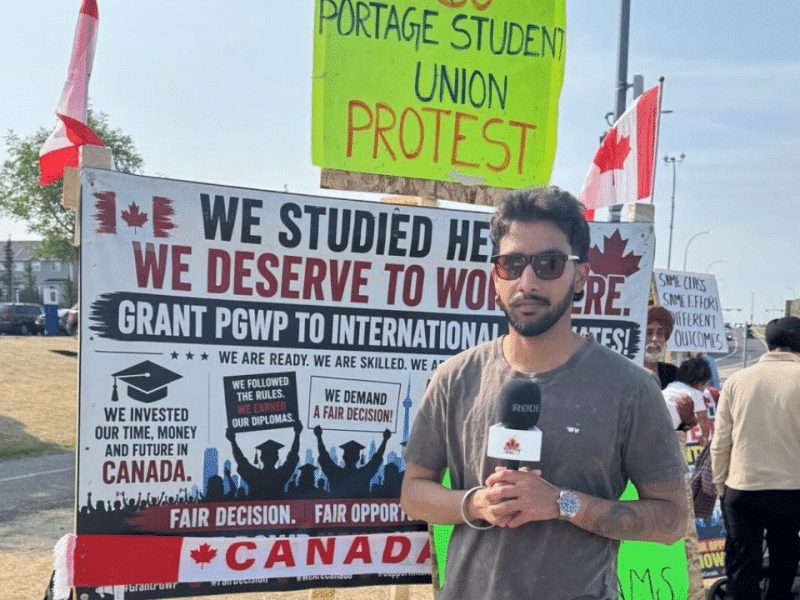
‘Canada must not go down that road’: More than 250 organizations demand investigation into CBSA after student protesters issued exclusion orders
The students were protesting after being denied post-graduation work permits they say they were eligible for when they enrolled at Portage College.
Partnered Partnered content How construction contracts became the blueprint for social change in Manitoba
Manitoba is a leader in social procurement, with decades of partnerships among government, businesses and social enterprises that have shaped a model other communities can learn from.
