This Indigenous founder moved back home to Northern Ontario to help solve food insecurity — here’s how he’s doing it.
Why It Matters
With historically unprecedented inflation rates in Canada, northern communities are facing some of the most drastic increases in food prices. Initiatives seeking to boost food security in these regions need to make meaningful connections with local communities — to go beyond quick fixes and establish sustainable, long term solutions.
This journalism is made possible by the Future of Good editorial fellowship on community resilience, supported by Co-operators. See our editorial ethics and standards here.
Back in January 2021, Benjamin Feagin Jr. was looking to move back to his Northern hometown in the traditional territory of Anishinabewaki and Michif Piyii (Metis) peoples (colonially known as Dryden, Ontario) to be closer to his family and his fiance. The pandemic had hit the region hard, exacerbating issues like food insecurity — but hunger has been in this community for as long as Feagin Jr. can remember.
When he moved back to Dryden, Feagin Jr. and his fiance, Fabian Velez, a grower himself, set out to build a social impact organization together that could combine their interests: technology and agriculture.
As a starting place, the pair got in touch with local organizations in the area, including the Local Food and Farm Co-ops association, to understand the history of food security in the area — and the current state of it.
Like many other remote communities in Northern Ontario, Dryden’s residents face a monumental barrier to accessing affordable and nutritious food. According to research, remote northern communities face five to six times more food insecurity than the Canadian national average.
“We spent a year doing literature reviews, and trying to understand where the bottleneck was — what was the underlying issue that was keeping the problem from being resolved? It seemed like things always came back to a lack of local production that was on a year round basis,” says Feagin Jr.
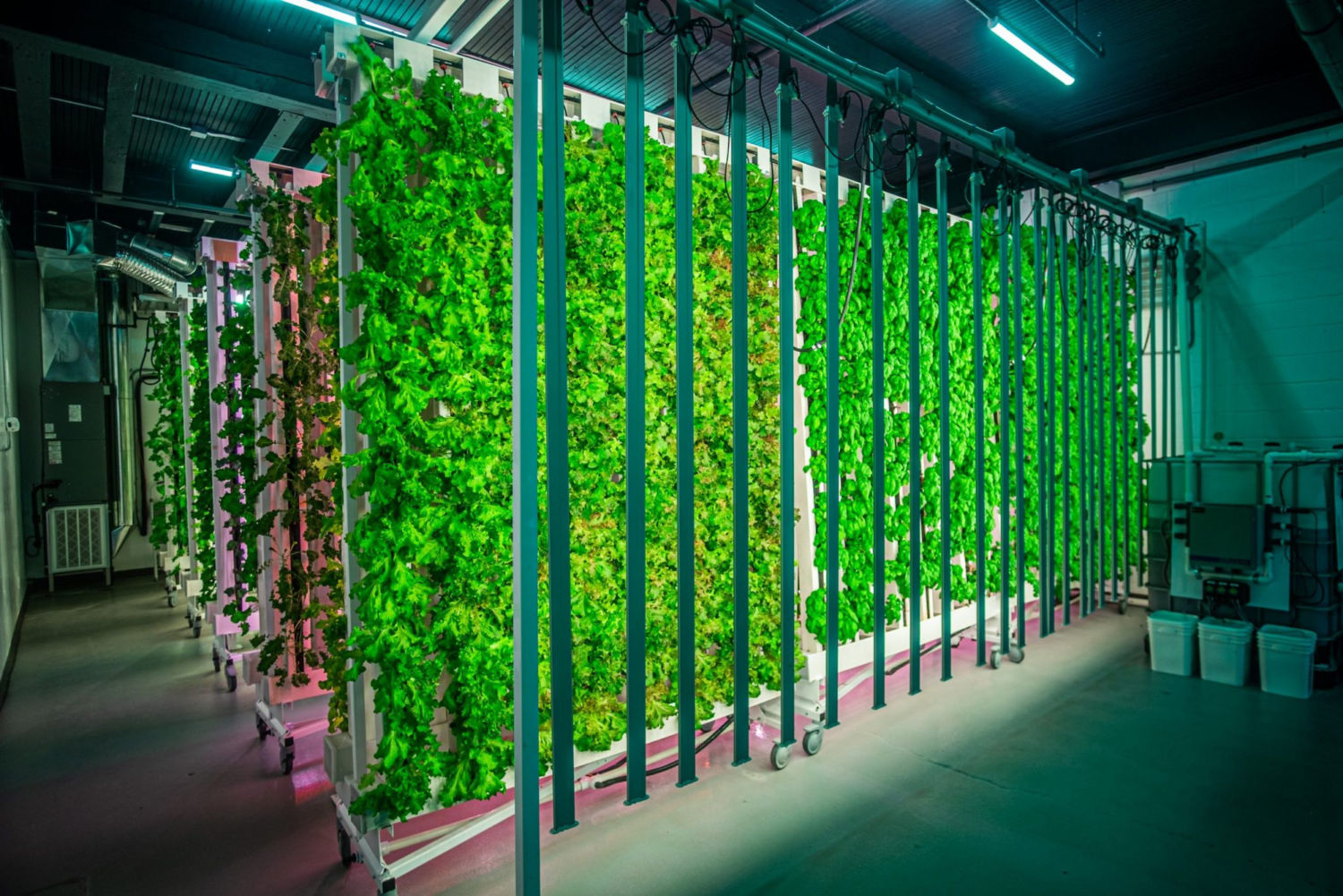
So Feagin Jr. and Velez started AgriTech North, an Indigenous-, disabled-, and 2SLGBTQI+-owned social enterprise b-corp that uses hydroponic tech farms to grow fresh produce year-round and distribute it around the region. But their journey has not been solitary. The team has proudly been collaborating with other organizations in the area that have also been working to solve food security, and spending time making connections with community members.
At the moment, AgriTech North has 900 vertical ZipGrow towers which produce 450 kilograms of fresh greens, herbs, and fruit every week. Their goal is to lower costs of locally grown fresh produce in northern Indigneous communities by 25 percent.
Feagin Jr. explains that too often, companies come into areas like Dryden with new technologies that will ‘solve local problems’ but haven’t committed the time to train local community members on understanding the infrastructure and how to operate the systems.
Without understanding the nature of the community, without spending time building community trust, these solutions don’t work and can’t be long term, Feagin Jr. says.
Future of Good sat down with Feagin Jr. to learn more about how he goes about connecting himself and his work to the Dryden community, for maximum impact.
This conversation has been edited for length and clarity.
Neha Chollangi: What are some challenges when it comes to creating solutions for food security issues in Dryden, Ontario?
Benjamin Feagin Jr.: I grew up here, and ever since I was a kid, we have always had a food insecurity issue. But sometimes people don’t realize that they have food insecurity. And so it’s difficult to convince someone who has become accustomed, for a long period of time, to not having fresh produce. The norm becomes that you buy fresh produce and it goes bad within a day or two. It’s been a multi generational issue. And there’s even many communities that don’t eat fresh produce at all, even when it is available, because it’s $10 for a head of lettuce. Many of these communities spend more than half of their household income on boxed or canned food alone.
I think the biggest challenge is cultural — convincing people to eat fresh produce when that’s been a luxury item for generations, or has been unavailable for generations — when people don’t remember their ancestral role in farming or agriculture anymore, or don’t have the palette for fresh produce anymore. That knowledge loss is the most significant challenge.
Neha: It seems like there are already a few organizations in the community working towards food security in the region. How did you meet them in the middle with your work?
Benjamin: There is no meeting in the middle. I think that being from here is the commitment level that we needed. I think you really need to have a local champion that is connected in some way to the community being served. Some people call it the infinite game — it’s where you are focused and committed to an infinite level of support. There is no end. There is no beginning. It’s just where you are essentially part of the community you’re serving and you’re not like, ‘I’m going to provide one year of service and then you’re on your own.’ Once you commit to being present and supporting a community, we consider ourselves part of the fabric of that community.
Neha: What is often a mistake you see with mainstream solutions for food insecurity?
Benjamin: Generally, we found that there’s too much trying to make the problem go away with money, where everyone just wants to throw money at a piece of technology and give it to a community and just wash their hands with the issues so they can feel good about solving food insecurity. But generally, when people do that, [the technology] just ends up in a corner collecting dust. I think people end up getting frustrated with the lack of support.
Neha: How do you work through this challenge?
Benjamin: We’re doing training and workshops,and trying to hire Indigenous staff from a variety of communities in the hopes that they want to bring those technologies back [to their communities]. The kind of support you need is a constant rotation of trained individuals that have the skills necessary to operate these systems. But you need to put in the time to actually establish those capabilities before you drop millions of dollars in equipment on the community. We’ve done this enough times that they should know why it’s not working. It’s because you didn’t do all the work to create the labor force before you dropped all this equipment on them — and then told them it’s their fault.
Neha: How do you build that community trust?
Benjamin: That’s as complicated of a question as how you build trust with a family member, or a friend. Everyone’s different. And I think the same holds true for whoever you’re talking to from a particular community; the things that they value as individuals are going to change and there needs to be patience and commitment to being woven into the cultural fabric of a community. You have to have the commitment to be a part of that. That includes supporting your neighbors and being present — physically being present — when it’s important to that community, and not exploiting the relationships in a way that you’re using them as a marketing token. You can’t build trust if the entire basis of the conversation is money. Showing up to the cultural events, supporting your community members, and whatever it is they’re doing is a good start. It should not start with, ‘What’s in it for me?’ You should be looking to make real connections with the people that you’re serving,
Neha: What are some of the tangible actions you take to make those connections?
Benjamin: These communities have been over-studied, are tired of surveys, are tired of reports, are tired of interviews, because it’s just been going on for so long and nothing has been solved. And so being cautious of that, we need to limit the amount of studying that’s done in these communities and be respectful of people’s time, knowledge, and sharing. Now, we’re asking, ‘What is the infrastructure and who are the people to talk to in order to make this happen now?’ Because we have the capability. So it’s a very different discussion, but even that gets hesitation because of the amount of projects that have fallen through over time where they haven’t really done what they say they’re going to do. And so we’re working through that with communities. It doesn’t move at the speed of business.
Tell us this made you smarter | Contact us | Report error