New bill on employee ownership trusts welcomed by Canadian businesses
The model is a tool in succession planning as Boomers find their children may not want the family business
Why It Matters
The changing Canadian business climate can arguably be felt most in its small communities, where the fate of a few key employers can determine the health of an entire region. Some businesses are looking at employee ownership trusts if there are no local buyers.
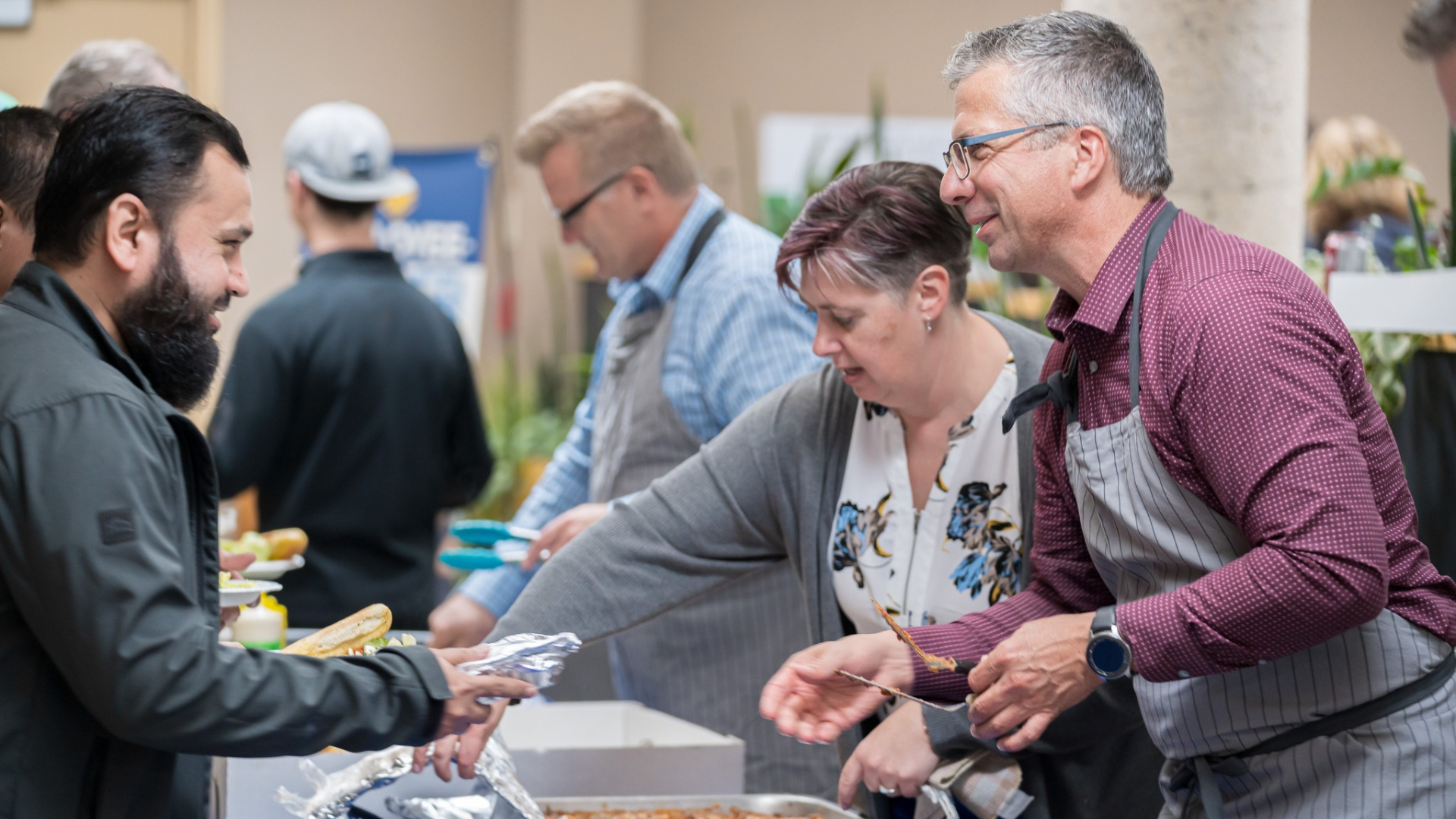
Chad Friesen, right, of Friesens Corporation, serves up a Thanksgiving lunch during the company’s Employee Owner Days in October of 2023. (Friesens/Facebook)
This journalism is made possible by a partnership with Social Capital Partners. See our editorial ethics and standards here.
The Canadian government has introduced a way to make it easier to turn the family-run business into an employee-run business – and it’s a welcome change, say advocates.
“It’s a different wealth-building model, but it lifts everybody and creates good economic opportunities,” said Arnold Strub, executive director of Employee Ownership Canada, which advocates and educates private businesses on employee ownership.
“When employees have skin in the game and an ownership mindset, good things start to happen.”
The Government of Canada first read Bill C-59 in the House of Commons, including proposals on Employee Ownership Trusts (EOT), on Nov. 30.
Highlights include extending the capital gains reserve from five to 10 years, a $10 million capital gains exemption, and the ability to use the loan as a tax deduction, all designed to make turning a business into an EOT easier, said Strub.
The proposed legislation is similar to measures enacted in the United States and the United Kingdom long ago, he added.
Broadly, employee ownership meets two crucial goals, said Strub. First, it’s a democratic way for working-class Canadians to acquire wealth.
Such models are also a retention tool, as employees generally have better compensation and develop an ownership mindset.
“There’s a lot of research from the UK and the U.S. that shows that private companies with some type of employee ownership plan do better,” said Strub.
“They’re more productive and profitable, especially in economic downturns, they do better, and there’s fewer insolvencies.”
Many business owners struggle with succession planning, and Baby Boomers are retiring and want to sell, said Strub.
Before employee ownership models, if there was no “next generation,” outside interests could buy the company. From his home in southern Ontario, Strub saw many examples where jobs were lost.
“You lose,” Strub said. “The economy of the community goes down. Employee ownership helps build local economies. It keeps companies local. It attracts people, and it builds up local economies. It’s a great way of doing that.”
How it works
The logistics are relatively simple: the company is sold to a trust, so employees do not pay out-of-pocket. The loan is then paid off from company profits, and employees begin to receive dividends.
Employee Ownership Canada connects companies interested in employee ownership with service providers who review the details, from various structures to tax advantages. In preparation for employee ownership, they explain what the business is worth and how they arrived at that valuation.
“You’re increasing their financial knowledge across the board,” Strub said. “Understanding how what they do daily either increases or decreases the company’s value. That’s why communication is a big part of building a good employee ownership plan.
“Part of that communication is understanding where value comes from. That’s where good business valuators come in.”
One employee ownership success story can be found in the Canadian prairie town of Altona, Man. where Friesens Corporation has 600 employee-owners in a town of 4,300 people. Established in 1907, the company evolved into four divisions offering trade books, academic annuals, packaging and self-publishing assistance.
In the 1950s, the owners began investigating new ownership models once they knew no next generation would take over. Influenced by the co-operative movement, they started gifting shares to employees who, for a time, could exchange them on a private market. About 30 per cent of the staff owned all of the shares.
That worked until the early aughts when Friesens created an EOT since more people were retiring than purchasing shares.
Then came the late-2000s economic downturn, the Kindle’s debut and increased Asian competition. Friesens lent money to the trust to buy back shares and preserve value for the employees.
Now, every employee is an owner, and every employee is a beneficiary.
“Over the last 12 months, we’ve distributed in the neighbourhood of $5.5 million in proceeds to our employee-owners,” CEO Chad Friesen said. “On average, our employee-owners received over $10,000 of what we would call an EOT distribution.
“We feel that our model is the great equalizer in business. It doesn’t matter whether you’ve come from an affluent family down the road or you’re a newcomer who’s arrived here from the Philippines. You both have an equal opportunity within this company to take advantage of ownership benefits.”
The company is keenly aware of its essential role in the region’s economic health, said Friesen, adding their employee-owners generate wealth quicker than they could elsewhere. While creating jobs is vital, delivering well-paying ones has more significant residual effects throughout the area.
When outside interests take over, Friesen said, the first jobs cut are often management-level, removing several large salaries from the community.
With an EOT model, employee-owners directly influence company operations and their role in the community. All are invited to the annual general meeting; one board position is reserved for non-management personnel.
Friesen also meets with an employee-owner council several times per year.
“It’s a two-way discussion,” he said.
“I bring to them strategy, choices or challenges the company faces. Part of that is to gain their feedback, but it’s also to build more awareness on the shop floor.”
Friesens operates an employee-directed giving plan where employee-owners determine a portion of corporate donations. An advisory council creates a list of causes, and employees vote for them.
The benefits to Altona and the surrounding region have been immense over the two decades since Friesens adopted its current employee ownership model.
“Friesens doesn’t exist in Altona today if it wasn’t for employee ownership. Period. Full stop,” Friesen said. “This company has been a massive contributor to the region’s economic engine for decades.”
Laurent Tetrault knows how crucial local ownership is to small communities. A successful entrepreneur, Tetrault is a former CAO of several municipalities. Now a councillor for the Rural Municipality of La Broquerie in Manitoba, Tetrault is also a Federation of Canadian Municipalities board member.
Tetrault said good things happen when community leaders are involved in business and businesses are involved in the community. Three decades ago, the La Broquerie Hotel was bought by outside interests, so five community members banded together and repurchased it. They quadrupled the beverage room capacity and made other enhancements.
Today, the hotel is a community hub, said Tetrault.
“As a community, we must continue improving what we have or else the municipality never improves,” Tetrault said. “The community leaders must get involved so the community can survive.
“The hotel touches most people in the community now. Everybody’s more interested in coming to the bar and restaurant to encourage someone from the community.”
That local involvement was recently vital to reviving the local golf course. As former CAO of the RM of La Broquerie, he encouraged the council to buy the land. Tetrault spoke with a local businessman who formed a partnership, building 250 units of 55-plus housing overlooking the course.
“He can’t keep up,” Tetrault beamed. “As soon as he finished them, they were full.”
In contrast, pork producer HyLife was founded in La Broquerie in 1993, growing to a global company employing 3,500 people. In 2012, half the company was sold to Japanese interests. Seven years later, the remainder was sold to a Thai corporation. While HyLife maintains a significant presence across Manitoba and employs many people around LaBroquerie, the company moved its head office to another community.
The communities where HyLife has invested have grown instead of LaBroquerie.
“It was local people owning a local business, a huge business,” Tetrault said. “They hired their friends and family. LaBroquerie started to grow because of the employment.”
Tetrault said local leadership’s involvement has been crucial to LaBroquerie’s growth.
“We have a success story in La Broquerie,” Tetrault said. “In 1975, we had 900 people. In 2023, we have 8,000.”
Control by external interests will be bad news for communities: Friesen
Friesen believes if more isn’t done to preserve locally-owned businesses over the next decade, Canada will see more companies being controlled by external interests.
To help stop that, Friesen joined the steering committee for the Canadian Employee Ownership Coalition, a non-partisan network committed to unlocking the potential of employee ownership for the benefit of Canada’s economy and workers.
“If I’m a business owner, and I don’t have a generation of people coming up to take over, what are my options, especially for larger companies?” Friesen asked.
“In small communities, there are just not many people off the street who will come in and slap down millions of dollars to buy a large company and keep it operating in these communities.
“We believe that employee ownership represents a viable third option that does multiple things. It preserves the business’s legacy in the community it exists in, which is also very important to sellers. It keeps high-paying jobs and decision-making within those communities. We have to have a bit of a protectionist viewpoint from a Canadian perspective to say what happens when major employers are bought by external entities and, 10 years from now, and we don’t have as much control as we once had in our business community?”
Friesen isn’t stopping there. Friesens Corp. is further investing in employee ownership through the Tall Grass Employee Owner Equity Fund, which has a social rather than a financial objective.
The goal is to export the Friesens ownership model by buying stable, long-term businesses and turning them into employee-owned entities.
“We’re trying to help propel employee ownership in other small communities,” Friesen said. “We believe that together with the legislation… and with some dollars and know-how from Friesens, we can help other companies make that transition.”
Your job. Your mission. Your news.
With your support, the sector you're building gets the journalism it deserves, and you get a tax receipt.

Related Articles

First Bite Fund launches as Ottawa puts $1 billion behind domestic food processing
New revenue‑based loan fund aims to reach the 92% of food processors that conventional capital has overlooked

New database maps Canada’s $17.3 billion DAF landscape and where philanthropic wealth is concentrated
A new database is highlighting Canada’s donor-advised fund landscape in an effort to increase transparency, but not all sector leaders believe the tool will have that effect.

Edmonton housing fund uses values-aligned, blended financing to create affordable homes
The Housing Prosperity Fund combines values-aligned financing, community investment and family-focused housing to create a model it hopes can scale across Canada.
