Record food bank numbers persist despite falling inflation levels; Canadian food disparity a “moral failure” say experts
Food bank use has increased by nearly 80 per cent over the last five years.
Why It Matters
Inflation has fallen to its lowest level in three years, but those in the food security sector say adequate sustenance is still out of reach for many people struggling to make ends meet.
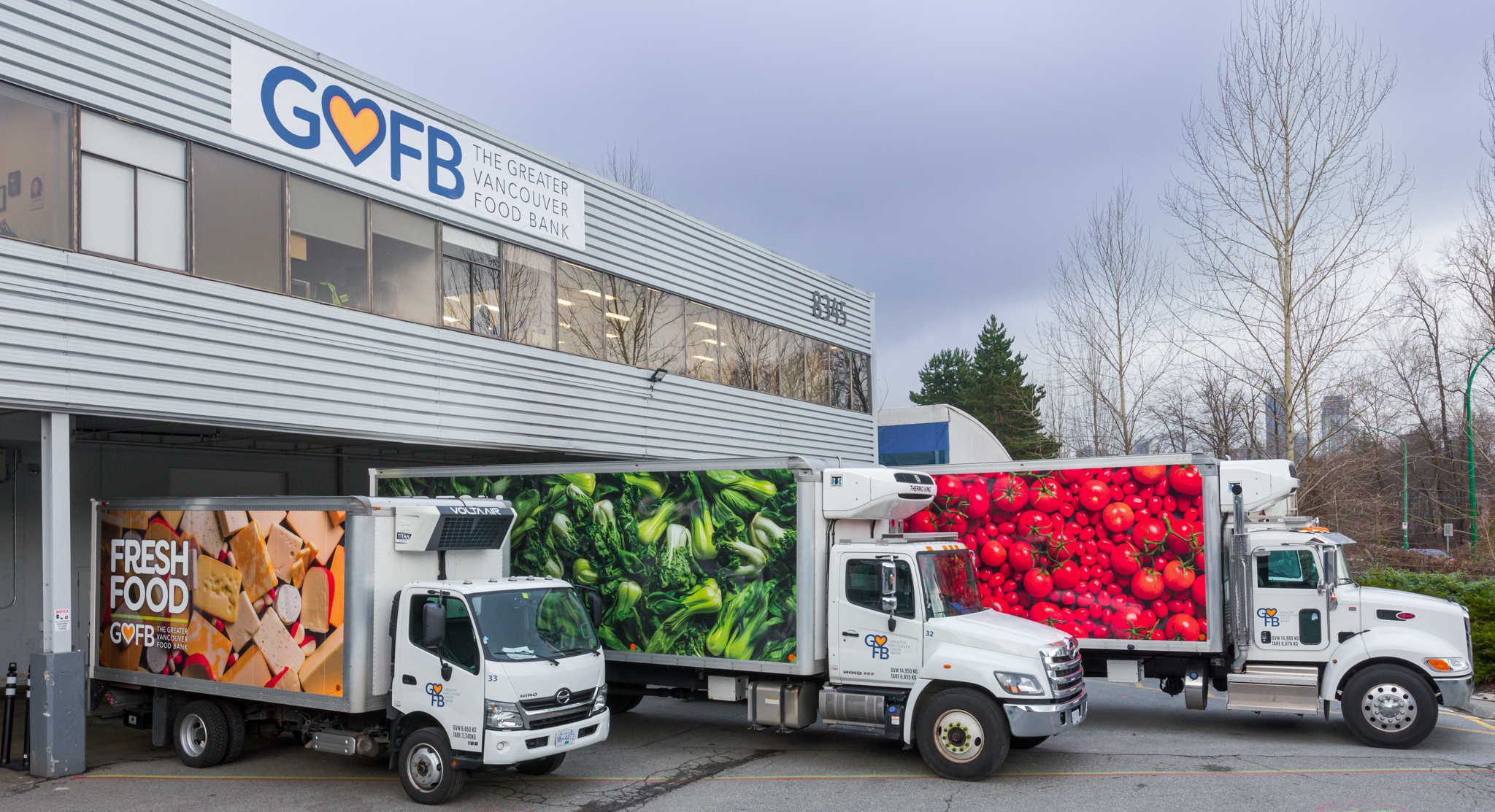
Delivery trucks at the Greater Vancouver Food Bank. (Emma Nelson/Supplied photo.)
An unprecedented number of Canadians now rely on charities for their basic nutritional needs, and those in the hunger-relief sector say only systemic change can satiate demand.
“Access to food is a human right,” said Ash Avery, executive director of Feed Nova Scotia, a network of 40 food banks and programs in that province.
“In a country like ours, it’s a moral failure to have such a disparity when it comes to access to food.”
Food distribution organizations across the country have seen a 79 per cent increase in demand since 2019, according to Food Banks Canada. Canadian residents now make almost 2 million food bank visits every month.
Deputy Prime Minister Crystia Freeland provided an economic update last week, telling reporters in Ottawa that “we’ve had some good news over the past few months, we have now had inflation down within the Bank of Canada’s target range for seven months in a row.”
Inflation hit a 40-month low in July, she said.
However, for those trying to put food on the table, falling inflation levels are largely theoretical.
“I think it’s an academic thing,” said Ryan Baker, national program lead at Breakfast Clubs of Canada.
“I constantly hear that inflation is going down, but food prices have gone up; even though the inflation rate is lower than it was six months ago, food prices haven’t come down.”
Inflation returning to a normal rate doesn’t mean falling prices; it means prices are still rising, just at average historical levels.
Food banks nationwide are painting similar pictures of how the current affordability crisis is impacting the communities they serve.
“Five years ago, we opened our doors to 45 households,” said Bob Mandel, founder of Toronto’s Avenue Road Food Bank.
This year, the non-profit will serve close to 600 households. “It’s scary,” he said.
“When we released record-breaking data last year, we thought that was the high-water mark,” said Carolyn Stewart, CEO of Feed Ontario.
“But food bank use has only continued to climb as more Ontarians find themselves struggling to make ends meet.”
Ontario food banks were visited 7,689,580 times between April 1, 2023 and March 31, 2024—an increase of 31 per cent over the 2022-2023 fiscal year, and 134 per cent increase over 2019-2020.
Like food banks in Ontario, those in Nova Scotia also continue to see record-breaking demand: 36,000 individuals made 104,000 visits in this year’s second quarter, nine per cent more than last year.
About 13 per cent of the people visiting the province’s food banks were also doing so for the first time, Avery said.
“Which is clearly an indicator of the affordability crisis,” she said. “And 22 per cent of clients also reported employment as their primary source of income, which of course is another indicator of the affordability crisis.”
“We’re seeing an expansion of what we would characterize as the working poor.”
On Canada’s other coast, B.C.’s largest food charity is seeing an uptick in the number of older adults accessing its services and member agencies.
“We’re certainly seeing the number of seniors rise. Pensions are not covering people’s basic needs,” said Cynthia Boulter, chief operations officer of the Greater Vancouver Food Bank.
“Seventy per cent of seniors who are using us right now see us as a life-saving service … that’s a harsh reality for someone in their golden years.”
When she entered the role six years ago, the organization met demand with 74 community agencies. Today, it operates 150.
“We took on about 20 new community agencies in the last six months. That’s a big, big jump for us, but the need is out there,” Boulter said.
Roughly 35 per cent of the food bank’s new clients have recently arrived in Canada, but the vast majority of new registrants—60 per cent—cite low wages, loss of income or cost of living as the impetus for their first visit.
However, Boulter said new registrations have fallen since peaking in 2022.
“Two years ago, we signed up 10,000 new clients, so an average of about 800 a month, and then we went down to about 7,000 new clients, which is still a record when you look back historically,” she said.
“But then, on the community agency side, we have seen a significant increase in need. So overall, we don’t see a whole lot of change out there.”
Baker said Breakfast Clubs of Canada has seen demand for programming increase by nearly 35 per cent in recent years.
Rural and northern communities are being especially hard hit right now, he said, noting food prices are often highest in those areas with the least access to food banks and support programs.
High costs impacting donors
The high cost of living is also impacting donors, Baker said.
“Schools are paying more money, but they’re actually receiving less funding,” he said. “I think there’s a lot of donors, whether they’re individual donors or corporate donors, who want to contribute, who are providing what they can, but they’re not necessarily able to donate what they’d like to or what’s needed to offset higher costs.”
The Greater Vancouver Food Bank has also seen a donation slump.
“There was such a big focus on food security (early in the pandemic), and I think a lot of people who would normally donate to other charities donated to food charities,” Boulter said.
A 2023 report by CBC News found that 12 of Canada’s largest food banks socked away a combined $168 million in cash and investments during the first two years of the pandemic.
Those reserves are now shrinking.
“It’s something that we watch month to month as our operations increase, as the need increases,” said Boulter. “We are in decent shape, but I, I know that a lot of food banks are grateful they were able to build up a few months of operational income because you just don’t know.”
The number of individual donors has definitely decreased over the last year, but an increase in corporate employee donation programs has helped to offset that loss, she said.
Government solutions needed
Avery said government needs to step in with concrete measures to address food insecurity and poverty more generally if the situation is going to improve.
“We need a provincial plan with measurable targets, a strategy, milestones and accountability,” said Avery. “Without this, we are going to continue to struggle as a province.”
One-time top-up funding can’t address the root causes of hunger, she said, adding that people need a robust social safety net that invests in community innovation and focuses on food sovereignty.
Nova Scotia’s most recent poverty reduction plan is 15-years-old.
“So it’s really time for political leadership to step up and to take this crisis more seriously,” Avery said.
The Greater Vancouver Food Bank has implemented new programs, working directly with farmers to glean, distribute and preserve produce to reduce costs and increase their supply of fresh foods.
However, like other food security organizations, it’s also advocating for the establishment of a basic income and a stronger social safety net.
“During the pandemic, when people were receiving CERB, we saw a decrease in the use of the food bank,” Boulter said. “People had some dispensable income, and they used it for food.”
When the Canada Emergency Response Benefit ended, she said food bank usage increased.
“Food banks were only ever designed to be a temporary measure. They were never meant to patch holes left in our weak social safety nets,” Stewart said.
“When will our governments say enough is enough and take meaningful action against food insecurity and poverty?”
Your job. Your mission. Your news.
With your support, the sector you're building gets the journalism it deserves, and you get a tax receipt.

Related Articles

Fires and floods: How Canada’s non-profits are responding to summer disasters
Several organizations have set up ways Canadians can help as more than 900 wildfires burn across the country

New “endings” hotline to help the social sector with closures, insolvency and succession
Ever / Was is run by a collective of navigators seeking to destigmatize closures and endings in the Canadian social purpose sector.

Should B.C.’s condo buyout be an opportunity to grow housing through non-profits?
The federal and B.C. governments plan to buy thousands of unsold condos to expand homeownership, but some housing advocates say the units would have a greater long-term impact if they were transferred to non-profit providers.
