Feeding change: Regina’s free grocery store will soon be developing its own food products
The BMO Asahtowikamik Community Food Hub opened its doors in August 2024. After 15 months, the Hub – operated by the Regina Foodbank – has amassed enough data to better understand supply and demand in the free food store.
Why It Matters
While the choice model food bank is not a new concept, Regina’s Community Food Hub has also added a “layer of innovation” through data-enabled decision-making, said CEO John Bailey. Although clients are not paying for their food, data about what they are “buying” is becoming invaluable to the food bank’s operations.
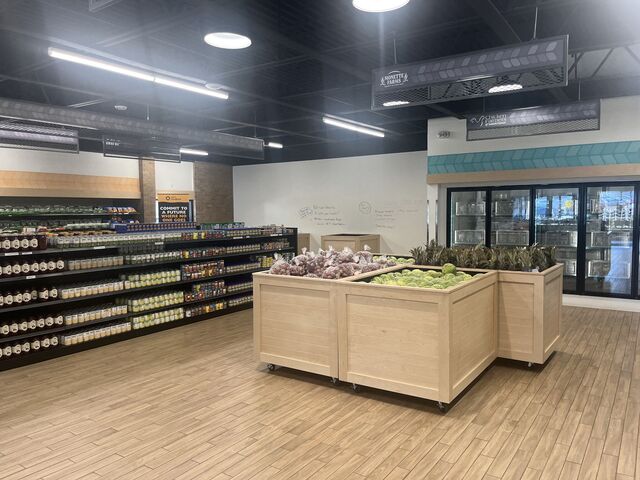
Image Caption: The Regina Foodbank is the first in Canada to open a free grocery store model, complete with stocked shelves and a checkout system (Regina Foodbank / Supplied)
For the past several months, we’ve reported on the rapidly rising numbers of food bank users across Canada as inflation, a lack of rent-geared-to-income housing, and stagnant wages have reached a critical point for families nationwide. This is the second in a three-part series called Feeding Change, focusing on innovative ways food banks across Canada are meeting the demand – and what they’re doing to reduce it. Read part one here, and watch for part 3.
Regina’s free grocery store will soon develop and offer its own locally made food products.
A national first, the BMO Asahtowikamik Community Food Hub was launched by the Regina Foodbank in August 2024. They now hope to bring three to four new and bespoke products to their shelves each year, said CEO John Bailey.
The catalyst, he said, was the organization’s “fairly aggressive local food sourcing targets.”
@futureofgood Regina’s free grocery store is working on something new. #FoodBanks #Groceries #Regina #Affordablity ♬ original sound – Future of Good
The organization wants a quarter of all its food to be sourced from local farmers, producers and agricultural / food companies, and eventually to grow that to half of all its procurement in the next three years, Bailey said.
“With that comes some very specific challenges, especially in our region of the world, which is based mainly on growing ingredient crops,” he said, adding that the food bank connects with the province’s agricultural industry to source products like lentils, oats, pulses, meat and produce.
“While we can really readily access things like lentils and oats, there is a limit to how much folks are able to use them and comfortable using them,” he added.
Despite the nutritional value and local availability of these crops, many food bank clients may not have been able to cook with them, or have the time to cook with them, either, Bailey said.
That led the Regina Foodbank to work with the University of Saskatchewan and a food development company in Saskatoon on its own consumer-packaged goods.
A soup mix made with locally-sourced ingredients from around Saskatchewan is soon to become available, followed closely by a just-add-water pancake mix, Bailey said.
Data-driven food sourcing
Even though clients are not formally purchasing anything at the Community Food Hub, the retail-like experience of shopping in a grocery store also includes a point-of-sale (POS) system.
The data collected by this system has helped the food bank team better understand the products that clients are more likely to pick up, and those that are less popular.
The Regina Foodbank would typically source food products based on what was best value, or simply by guessing demand, Bailey said. With the POS system, the team had more information to work with.
“This allows us to go ‘Actually canned beans are moving, but peanut butter is not,’” Bailey said as an example.
“That has allowed us to direct what our procurement looks like, to actually meet the needs of the people we’re serving. When it comes down to donations and purchases, [the Hub data] is guiding that.”
One major finding, Bailey said, was that the Hub’s initial offering did not include easy-to-cook foods like instant ramen or Kraft Dinner. Following consultation with and feedback from the Hub’s clients, these products are now available alongside the store’s original offering of fresh and organic products.
“It can all be part of a person’s diet and we need to honour and respect that,” Bailey said.
Why choice feels powerful in a food bank
The food bank model in which clients are able to choose what they take home has existed for a long time, Bailey said. What the Community Food Hub in Regina does differently is replicate the experience of shopping in a retail setting, from how the shelves are stocked to how clients go through a ‘checkout’ process.
Both the Regina Foodbank and the Asahtowikamik Community Food Hub have the same provisions, but the latter does not have any references to food banks in its physical space, despite serving a quarter of the Regina Foodbank’s clients.
It took many months of focus groups and surveys with clients to design the physical space of the grocery store, and the process by which people would access food, Bailey said.
“The ability to pick their own food changes folks’ perception of their own food insecurity,” he said. “They have full control over what they bring in.”
Your job. Your mission. Your news.
With your support, the sector you're building gets the journalism it deserves, and you get a tax receipt.

Author

Related Articles

Fires and floods: How Canada’s non-profits are responding to summer disasters
Several organizations have set up ways Canadians can help as more than 900 wildfires burn across the country

New “endings” hotline to help the social sector with closures, insolvency and succession
Ever / Was is run by a collective of navigators seeking to destigmatize closures and endings in the Canadian social purpose sector.

Should B.C.’s condo buyout be an opportunity to grow housing through non-profits?
The federal and B.C. governments plan to buy thousands of unsold condos to expand homeownership, but some housing advocates say the units would have a greater long-term impact if they were transferred to non-profit providers.
