Can community ownership save a historic neighbourhood? This land trust thinks so
Second community bond campaign planned as Kensington Market Land Trust eyes additional property.
Why It Matters
Canada’s housing crisis has hit those searching for affordable apartments hardest. Community land trusts could help keep rents reasonable.
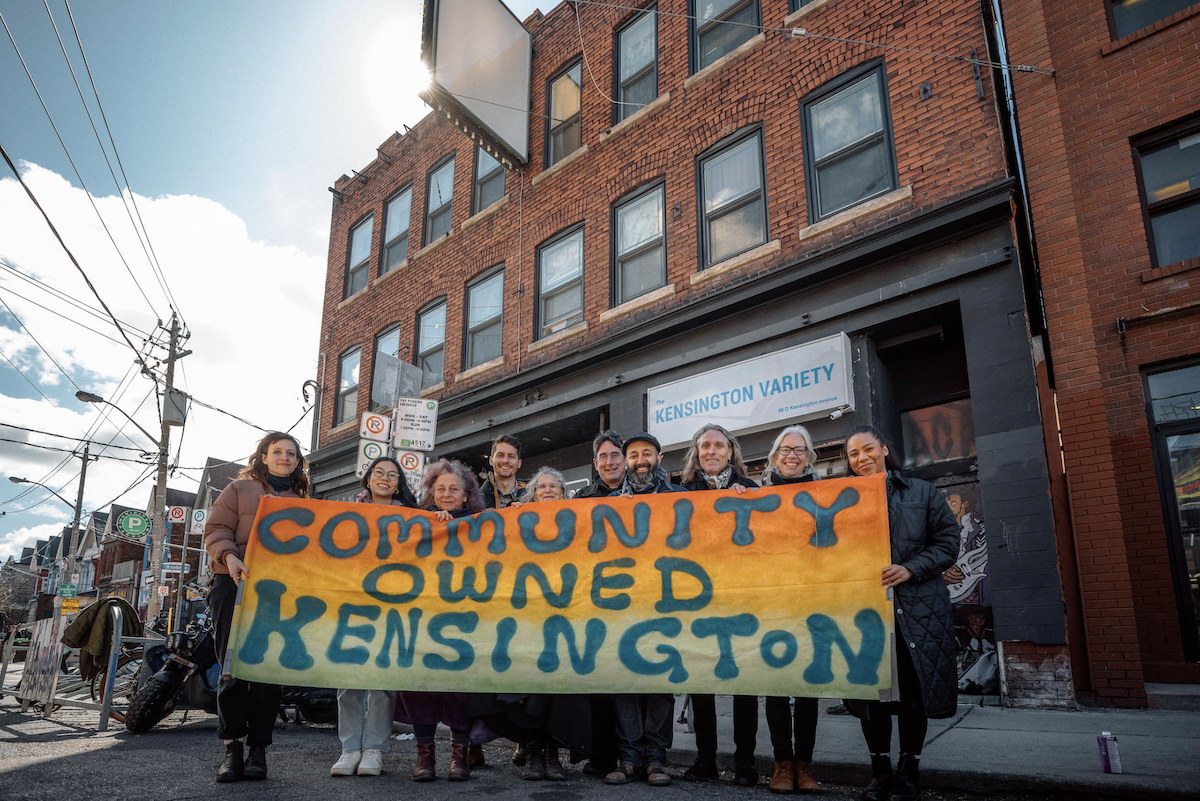
Members of the Kensington Market Land Trust in front of 54-56 Kensington Ave. in Toronto. (Supplied photo/Kensington Market Land Trust)
It’s a message few tenants will ever receive—one informing them that their rent is going down, not up.
However, that’s exactly what happened when Toronto’s Kensington Market Land Trust acquired a mixed-use building at 380 Spadina Ave. earlier this year.
“We were actually able to reduce the rent for our residential tenants, and that’s a pretty cool achievement … you don’t often see that when you have a change in ownership, usually, the rents go up,” said Angela Ho, the trust’s community investment manager.
Rooted in community efforts to keep big-box retailers out of the market, the trust was established in 2017 to fight gentrification while protecting social and economic diversity in Toronto’s most distinctive neighbourhood.
Once a middle-class Victorian suburb with strong ties to Britain, Kensington became a home to Jewish immigrants in the early 1900s. These immigrants established many storefronts that still define the market.
Portuguese immigrants came in the 1950s and 1960s, followed by Chinese, Korean, Vietnamese and Filipino immigrants in the 1970s, and Latin American refugees in the 1980s.
Today, the market’s vibrant, walkable streets are lined with locally owned small businesses, reflecting the community’s continuing commitment to welcoming new arrivals from across the globe.
“It has a really strong, community grassroots feel that, I think, makes it a really unique place for advocating for social change,” Ho said. “And in Kensington Market, that looks like protecting affordability, protecting the character of the neighbourhood and using land at the direction of the membership.”
Future of Good contacted tenants at both trust-owned buildings, and while none wanted to discuss their experience publicly, they overwhelmingly described the transition as positive.
However, transformation doesn’t come cheap in the heart of Canada’s largest city, where real estate has been compared to a blood sport.
To raise the capital needed to buy a second Kensington Market property, the non-profit corporation turned to an increasingly popular fundraising solution: community bonds.
While they’ve existed in Canada for two decades, the bonds made their way into the spotlight during the COVID-19 pandemic and continue to grow in popularity.
Ho said the organization discussed community bonds for nearly two years before launching its first offering in 2024, adding that much learning was done along the way.
“Financing was a really challenging piece to secure,” she said. “We had made multiple attempts (to purchase buildings), but oftentimes we weren’t able to close on a potential acquisition because of funding.”
A regular mortgage wasn’t out of the question, but Ho said that would mean passing higher interest costs onto tenants.
“So, as an organization that is really trying to protect affordability, we needed to explore alternative ways to finance our acquisitions,” she said. “And really, we saw (community bonds) as a way to lean into our focus on mutual aid and community.”
The trust bought its first building, 54-56 Kensington Avenue, in 2021 with the assistance of a $3 million forgivable loan from the City of Toronto: a percentage is forgiven each year the organization provides affordable housing.
A community member also provided the trust with a privately funded vendor take-back mortgage, while a regular mortgage and a small crowdfunding campaign covered the rest of the purchase cost.
However, when the organization began preparing to buy a second building, it partnered with Tapestry Community Capital and explored what community bonds could offer them and the community.
A tool, not a panacea
“Community bonds are not right for every organization … because at the end of the day, they are a debt source,” said Satyameet Singh, Tapestry’s program manager.
“So they’re not a replacement for philanthropic or government funding, but they are able to unlock an additional source of funding as part of someone’s capital stack.”
They also offer supporters an innovative way to get involved with a cause or organization they’re passionate about, he said.
“There’s a sense of community ownership because investors are investing in projects that they can touch and feel,” said Singh.
“There is also a greater interest amongst Canadians in investing locally right now, and that’s another reason why we are confident that you’ll see many more (community bond) campaigns coming down the road.”
Additionally, Singh said community bonds offer organizations considerable flexibility, adding that terms can be designed to meet a wide range of cash flow needs.
Investor consultations—discussions between bond issuers and potential contributors—also allow bond programs to be fine-tuned to meet the needs of a particular community, initiative or organization.
After consultations with Tapestry and stakeholders, Kensington Market Land Trust decided to build investor confidence with an extra layer of protection.
“They parked all of the funds that were being generated through the bond investments in an escrow account, which would only be … exited from the escrow account when they had closed the deal,” said Singh.
In the end, 170 investors contributed $1 million over eight months. Toronto’s Multi-Unit Residential Acquisition Program (MURA) kicked in an additional $400,000, while a private donor covered the remaining costs with a sizable contribution.
Investors will be paid back in the coming years, but with interest below commercial mortgage rates, sparing the land trust and its tenants from increased costs.
In the coming months, the trust will launch a second community bond campaign to raise $2 million. However, Ho said that the success of community bonds doesn’t ameliorate the role of government.
“It’s also really important that cities and governments invest in affordable housing through things like the MURA program in Toronto, so that organizations like us are able to acquire and protect important buildings in our communities.”
“Community bonds alone won’t allow us to do this work,” she said. “We also need funding.”
Your job. Your mission. Your news.
With your support, the sector you're building gets the journalism it deserves, and you get a tax receipt.

Related Articles

First Bite Fund launches as Ottawa puts $1 billion behind domestic food processing
New revenue‑based loan fund aims to reach the 92% of food processors that conventional capital has overlooked

New database maps Canada’s $17.3 billion DAF landscape and where philanthropic wealth is concentrated
A new database is highlighting Canada’s donor-advised fund landscape in an effort to increase transparency, but not all sector leaders believe the tool will have that effect.

Edmonton housing fund uses values-aligned, blended financing to create affordable homes
The Housing Prosperity Fund combines values-aligned financing, community investment and family-focused housing to create a model it hopes can scale across Canada.
