Diverse volunteers crucial to making sure racialized, newcomer kids participate: Umoja Community Mosaic
UCM’s invitation to contribute, not just participate, creates ripple effects through Calgary communities
Why It Matters
Access to sports has long been a way to help youngsters live better lives. However, a diverse volunteer base is needed to get more children and teens from racialized and newcomer communities to participate.
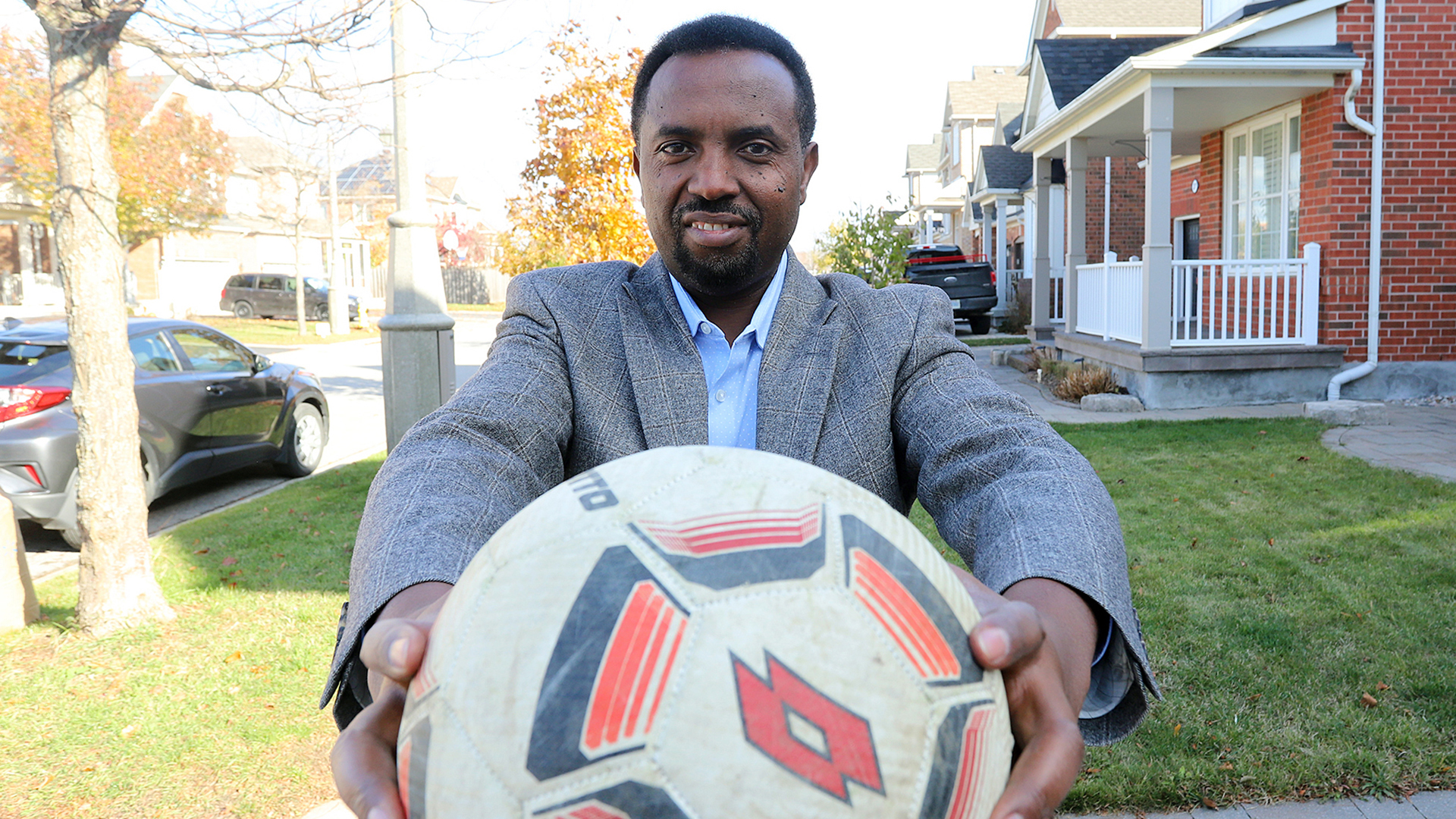
Jean Claude Munyezamu, Founder, Umoja Community Mosaic. (Jeff Tribe/Future of Good)
This independent journalism is supported by Canadian Tire Jumpstart Charities. See our editorial ethics and standards here.
Diverse, representative volunteers are among the most valuable players in youth sport’s power to build inclusive communities and change lives, says the executive director of one of Calgary’s largest youth sports organizations.
“Our organization cannot exist without volunteers,” said Calgary’s Umoja Community Mosaic (UCM) Executive Director Jean Claude Munyezamu.
UCM’s success in attracting and empowering diversity in its volunteer team has helped it drive the group’s sustainability and effectiveness and expanded its impact in the community, said Munyesamu.
Often, gatekeepers can be determined to restrict access to sport, serving members rather than supporting the participants, Munyezamu said. He gave the suspension of a Central Alberta Soccer Association president in October, following an anti-gender email deriding diversity and inclusion initiatives, as an example.
“Soccer is really a people’s game,” he said, noting he was shocked at the suggestion Black, Indigenous, female, and LGBTQ+ players take space away from white youth players.
“It is really outrageous and very hurtful for the people who have been trying to bring inclusion into sport and other bodies of our society to have someone who sits on the executive, decision-making, who has that belief.”
There is well-funded and organized pushback against greater diversity and inclusivity throughout society, said Travers (who uses only that name), Professor of Sociology and Anthropology at Simon Fraser University and author of The Trans Generation: How Trans Kids (and Their Parents) Are Creating a Gender Revolution.
Privileged access to recreation is one of those places where there is pushback, they said.
“We need to be vigilant and keep pressing forward for more inclusivity.”
Travers agreed to contribute to a 2021 review of the British Columbia Soccer Association’s Diversity, Equity and Inclusion initiative, partly because of the far reach of minor sports.
Diversity throughout all levels of organizations is crucial to welcoming inclusive participation, they added, noting, “If you can’t see it, you can’t be it.”
Those wishing to encourage positive growth should be clear there is a place for diverse individuals, and their presence will be welcomed and supported.
Involvement in sport is a powerful predictor of social connectedness, said Karri Dawson, executive director of Values-Based Sport, Canadian Centre for Ethics in Sport.

Karri Dawson, executive director of Values-Based Sport, Canadian Centre for Ethics in Sport. (Contributed Photo)
“Which is why it’s extremely important to provide opportunities for equity-deserving groups such as newcomers, people with disabilities, LGBTQ+ participants, and racialized and Indigenous peoples.”
When sport is leveraged as a driver for social inclusion and integration, more Canadians benefit from the positive outcomes of sports participation that improve the lives of all demographics.
The Canadian Centre for Ethics in Sport reported in 2022 that more than 75 per cent of Canadian children participate in organized sports and more than 90 per cent of adults believe in its ability to build character.
The study revealed that children who participate in sports see higher rates of self-esteem, improved sleep, concentration, fine motor skills and executive functioning, higher grades, and better physical health.
The study also revealed that teens who participate in team sports are less likely to engage in high-risk behaviours, including substance abuse and gang involvement.
“Initiatives that advance equity and inclusion within sport should remain an important goal within Canada, especially for populations with lower participation rates.”
Sport and play can be essential vehicles that support kids of all ages and abilities in reaching their full potential, added Stuart McReynolds, AVP, Programs with Canadian Tire Jumpstart Charities.
“Whether it be improving their health and wellbeing, their mental health, developing new friendships or settling into a new community,” all must be welcomed and supported, McReynolds said, emphasizing respect and inclusion as core principles.
“What works in one community may not be suitable for another. An intersectional, community-driven approach often demonstrates the most success in meeting the needs of that particular community.”
Sports may also be the first connection a growing number of newcomers have to the community, he added. Encouraging inclusive volunteerism is one crucial way to welcome and build diverse participation, leading to multiple benefits beyond sports fields.
“Representation matters,” said McReynolds, citing the importance of focusing on the additional positive aspects that community-building volunteers bring.
Optimist without boundaries
Racism is a “habit” introduced to divide people, said Munyezamu, so changing that habit requires meaningful, inclusive effort from a communal table.
“Letting people not just be welcomed, but letting people welcome others, and rather than inviting people to participate, inviting people to contribute,” said Munyezamu.
He gave an example of Canadian soccer player Alphonso Davies, who was born in a refugee camp in Ghana. Davies has become one of the world’s most elite players, a role model for meaningful inclusion and diversity, said Munyezamu.
“It’s win-win. When you exclude people, you are missing out. Any child we help to go to university, there is a company out there who’s going to benefit from their skills.”
A Rwandan who narrowly escaped genocide, Munyezamu said his volunteerism began in Kenyan, Somalian and Sudanese refugee camps before he arrived in Calgary in 1998.
Concerned about crime and his children’s safety in the family’s public housing neighbourhood in 2010, Munyezamu chose to help rebuild what he called a “disrupted community” instead of sheltering his children indoors.
A talented soccer-goalie-turned-striker, Munyezamu said he leveraged the sport’s universal language to drive youth toward community, belonging, mentorship, support and opportunity.
He began small, informal soccer sessions on a neighbourhood greenspace, striving to change one child’s life at a time. Word-of-mouth swelled their ranks. Noticing many struggled academically, with the support of community associations and retired senior volunteers, Munyezamu instituted an hour of math and English tutoring before an hour of soccer.
He then gained parental and school support and an invitation to incorporate the program into the local school.
His efforts were formalized as Soccer Without Boundaries (SWB), inspired by four principles: giving 100 per cent, reliability, respect and honesty.
Conflict resolution was also embedded into the program — along with accountability — to recognize some children’s exposure to horrific events in their origin countries. If a child doesn’t complete their tutoring, is consistently late or is intentionally over-aggressive, they may lose soccer privileges or face suspension.
When participants reach age 15, five fundamental skills are added to the program, including awareness, routine, resourcefulness, relationships and focus.
Character tends to show up through athletic competition, said Munyezamu. Those with superior talent are supported through competitive avenues and the possibility of university scholarships.
While a majority eventually realize they are not the next superstar like Davies or Argentine soccer forward Lionel Messi, confidence built through a supportive community and the program’s 100 per cent high school graduation rate provides hope and a viable path toward contributing members of society, said Munyezamu.
When COVID struck, SWB pivoted to add a culturally appropriate food bank, sourced laptops and internet connectivity for remote learning, helped create a Zoom hub in a locked-down seniors complex, and incorporated mental health support.
The organization eventually rebranded as UCM, evolving into an entity still featuring soccer for children from more than 30 countries, ongoing food support, free after-school educational opportunities, and community-based women’s, recreational, artistic, anti-racism and wellness initiatives.
There is no such thing as a “bad child” said Munyezamu, “society makes a child who they are.
“It is very important for children to feel that they belong, someone believes in them, someone cares. Every child needs that; if they don’t have it, that’s emptiness. They’re looking for where they can fill it. As a society, I think we have a solution if we are willing to listen and respond.”
A business case exists for spending money to channel youth into community programs before they turn to something criminal or destructive or “catching someone before they fall,” said Munyezamu.
That value can be hard to quantify.
However, it’s a safe assumption that encouraging athletic and educational pursuits to prevent gang membership is an exponentially superior societal outcome.
“This is an investment that makes sense,” Munyezamu said, citing an annual $250,000 price tag per incarcerated individual in Canada, a cost borne by taxpayers.
The organization has expanded into five Calgary neighbourhoods in partnership with public housing.
“We give people hope,” Munyezamu concluded. “Because without hope, you cannot see possibility.”
Inclusion, inclusion, inclusion
Volunteers, the board of directors, and the staff of UCM reflect a principle of inclusion, and a tour of its website and accompanying videos illustrate racial, cultural, religious, and socio-economic diversity.
“They have to reflect the children they serve,” Munyezamu said.
UCM’s success in attracting diverse volunteers grew organically from its origins, said Munyezamu, and expanded partly due to its demonstrated success that was recognized in surrounding middle-class neighbourhoods.
Because the organization welcomed anyone from surrounding areas, volunteers were found from the families of the children who wanted to participate, naturally making their volunteers more diverse.
And with UCM’s focus on making sure volunteers have a say in how programs are run, the program continues to expand while still representing the communities it serves, he added.
Maturing soccer players are empowered to become contributing volunteers, adding direct community connection, representation, and lived experience, an invaluable advantage for volunteers.
Close to 80 per cent of children served are Black; however, everyone is welcome.
“Inclusion means inclusion to us. If you are serving the poor, poor is poor is poor. If you set up a program to catch people if they fall, it doesn’t matter who’s falling.”
Focusing on community building rather than one demographic or issue means more needs are met while avoiding potential resentment through exclusion, said Munyezamu.
Participants from surrounding middle-class neighbourhoods benefitting from UCM’s community-building have led to financial donations or additional volunteers and skillsets.
For example, an appreciative lawyer negotiated to add day-old bread from a high-end bakery to the food program and is the first person Munyezamu calls if a legal concern arises.
“And she always answers.”
Respect and empowerment
Munyezamu distinguishes between inclusion and integration, the latter inviting volunteers to provide a service, the former an invitation to influence and improve its delivery.
“If you give (volunteers) the platform, you’re going to have a better product than what you might have come up with.”
Munyezamu said that internationally and locally, there is a tendency to enter with solutions from outside the community.
“When they say, ‘Let’s take the children, they’re going to be like us.’ We still believe in people becoming like us, and we’ve been wrong each time we take that approach.”
Munyezamu said identifying problems together provides better outcomes. The approach extends to empowering community-based volunteering, asking what people would do if they could help versus simply telling them to complete tasks.
This shift in thinking makes volunteers feel respected, valued and empowered and keeps them returning, said Munyezamu.
“This is how you create sustainability in what you are doing.”
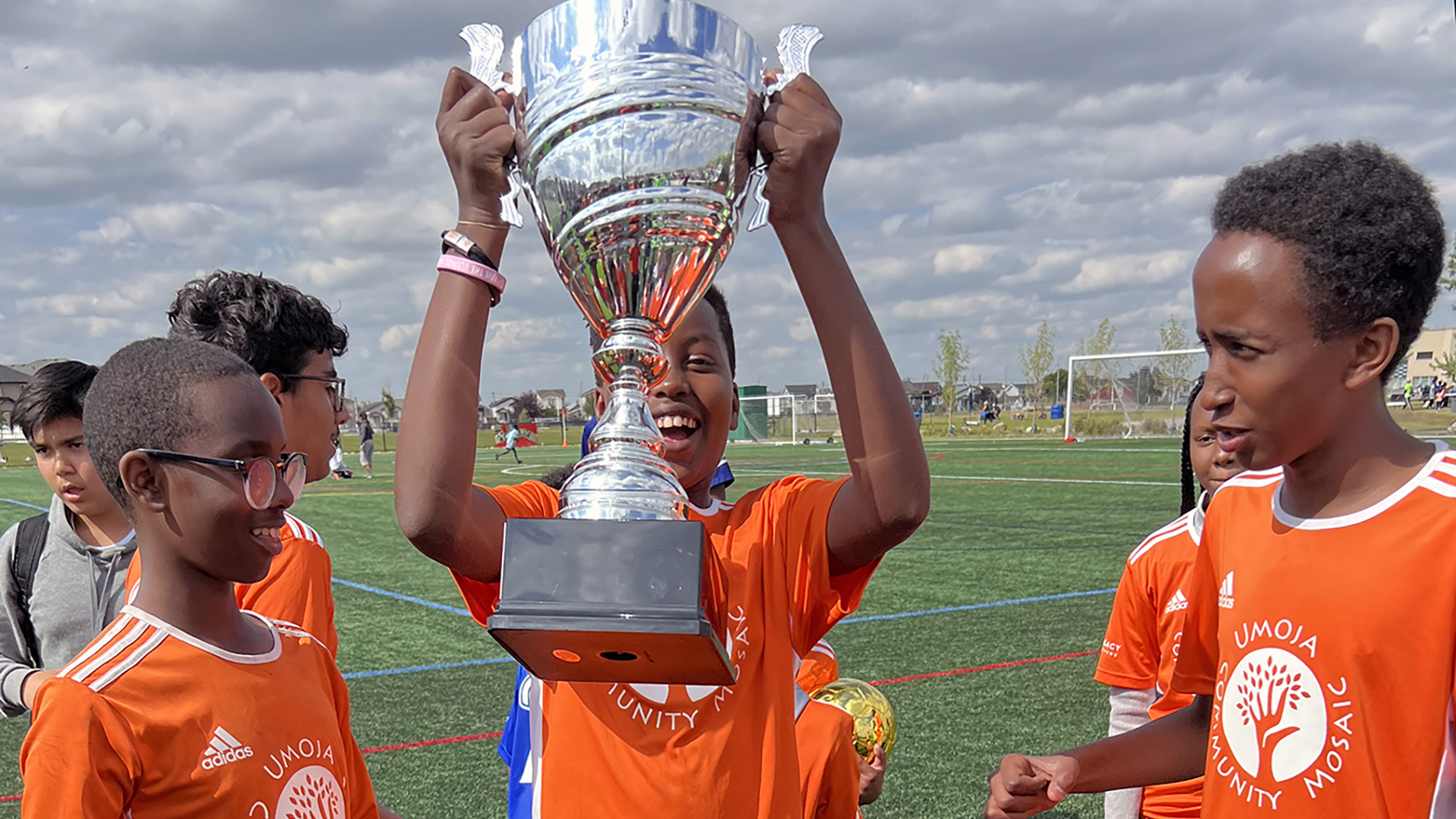
Soccer Without Boundaries. (Contributed Photo)
Refugees and newcomers can replace everything they lost or left behind when they come to Canada, except community, said Munyezamu.
UCM intentionally calls the people it serves family, not clients. Inclusive volunteering and introductory events, including potlucks, allow neighbours to get to know each other and build relationships and commitment.
Seeing their kids’ soccer and life progression promotes volunteer engagement, enjoyment, shared investiture and reward, said Munyezamu
“Every parent wants their children to succeed, and that’s where we capture the heart of families to get involved and contribute.”
Newcomers can be a rich source of experienced and enthusiastic volunteers, said Munyezamu. Refugees, by necessity, are resourceful people used to accomplishing lots with very little.
“As newcomers, we are sometimes excluded because everyone assumes we have need; we don’t have something to give,” he said.
“Immigrants who come here, you never know who they used to be. If you give them room, you will be amazed how much they can contribute to this country.”
Immigrants were often community builders in their home countries, and we should seek their input to shape, design and improve programs, he added.
Developing talent in-house
UCM developed its in-house volunteer talent over time, encouraging young participants’ appreciation for serving their community as they turn 13.
The goal is to have players become community champions. As one example of this, the players acted as community captains during COVID-19 and compiled clipboard lists of potential food support recipients.
Another priority is proactively developing spotting problems early in their emergence, developing intuition to anticipate others and either solving or identifying them if the issue is more than their scope can handle.
Players also form a knowledgeable talent pool for soccer officials, along with the opportunity to work in summer soccer camps, earning money while developing employment skills.
A couple of former players also started their version of SWB in their neighbourhood, said Munyezamu, supporting their initiative with balls, pylons and nets.
There is a “home-field” advantage, but graduates have continued contributing in locations well outside Calgary, he noted, carrying forward the principles learned within Umoja.
“When they move to other cities, they don’t sit down; they continue to be active in any community where they go,” said Munyezamu.
Quid pro quo
Beyond the many positives of volunteer experience, UCM helps volunteers with resume building and writing and happily provides reference letters.
“We are also the first place (prospective employers) reference because we can talk about their character.”
Youth program volunteers can mature into summer camp leaders, a tangible recognition for volunteer investment and personal development.
Munyezamu added that it doesn’t hurt to say thank you, citing the popularity of volunteer appreciation events, including bowling, pool, or indoor virtual golf.
“It doesn’t matter if you win or lose. Again, it’s belonging,” Munyezamu said with a smile.
Your job. Your mission. Your news.
With your support, the sector you're building gets the journalism it deserves, and you get a tax receipt.

Related Articles
Partnered Partnered content How construction contracts became the blueprint for social change in Manitoba
Manitoba is a leader in social procurement, with decades of partnerships among government, businesses and social enterprises that have shaped a model other communities can learn from.
‘Fiercely dedicated’: Prominent Winnipeg labour advocate Gord Delbridge dies
Former CUPE 500 President leaves behind a legacy of years advocating for city workers and opposing the privatization of municipal services.

Analysis: What The Guardian can teach Canada about Ontario and New Brunswick’s private child care bet
Ontario and New Brunswick are pushing the federal government to lift the cap on for-profit child care providers, bucking a national model built on public and community-based care.
