Escaping the grant cycle: Funders helping non-profits through buying social enterprises, businesses
Why It Matters
Non-profits that have participated in – and benefited from – revenue diversification programs say that they have been able to generate unrestricted revenue that reduces their reliance on the grantmaking cycle. On the other hand, those who run the programs recognize that a significant “mindset shift” is needed for many in the non-profit sector.

Note: Thriving Non-Profits is an initiative of Scale Collaborative, which also houses the Thrive Impact Fund. Future of Good has previously received funding from the Thrive Impact Fund. Read our editorial ethics and standards here.
More non-profits across Canada are exploring ways to make money outside of grants, as foundations, provinces and municipalities make moves to fund access to revenue diversification programs.
The Government of Alberta, through the Creative Partnerships program, funded Innovate Calgary to run a Business Model Enhancement Program (BMEP), which provides selected non-profits with access to coaching, hackathons, and seed funding in their pursuit of financial sustainability.
In the meantime, Thriving Non-Profits is a non-profit leadership program that has already been partnering with several foundations in western Canada. In the last couple of years, the program has expanded to Saskatchewan and Newfoundland and Labrador, where local community foundations are subsidizing the cost of non-profits participating in the program.
Future of Good caught up with the people running these programs for the sector, as well as a number of participants, to learn more about this shift towards financial independence.
Non-profits seek unrestricted funding
Kyle Empringham is the co-founder of The Starfish Canada, which supports youth changemakers working on environmental sustainability. In an already small pool of grants, Empringham found that he was “trying to compete with a lot of [organizations] that actually I should be collaborating with.
“But by the nature of how things are structurally, we end up operating and competing at the same time for scarce resources in terms of funding.”
Empringham has also found that funders are getting increasingly specific about what they will fund.
“We’re throwing a lot of grants against the wall and not many are sticking,” he said.
Having then taken the Thriving Non-Profits program alongside a board member and another member of staff at The Starfish – and subsequently launched summer camps as a paid service – Empringham has been able to generate “tens of thousands of dollars” in unrestricted revenue.
“It’s been so interesting to be able to now feel like we have a bit more agency […], that we’re not forever reporting back on grants,” he said.
Over in Calgary, Agnes Chen faced similar challenges with restricted grant funds and wanted to transition her organization, Starlings Community, to a fee-for-service model.
Bound by specific requirements from grantmakers, Chen found she would often get more funding to hire contractors for projects rather than full-time, permanent staff.
Small non-profits, Chen added, are in a particular bind when it comes to grants.
“Large organizations have four or five grant writers. When you’re a volunteer-run organization, your entire capacity goes towards that and you’re already at a disadvantage.”
“As a small non-profit, I’m the executive director, I’m the founder, I’m our social media tech, I’m our website tech, and I’m our facilitator,” she said.
“We’re fortunate this year to have accessed a few really small grants, but not enough to hire staff.”
Chen was one of the participants in Innovate Calgary’s Business Model Enhancement Program. “We aren’t going to be sustainable without another method of getting funds,” she said.
The transition to a paid-for service, however, required a totally different mindset, Chen said.
“It’s a hard transition to move from free to fee-for-service, and putting money towards marketing yourself when it seems so counterintuitive.”

Why the sector needs a large-scale mindset shift
Leaders of both the BMEP in Calgary and the national Thriving Non-Profits Program emphasized the need for non-profit professionals to embrace a “mindset shift” about money.
“A lot of organizations don’t necessarily want to spend money on their own professional development, because they feel everything has to go to impact,” said Kristi Rivait, co-founder and director of partnerships and programs at Scale Collaborative, the home of the Thriving Non-Profits program.
There is a “long-held traditional belief system” that has locked the non-profit sector into a dependent financial model, Rivait said.
For Raissa Espiritu, former executive-in-residence at Innovate Calgary, the mindset shift was the biggest outcome the team wanted to achieve through the BMEP.
“It’d be awesome to say that all of them [the non-profit participants] developed social enterprises that were generating revenue, but it honestly does take a lot of time.”
In a report shared with Future of Good, Espiritu wrote that “most non-profits had to reframe the idea of ‘profit’ from a threat to a sustainability tool.”
Non-profits also needed more support around legal structures and implications of generating revenue, she said.
The report also highlighted the need to move away from “restrictive grants that prevented experimentation or reinvestment.”

How exactly can the non-profit sector generate revenue?
As with the team at The Starfish Canada, any organization that wants to participate in the Thriving Non-Profits program should have a board member, an executive director, and a senior staff member signed up.
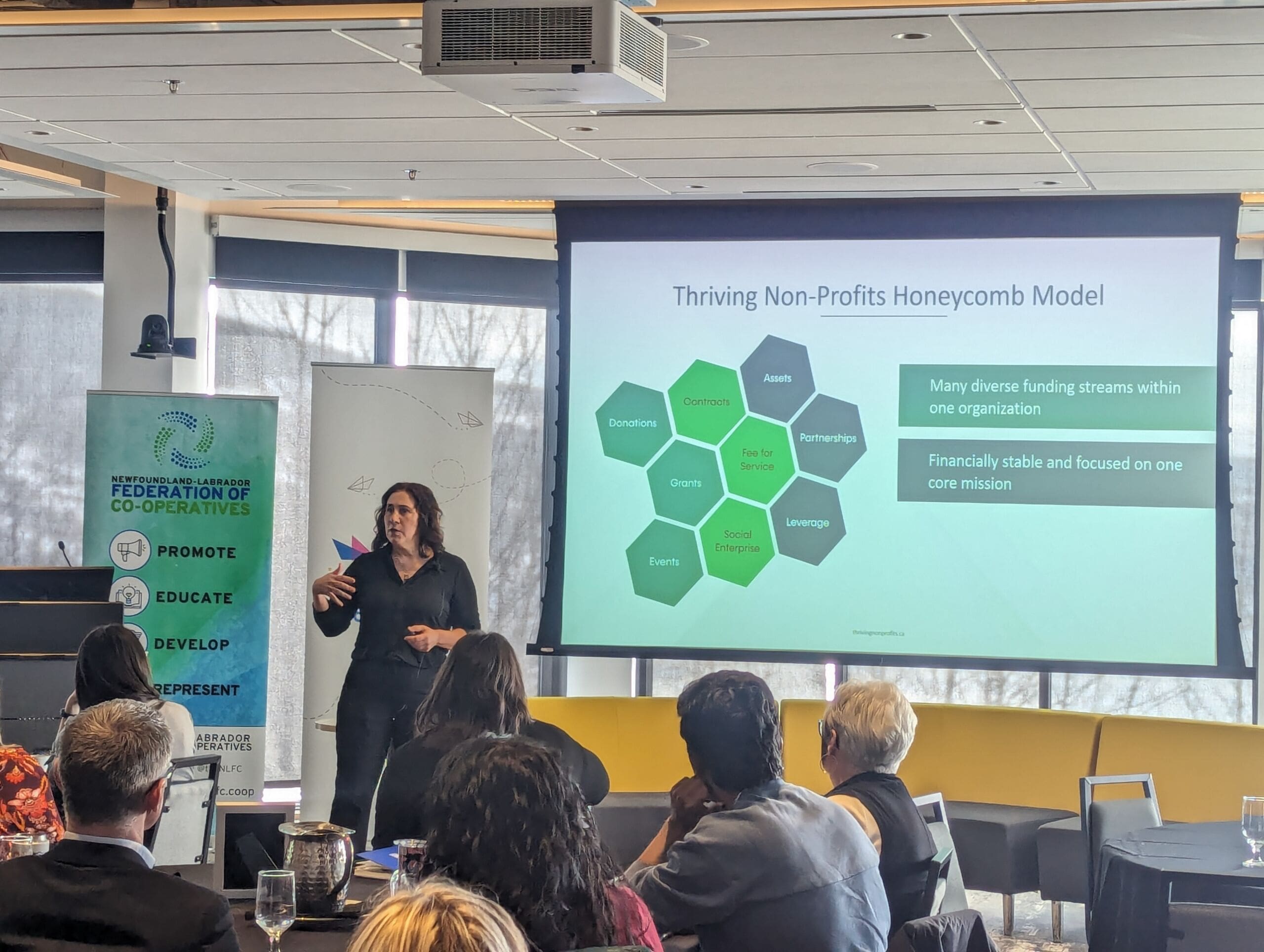
The program focuses on nine types of revenue-generating activities, from donations and grants to social enterprise, fee-for-service models, physical and financial assets, and strategic partnerships.
Rivait also highlighted the potential opportunity in acquiring local businesses, such as cafes, thrift stores, and grocery stores.
As more than three-quarters of Canadian business owners plan to exit in the next ten years, “there is a real opportunity in our country right now to skip the startup phase of a social enterprise and think about what acquiring a business looks like in your local community.”
The BMEP required one “significant decision-maker” to participate, but Espiritu could not work with organizations that were entirely board- or volunteer-run. Twenty organizations were engaged throughout the program, and upon completion, each received a financial award of $15,000 to continue their revenue-generating activities.
Espiritu emphasized that non-profits that completed the program and received the award were not required to report progress back to Innovate Calgary.
“There was an understanding that the Business Model Enhancement Program was a bit of a research project, and so we were capturing information that would then be reflected in reports to provide recommendations to the Government of Alberta,” she said.
Foundations and government funders are flocking in
The Thriving Non-Profits program has been running since 2016, and has steadily increased partnerships with foundations in western Canada. In 2024 and 2025, the team has forged new partnerships with foundations in Ontario, Newfoundland and Labrador and Saskatchewan.
The Government of Newfoundland and Labrador, the province’s community foundation, and the Community Sector Council Newfoundland and Labrador have provided funding to make participation in Thriving Non-Profits free for selected applicants. Ordinarily, it would cost an organization $3,900 to take the course.
Revenue diversification has been a key focus area for the Community Foundation of Newfoundland and Labrador, said Executive Director Nicole Dawe. Like Rivait, she also felt that there were significant opportunities for non-profits to acquire businesses.
“In Atlantic Canada, there is a huge number of businesses that are or will be looking to transition over the next five, ten, 15 and 20 years,” she said.
“This piece around [small business] acquisition for non-profits and charities is really, really important, particularly for the ones that are in more rural and remote areas, because some of those businesses are also really important anchors to keep a community economically and socially viable.”
Elsewhere, the Saskatoon Community Foundation was also able to subsidize the participation costs for Saskatchewan non-profits. In 2025, the foundation aimed to introduce Thriving Non-Profits to the province in collaboration with the Community Initiatives Fund (CIF).
The CIF is a Special Purpose Fund that distributes a portion of the profits from SaskGaming to non-profits and community organizations through grant programs. It works independently of the provincial government.
Together, CIF and the Saskatoon Community Foundation hope to support 20 Saskatchewan non-profits through the Thriving Non-Profits program.
Operating costs, such as salaries, benefits, and technology investments, continue to be gaps that the non-profit sector identifies, said Tracey Mann, executive director of CIF. Neither grants nor contracts include the cost of those line items in their funding agreements, she added.
While she acknowledged that unrestricted revenue through social enterprise could make the sector more resilient and independent, she also felt that it wasn’t a one-size-fits-all solution.
“Certainly we’ve seen some organizations here be very successful in terms of running social enterprises, but I would not want government to think that that’s the answer to everything, because there are just organizations [where] that is not a viable mode.”
The CRA implications
Any business activity that a charity carries out must be related to and continue to support the charity’s primary purpose.
“A lot of folks aren’t as aware of their charitable purposes with the CRA as they need to be,” Dawe said, adding that the T3010 requires charities to break down different types of revenue. Some charities are having to figure out what social enterprise or earned income means for HST and tax rebates, she said.
“As with most things with CRA, there is a lot of opaqueness. I feel like that opaqueness can create some risk aversion or a barrier for staff or boards,” Dawe said.
In comparison, there is little guidance for registered non-profits, said charity lawyer Richard Bridge.
Future of Good reached out to the CRA to clarify income reporting guidelines for the social purpose sector and asked whether the guidance differs for non-profits and charities. In a response provided in July 2025, a representative said that “there is no requirement for tax-exempt NPOs to be registered by the CRA for purposes of the [Income Tax] Act.”
“The courts have recognized that a tax-exempt NPO can earn a profit, if the profit is incidental,” they wrote. “That is, the profit is not significant and arises from activities directly connected to the organization’s not-for-profit activities.”
Non-profits must also file a T1044 if they receive income through property, dividends, interest, rentals and royalties above a certain threshold.
Tell us this made you smarter | Contact us | Report error