How advocacy from the food bank sector led to the Canada Groceries and Essentials Benefit
While many in the sector have long campaigned for additional social assistance to address the rising cost of living, there is more to be done, they say. Now, they’re targeting a reform of Employment Insurance.
Why It Matters
The Canada Groceries and Essentials Benefit (CGEB) is a rebranding of the GST / HST credit infrastructure, delivered through the federal tax system. The food bank sector advocated for $150 per month per adult, and $50 per month per child in a grocery stipend for families under a certain income threshold. What is rolling out will be significantly less than that.
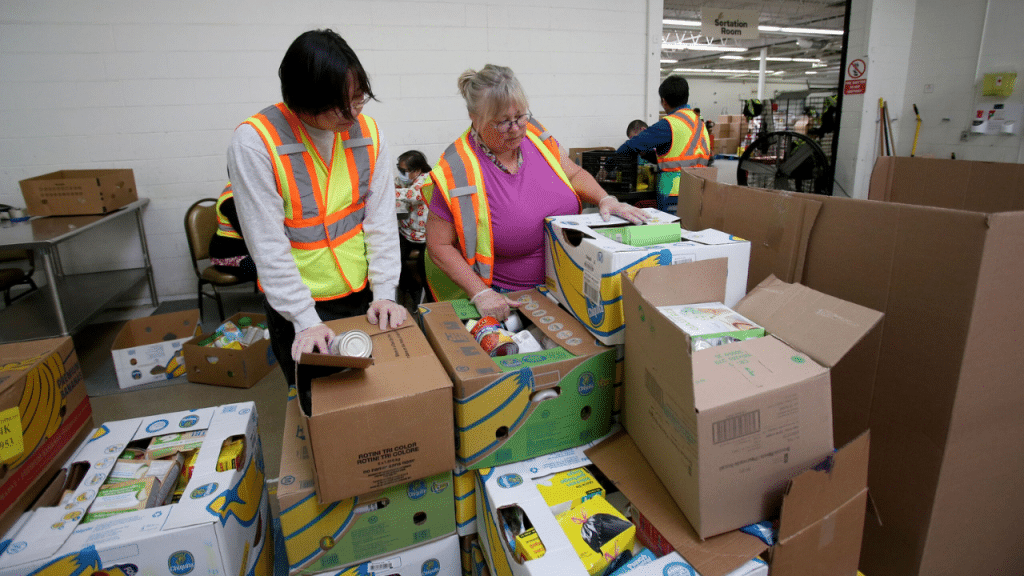
The new Canada Groceries and Essentials Benefit (CGEB) is a direct result of sustained, coordinated campaigning efforts from food banks and food security organizations across the country, say advocates.
Food Banks Canada – who were mentioned in Prime Minister Mark Carney’s announcement of the CGEB in January – led a nationwide effort to propose a Groceries and Essentials Benefit that would be “an expansion of the GST / HST rebate that already goes out to households with low incomes.”
The sector’s proposal was for low-income households to receive $150 per adult and $50 per child per month, totalling $1,800 and $600 of additional social assistance annually.
Under the federal government’s rollout of the CGEB, the maximum benefit for a family of four with $40,000 in net income – including the top-up received on Jun. 5 – would be $1,890 for the 2026-27 fiscal year and $1,358 for the next four years. Payments will be made quarterly.
An advocacy brief from Food Banks Canada estimated that the proposal would cost the federal government $11 billion per year. The CGEB delivered by the federal government will “provide $11.7 billion in additional support over six years […].”
The CGEB is not specifically allocated for spending on groceries or essentials, but rather acts as additional support for low-income families. The top-up received earlier this month was a one-time addition, and the benefit will stay stable until the 2030-31 fiscal year.
A spokesperson for the Department of Finance Canada said that the government “will continue to monitor income tax data and developments in food prices and broader inflation measures, including the Consumer Price Index, as well as indicators of household financial wellbeing.
“These data will help assess economic conditions and inform future policy decisions.”
Eligibility for the CGEB is assessed based on income tax returns, and what is declared about an individual’s income, marital status and dependent children. The maximum income threshold to receive the CGEB for a single person with no children in 2025 was $60,012. Married or common-law households with two children had to show that their maximum income in 2025 was at a maximum of $73,592.
Along with the CGEB, the Carney government announced several other measures in January to tackle the cost of food, including supporting businesses in addressing “the costs of supply chain disruptions without passing the costs on to Canadians at the checkout line.”
The Regional Tariff Response Initiative sought to support small and medium-sized businesses amid rising costs as well.
The Local Food Infrastructure Fund will also see $20 million to support food banks.
On Jun. 11, the Carney government announced a National Food Security Strategy to increase grocery store competition, increase domestic food production capacity, and “cut red tape across the agricultural supply chain.”
Is the policy designed robustly enough?
The Ontario Nutritious Food Basket (ONFB) lists 61 items that a family of four would need. In 2025, it would cost a family of two adults and two children just under $1,200 per month to cover the cost of healthy, nutritious groceries as per the ONFB’s estimates.
Meghan Nicholls, CEO of Food Banks Mississauga, came across a Reddit thread where recipients of the CGEB were speaking about the amount they received as part of the top-up on Jun. 5.
“The fascinating thing for me is that people seemed to have no sense of what they would be receiving,” she said, adding that “all media has been very clear” about the structure of the payment in the context of the previous GST / HST rebates, the top-up, and the frequency of the payments.
“It definitely indicated to me, I think, the federal government overestimates how plugged in to that kind of information folks who are struggling are,” she said.
“If you’re just trying to survive, you’re not paying attention to government announcements.”
Renaming an existing benefit – in this case, the GST / HST rebate – also caused confusion, Nicholls observed.
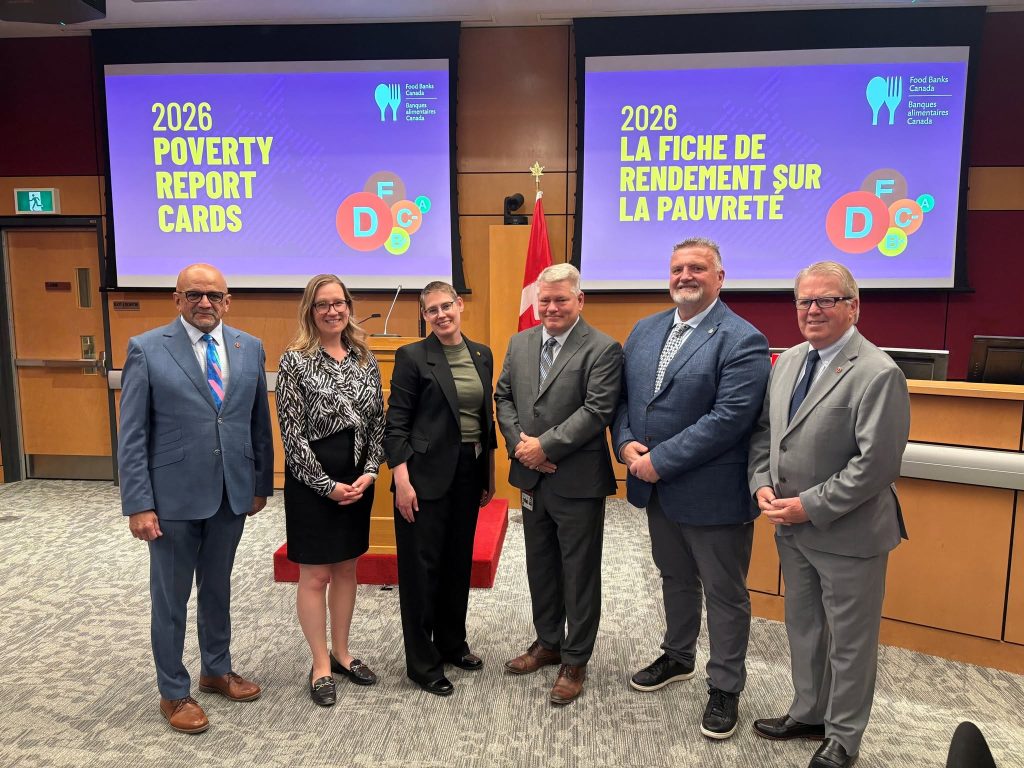
An additional adjustment for the CGEB is needed in the North, according to Food Banks Canada.
“Recognizing that the cost of food and necessities are significantly more expensive in the north, CGEB’s income eligibility thresholds and amounts should be expanded to reflect the economic realities of households living in northern communities,” they wrote in their 2026 Poverty Report Cards.
Several of the food banks that Future of Good spoke with said it is too early to judge whether the CGEB top-up and additional payments – which amount to a 25 per cent increase on existing GST / HST credit payments – will have an impact on food bank usage.
Income insecurity is root cause
Many in the food bank sector welcomed the CGEB’s January announcement, but emphasized that food insecurity is a continuing symptom of income insecurity.
For both Food Banks Mississauga and the Parkdale Community Food Bank (PCFB) in west Toronto, community-run tax clinics and workshops have been a critical tool to ensure that people access these benefits.
“We’ve been operating tax clinics now for the last six years,” Nicholls said. “It’s one of the only programmes that food banks operate that actually decreases food insecurity, because it’s the only thing we do that actually gets money in people’s pockets.”
However, she has found that sometimes those who are working but need food bank access, and newcomers to Canada, are not filing their taxes for fear of owing money to the government.
Barriers to technology are also a big factor in food bank users’ ability to fill in tax returns, said PCFB Executive Director Kitty Raman Costa.
Many in the food security sector have long advocated for more robust income security measures, with Employment Insurance (EI) reform a key agenda item.
In particular, they’d like to see access to EI expanded to include part-time, seasonal, self-employed and gig workers, as well as a minimum weekly benefit of $450.
The gaps in EI lead people to seek assistance from the provincial government, Nicholls said. In Ontario, Ontario Works has been frozen at $733 per month since 2018.
In the federal government’s current agenda of pushing employment, business and industry, “it is more palatable and probably more passable for us to be talking about EI reform in that context,” she said.
In 2024, the North York Harvest Food Bank ran a pilot in which it distributed debit cards to 500 households across two food banks, pre-loading the cards with a monthly fund based on household size.
A household of seven or more people was allocated $200 per month, while a one or two-person household would have received $50.
All households made under $60,000 annually, with half reporting at least one working adult.
The three-month pilot showed that 95 per cent of the pre-loaded funds were spent on food and food-related purchases. However, most clients still came to the food bank to supplement their purchases.
The North York Harvest Food Bank concluded that “a relatively small amount of funds will help a significant minority of people meet their needs, but does not provide any structural change to their situation.”
“We are very, very strong believers that there are – in Toronto, in a lot of Canada – no food solutions to food insecurity,” said Sarah Watson, director of community engagement at North York Harvest.
“People are food insecure because they don’t have enough money. People are food insecure because they are poor.”
Any funds received, such as those from the CGEB, will provide the immediate relief people need now, Watson said.
“Sometimes, it really is like $50 a month [that] is the difference between coming to the food bank and not coming to the food bank.”
Your job. Your mission. Your news.
With your support, the sector you're building gets the journalism it deserves, and you get a tax receipt.

Author

Related Articles

Show your cards: Quebec entrepreneur urges young customers to vote in the upcoming elections
Historically, youth aged 18-34 have the lowest voter turnout in provincial elections, according to Elections Canada.
Deadline looms for non-profits, charities to report ‘foreign principals’ to Ottawa
Charities, non-profits and institutions must now register any arrangements with foreign principals working to effect government behaviour

Explainer: The divergent fix-it paths of Ontario and B.C.’s condo oversupply problem
Both provinces have too many tiny, shoebox condos, but both are taking different approaches to fixing it.
