Manitoba to remove provincial taxes from groceries
Premier Wab Kinew told media before the budget dropped Tuesday that Manitobans would no longer pay provincial taxes at the grocery store on prepared foods.
Why It Matters
Removing the PST from all grocery-store foods offers modest but immediate relief for households. It also signals a broader shift toward tackling structural issues in the grocery sector to find price relief beyond short-term tax cuts.

Editor’s note: This is a breaking news story. Future of Good has reached out to numerous social and food advocates and will add their comments as we receive them.
Manitobans will no longer have to pay provincial taxes on all foods at the grocery store starting July 1.
In an interview with media on Tuesday, Premier Wab Kinew said that the province will be removing provincial taxes on “all foods from grocery stores.
“So that means that rotisserie chickens, salads, a case of Bubly (sparkling water) all the stuff that you’re grabbing on the way home when you’re in a rush and you’ve got to try and put a meal on the table for the family, right now you’d be paying the PST.
“After our budget passes… that will all be tax-free.”
Basic groceries in Canada are already tax-free, called “zero-rated” for GST/HST across Canada. They include broad categories like fruit and vegetables, most milk and dairy, meat, poultry, fish, breads, cereals, eggs and coffee beans.
However, GST is charged on prepared foods like pre-made salads or sandwiches, or foods with little nutrition, like potato chips, candy or soda.
“Budget 2026 reflects the priorities we heard from Manitobans every day,” said Manitoba’s Finance Minister Adrien Sala in a press release.
“We’re delivering real progress with relief at the grocery store.”
The cut doesn’t address the root of Manitoba’s food insecurity problems, according to Cynthia Neudoerffer, of Food Matters Manitoba.
“This is sort of a blanket cut that goes to everyone where it’s not really targeted at the people that most need it,” said Neudoerffer, the special projects lead of the organization.
“We’ve got a bigger issue with issues in supply chain, issues of concentration in our grocery stores, there’s pricing in general, the increase in price that has gone up, that’s more of an issue than simply the PST, on prepared foods.”
One in four Manitobans is food insecure, she said, which should signal the greater need for system changes, she believes.
She points to an increase in the minimum wage or additional income for people who are food-insecure as possible solutions.
“Reducing a few pennies on a grocery bill when most people that are food insecure, they’re not spending a lot of money on food. They’re making decisions between eating and paying rent.
“The situation’s much more dire for many Manitobans.”
@futureofgood The removal would save Manitoban’s 7 per cent in taxes on some grocery items 🛒 #Manitoba #Government #Groceries #Groceryprices #Affordability ♬ original sound – Future of Good
Food taxes in your province
Several provinces and territories charge provincial taxes on prepared foods, but not all of them.
B.C., for instance, does not charge PST on prepared foods, but does charge PST on foods containing cannabis.
Alberta does not have a provincial sales tax, so no foods are taxed by the province. The same goes for Yukon, Northwest Territories and Nunavut.
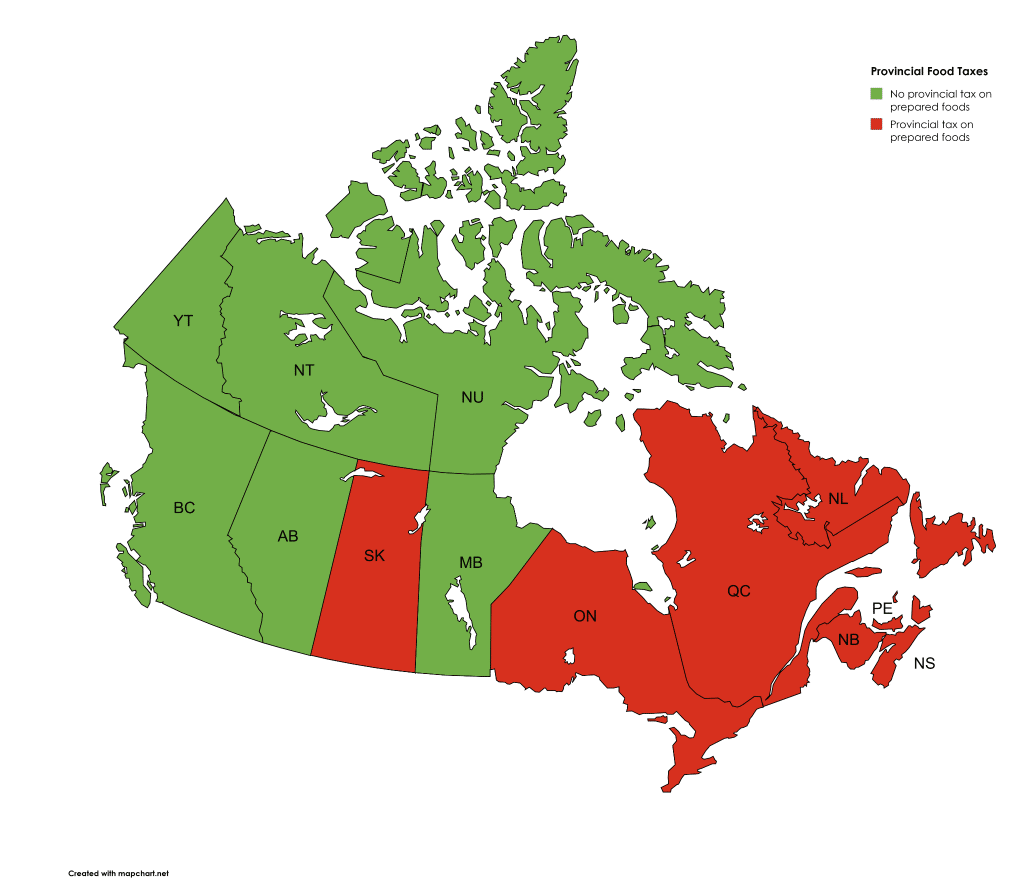
Saskatchewan charges 6 per cent PST on prepared foods and Quebec’s tax rate is 9.975 per cent.
Ontario, Nova Scotia, New Brunswick, Newfoundland and Labrador and Prince Edward Island all use HST (harmonized sales tax) and therefore follow the federal rules for grocery taxes.
How much will Manitobans save?
In February, Statistics Canada reported that food inflation in Canada continued to grow at historic levels.
“On a year-over-year basis, prices for food purchased from stores rose 4.1% in February following a 4.8% increase in January,” according to the Consumer Price Index released March 16.
In Manitoba, food prices have risen 5.6 per cent year-over-year as of February 2026. However, month-over-month, Manitoba’s food inflation rate is 0.3 per cent. Saskatchewan had the highest month-over-month inflation rate in February at 0.4 per cent.
The average in Canada was 5.4 per cent year-over-year in February, however prices remained flat month-over-month from January to February, according to the latest Statistics Canada data.
Manitoba PC leader Obby Khan claimed in a media interview last week that “everything is far more expensive in Manitoba than anywhere else in Canada,” However, Manitoba’s food prices are among the lowest in Canada, behind only B.C. and Newfoundland, according to the data.
Manitoba households spend about $1,150 a year on prepared foods, snack foods and soft drinks, according to Statistics Canada. Removing the PST on these foods would save the average household about $75 a year.
Studying the problem
Manitoba commissioned a study earlier this year to examine grocery prices and says it will look at everything from data-driven price discrimination at the checkout to rising costs for staple foods.
It will also look at outdated competition rules, red tape that blocks new retailers and food access gaps in poorer neighbourhoods and rural communities, especially in the north.
The goal, said the province, is to lower prices and strengthen consumer protections, improve shelf-price accuracy, and tighten rules on grocery surveillance technology such as facial recognition. The province may also reform food-donation rules, they said.
Other highlights for the social services sector in Manitoba include increased spending to add more than 4,000 new health-care staff to frontline care, a 2.9 per cent wage raise for early childhood educators, and a pledge for free transit for children and youth.
Your job. Your mission. Your news.
With your support, the sector you're building gets the journalism it deserves, and you get a tax receipt.

Authors


Related Articles
Explainer: Why, despite Ottawa’s billions in spending, the country’s biggest housing provider is still facing a $3B hole
Expiring funding streams and lack of funding keeps social housing stock in poor condition

Non-profit coalition joins Supreme Court intervener list challenging Doug Ford’s Ontario Place destruction plan
The case, which will begin hearings in October, has attracted national interveners as the fight over redevelopment escalates.
Redesigned Canada Housing Benefit could reduce homelessness by more than half: Report
End Homeless Canada’s new report shows if Canada’s Housing Benefit is redesigned, it could dramatically reduce homelessness in the country.
