Migrant-led non-profits prioritized through RADIUS’s participatory grantmaking
RADIUS’s participatory grantmaking process shows how community voices and lived experience can shape funding decisions.
Why It Matters
Participatory grantmaking provides equity, transparency and inclusivity by shifting decision-making power to communities. It puts local voices in charge by determining where funding could be best utilized in their community.
Generously funded by World Education Services, this series seeks to advance trust-based philanthropy within the Canadian context, recognizing the unique socio-economic landscape and diverse needs of communities across the country. Read our editorial ethics and standards here.
Charlet Muskwe faced repeated grant rejections when she first began building her B.C.-based non-profit, Baobab Black Seniors Care.
After more than a decade supporting Black seniors in her community by helping them get to appointments, preparing meals and providing day-to-day assistance, she officially registered as a non-profit last January.
“Our first client was a Canadian, white ‘young’ man, in his 90’s. I didn’t see him at church for a while, which was unlike him and a friend of mine got worried,” she said.
“We found out that he was in the hospital, so we went to visit him. And that’s how it started.”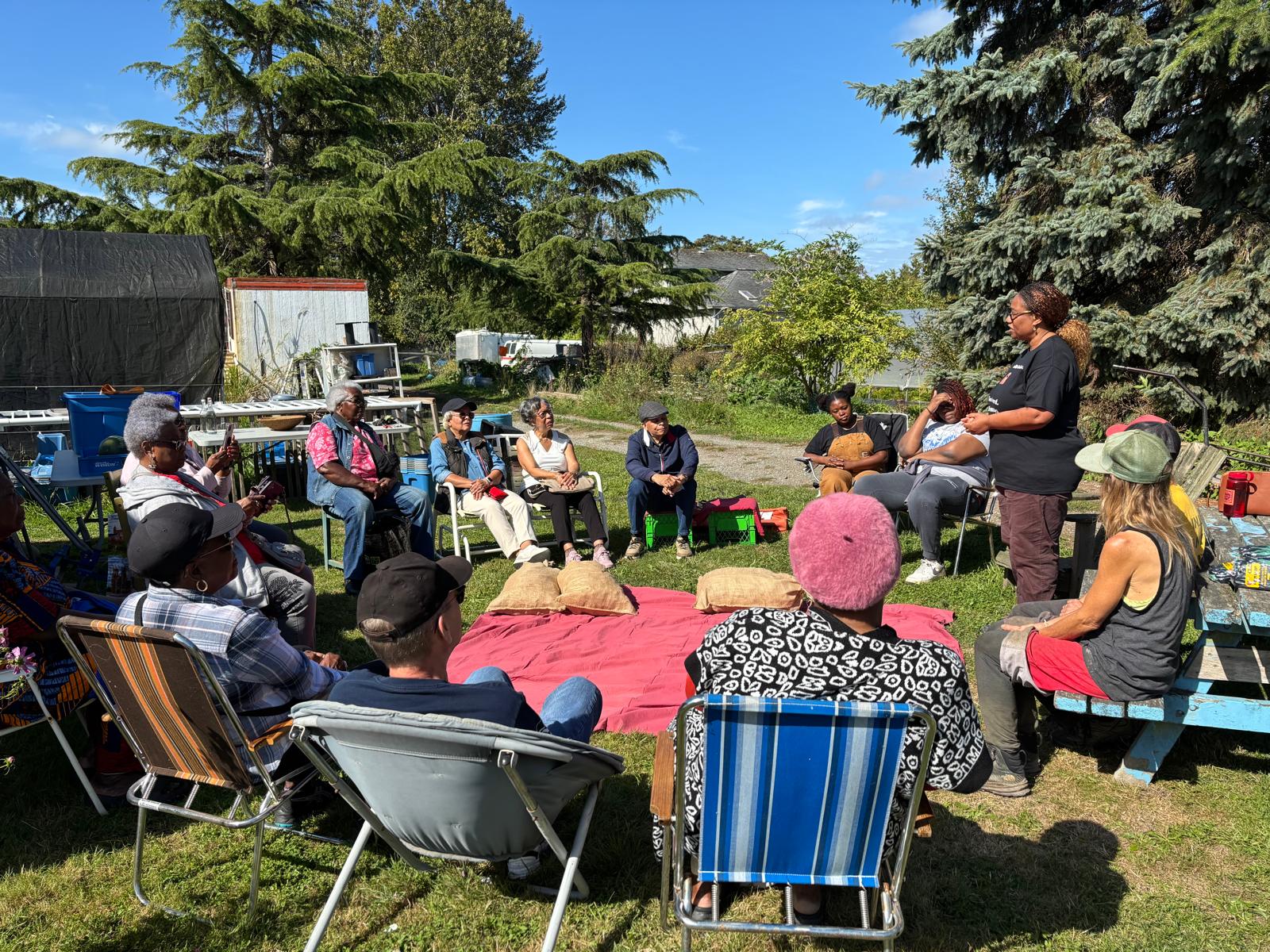
Charlet Muskwe, founder of Baobab Black Seniors Care is pictured during an event with clients. (Baobab Black Seniors Care / Supplied photo.) Muskwe began applying for grants after registering Baobab to expand her services and focus on racialized communities, but her applications were repeatedly rejected.
“We applied to many grants, which was very disheartening because we even used a grant writer,” she said. “We didn’t have all the stipulations and the restrictive requirements that they wanted.”
She continued searching for funding, until she discovered the participatory grantmaking initiative launched by RADIUS in partnership with World Education Services (WES) .
“We felt it was very different from the traditional grant applications that we had done,” she said.
Participatory grantmaking gives communities a direct role in deciding where funding resources are allocated by designing the grant and selecting recipients.
“RADIUS has a lot of community knowledge and lived experiences and they were a part of that decision making. So that shifted the power dynamics and made the process feel more relational and respectful.”
The approach is gaining momentum in Canada’s social sector.
RADIUS first offered it through its Refugee Livelihood Lab, with support from the WES Mariam Assefa Fund.
Since 2021, as a philanthropy focused on economic inclusion for newcomers, WES said it has been committed to funding participatory grantmaking approaches.
To that end, WES selected RADIUS Refugee Livelihood Lab to implement its latest participatory grantmaking initiative in British Columbia.
“RADIUS was the perfect partner to lead this work, as we have partnered with them for five years and know that they are well-connected to migrant communities in B.C. That connection and trust is key to success in participatory grantmaking,” said Marina Nuri, Director of Program and Strategy at the WES Mariam Assefa Fund.
“As a funder, we wanted to remove ourselves from the design of the process, outreach and decision-making. We recommend that other philanthropies considering participatory grantmaking similarly work with a trusted organization – like RADIUS – who can deeply engage with the community.”
Designing for equity
Traditional top-down funding models have long dominated the social sector, but these models create barriers for grassroots groups and non-profits led by equity-seeking communities.
For example, Black‑led organizations received just 0.03 per cent of total funding from Canadian foundations between 2017-2018, while black‑serving groups received only 0.15 per cent, according to a study of grant data.
Statistics like this inspired the design of RADIUS’s participatory grantmaking, through the Refugee Livelihood Lab, which advances migrant justice through leadership development and advocacy.
“The core of designing this initiative was to have those obstacles in mind and try to avoid them, and try to make it a straightforward process for folks of all ethnicities and all genders and backgrounds,” said Imane Tounsi, a community member involved in the grant design.
Tounsi was among nine community leaders who came together to design the grant.
The group focused on breaking down barriers created by traditional funding models that often overlook how community needs can differ by location, culture, and language, Tounsi said.
“The language barrier is very high and, especially for those grants, usually the process is so complex,” she said.
“Their idea is solid, but they don’t have the tools to get into that process. So they are systematically dismissed because they cannot fill out the application form or express what they want in a proper English format.”
The group worked to simplify applications, expand outreach through text-messaging networks of community members and leaders, eliminate demanding requirements, offer personalized support and prioritize community‑led applications.
The grant was designed to shift power, decision-making, and resources directly to racialized migrant communities in B.C., rather than relying on traditional, often exclusionary approaches, she added.
“The willingness of the granting institutions to accommodate the people because you look at them as humans and not numbers and not targets, I think this is the shift in perspective.”
Inside the selection process
RADIUS received 142 applicants for their participatory grant, totalling $6.65 million in needed funds.
The majority of the applicants focused on community building and engagement and health and wellness.
With just $500,000 to disburse, the organization brought together six community members to help with the selection process, including Thabata Costa.
“I think that the most innovative piece of this was having members with so many different backgrounds,” Costa said.
After multiple rounds of review, the selection process narrowed to 32 strong applications, which were then reviewed individually by each community member before final funding decisions were made.
The selection committee looked for applications led by refugee and migrant leadership, focused on community voices and aimed at making real change in the system.
“Are these voices, voices of racialized people who arrive in Canada and are very much aware of their needs? Or do we have privileged people making decisions looking at our living experiences, which are living experiences that they don’t have and telling us what we need?” said Costa.
“When you allow people with living experiences to implement the projects that they really know will help people like them, because they have been through it, that is systemic change,” she said.
Among the 16 recipients was Baobab Black Seniors Care.
“I was shocked, at the same time excited,” said Muskwe. “Our vision was there, but we had no financial capacity to pull it through.”
“The funding played an important role in helping us build our organizational infrastructure at a critical early stage.”
“It allowed us to begin considering longer-term work related to research, advocacy, and systems change, while continuing to focus on reducing isolation and investing in culturally grounded programming for Black seniors.”
Given the positive feedback on the participatory grantmaking initiative, conversations are already underway with other funders to sustain future rounds, according to RADIUS.
Your job. Your mission. Your news.
With your support, the sector you're building gets the journalism it deserves, and you get a tax receipt.

Author

Related Articles

Caste, corruption, and the collective: Crow’s Theatre’s A Fine Balance confronts India’s enduring inequities with humour and heartbreak
The Giller Prize-winning novel explores the realities of caste violence in India, which has been adapted into a powerful stage production in Toronto.

‘Canada must not go down that road’: More than 250 organizations demand investigation into CBSA after student protesters issued exclusion orders
The students were protesting after being denied post-graduation work permits they say they were eligible for when they enrolled at Portage College.

Half of Filipino immigrants to Canada are overqualified for their jobs: StatCan
‘For the relationship that Canada has with the Philippines, it seems like it’s lopsided.’
