Transformed Vancouver church reopens its doors as massive housing and support services centre
First United transformed its former church site in response to changing community needs, to prioritize essential support services over traditional religious activities in the neighbourhood.
Why It Matters
As congregations shrink and faith buildings become expensive to maintain, churches are repurposing their properties to provide housing and community support services as social needs grow.

Following years of construction and planning, a major redevelopment project in Vancouver’s Downtown Eastside has officially opened, bringing new housing and support services to a neighbourhood facing significant homelessness challenges.
First United transformed its former church site in response to changing community needs, to prioritize essential support services over traditional religious activities in the neighbourhood.
The new building triples the current service capacity of First United, which has been operating in the neighborhood for more than 140 years in a smaller facility.
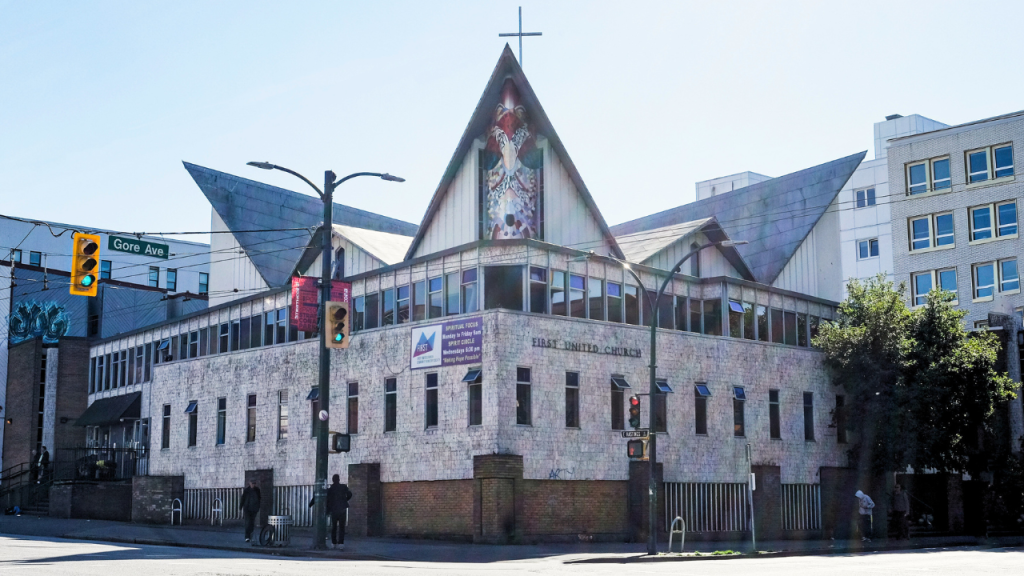
The former First United Church at East Hastings St. and Gore Ave. before undergoing a massive redevelopment into housing and support services (Submitted/First United)
The building has four floors of community services and amenities and seven floors of low-market housing.
The organization raised $39 million for the redevelopment at 320 East Hastings St. through more than 1,800 donors.
The housing units received funding from all three levels of government, while the remaining costs were covered through a mortgage carried by Lu’ma Native Housing Society, the housing operator.
The 40,000 sq. ft. space will offer free services for low-income residents in the downtown Eastside and for those living on-site in the affordable housing units.
There is an expanded meal program, showers and washrooms, tax and legal advocacy clinics, mail and phone services, extreme weather response services, culturally safe care, indoor and outdoor spaces for social gathering and ceremony, and women-only programming, including women’s day sleeping.
The 2025 Vancouver Homeless Count found 2,715 people experiencing homelessness in the city, including 763 people living unsheltered.
Transformation trends
The transformation reflects a broader trend across Canada, where churches are repurposing their properties to provide housing and community support services as congregations shrink and social needs grow.
Earlier this year, the non-profit, Releven called on faith groups to help address the growing homelessness and housing crisis.
The charity is encouraging religious leaders to provide their underused land and buildings through the launch of its Winnipeg Declaration.
Many congregations have already decided to transform their spaces.
In Winnipeg, St. Mathew’s Anglican Church was transformed into WestEnds Commons, combining 26 affordable housing units with a neighbourhood resource centre, community kitchen, and a smaller worship space.
In Waterloo, St. Paul’s Lutheran Church partnered with community organizations to develop 48 affordable rental units on its property, responding to the growing need for affordable housing while maintaining the church’s presence.
The Canadian Urban Institute estimates that nearly one-third of the country’s 27,000 churches and faith-built spaces could close within the next decade.
First United’s redevelopment project has been underway since 2022, but a $3.5 million contribution from a private foundation last month helped complete the work.
The same anonymous donor provided $10 million at the beginning of the project, making their total contribution of $13.5 million the largest direct donation to a United Church congregation in Canada.
The total redevelopment project cost $94 million.
Your job. Your mission. Your news.
With your support, the sector you're building gets the journalism it deserves, and you get a tax receipt.

Author

Related Articles
Food bank vending machine launches in 2 Vancouver SkyTrain stations
A new food preservation system is helping the Greater Vancouver Food Bank turn excess fruit into new funding.
Partnered Partnered content How construction contracts became the blueprint for social change in Manitoba
Manitoba is a leader in social procurement, with decades of partnerships among government, businesses and social enterprises that have shaped a model other communities can learn from.

Fires and floods: How Canada’s non-profits are responding to summer disasters
Several organizations have set up ways Canadians can help as more than 900 wildfires burn across the country
