Volunteer firefighters fill countless roles in rural communities, so why are their numbers shrinking?
Can volunteerism sustain Canada’s emergency response systems in the face of climate change?
Why It Matters
More than 70 per cent of Canadian firefighters are classified as volunteers, but thousands have hung up their turnout gear in recent years. New recruitment strategies and better funding could help turn the tide.
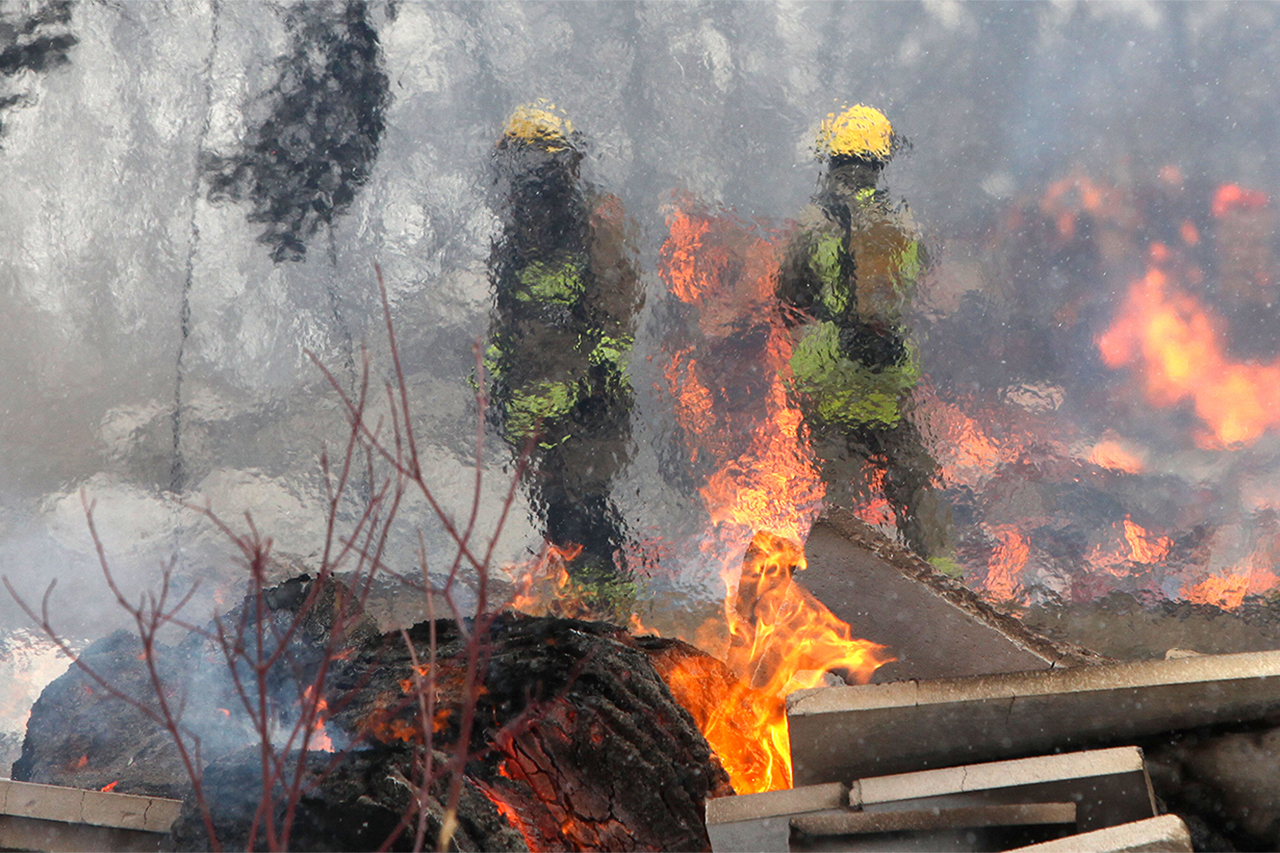
Volunteer firefighters manage a controlled burn south of Winnipeg. (Shannon VanRaes/Future of Good)
Quinn McCutcheon remembers watching fire trucks drive through Portage la Prairie, Man. as a kid and thinking that one day, he might be the one responding to emergency calls.
“This is home for me, and when I saw the trucks going down the Avenue or wherever, I just thought, yeah, volunteering would be a good way to give back to my community,” he said.
The 21-year-old HVAC apprentice had no firefighting experience when he walked into the city’s fire hall last fall, but after a six-month probation period, extensive training and an upgrade to a Class-4 license, he was ready to go.
“It does take quite a bit of time,” he said. “I spend, maybe, between five and 20 hours a week on this.”
Of Canada’s 126,000 firefighters, nearly 89,000 or 71 per cent are currently classified as volunteers, like McCutcheon. However, that number is rapidly decreasing.
According to the 2023 Great Canadian Fire Survey, the number of volunteer firefighters has declined by more than 37,000 since 2016.
Fire departments nationwide are struggling to recruit and retain volunteers, and those in the sector say small rural and northern communities are being especially hard hit.
Climate change, shrinking municipal tax bases, inflation and demographic shifts compound the problem.
“The constraints on today’s working families makes it impossible for many people to serve in any type of volunteer capacity, let alone as a volunteer firefighter,” one long-time fire chief told the Fort Frances Times earlier this year.
Canadian firefighters respond to roughly two million calls for service each year, an increasing number of which are related to climate change.
Unprecedented destruction
Natural Resources Canada pegged 2023 as Canada’s most destructive wildfire season on record. More than 6,100 fires destroyed 16.5 million hectares of land, twice the previous record set in 1989.
“The word ‘unprecedented’ doesn’t do justice to the severity,” said Yan Boulanger, a forest ecologist with the department. “From a scientific perspective, the doubling of the previous burned area record is shocking.”
More than four million of those acres were in the Northwest Territories, which saw a harrowing evacuation of its capital city last August.
As flames raced toward the territory’s communities and camps, NWT Fire issued a desperate plea for anyone with fire training—or even an interest in helping—to come forward and join the fight.
“There is … a huge shortage of firefighters throughout the territory, and the department is in great need right now,” Paulie Chinna, the territory’s housing minister at the time, told Cabin Radio. “I’m so sorry this is happening.”
Anabela Bonada is managing director of climate science and wildfire lead at the Intact Centre on Climate Adaptation at the University of Waterloo. She said rural communities are at the highest risk for wildfires but have the fewest personnel on hand to respond.
“These communities rely heavily on volunteer firefighters and are mostly found in this wildland-urban interface where forest interacts with infrastructure,” she said. “The same is true for Indigenous communities.”
McCutcheon said wildfires make already unpredictable work even more unpredictable.
“We had a decent-sized marsh fire this March, and we were thinking, ‘If this is what we’re getting in March, what’s the rest of the summer going to be like?’” he said. “There’s a level of uncertainty with it.”
However, fires aren’t the only climate change-related emergencies volunteers respond to.
“I’m not worried about the wildfire season in Nova Scotia this year. So far, knock on wood, we’ve been getting some decent rain,” said Michael Lockett, director of the Canadian Volunteer Fire Service Association and a long-time paramedic now working as an operations supervisor with that province’s Emergency Health Services.
“What I’m worried about is this year’s hurricane predictions.”
Community catchalls
A volunteer firefighter for nearly 35 years, Lockett said volunteer firefighters fill a myriad of roles, ranging from flood response to accident clean-up, by-law enforcement, building inspection, medical intervention, water rescue, woodland search and vehicle extrication.
“A fire service is that one agency that finds itself doing everything that no one else wants to do,” he said.
“Volunteer fire services are entrenched within their communities, particularly small rural ones, and they want to be able to help out their fellow humans, people who live in their communities.”
However, unless this rapid decline of volunteer firefighters is reversed, rural municipalities and northern communities could lose these services they’ve come to rely on—and at a time when they need them more than ever before.
Creating a “family lifestyle” where everyone is welcome has long been a firehall tradition, but Lockett said fire services need to be more expansive and inclusive to draw recruits from underrepresented communities.
“Welcome everybody with open arms,” he said. “And let the community know that you’re looking for people, invite them in.”
In 2021, NWT Fire began offering training courses specifically for women and non-binary people, and other fire services have followed suit. However, most diversity-geared programs target those aspiring to a career in firefighting, not volunteer work.
Only about 11 per cent of all Canadian firefighters are currently women, according to recent statistics. Data on BIPOC firefighters is not collected nationally.
In many cases, outreach programs also require additional funding, something most volunteer fire services lack.
However, Lockett said he’s seeing innovation across the country and encouraged fire services to network, compare notes, and share recruitment strategies.
“I’m seeing some really good things being done that could easily be adopted by others,” he said. “Knowledge sharing is really important.”
Changing demographics
Eric Korhonen, chief of the North Frontenac Fire Department and director of emergency services for the small municipality in Northern Ontario, said the volunteer landscape is changing rapidly, partly due to the retirement of many longtime members.
Nearly 9,500 volunteer firefighters retired from departments nationwide in 2023, representing more than 102,000 hours of experience.
“I think society is changing, and it’s changing pretty quickly,” Korhonen said. “And the recruits, our volunteers, have also changed.”
When he started volunteering 16 years ago, volunteer firefighters tended to be retired people who wanted to keep busy and give back to their community.
Now, many recruits are younger.
“They also have a strong commitment to the community,” Korhonen said. “But they’re struggling to balance work, life and volunteering in order to become a firefighter, so they are asking, you know, ‘What’s in this for me?’”
In 2018, the North Frontenac Fire Department received the Ontario Association of Fire Chiefs’ Volunteer Firefighter Recruitment and Retention Award—something that seems like a lifetime ago, Korhonen said.
Like many volunteer departments, North Frontenac is now navigating increased training and certification requirements. In July 2022, the province of Ontario introduced mandatory minimum certification standards for volunteer firefighters.
This requires potential volunteers to take time off work to attend regional training centres, but ultimately, they attain the same qualifications as professional firefighters.
Training costs usually fall to the municipality.
“This has definitely changed how we recruit, what we’re looking for, and what we’re able to offer. It’s also changed how we train and how we do business,” Korhonen said, adding younger volunteers are often attracted by the opportunity to attain professional certification.
Back in Manitoba, the Headingley Fire Department immediately west of Winnipeg faces similar challenges.
Chief John Sparham said proposed regulatory changes by the province’s College of Paramedics could triple training hours and costs, a challenge for small municipalities with limited tax revenue.
“The goalposts keep moving,” he said, adding new requirements are being imposed in almost all provinces and territories. “And that makes recruiting new volunteers a real challenge.”
To help overcome those challenges, the 34-member volunteer department has opened its ranks to people living in West Winnipeg, provided they already have the necessary training.
The average multiple listing service price for a home in the growing municipality is just over $1.1 million, and Sparham said the area is mainly attracting older professionals who haven’t shown an interest in volunteer firefighting.
So, he’s betting on their children, many of whom are living at home longer than they used to.
“We’re looking at the 18 to 25-year-old community, trying to attract them to volunteering,” he said. “They generally have more flexible schedules and maybe are not yet working nine-to-five.”
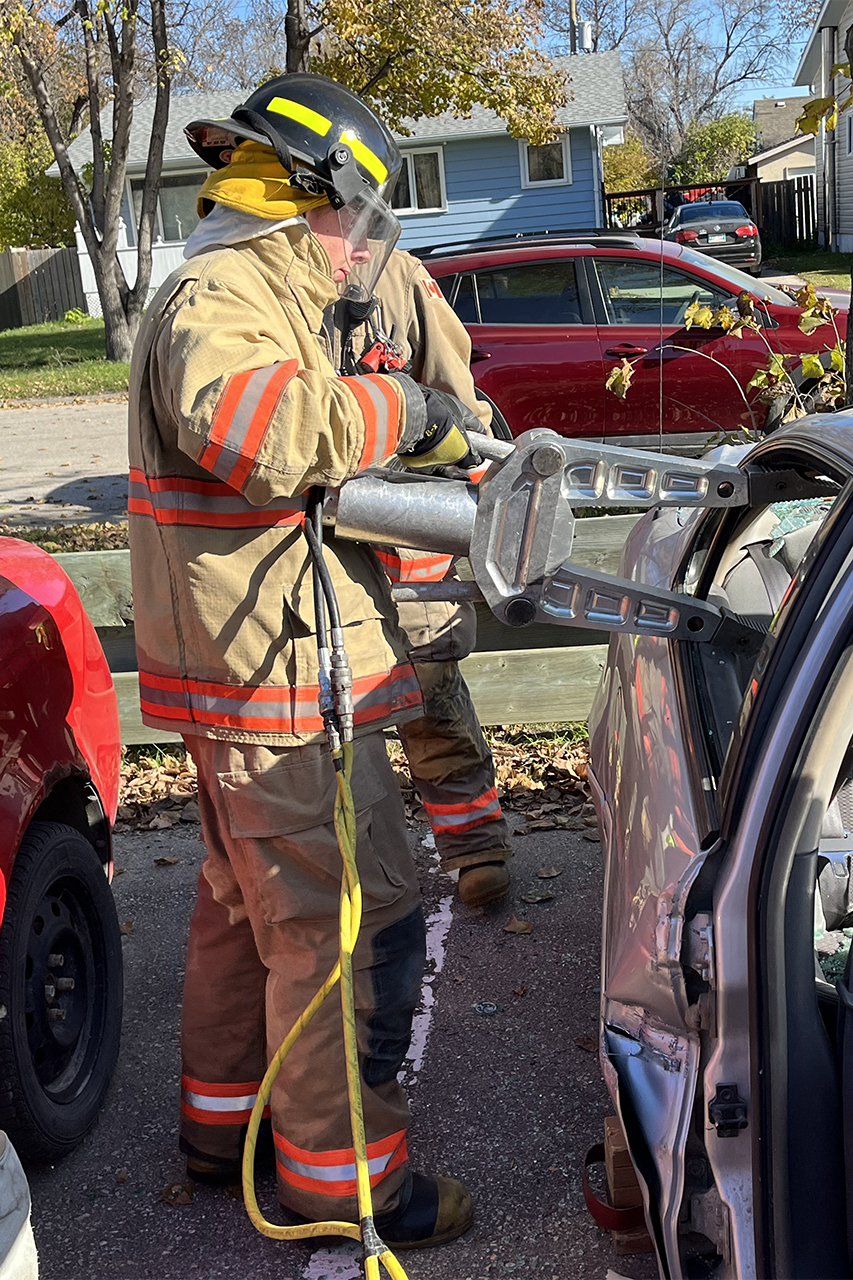
Quinn McCutcheon trains with a hydraulic rescue tool, also known as Jaws of Life, in Portage la Prairie. (Shannon VanRaes/Future of Good)
Sparham said that if a department can engage young volunteers and get eight or ten years out of a member before they move on to other family or life obligations, all the time and money put into training pays off.
Lockett suggests volunteer departments create junior firefighter programs to drive future recruitment.
“That way, you’re not looking for people when they’re turning 18, 19, or 20 years old; you’ve actually got them in their junior high years, and they’re already interested,” he said.
However, recruiting volunteers is only half the battle. Fire services also need to retain them.
Fire chiefs across the country have called on the federal government to increase the Volunteer Firefighters Tax Credit to $10,000 per year. This spring, it was doubled from $3,000 to $6,000.
According to the Canadian Association of Fire Chiefs, 28 per cent of the country’s fire departments require members to pay for expenses out of pocket.
Being upfront about the responsibilities volunteer firefighting entails and realistic about the time commitment from day one is an important part of building trust and retaining new recruits, Lockett said.
So is flexibility.
As volunteers skew younger, they want to be able to minimize the impact firefighting has on their families, which are more likely to include small children.
Some people in the emergency services sector also suggest offering volunteers health and medical benefits, which, given the hazardous nature of the work, could help with recruitment and retention, Lockett said.
However, few communities have the resources to offer benefit plans to volunteers.
Mental health impacts
Lockett said it’s not uncommon for volunteer members to resign due to mental health considerations.
“Traditionally, the fire service has not been great at managing the mental health aspects of stuff that happens on the ground. You see some horrendous stuff, whether it’s a motor vehicle crash or a fire death,” he said.
“We need to be able to offer mental health services, or at least point them in the right direction,” said Lockett.
Volunteering and living in the same small community also means firefighters are likely to have a connection with the people or places involved in any given call for service, which can exacerbate the effects of trauma, veteran volunteers said.
“I do feel like we are getting better at it. It’s okay not to be okay; the days of ‘Suck it up, buttercup, this is what we do’ are gone,” Lockett said. “But there’s always more to do.”
Some municipalities now include emergency service volunteers in their employee assistance programs, and debriefing protocols for traumatic events are far more common than they used to be, he said.
Nova Scotia, for example, has a citizen-led team that works with emergency personnel and can escalate mental health care to professionals for those who need it.
Professional associations, such as the Canadian Association of Fire Chiefs and the Canadian Volunteer Fire Service Association, also offer mental health support to volunteers.
McCutcheon said mental health was prioritized from the day he walked into the Portage Fire Hall.
“I’ve been fortunate. I’ve never gone to one of those bad calls where someone isn’t going home to their family,” he said. “But since week one, the importance of mental health has been pushed.”
Anger, liability and expenses
However, even as old issues are addressed, Lockett said new recruitment and retention challenges have emerged, particularly since the COVID-19 pandemic was declared in early 2020.
“I’ve seen a huge shift in the way that first responders are looked upon by the general public,” he said. “The verbal abuse and the physical abuse towards first responders now, I’ve never seen the likes of it.”
There’s also a growing number of volunteer firefighters facing civil suits, he added, noting so-called Good Samaritan laws don’t protect volunteer emergency responders.
“It’s not necessarily the individual that they helped suing them, but it might be their insurance company coming back and saying, ‘Oh, you didn’t do your job right’,” Lockett said.
Volunteer fire services are also facing intense funding constraints and often struggle to cover basic expenses, he said.
Even if a department has enough members, it might not have enough equipment.
“Fire sector equipment isn’t cheap, but the longer it deteriorates, the more difficult it is to replace,” said Paul Boissonneault, co-chair of the Canadian Association of Fire Chiefs’s leadership committee.
The association has called on the federal government to reinstate the Joint Emergency Preparedness Program, which was cancelled in 2013 and facilitated cost-sharing agreements for everything from radios to firetrucks.
Forty-three per cent of all Canadian fire services were in need of a new firetruck in 2023, according to the organization’s annual survey.
A further 33 per cent of fire services reported using tanker trucks more than two decades old, while 54 per cent said they had deferred purchasing new equipment due to financial constraints including self-contained breathing apparatus or SCBAs.
To fill equipment gaps—especially during Canada’s prolonged wildfire season—GlobalMedic provides rural and Indigenous fire services with fire skids: 1000-litre tanks with compact pumps and hoses that turn any pick-up truck into a fire-fighting vehicle.
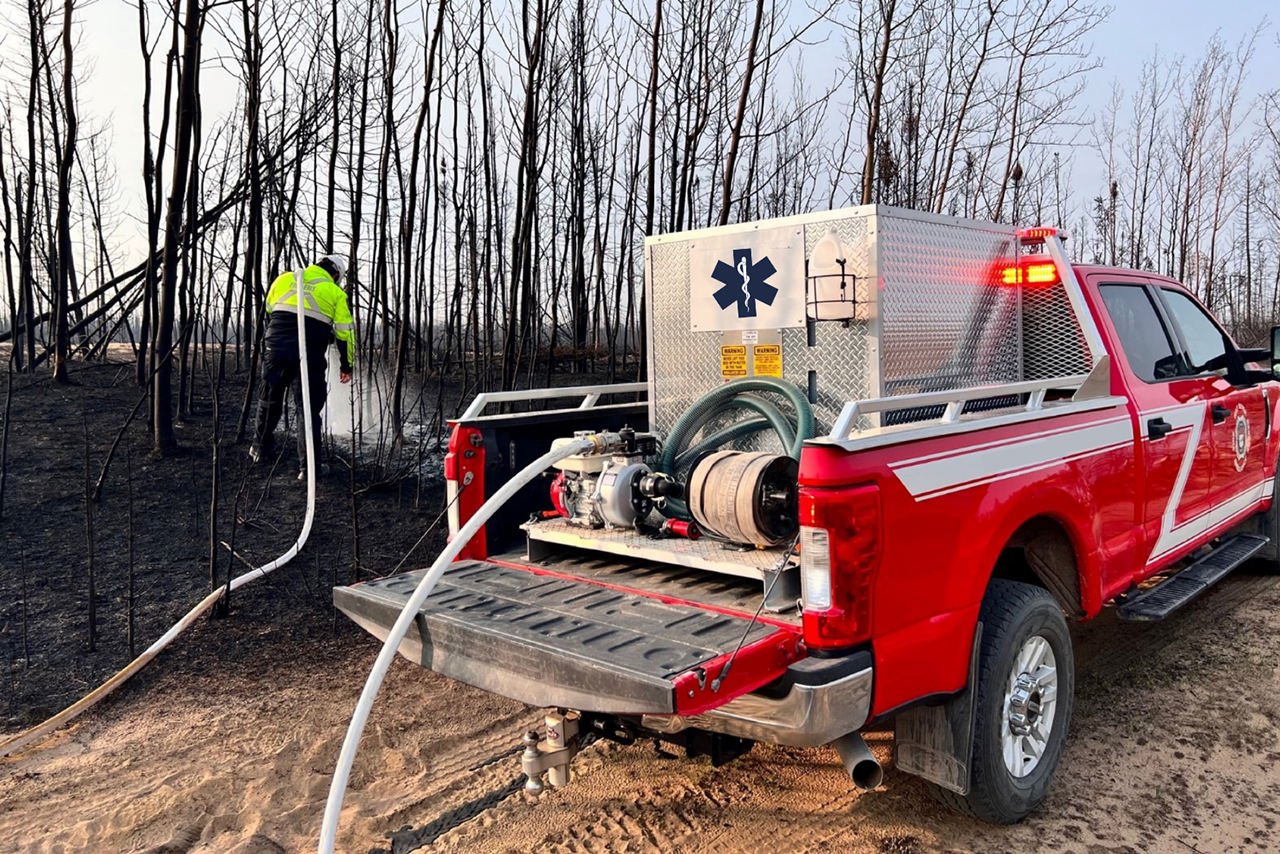
A GlobalMedic fire skid in use near Hay River, Northwest Territories. (GlobalMedic/submitted)
“Rural departments just have no resources right now,” said Rahul Singh, the charity’s founder and executive director. “I see trucks that are sometimes 30 years old, and it takes two mechanics just to keep them going, particularly in the North.”
The 70 Mile House Fire Department in BC’s interior received one of the more than 120 units GlobalMedic has distributed so far.
“It’s like this thing was sent by angels,” said Pat McWilliams, a member of the 70 Mile House Firefighters Association. “It’ll never be taken out of the crew truck because it’s now our number two firefighting asset behind our actual fire engine.”
The department, which has eight volunteers trained in urban firefighting and a further nine with basic wildfire training, currently relies on a secondhand pumper truck built in 1998.
“It’s a great truck, but it’s a city fire engine,” McWilliams said. “So, it can’t go into the bush, and we go off-road a lot.”
Additionally, some fire service accreditation bodies and insurance providers won’t approve vehicles older than 20 or 25 years, creating further challenges for small departments with limited resources.
The 70 Mile House department lost municipal funding last year and has moved to a fee-for-service model. Property owners who pay a yearly fee of $400 receive fire protection services, but it’s not enough to replace aging equipment.
So the department now rents its fire skid and crew truck to the BC Wildfire Service for “spark watches” to try and make ends meet. It’s also pursuing charitable status as it searches for ways to stay viable.
Singh said he doesn’t understand why the federal government doesn’t facilitate bulk purchases of emergency equipment, something that could lower costs.
“This government is not walking the walk. It talks a lot, but it’s not walking the walk,” he said. “Do we not think climate change is real and that forest fires will increase? Well, if we do, why aren’t we giving more equipment, right?”
Tough questions
Lockett said tough questions need to be asked about the future of volunteer fire services in Canada.
“At some point in time, you have to ask yourself, is this even sustainable? Can we even offer what we say we offer anymore? And I think we’re probably approaching that point faster than what anybody wants to admit.”
More and more municipalities are moving to paid-on-call models, where volunteers are renumerated for emergency calls they attend, but not always for the time they spend training or helping out with non-emergency-related tasks.
How much they’re paid varies widely, from token amounts to the equivalent of a part-time position.
However, some municipalities simply can’t afford to take this approach and emergency service providers continue to operate without any compensation in many northern and remote communities, as well as in parts of the Maritimes.
Some fire services, like the one in Portage la Prairie, which covers both the city and the surrounding rural municipality, operate using a hybrid model. It has 16 professional firefighters and 25 paid-on-call volunteers, including McCutcheon.
“There’s a lot of your own time that goes into it, and you might be called in in the middle of the night when you have work the next morning, but honestly, I’d say give it a shot,” he said. “It’s great to be a part of it.”
In addition to responding to emergency calls, McCutcheon said the department participates in fundraising and community events, something he didn’t expect but has come to look forward to.
Fire hall camaraderie took a hit during pandemic lockdowns when the social side of volunteering moved online, Lockett said. He hopes the resurgence of this also draws in new volunteers, but is realistic about the scope of the problem facing rural fire departments.
Some problems can’t be solved at the municipal level, he said, even if that’s the level of government tasked with providing most fire protection services.
Canadian fire chiefs have repeatedly called on the federal government to establish a national fire administration “to better coordinate, advise, lead and support the complexity of fire situation in Canada.”
But for 18 years, that call has gone unanswered.
“At the end of the day, it all costs money,” Lockett said. “And to keep this going, we need to be strategic.”
Your job. Your mission. Your news.
With your support, the sector you're building gets the journalism it deserves, and you get a tax receipt.

Related Articles
New UBC-Kelowna tool helps cities plant trees where they’re needed most
CanopyFit maps physical barriers alongside heat and equity data to maximize shade and cooling.

Canada’s Sustainable Finance Taxonomy: What it is, what is happening and what’s coming next
Canada’s sustainable finance taxonomy faces big challenges, from oil and gas, Indigenous rights and the real meaning of the word ‘transition.’

Q&A: Climate action, community resilience begins with who owns our economy, Jon Shell says
Canada can’t tackle climate resilience until it confronts who owns its economy, and how inequality is rising.
