10 Black leaders in social impact you should know
From anti-racism work to food security to changing the face of the tech industry, these Black leaders are moving social impact work forward
Why It Matters
Black leaders are underrepresented in most, if not all, parts of the social impact world — from tech for good to corporate social responsibility to philanthropy. For instance, a recent study by the Foundation for Black Communities found that Black-led non-profits receive a minuscule amount of philanthropic funding in Canada. But there are Black leaders transforming the world of impact, regardless, and their stories are important.
This year’s Black History Month comes on the heels of the global racial reckoning Black Lives Matter ignited in 2020 — and the Canadian social impact world was not exempt. Black, Indigenous and people of colour have been vocal about racist work environments across the world of social impact, how diversity and inclusion strategies need to change, and generally what it means to build a truly anti-racist impact sector — from tech to corporate social impact to philanthropy and beyond.
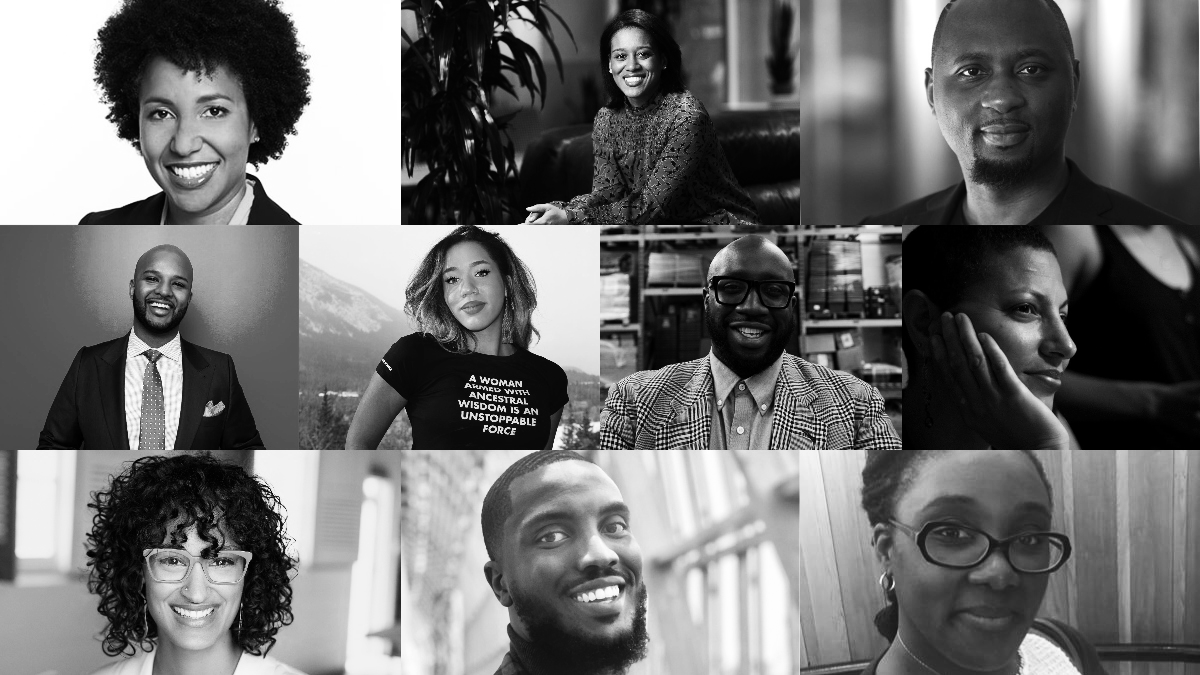
Black leaders across Canada are pushing social impact work forward. Future of Good is featuring 10 of these leaders.
Daniella Johnson | Senior manager, social impact, LIFT Partners
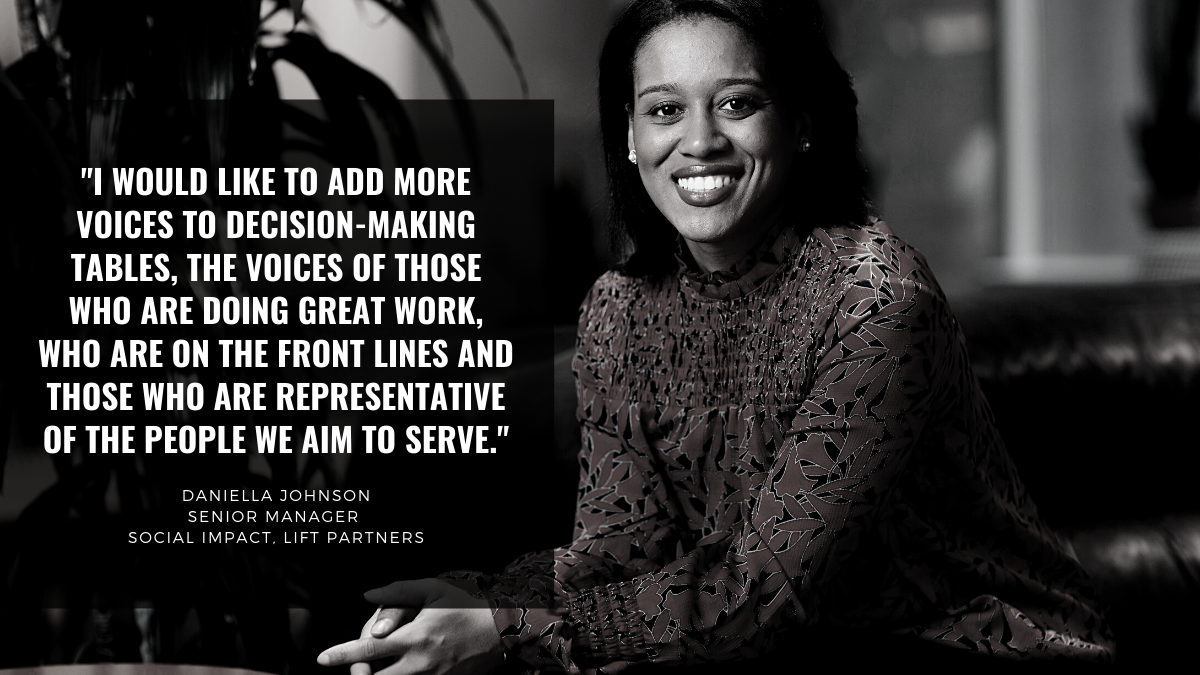
Daniella Johnson is a leader in the social impact division of LIFT Partners, a venture philanthropy organization that supports social purpose organizations’ growth. A champion of the social impact world, Johnson says, “Every day, I’m motivated by the idea of possibility and my personal desire to contribute to something bigger than myself. I take great pride in doing the work that I do and consider myself lucky to be surrounded and inspired by the creativity, resilience and purpose-driven nature that exists within the social impact space.”
Johnson says she’s “very optimistic and excited about the possibilities of 2021.” She points to Stacey Abrams 2018 TEDWomen talk, 3 Questions to Ask Yourself About Everything You Do, in which Abrams said, “I’m going to move forward, because going backwards isn’t an option and standing still is not enough.” That quote has become something of a mantra for Johnson. “I see us being on the cusp of great change for communities and humanity as a whole — in the ways that we treat each other, finding new and better ways to deliver hope and offer support, and reinventing how we make space for and amplify the voices that need to be heard.”
But she can’t do it alone — Johnson needs the rest of the social impact world to get on board. “I would like to add more voices to decision-making tables, the voices of those who are doing great work, who are on the front lines and those who are representative of the people we aim to serve. We need to go beyond solidarity statements and simply naming diversity, equity and inclusion as organizational values. This isn’t unique to Canada’s social impact world, or the non-profit or philanthropic sector more specifically, but I think we are well positioned and should be leaders on this front. I would also like to see deeper financial investments and sustainable funding opportunities, better streams of partnership opportunities and a willingness to collaborate, and a stronger focus on supporting the organizations and the leaders who are actually serving communities, not just those who say they are.”
Gladys Ahovi | Executive lead at the Canadian Council for Youth Prosperity
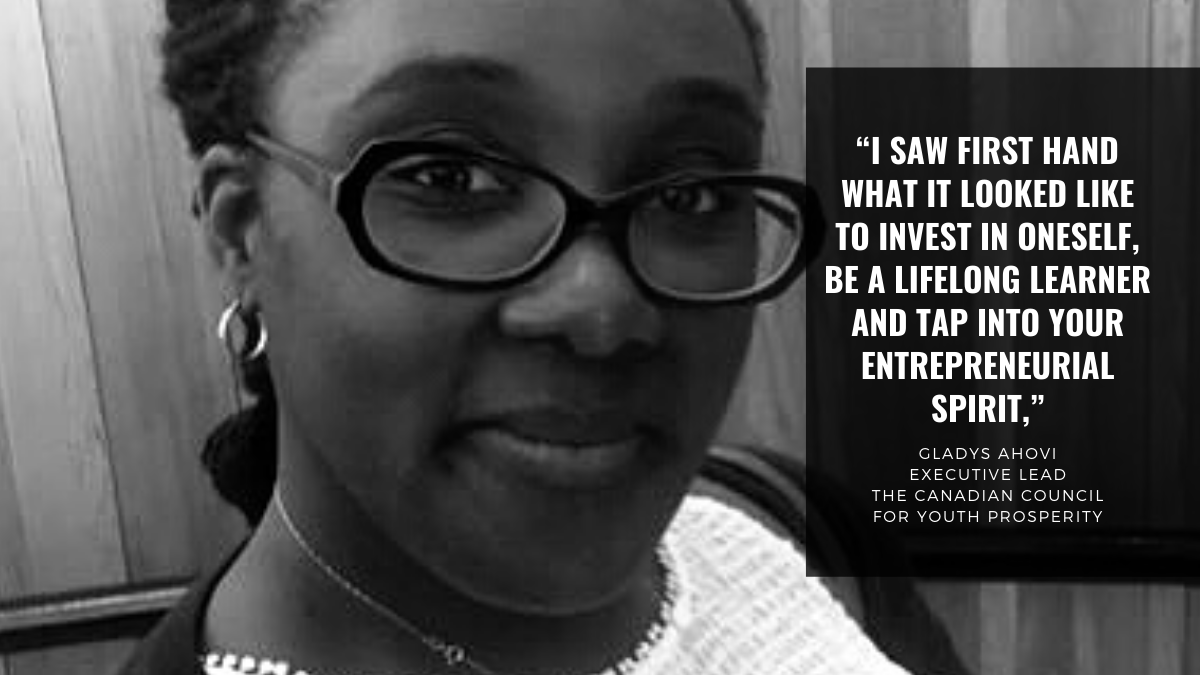
Growing up, Gladys Ahovi watched her parents try to navigate Canada’s work environment as African newcomers. One of them was highly educated, while the other was not. “I saw first hand what it looked like to invest in oneself, be a lifelong learner and tap into your entrepreneurial spirit,” she says. “I also saw the importance of sharing that experience with others and creating opportunities for others.” As executive lead at the Canadian Council for Youth Prosperity, she strives to ensure all people deserve the opportunity to earn, learn, and contribute to Canadian society.
The COVID-19 pandemic is one of the greatest challenges faced by the social impact sector right now. Youth are particularly vulnerable to job losses, educational barriers, and unemployment in the wake of the virus itself. Ahovi says she’s excited to work on a COVID-19 recovery for Canada alongside youth, rather than just on their behalf. She’s also looking forward to improving job prospects for Black youth who can face systemic racism in trying to secure employment. “They are heavy pieces of work and we are ready for the challenge,” Ahovi says.
Social impact organizations will need to not only survive the pandemic’s coming months, but look back and learn how to become more resilient. Ahovi hopes Canada’s social impact world can pay particular attention to investing in research, development, and technology. The sector hasn’t traditionally poured a lot of money into these areas, but Ahovi believes they could be essential to reaching people in need. “If these were core, the workplace ecosystem we’d be much further ahead in reaching those furthest from opportunity, as well as deploying rapid response interventions when needed,” Ahovi says.
Larissa Crawford | Founder and managing director, Future Ancestors Services Inc.
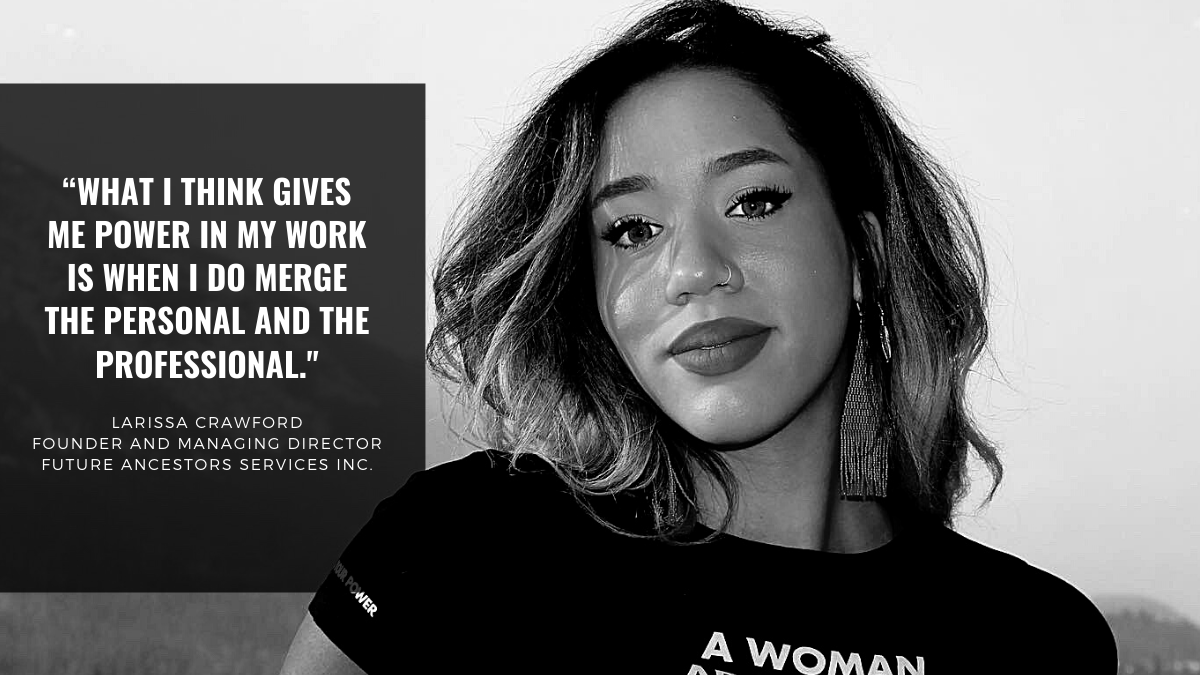
Merging culture, personal history, and professional goals provides purpose for the work Larissa Crawford does. She is the managing director of Future Ancestors Services Inc, an Indigenous and Black-owned social enterprise that focuses on climate and racial justice. The causes behind the climate crisis and systemic racism are intertwined, she says, and bringing her own experiences into her work is important. “What I think gives me power in my work is when I do merge the personal and the professional — when I do seek to really access the power of my ancestors, the power of my culture, the power of the communities I belong to as inspiration, as direction, and as purpose for my work,” she says.
Crawford is looking forward to the Waashayshkwun Grants that offer financial relief and business development investment for Indigenous, Black, racialized, LGBTQ, and disabled service providers during the COVID-19 pandemic. Future Ancestors Services Inc has already assembled more than $20,000 for their grant. “I’m really excited for how this is coming together and the grants we’re going to be able to offer to entrepreneurs who are doing the exact same kind of work we’re doing, who are seeking to centre climate justice and racial justice in their work,” Crawford says. She is also excited about Future Ancestors Services’ northern grant, a way of prioritizing resources for northern communities. “One grant recipient, at least, will be from a community or living in a community above the 60th parallel,” Crawford says. “So I’m really excited for that.”
Going forward, Crawford wants the social impact world to have a greater sense of empathy and appreciation around workplace boundaries. “I see a lot of people forgetting…that we are in the midst of a global pandemic,” she says. “We are amidst an experience of collective trauma and that some people are going to be more affected by this collective trauma, especially when we bring into account our socio-political context and our environmental context,” she says. Crawford says Future Ancestors Services Inc makes a point of actively discussing how their relationships with clients and their community should be. “By asserting our boundaries and our need for respect, we’re also supporting the people we’re working with and shifting their mindsets of what healthy work practices actually look like in practices in our work,” she says.
Lekan Olawoye | Founder and CEO, Black Professionals in Tech Network
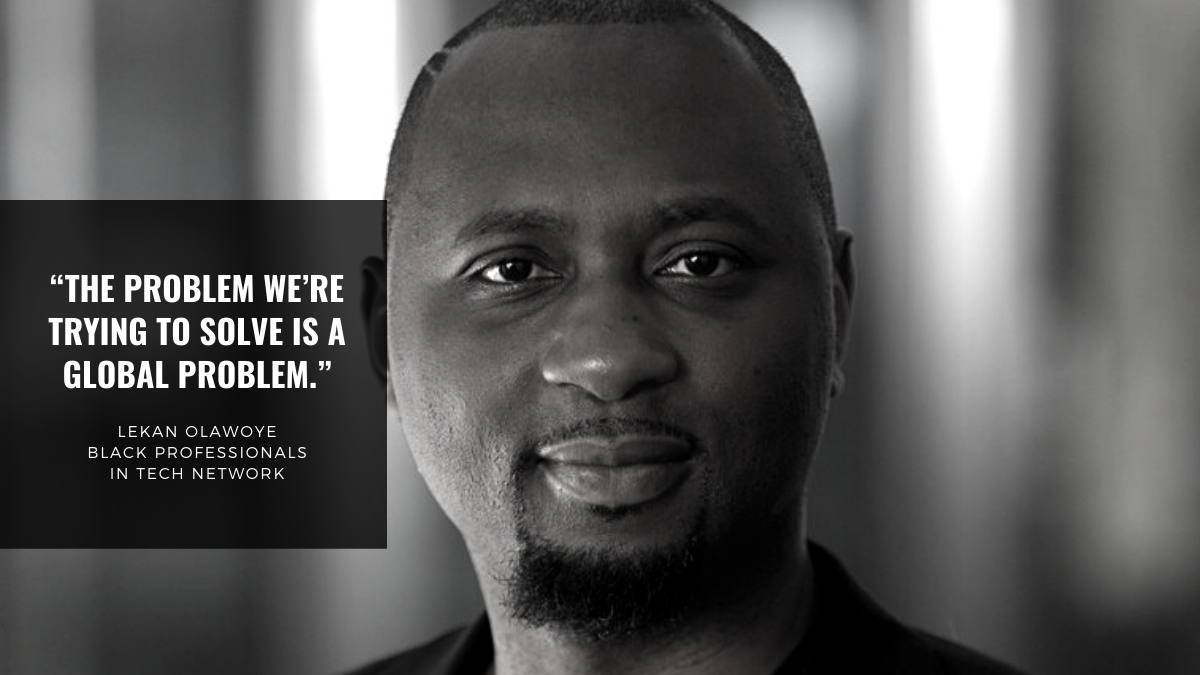
Lekan Olawoye is driven to create equal access to good jobs for Black tech professionals around the world as the founder and CEO of the Black Professionals in Tech Network (BPTN). “It keeps me up because I recognize that we have such incredible and passionate and strong and smart and accomplished Black professionals, yet these professionals are not represented in leadership in companies,” Olawoye says. “Many companies do not have a representative sample of Black professionals, especially in mid and professional and senior-level roles. And I think that’s problematic.” Not only are many Black professionals missing out, Olawoye says the tech industry itself is also missing out on good talent.
The same goes for Canada’s social impact world. Olawoye says the sector’s workforce is very white, but so too is how it frames the very concept of social impact. “If it dives beyond its way of thinking and framing, it will see social impact in so many incredible places,” he says. Leveraging the significant diversity of professionals in Canada won’t just mean a more inclusive sector, Olawoye says — he believes it will offer a competitive advantage. But everyone in the sector needs to step up. “It is every single person’s job, especially leadership, to ensure that your network is diverse,” Olawoye says. “That is the way we begin actually using the rocket fuel that we have — diversity — and using it as a competitive advantage right across the world.”
BPTN already has over 30 full-time staff, at least 60 large enterprise companies in their network, and over 20,000 members. But Olawoye is looking to go further in 2021. “The problem we’re trying to solve is a global problem,” he says. The network is looking to expand its membership beyond Canada and the United States but also make it easier for major companies who come to them looking to hire or retain Black professionals, to ensure they don’t have an excuse to not do so. “We are going to make it easier for the right companies to access this incredible talent and ensure that we’re able to scale it globally,” Olawoye says. “This is something I’m incredibly excited about. I don’t know how it’s going to turn out, but I’m excited about it.”
Paul Taylor | Executive director, FoodShare
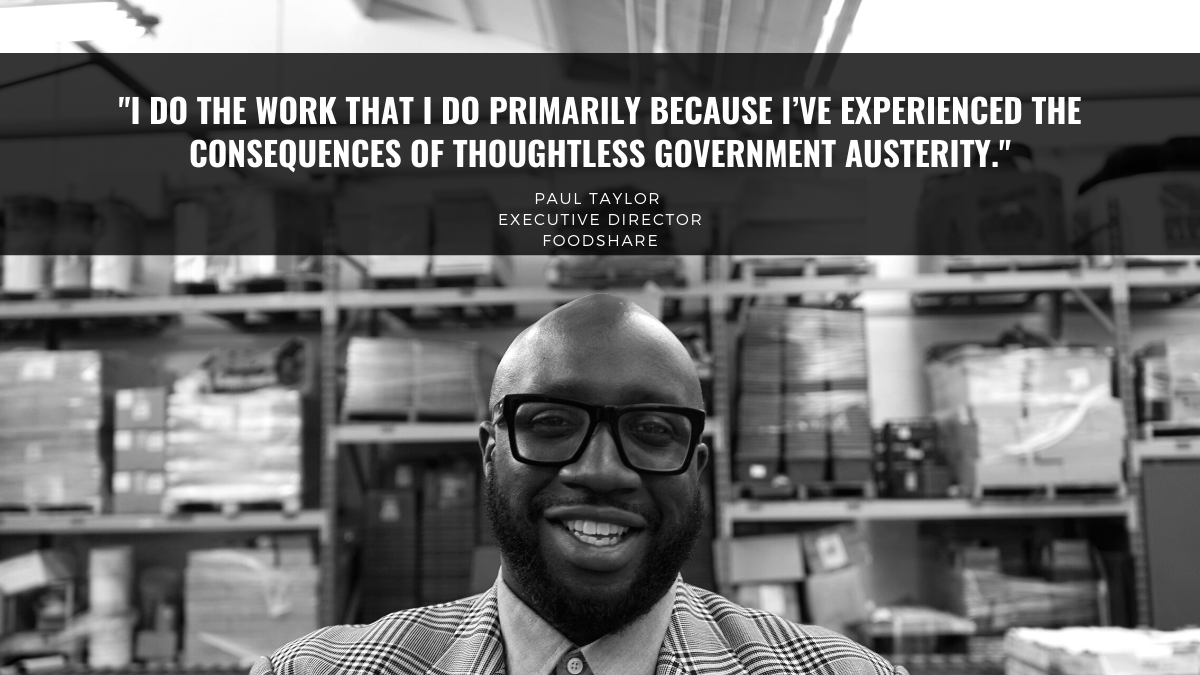
Paul Taylor is a voice for a movement in food security — away from overreliance on a charity-based food bank model and toward meaningfully addressing the root causes of food insecurity. “I know what it’s like to be told that what I deserve are other people’s leftovers or corporate cast-offs. Low-income people are not compost bins for multinational corporations. Low-income people deserve community organizations and politicians willing to fight alongside them,” he says. “I do the work that I do primarily because I’ve experienced the consequences of thoughtless government austerity, ho-hum incrementalism and the lack of ambition of many of our politicians when it comes to tackling issues like poverty, housing insecurity and food insecurity. More often than not it seems that they incorrectly view the existence of these issues as inevitable — and that should never be.”
Taylor says he’s hoping to see two major changes to Canada’s social impact world, sooner than later: “The first is that social impact should not be advanced on the backs of low-wage exploited and precarious labour. The social impact world by definition needs to be at the forefront of advocating for decent work and pushing back against models informed by oppressive and extractive capitalism.”
“The second,” he says, “is that this work cannot be the sole purview of middle class (and higher) white folks. Social impact organizations must look at the ways in which our processes exempt and exclude those with personal experiences of the issues that we’re collectively trying to address. It means going beyond the use of token hires as organizational shields. It means that those most affected by an issue should be working at the heart of it, leading it and evaluating efficacy. To do so, they should be appropriately and sustainably resourced for their leadership and vast experience.”
Rachel Zellars | Co-founder, the African Nova Scotian Freedom School
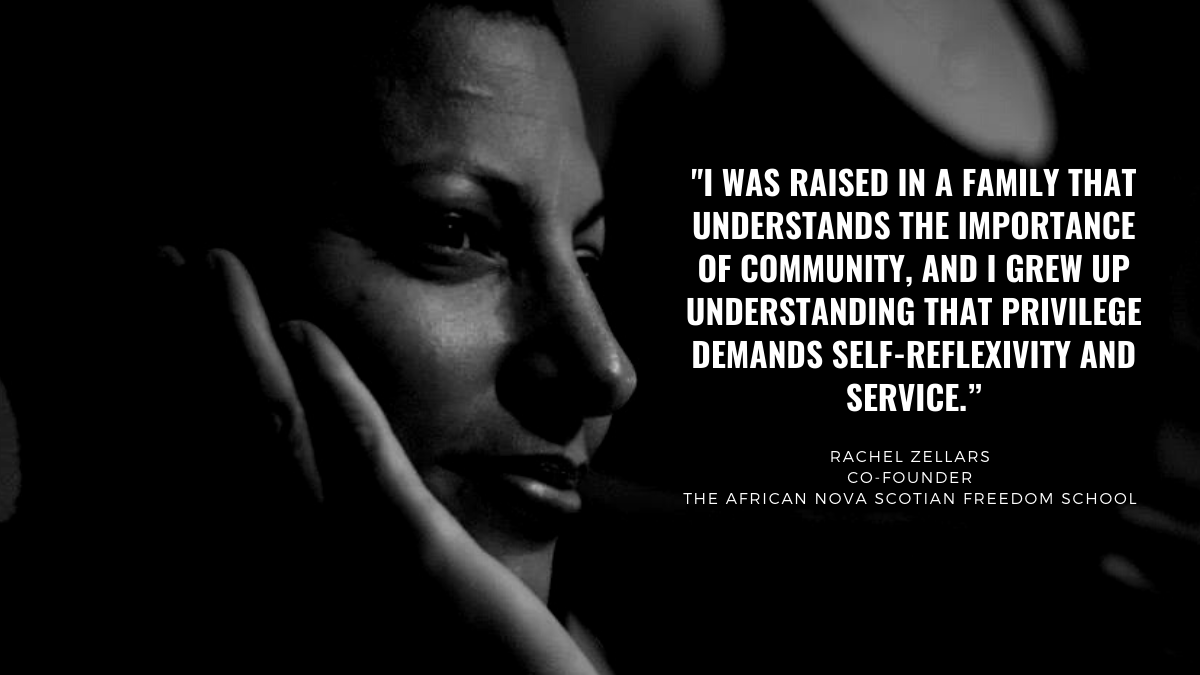
What brings Rachel Zellars to her work? “My love for Black people and the wide arc of our brilliance and complexity. I was raised in a family that understands the importance of community, and I grew up understanding that privilege demands self-reflexivity and service.”
Zellars plans to bring that appreciation to all of her work in 2021, “growing conversations and practices of transformative justice” — an alternative to policing that responds to acts of violence with community or social service solutions, rather than with force and aggression — “work that is embedded in my ancestral family tree and work that has shaped me profoundly over the last decade. I will work with a group of Black women to collect [transformative justice] stories and practices nationally and publish these teachings to share throughout Canada.” Zellars says she hopes to see the rest of the Canadian social impact world takes on a “greater commitment to an embodiment of transformative justice values and practices.”
Back in March of 2020, Zellars co-founded the Black Lives Matter Solidarity Fund Nova Scotia, a mutual aid network that raised funds for Black people living in the province impacted by COVID-19, which went on through the year to raise over $300,000. She says she’s looking forward to watching those funds “take shape in the form of projects in Black communities throughout the province” in 2021.
Rebecca Darwent, Liban Abokor, Djaka Blais-Amare and Joseph Smith | Co-founders, Foundation for Black Communities
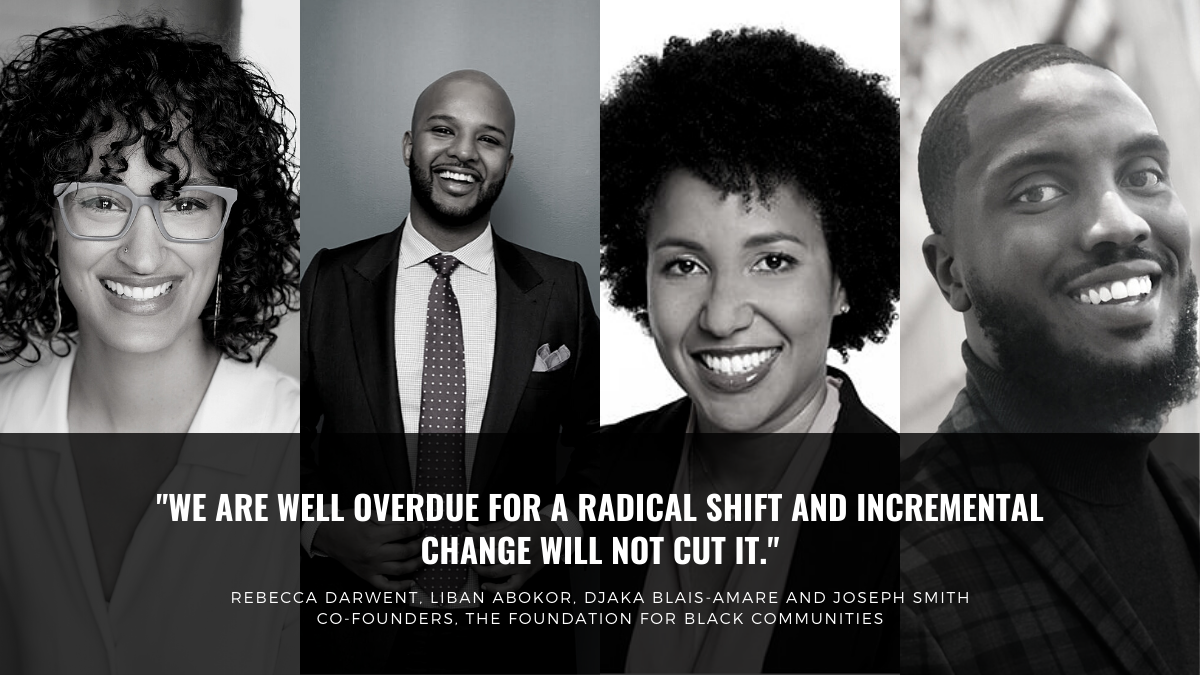
Rebecca Darwent, Liban Abokor, Djaka Blais-Amare and Joseph Smith got together to create the Foundation for Black Communities late last year, after years respectively working in the social impact world and witnessing the effects of vastly underfunded Black-led and Black-serving organizations.
“Because of my proximity to whiteness, I was in rooms and at tables where I was the only Black or person of colour. I felt a responsibility to advocate for those who weren’t at those tables and for a change in the makeup of those tables,” says Blais-Amare, who also works as a grants associate at the Calgary Foundation. “That’s why I’m excited by the potential of the Foundation for Black Communities which is working to develop a stronger ecosystem to support Black communities across Canada… Black Communities are not a monolith and we need a stronger ecosystem of Black-led and Black-focused organizations, as well as Black leaders from varying backgrounds and experiences to advance our communities.” Abokor says the Foundation will help other philanthropic actors make these changes: “In addition to being an essential structure of support for Black people in Canada, the Foundation for Black Communities will serve as an important partner to the wider foundation community and its effort to create a fairer and more equitable philanthropic sector here in Canada.”
To do so, the philanthropic world needs to move toward trust-based philanthropy, something the Foundation will embrace. “The measure of success in philanthropy is not the sum of giving but who we give to,” Abokor says. “It starts with understanding and accepting that our communities have the tacit knowledge, capacity and agency to lead in their own solution making. In this trust-based configuration, our job is not to dictate but to facilitate the marshalling of resources where communities indicate.”
Darwent says the world of Canadian social impact needs to be disrupted in 2021. “Where’s the innovation? Where’s the creativity? We are well overdue for a radical shift and incremental change will not cut it. If I had a magic wand, I would wave it and have the tentative, risk averse, ‘let’s see others go first’ mentality of the sector disappear. Let’s be bold. Let’s experiment. Let’s do things differently. The inequities that we face in our society cannot afford the typical business as usual approach.”
A thriving, equitable social impact sector is deeply meaningful to Joseph Smith, who also leads a non-profit called Generation Chosen that supports Black youth. “I grew up in a lower-income marginalized community in Toronto,” he says. “I have experienced how the intersections of race and class disproportionately impact folks from my community in a negative way. Impostor syndrome and self-sabotage, as a result of institutional racism, feel like insurmountable obstacles for those that my non-profit serves.”
Darwent feels similarly. “In my culture social justice and philanthropy are not considered a profession. It’s a way of life. Communal care was passed on to me from my mother, family, elders, and ancestors before them. This approach and worldview inform who I am and the work that I do.”
Your job. Your mission. Your news.
With your support, the sector you're building gets the journalism it deserves, and you get a tax receipt.

Related Articles

Caste, corruption, and the collective: Crow’s Theatre’s A Fine Balance confronts India’s enduring inequities with humour and heartbreak
The Giller Prize-winning novel explores the realities of caste violence in India, which has been adapted into a powerful stage production in Toronto.

‘Canada must not go down that road’: More than 250 organizations demand investigation into CBSA after student protesters issued exclusion orders
The students were protesting after being denied post-graduation work permits they say they were eligible for when they enrolled at Portage College.

Half of Filipino immigrants to Canada are overqualified for their jobs: StatCan
‘For the relationship that Canada has with the Philippines, it seems like it’s lopsided.’
