2SLGBTQIA+ organizations rally for more funding, support amidst growing anti-gender movement
“We’re seeing this heightened level of polarization in Canada where specific communities are being targeted.”
Why It Matters
With a rising tide of far-right activists working to claw-back gains made by Canada’s 2SLGBTQI+ communities, more funding and support is needed for the organizations that serve those communities and advocate for their interests. Without an increase in support, human rights and lives may be at risk
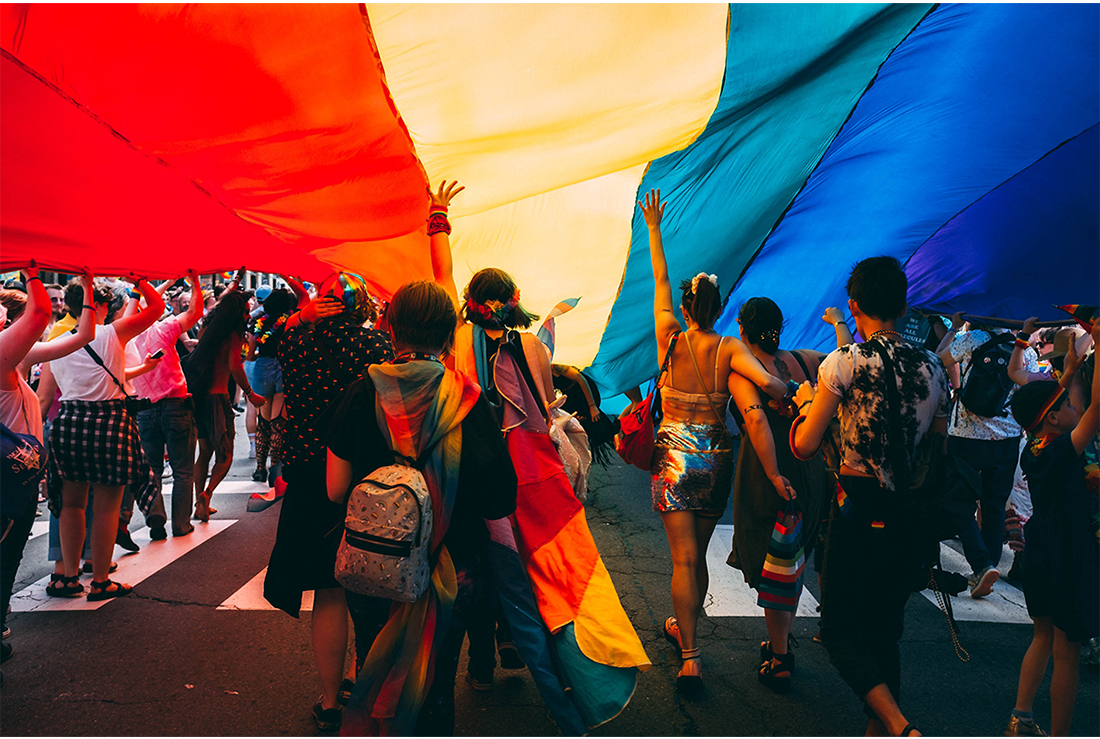
Photo: Mercedes Mehling
This independent journalism is made possible by the Future of Good editorial fellowship covering inclusion and anti-racism in the social impact world, supported by the World Education Services (WES) Mariam Assefa Fund. See our editorial ethics and standards here.
The first Pride event was a real riot.
Fed-up with years of discrimination, harassment and violence, often at the hands of law enforcement, 2SLGBTQIA+ folks fought back in a series of uprisings centred around the Stonewall Inn in New York’s Greenwich Village. Some 54-years-later, advocates say the community is losing its recent gains to a groundswell of violence, threats, intimidation and bigotry, rooted in an anti-gender movement opposed to what it calls “gender ideology”.
The Enchanté Network, Canada’s largest network of 2SLGBTQIA+ organizations, recorded 34 reports of hate crimes this March alone, something executive director Tyler Boyce describes as “unprecedented” and “alarming.”
The activist and University of Ottawa professor says frontline workers across Canada, be it those working in housing, healthcare or employment services, are facing increasingly intense forms of harassment from people and entities working to devalue and destroy 2LSGBTQIA+ serving organizations.
In the face of this grim reality, 2SLGBTQIA+ leaders across Canada are rallying to support each other and demand the federal government do more to protect their communities, both at home and abroad, through increased funding.
Currently, 2SLGBTQIA+ organizations only receive a tiny slice of the philanthropic pie. A recent CanadaHelps’ study found just 0.3 per cent (equalling $592,456) of all donations went to 2SLGBTQIA+ charities in 2021.
“We need to be thinking about how we can accelerate funding to queer and trans organizations to meet this current moment and ensure that queer and trans Canadians and our allies have access to the same basic services as all Canadians and to make sure that Canada’s human rights infrastructure remains intact,” Boyce says.
With this in mind, the Enchanté Network is currently in talks with the federal government, as Ottawa works to create a national endowment fund aimed at keeping the doors of 2SLGBTQIA+ organizations open. Similarly, a new non-profit called Momentum was launched earlier this year, which runs programming and advocacy campaigns “that help 2SLGBTQIA+ people thrive.”
“We are launching this non-profit in part due to rising tides of anti-2SLGBTQIA+ hate and stagnation in terms of government leadership, locally, provincially, and federally on queer and trans issues,” says Fae Johnstone, executive director and co-owner of Wisdom2Action and the driving force behind Momentum.
Most recently, Momentum launched an #Act4QueerSafety campaign encouraging people to sign a petition calling on the federal government to fund a grant program enabling 2SLGBTQIA+ organizations to better protect themselves, while also educating the public on queer and trans hate. The petition also calls for the creation of a special representative for Anti-2SLGBTQIA+ hate, similar to the role of special representative combatting Islamophobia, as well as incorporating anti-2SLGBTQIA+ into the upcoming national plan on combating hate.
“[We’re] bringing old-school organizing tactics back to queer advocacy,” Johnstone says. “We want to be able to cause good trouble for homophobic and transphobic parliamentarians and politicians and we want to be getting folks into their MPs’ inboxes to call for further action of queer issues.”
How did we get here?
While the 2SLGBTQIA+ community has always faced hate, Johnstone says there was a brief “heyday” when it felt like progress might have been here to stay.
“Provinces and territories started protecting gender expression and gender identity largely in the early 2010s and from there we saw what is often described as The Transgender Tipping Point,” says Johnstone, referring to a phrase coined by Time Magazine in 2014. It was a time when transgender visibility in North America was on the upswing and transgender celebrities, like actress Laverne Cox and YouTuber Gigi “Gorgeous” Getty were advocating for trans rights and equity.
With more visibility and advocacy, came more policies protecting the trans community. Ontario became the first province in Canada to ban conversion therapy in 2015 and other provinces and territories soon followed suit. In 2017, the federal government passed Bill C-16, which amended the Criminal Code and the Canadian Human Rights Act to include gender identity and gender expression as identifiable groups protected from discrimination.
“That’s what I think created this impression that there was this path of progress that we were heading to,” says Johnstone. But that progress was short lived.
In 2017, after Donald Trump became president of the United States, there was a resurgence of far-right extremism and white supremacy that has since caused backlash to trans communities and other communities.
“I think the backlash has to do with anything that’s considered ‘woke,’” says Alexis Marcoux Rouleau, research director at JusticeTrans, a nonprofit providing legal and justice-related information for gender diverse people across Canada.
“By ‘woke,’ [far-right and white supremacist people] don’t mean the actual sense of the term, which is to be awake to oppression,” Rouleau says.
“They mean whoever is different, marginalized and doesn’t conform to mainstream society’s expectations. I think all of that works together.”
More and more often, that backlash is proving deadly. The Trans Murder Monitoring Project recorded 327 deaths globally between October 2021 and September 2022; most victims identified as Black or racialized and many were also migrants. Sex workers were also disproportionately represented.
Anti-LGBTQ+ laws are also being passed overseas. Ugandans now face the death penalty if convicted of “aggravated homosexuality” and forced “rehabilitation” if they identify as gender diverse. Russia has made it illegal to suggest non-heterosexual relationships are normal.
Here at home, Egale Canada reported nearly 6,500 instances of online hate and protests against the 2SLGBTQIA+ community in Canada within the first three months of 2023. Those working in the sector have faced particularly intense harassment.
Not a community that lives in fear
Johnstone was targeted after appearing on limited edition chocolate bars produced by Hershey’s Canada as part of the company’s International Women’s Day campaign. Tucker Carlson, a Fox News personality at the time, ridiculed and attacked Johnstone on-air.
“[What happened to me] shows that anti-trans and far-right extremism transcend borders, and that these folks will try to turn anything into a scandal and none of it warrants that attention,” Johnstone says. “Trans folks are not a threat to anybody. We just want to not be harassed and hated when we live our lives.”
Johnstone’s case is not an isolated one. Guillaume Bouchard Labonté, communications manager at JusticeTrans, says the non-profit regularly receives messages of hate through the organization’s social media and email accounts. ‘They say several employees were harassed and doxxed’.
“It’s been a psychological toll for a lot of people working in these organizations,” Labonté says.
But that hasn’t stopped JusticeTrans, or any other queer or trans-serving organization from serving the community. The CHEW Project continues to provide free access to mental health support, harm reduction services and emergency food hampers in Edmonton, Alberta. Trans Health Klinic in Manitoba continues to serve trans people with transitioning care, as well as counselling. And the Youth Project in Nova Scotia continues supporting queer and trans youth through chest binding and gaff programs and summer camps.
“The wellbeing of workers is obviously under attack. But I think it’s also important to recognize that the queer and trans community is not a community that lives in fear,” Boyce says.
“There has always been pushback since the moment we lived our truth. This is a community that is resilient, is strong and has allies from coast to coast to coast , who understand that the reality of queer and trans people having their human rights attacked by these extreme right groups in this country will not stand.”
Much more work to do
Increased hate towards the 2SLGBTQIA+ community has also increased demand for services, says Johnstone, straining the limited resources of many organizations serving the 2SLGBTQIA+ communities. More funding could help offset that strain.
“Queer and trans people are more likely to be homeless, more likely to have experienced intimate partner violence, family abuse, street harassment, employment discrimination, you name it. We’ve got it at disproportionate rates,” they say. “We have this incredible community coming into services that are doing this incredible work, but simply don’t have the resources to meet demand. That means there are not enough services available.”
At the same time, Johnnstonen is worried unstable funding means that the progress these organizations have made won’t last. “How quickly can many of these whims run away if a new government comes in or if funding commitments that have previously been made, don’t continue?” they say.
These organizations need more funding “before it’s too late,” says Boyce.
“We’re at a critical point where the possibility to do something preventative before hate crimes against our community reach a boiling point is still possible,” he says.
Historically, 2SLGBTQIA+ organizations have been one of the least supported sectors by government and philanthropy. A Global Philanthropy Report found out of the $8 billion granted by public and private foundations in 2020, only $2 million went to the 2SLGBTQIA+ community.
When asked why such a dramatic funding gap exists, Narinder Dhami links it to a lack of awareness on the part of funders. “I think it’s harder for foundations to understand how they move forward with 2SLGBTQ+ funding particularly because many don’t have a specific pillar to fund it,” says president of The Sonor Foundation and executive lead of New Power Labs.
“I think very few foundations have explicitly thought about and integrated the community across their funding strategy,” she adds.
Another reason for the disconnect between philanthropy and queer and trans organizations? Until recently, there hasn’t been enough relationship building between the philanthropic sector and 2SLGBTQIA+ sector, which is important to creating awareness, Boyce said.
“What I always hear from the philanthropic sector is that ‘wow we didn’t know that there are so many queer and trans organizations in Canada,’” he says. “So many of these organizations have been here for decades.”
Professionals in the 2SLGBTQIA+ sector also say there wasn’t much federal funding prior to 2022, when Ottawa launched its historic five-year, $100 million 2SLGBTQI+ Action Plan.
“It’s historic,” Boyce says about the funding. “It’s still not enough to rectify decades and decades and decades and decades of queer and trans organizations being excluded from federal funding in this country. We have so much more work to do.”
That’s why 2SLGBTQIA+ organizations across Canada have been working together — alongside allies — to garner additional funding from all levels of government, as well as the philanthropic sector. And philanthropic allies like the Sonar Foundation have responded; it created a $1.5 million dollar fund in February to support the sector, though Dhami acknowledges no one fund can meet the sector’s needs.
“We got 155 applications that totaled over $35 million in asks. And across all the provinces and the territories, 71 per cent of the organizations that applied were self-reported as trans-led,” she says.
Boyce says all Canadians should be concerned about the recent and continuing surge of anti-2SLGBTQIA+ hate, as well as the future of marginalized communities and the organizations that serve them.
“We’re seeing this heightened level of polarization in Canada where specific communities are being targeted,” Boyce said. “More specific communities will be targeted as time progresses. Today it’s queer and trans folks that are under attack. I think all folks who care about human rights should see this as a warning sign.”
Disclaimer: Part of the Sonor Foundation’s $1.5 million fund is partially funded by the World Education Services (WES) Mariam Assefa fund, which also funds the reporter on anti-racism and inclusion fellowship at Future of Good.
Your job. Your mission. Your news.
With your support, the sector you're building gets the journalism it deserves, and you get a tax receipt.

Related Articles
‘The need is endless’: Food insecurity highest in Canada’s Black, Arab and Indigenous communities
Food insecurity gaps aren’t closing, so community organizations across Canada are trying new ways to help beyond just providing food.
Controversial Palestine exhibit opens at Canadian Museum for Human Rights
The exhibit, called Palestine Uprooted: Nakba Past and Present, drew criticism even before it opened at the national museum in Winnipeg.

Vancouver tests new app to map accessibility in parks and trails
The pilot program allows app users to identify barriers in city parks to help make outdoor spaces more accessible and inclusive for everyone.
