This former Quebec solidarity minister’s message about who really drives social reform
Social progress occurs when the government recognizes checks and balances, she says.
Why It Matters
From Mar. 23 to Apr. 2, Quebec’s community sector went on strike. The slogan was “Le communautaire à boutte!”, a deliberate double entendre in Quebec French. It means both "at the end of our rope" and "the best there is" — a wry declaration that community workers are exhausted, undervalued, and indispensable all at once.

It’s the people, not the government, who drive societal progress and reform, according to a former Quebec politician at a recent conference in Montreal.
“No progressive reform, such as the automatic collection of child support payments, is the result of a governmental epiphany. Its genesis always lies in community, academic, or other forms of mobilization,” said Louise Harel, who held seven provincial ministerial portfolios, including Employment and Solidarity, between 1984 and 2022, before turning to municipal politics.
Harel was one of the speakers at the conference “Rebuilding the social fabric to reduce inequalities organized by the Quebec Observatory of Inequalities on Apr. 14, a mere two weeks after Quebec’s social sector wrapped up a general strike, comprised of more than 1,800 community groups.
Insights from a peer researcher’s experience of homelessness
The day-long event brought together representatives from the community sector, unions, economists, public servants, and academics. It also included peer researcher Karine Léveillée, who collaborated with the Observatory on a research-action on homelessness. A peer researcher is a person with lived experience who actively participates in the research process, from design to analysis.

Léveillée said she was born in the ‘70s in the city of St-Jérôme, 71 km north of Montreal. Despite graduating from university with a bachelor’s degree in psychoeducation, her adulthood had a rocky turn.
At one point, severe depression left her jobless, friendless and homeless for a year. A few years later, a second episode of homelessness took her to the limit of her resilience.
“Looking for food and a place for the night, constantly adapting to new resources, new social workers and new rules is so stressful, it takes up all your energy,” she said.
“When the suffering was too intense, I went to a park and drank. It got me disorganized and noisy, and I would get tickets for disturbing the peace,” she said.
The bill totalled $7,000.
“I am almost done paying them and almost done with my past,” she said.
She has been selected for an apartment through the City of Laval residential security program with support (SRA).
The SRA approach aims to provide homeless people with permanent housing through tailored individual support.
Léveillée’s testimony highlighted the need to resist oversimplifying solutions to social challenges.
“Getting a homeless person housed does not create magic,” said Léveillée. “After three years on the streets, I had to relearn stable apartment living.”
The same goes for shelters; they are a complex quilt of life stories, she said.
“Some nights, I was so discouraged that I drank and got verbally inappropriate toward other residents. It got me evicted to protect the other women who experience episodes of violence.”
An economist’s message about Quebec falling from its lead in the fight against inequalities.
Quebec is the least unequal province in terms of disposable income, thanks to its redistribution system. In 2023, Quebec recorded the lowest poverty rate (7.4 per cent) among all Canadian provinces, compared to a national rate of 10.2 per cent.
The poverty rate, based on the Market Basket Measure, is also lower in Quebec than in the rest of Canada. Furthermore, Quebec has the lowest rate of food insecurity, at 15.7 per cent, compared to the Canadian average of 22.9 per cent in 2023.

However, the situation is worsening for many, said Geoffrey Boucher, economist with the Quebec Observatory of Inequalities.
Life is becoming more difficult for people living alone in Quebec, he said. About one in four adults has an annual income between $22,625 and $24,212.
This amount constitutes the low-income cut-off; below it, one cannot meet basic needs.
The 60-64 year group is also more exposed to hardship.
“Those few years before collecting a senior’s pension are difficult. It gets a bit better after 65,” said Boucher.
The urgency to rebuild democratic guardrails
One often refers to the quality of Quebec’s social net, those redistributive measures. Peter Graef, associate professor at the Department of Political Science at McMaster University, favours a wider lens.
“The government should consider the social protection spectrum, including prevention, adaptation, inclusion, health and education. The social net compensates the holes in the social protection system; it should not be considered the whole system,” he said.
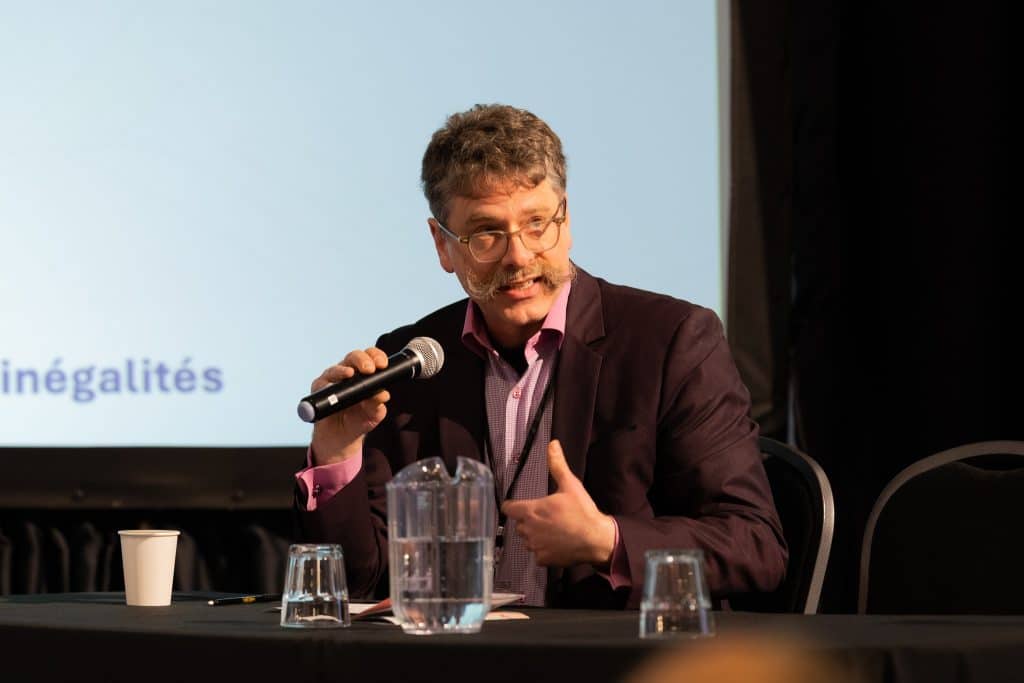
Harel associates the recent setbacks in the Quebec social protection system – like growth in private child-care services – with the weakening of counter-powers.
“The government abolished many consultative bodies, such as school board representatives. Environmental protections are being weakened to expedite major projects. The healthcare sector is becoming hyper-centralized. Unions are weakened,” said Harel.
“These are all signs that checks and balances are losing ground.”
Social progress occurs when the government recognizes checks and balances, she added. “The reforms are the product of alliances of circumstantial allies, including politicians,” she said.
“Rebuilding democratic guardrails is critical to reducing inequalities,” she concluded.
Your job. Your mission. Your news.
With your support, the sector you're building gets the journalism it deserves, and you get a tax receipt.

Author

Related Articles

What everyone gets wrong about the modern job search — and what actually works
Four myths and one truth about job hunting in Canada.
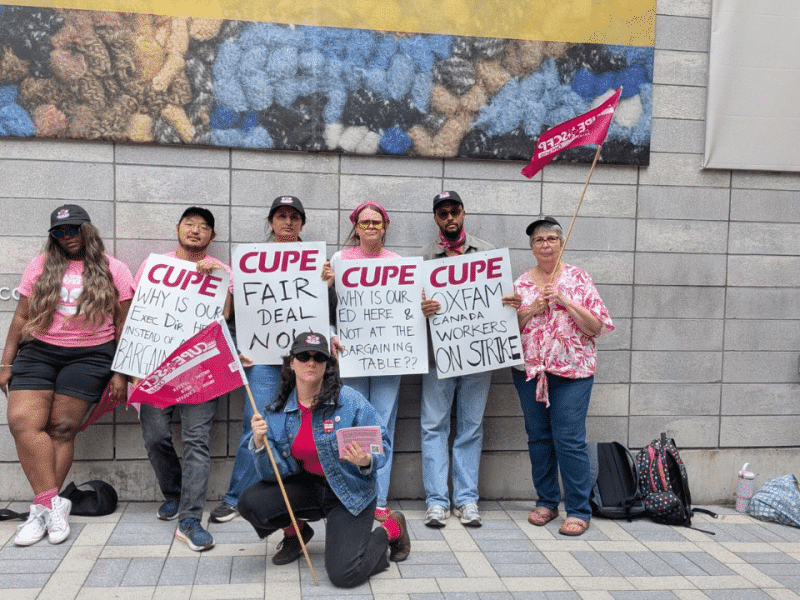
Mysterious website, changed email messages and no negotiations: Oxfam Canada strike continues into second week
Striking staff members are also urging supporters to steer clear of a new website that appears to have sprung up in solidarity with them, but rather to follow developments on CUPE 2722’s social media channels.

Partnered Partnered content Amid economic uncertainty, 22 per cent of Canada’s social enterprises report growth
New data from Buy Social Canada highlights the country’s growing and innovative social enterprise sector.
