Battling burnout: CanadaHelps CEO sounds alarm on non-profit ‘wildfires’
Why It Matters
Social purpose organizations are starting to offer in-house solutions to combat mental and physical fatigue among their staff. However, they say without government and community support, those solutions won’t go far enough to keep staff ready to help others.
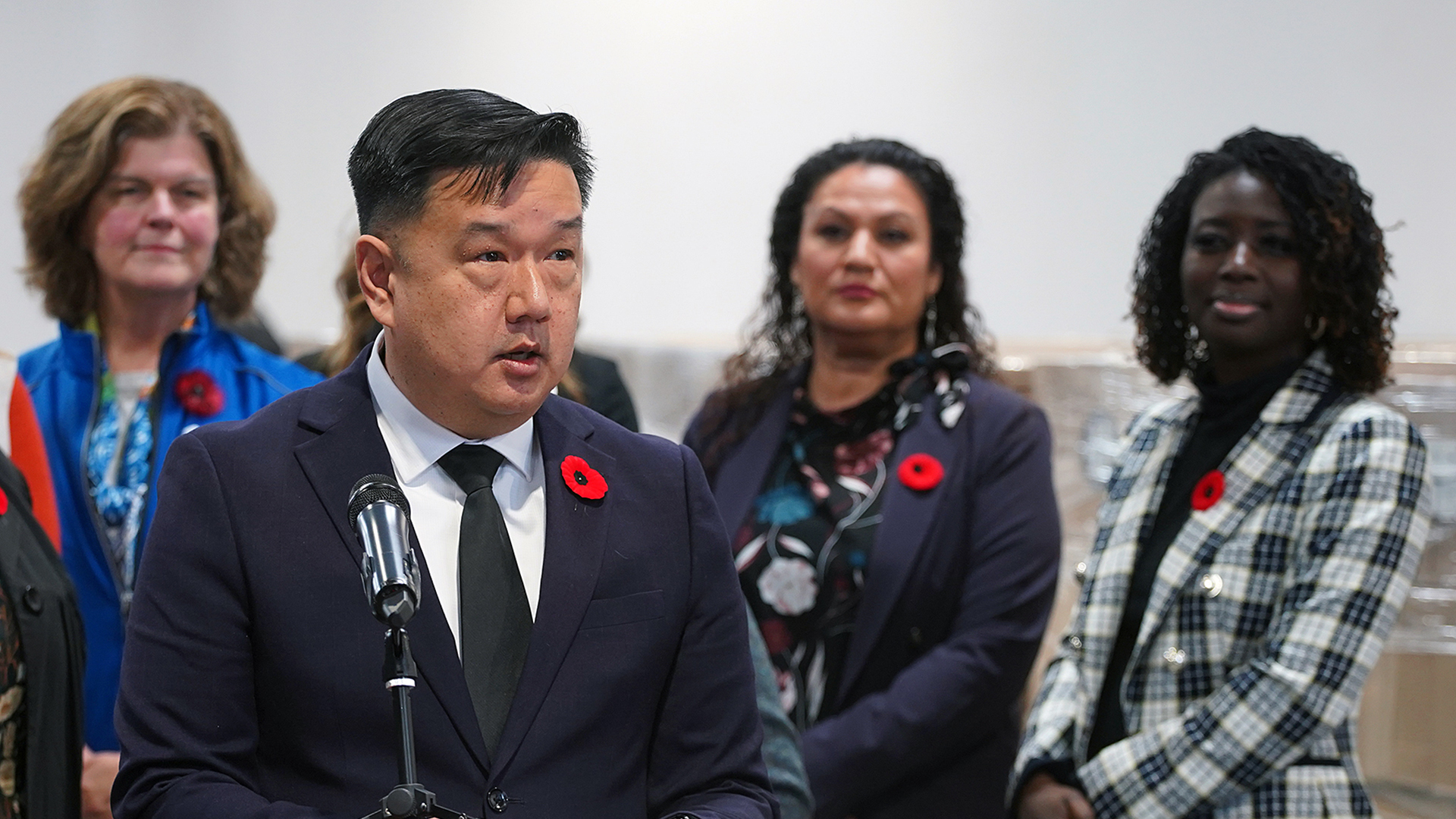
Unprecedented demand for essential community services facing Canadian charities can be compared to wildfires burning out of control.
“The way this problem has grown and level of response we need to have is of that magnitude,” said Duke Chang, President and CEO of CanadaHelps, during a November press conference in Etobicoke.
“These are the people on the front lines every day, trying to solve these problems, trying to help people out,” he added, calling the workers in the sector humanity’s first responders.
CanadaHelps’ 2023 The Giving Report says charities are facing rising demand. Combined with funding struggles, lower donations and fewer volunteers post-pandemic, the risk of staff burnout is high.
Sticking with the analogy, Chang outlined the progression from campfire-sized charitable-sector issues escalating through raging wildfires. The fallout or “smoke” will be apparent even if one is not directly exposed.
“The problem is everywhere,” he said. “We need to pay attention to it.”
The solution is a two-pronged approach, he said: a short-term emergency response backed by long-term pro-action.
“Now, let’s go to prevention,” he concluded. “How do we make sure these fires don’t burn again?
“That’s about systemic change, a larger change that’s going to take commitment and resource.”
Here’s what several organizations are doing to help fight volunteer and staff burnout.
Lauren Pragg, Interim Executive Director, Lesbian Gay Bi Trans Youth Line
The danger of staff burnout is not news for Pragg. Staff tend to be part of their community with a high level of empathy, which is hard to turn off at the end of the day.
“They are so invested and also impacted by the same stress people who reach out for support are impacted by.”
There has been a rise in transphobia, said Pragg, evidenced by protests and counter-protests around gender identity in schools, to the point trolls targeted a helpline created to support youth in need.
“It’s very demoralizing.”
The organization does its best to be a decent employer; however, with more competition for funding, keeping up with the rising cost of living can be challenging.
“There is no easy fix,” they said.
Lesbian Gay Bi Trans Youth Line provides biannual access to a fund to remove financial barriers for those seeking support. Those choosing to apply to receive money for services such as food, Internet service, mental health support or visiting a naturopath.
“We don’t really ask questions,” said Pragg. “They can use it for whatever they want.”
The organization has also found value in being part of a cohesive team and finding co-workers willing to offer support or understanding.
“You don’t feel as alone.”
 Quincey Kirschner, Executive Director, Avalon Recovery Society
Burnout is almost not an option for Avalon Recovery Society (ARS) staff.
“You need to bring all of your strength to work on what could be the worst or most important day of their lives on a regular Tuesday for you,” said Kirschner.
Front-line ARS staff have lived experience with addiction and recovery, said Kirschner. When staff members see ongoing and rising needs, it can push them to do “this one more thing.”
In essence, staff must sometimes be saved from themselves.
“We have to be very intentional about setting boundaries. There is a never-ending tide of need, so you have to set an internal boundary because the world will not set one. You will never run out of people who need support.”
Protecting staff from their own best intentions helps calibrate productivity and effectiveness, she said.
“They are very mindful of showing up in a manner which honours the experiences and needs of the women we serve,” said Kirschner.
The corollary is ARS not only supports but actively encourages days off when needed, as defined by the staff member. They are responsible for monitoring their energy and capacity and acting accordingly.
“And we will make that work,” said Kirschner.
ARS’s organizational DNA is supported by a board with a founding member who has lived experience with addiction and recovery. Supportive understanding from the top adds another layer of protection.
“I don’t think it would be possible for this team to develop this culture without a board deeply supportive of it,” Kirschner concluded.
Suzanne Duncan, Vice-President Philanthropy, Canadian Women’s Foundation
Gender-based violence spikes in times of economic stress worldwide, including in Canada.
“That’s not just how many people are affected, that’s the severity,” said Duncan.
Too often, women struggle with choosing between homelessness or staying in a dangerous situation, she added.
“Those are not good choices to make.”
Long wait times combined with the level and severity of violence, their own lived experience, and the balancing act between what they see daily and the requirements of being the primary caretaker in their homes contribute to staff fatigue, said Duncan.
Countering that risk includes extending the impact of service delivery as efficiently as possible. One method focuses on programs created by and for the communities they serve, and the organization also strives to tailor solutions to individual situations.
Duncan also encourages capacity building, HR and trauma support, and mentorship, which are crucial in smaller organizations in rural and remote areas.
“We are giving some backbone support to these organizations that are often two or three people.”
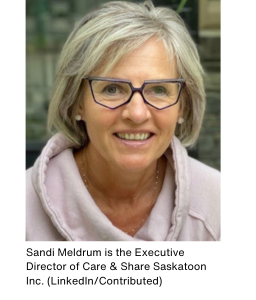 Sandi Meldrum, Executive Director, Care & Share Saskatoon Inc.
Poised to walk into one of the 18 Saskatoon schools whose students Care & Share will help serve a hot turkey dinner over the next six days, Meldrum speaks personally and in the moment to the stress and rising demand facing non-profit organizations.
“I’m here dealing with it,” she said, her voice exuding the boundless energy required to coordinate the delivery of 6,000 meals on a three-schools-per-day schedule.
“It’s going well, everyone is on task, and that’s what we’re doing.”
Staff burnout is not an extended concern for Meldrum, given that the organization’s executive director is also its lone employee, part-time.
“Right now, it’s full-time plus,” she laughed.
Meldrum embraces a daunting workload with a combination of ‘just do it,’ seasonal adjustment and a sense of humour; perhaps partly due to being raised on a farm.
Care & Share services the community’s school children, and her schedule is tied to the school year, with September through December being her busiest months. She tries to recover and recharge during summers dedicated to grant writing and follow-ups.
“I’ve been around a while,” said Meldrum, who understands the ebbs and flows 21 years into the job. She plans on continuing until her self-described ‘expiry date’ because, like many in the non-profit world, she won’t have a pension.
“And that will be my next stress,” Meldrum laughed. “Because I’ll have to find my replacement.”

Audrey Rochette, Executive Director, Anishnawbe Health Foundation
Rochette proposed meeting the “wildfire” of challenges Chang identified by addressing the source of the problem rather than its symptoms by growing the workforce to meet rising demand.
Building on the historical foundation of traditional Indigenous medicine people, elders and healers, the foundation works to find holistic health solutions for its clients.
In order to help those clients who are combatting homelessness, poverty, trauma, abuse and addiction, Anishnawbe Health Foundation recognizes the need to depend less on volunteers, said Rochette.
“We have to be able to invest in new complements and support staff so the stress on the team is manageable.”
She cited the example of a person doing the work of three, with that role divided into three positions.
The sector also needs the ability to offer jobs with stability at full-time complements, said Rochette.
“Move away from relying on part-time, temporary workers.”

Annika Voltan, Executive Director, Impact Organizations of Nova Scotia (IONS)
IONS has instituted a four-day week to help avoid burnout.
The organization also began experimenting to maximizing impact by mindfully seizing opportunities between demanding seasonal programming cycles.
In other words, breaks have been structured between busy programming cycles.
“Having what we’re calling ‘reflection seasons,’ where we pause the external-facing work as much as we can and cancel our regular team meetings and replace those with debriefs.
“What did we do over the last few months? What did we learn from that? What would we adjust?”
The exercise will also contain two days with meetings replaced with journal prompts and group-guided sessions with facilitators.
Voltan feels burnout can result from always working fast-paced, especially as a group. Breaks are associated with vacation, but Voltan believes it can also be associated with one’s career, still working but working differently.
Existing burnout data suggests resting or relaxing will not solve the issue; cultural and systemic change is required.
“I think a big part of that systems change in relation to this topic has to do with hours of work, expectations around productivity and just kind of pushing back on some of the assumptions that are very rooted in capitalism.”
The approach represents Voltan’s own extensive work and family responsibility experience. She tends to be busy but can hit a wall and need to unplug.
“If I know a break is coming, the busy period doesn’t feel so hard.”
Having periods for reflection and learning helps drive Voltan back into a strategic and inspired place, an evolutionary territory that disruptive organizations strive to find.
“If we are actually going to try and advance change and solve problems, you have to get into that creative mindset. Otherwise, you’re just perpetuating the status quo.”

Richard Matern, Director of Research, Food Banks Canada
Matern has seen a 32 per cent increase in demand over the past year, 79 per cent since the beginning of the pandemic. Food banks are an income problem, not a lack of food problem, exacerbated by inflation.
In addition to the difficulty of matching supply to increased demand, delivery challenges have stressed staff and volunteers.
“There definitely is a feeling people are reaching a breaking point, clients are reaching a breaking point, agencies are reaching a breaking point.”
The network is doing its best to support staff, says Matern, which is more accessible in urban centres with larger critical mass. Smaller food banks in rural areas tend to be volunteer-run, with less ability to share the load.
“What is the impact on them?” Matern asked.
Like CanadaHelps, Matern is sounding an alarm for policy recommendations, “preventing the fires from happening” through supporting lower reliance on food banks.

Julia Deans, President and CEO, Habitat for Humanity Canada
COVID-19 turned the world of volunteering on its head, including an organization that relies on a national office, a few thousand staff in 46 locations, and roughly 14,000 volunteers.
“They’ve come back, but slowly,” said Deans, a shortage she says is placing additional pressure on staff.
One solution is to acknowledge the challenge.
“Whether it’s volunteers or staff, encourage everyone to be open about their limits and when they need help.
“And that’s not natural for us.”
Secondly, Deans encourages giving each other grace.
“It’s not easy to do when you’re tired as well, but if you give grace, you usually get it in return.”
Finally, she believes there is encouraging light at the end of the COVID tunnel, an understanding of the severity of problems from corporate Canada on down to individuals, and a demonstrated tradition of meeting that challenge.
“The hopeful thing is people see the need is greater than ever and want to be part of the solution.”
Tell us this made you smarter | Contact us | Report error